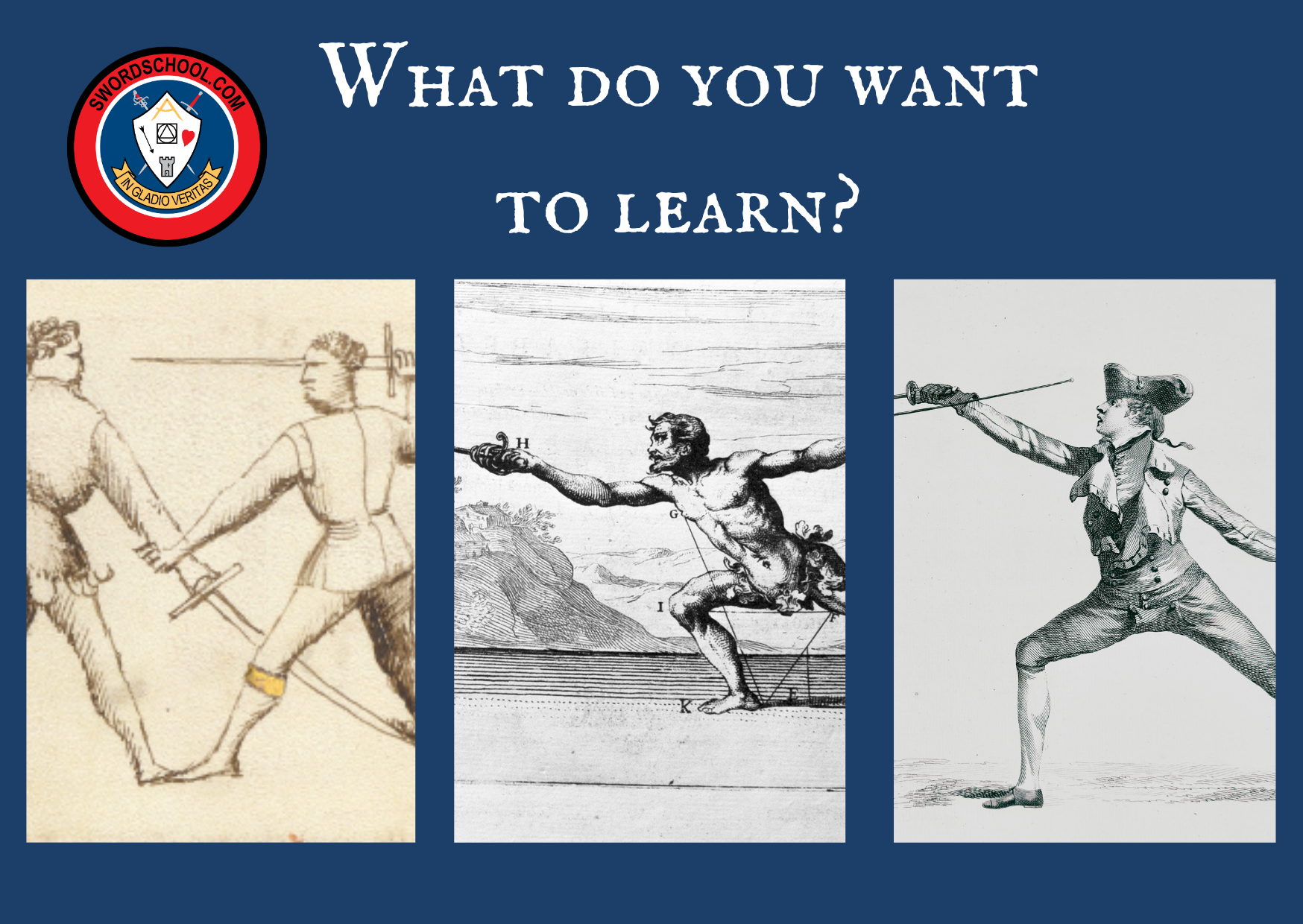
What are your sword goals?
It’s my job to help you accomplish your sword goals, through teaching in person (ideal!) and through books, articles, online courses, and other means.
I’ve been training in historical martial arts since the early 1990s, and teaching professionally since 2001. My first book came out in 2004 (there are over 20 out now), this blog started in 2012 (with over 400 posts), and I’ve been producing online courses since 2016 (there are over 20 courses published so far).
Not to mention The Sword Guy podcast (220 episodes), my newsletter (over 700 sent so far), and some 500+ videos on my Vimeo channel.
Fortunately, most of the videos are organised in my Syllabus Wiki, so you don’t have to dig through the Vimeo channel to find what you want.
There is a LOT of material for you to choose from. So much that it may be paralysing. This post is here to help you choose where to start in your sword career, or, if you’re already well on your way, help you find what you want in the smorgasbord of Swordschool material, both paid and free.
Before I can point you in the right direction, I need to know your goals…
Choose your path (you can have more than one)
What are your goals? For each goal, I’ll point you towards the most useful places to start: relevant parts of the Syllabus Wiki, blog posts and podcast episodes, and free and paid books and courses.
I want to get better at moving/keep my body working/train on my own
You will live in your body until the day you die, so you might as well look after it, and find out what it can do. Every body is different, so there is no one-size-fits-all approach to keeping yours as fit, healthy, and athletic, as possible.
I think your mindset is the most important thing to get right before you even start training. The Seven Principles of Mastery is a useful place to begin.
- Syllabus Wiki: Conditioning
- Free Body Mechanics course: learn to test and evaluate different movement choices and how they apply to martial arts.
- Free Human Maintenance course: learn how to keep your joints working. Martial arts are hard on the body, so you need ways to recover.
- Recommended podcast episode: Episode 01: Medieval shoulders, trees, and swords, with Jess Finley
- Bonus podcast episode: Making seated longsword work, with Ella Rose. This is especially useful if you’re working with a disability.
- Recommended blog post: Creating a Physical Practice
- Recommended book: The Principles and Practices of Solo Training
- Solo Training course. You can get the solo training course here, or on subscription here.
I like swords but I’m not sure what sword style to start with
There are SO MANY cool swords. How do you pick just one?
You don’t have to. Start by having a look at the range available to you, have a go with any that you like, then pick one to focus on for a while.
Choosing a sword can also apply to the sword itself. My short book Choosing a Sword takes you through the main options for historical martial arts.
You can browse through the landing page of the Syllabus Wiki to see examples of longsword, rapier, sword and buckler, backsword, and smallsword, both as academic study, and as practical modern training approaches.
- Recommended podcast episode: Community and the Club, with Samantha West
- Recommended blog post: How to Train With Beginners
Or try our Introduction to Historical Martial Arts course.
It’s a guided tour of the historical martial arts landscape, so you can find what suits you best.
I want sword people, not just sword information
There are tens of thousands of people practicing historical martial arts in one form or another, but we are widely dispersed across the world. I find most social media platforms truly awful places, because they are incentivised to keep you on the platform as long as possible by making you angry, and to sell you as much stuff as possible by making you scared. It’s awful.
So I have built my own social media platform, with no ads, no algorithms, no bots, no trolls. Everything you like about social media: you can chat with people you don’t know yet; hear about events all over the world; show us your new sword. But there is a zero tolerance policy on trolling behaviour, and the platform has no ads. It is quite expensive to run, so it is supported by voluntary donations from the people who value it and can afford to chip in.
Join us at swordpeople.com
It’s free, but every application is vetted (no bots!) so it may take a few hours or a couple of days for your membership to be approved.
I want to do historical martial arts research
Historical martial arts absolutely depend on historical research. Many of my students begin with no interest in research, then find themselves drawn to the books.
- Syllabus Wiki: Interpretation section
- Recommended podcast episode: You can’t learn swordfighting from a book, with Dr. Antti Ijäs (spoiler: you absolutely can)
- Recommended blog post: Show Your Work
- Recommended book: The Theory and Practice of Historical Martial Arts
- Online course: Recreating Historical Martial Arts from Historical Sources, which is included in our Solo Training course, available here, or on subscription here.
I want to learn medieval combat (such as longsword)
Four feet of glistening steel… knights in shining armour… what’s not to love?
- Syllabus Wiki: start with the Training Armizare page. (Armizare is the name Fiore uses for his medieval Italian martial art.)
- Recommended podcast episode: How to fight like Sir Gawain, with Dr Przemysław Grabowski-Górniak
- Recommended blog post: Entering the Fray
- Recommended book: The Medieval Longsword
- Recommended workbook (better for beginners): The Armizare Workbook
- Recommended course: The Medieval Longsword Complete Course also available in the Medieval Italian Martial Arts subscription package, and our Mastering the Art of Arms subscription package.
I want to study Fiore
Fiore is the single best source for medieval combat we have, and the author of The Flower of Battle (il Fior di Battaglia) in the early 1400s.
- Start with the Syllabus Wiki: Interpreting Fiore section. It includes translation and video links for all of Fiore’s plays on foot out of armour (we’re working on the armoured combat and mounted combat sections next…).
- Recommended podcast episode: I have a very in-depth discussion about a single paragraph from the Flower of Battle in: What is a volta? A very detailed examination of Fiore, with Dario Magnani.
- Recommended blog post: perhaps start with the first instalment of The Fiore Translation Project series, which spawned my From Medieval Manuscript to Modern Practice book series.
The Longsword volume was originally published as four ebooks, covering the sword in one hand, mechanics (grips, guards, and blows), the sword in two hands in zogho largo, and the sword in two hands in zogho stretto. The first of these is included in the care package (see the bottom of the post).
Recommended books: The From Medieval Manuscript to Modern Practice series, covering all of Fiore’s wrestling, dagger, and longsword plays on foot out of armour.
The Fiore Facsimile contains a complete facsimile of Fiore’s Flower of Battle (the Getty manuscript), and a second complete facsimile with the Italian text replaced with my translation into English.
I want to study Vadi
Philippo Vadi wrote The Art of Sword Fighting (De Arte Gladiatoria Dimicandi) in the 1480s. It’s a wonderful manuscript, with 16 chapters of theory followed by dozens of illustrated plays.
- The Syllabus Wiki: Interpreting Vadi section includes video and translation of every longsword play (we are working on adding all the rest of the plays now).
- Recommended podcast episode: Safety Testing Swords with Jamie MacIver. We do talk about safety testing, but Jamie is also a Vadi expert and we discuss that too.
- Recommended blog post: a geeky look at the first longsword play: True or False?
- The Vadi Facsimile contains a complete facsimile of the original manuscript, and a second facsimile with the Italian text replaced with my English translation. The print files for the facsimile are free to download, here. For interpretation, commentary, etc. you’ll want the Companion Volume too.
I want to learn rapier
There’s a reason the Three Musketeers have been popular for over a century and a half. And why The Princess Bride is such a classic film. The rapier is the quintessential duelling weapon, and a foundational system at Swordschool. It’s right there in the logo!
Rapier is the most physically demanding of all historical fencing systems, so I highly recommend taking our Get Ready For Rapier series of conditioning videos, included in the Human Maintenance course. Your knees and hips will thank you.
- The Syllabus Wiki rapier syllabus has just about everything you actually need to train from absolute beginner to competent fencer.
- Recommended blog post: Max Your Lunge all about the mechanics of Capoferro’s lunge.
- Recommended podcast episode: WMA, HEMA, the SCA, and other abbreviations, with David Biggs.
If you want a structured introduction to the system, start with the Rapier Part One workbook included in the care package at the bottom of this post.
- You can get The Complete Rapier Workbook (parts one to four) here.
- And if you prefer online courses, The Complete Rapier course is available here, or as part of our Renaissance Italian Martial Arts subscription, and our Mastering the Art of Arms subscription package.
I want to study Capoferro
Ridolfo Capoferro’s Great Representation of the Art and Practice of Fencing is the foundation of all our rapier training.
- The Syllabus Wiki: Interpreting Capoferro section includes video and translation of much of the book (we are working on adding all the rest of it).
- Recommended podcast episode: Talking Tempo, with Guy and Cornelius. This is a very geeky discussion of the concept of tempo in Capoferro.
- Recommended blog post: Size Matters: how long should your rapier be?
- Recommended book: The Duellist’s Companion. The first edition came out in 2006, and I updated it thoroughly in 2023.
I want to teach historical martial arts
I started teaching historical martial arts because I needed people to fence with, and found out I had to show them how to do it first. After a while I found that teaching was more fun for me than fencing (yes, really!).
The whole Syllabus Wiki is an exploration of how to teach these arts. There isn’t currently a section on how to teach specifically, but that may change.
- Recommended podcast episode: a lot of podcast episodes discuss teaching, because so many of my guests are instructors. Coaching Coaches, with Nathan Weston, is a good place to start, as is Classical Fencing and Digital Pedagogy with Dori Coblentz.
- Recommended blog post: How to Teach from a shopping list
- Recommended book: Get Them Moving: How to Teach Historical Martial Arts
- We have a course on how to teach here, which is included in the Mastering the Art of Arms subscription.
I want to learn other weapons
And why shouldn’t you? There are so many to choose from. The Syllabus Wiki includes sections on Smallsword, Backsword, and Medieval Sword and Buckler from Royal Armouries MS I.33.
I’m currently working on a complete interpretation and training method for Domenico Angelo’s smallsword system. So far I only have the audiobook of his School of Arms (1787) out, but there will be books and courses coming. You can whet your appetite and start moving like an 18th-century fencer with our Foundations of Smallsword webinar.
On the podcast we have guests discussing African martial arts, Persian martial arts, even Ninjutsu!
If you fancy something German, we have online courses on Von Baumann’s wrestling and the longsword Hauptstücke of Johannes Liechtenauer (both taught by Jessica Finley). You can get them separately, or as part of our Medieval German Martial Arts subscription, or our Mastering the Art of Arms subscription.
I also talk to a lot of German martial arts practitioners on the podcast, including legends like Christian Tobler and Dierk Hagedorn.
If you want some tasty Bolognese, we have a series of courses from Finnish instructor Esko Ronimus, available separately and as part of our Renaissance Italian Martial Arts subscription. And we have several podcast episodes with practitioners of the Bolognese tradition. You could start with a very in-depth discussion with Josh Wiest on whether the Bolognese tradition even exists!
If medieval sword and buckler is your thing, or you think it might be, I’ve interviewed Roland Warzecha here, and we have a complete I.33 sword and buckler course here, which is also included in our Medieval German Martial Arts subscription, and our Mastering the Art of Arms subscription.
I want to play games
Have you tried my game Audatia? It recreates my interpretation of Fiore’s longsword as a two-player card game. We also have expansion packs for Liechtenauer, and Armoured Combat. You can find it at audatiagame.com.
I want to browse books/ courses/ posts/ everything else
- You can find all my ebooks, print books, and audiobooks at swordschool.shop
- You can find all my courses at courses.swordschool.com
- There’s a handy ‘new to the blog- here are some recommendations‘ page.
- Or just go to swordschool.com, it links to everything.
Do you have a goal I haven’t mentioned? Then get in touch through the contact page or message me on Sword People, and let me know.