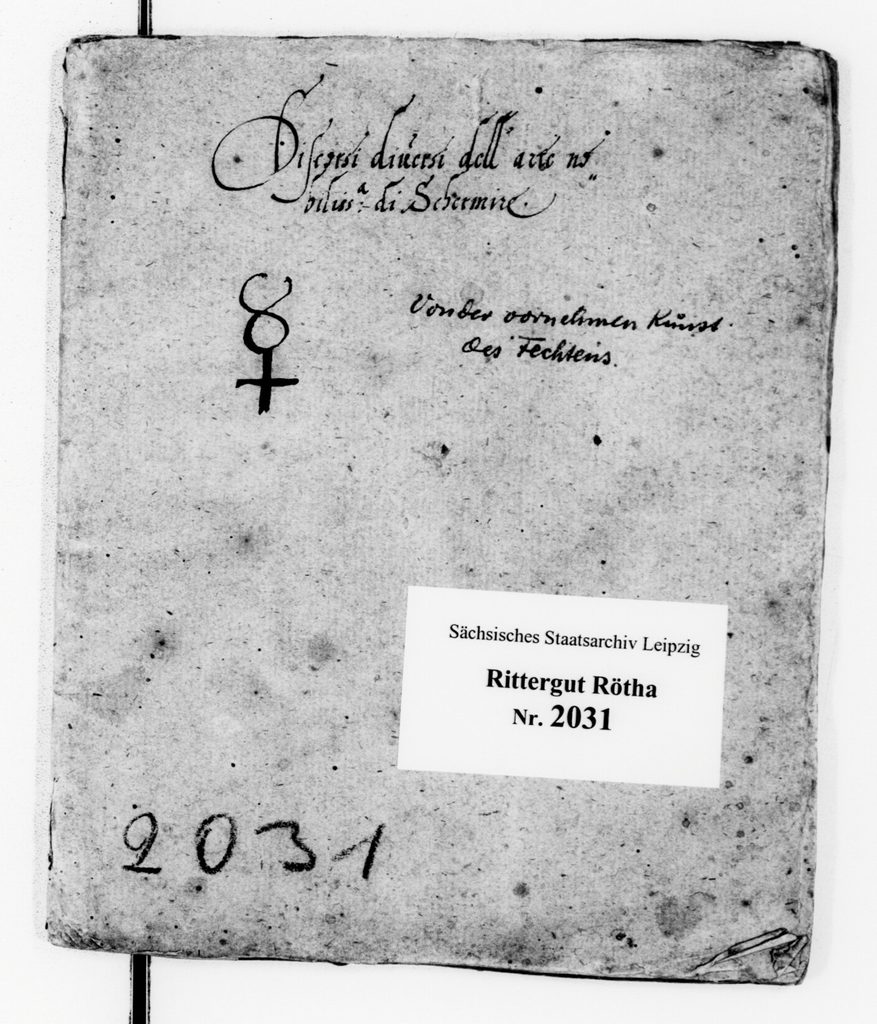
MS 2031 is a short, anonymous Italian rapier manuscript, probably dating from the early seventeenth century, preserved in the Sächsisches Staatsarchiv in Germany. It was discovered there by Chris Vanslambrouck, who transcribed it and generously shared his work with the historical fencing community. It contains just ten folios of fencing instruction, but those few pages describe a remarkably coherent system of swordsmanship and raise some intriguing questions about who wrote it and where their fencing came from.
On this page you can read the complete transcription and translation side by side, and download both the original manuscript facsimile and a PDF of the transcription and translation for free.
If you want my complete practical analysis of the fencing, including the reconstructed plays, drills, and comparisons with Fabris and other Italian sources, that’s available separately.
In essence: this manuscript is part of your birthright, and my transcription and translation are there to help you access it. My interpretation work and other research are mine, and this is my job, so I charge for them.
About the Manuscript
Manuscript Sächsisches Staatsarchiv, 20532 Rittergut Rötha mit Trachenau, Nr. 2031 (Saxon State Archives, collection 20532, Rötha Estate with Trachenau, MS 2031) is a small bound paper manuscript titled Various Discourses on the Most Noble Art of Fencing. It measures approximately 14.5 × 12.3 cm (5.7 × 4.8 in.), as calculated from the scans as I have not had the opportunity to examine the manuscript in person.
The Saxon State Archive identifies it simply as a seventeenth-century “Kunst des Fechtens” work, written by an Italian master.
The Rötha estate was acquired by Carl von Friesen in 1592 and remained in the von Friesen family until 1945. His son Heinrich von Friesen (1578–1659) held major offices in Saxony and is particularly interesting for us because the historical account says that he laid the foundations of the substantial Rötha library. The surviving Rötha library catalogue confirms that the collection’s origins probably extend into the sixteenth century and certainly into the seventeenth.
It is therefore possible that MS 2031 entered the collection during Heinrich von Friesen’s lifetime, though there is presently no direct evidence establishing when or by whom it was acquired.
It seems to have been written by a single person, who was not a professional scribe. The handwriting starts out beautifully legible, and deteriorates over the first three folia, until by folio 4 it is quite hard to make out. He then gets a new lease of life for a much cleaner final page. It’s a very interesting window into the humanity of the author: everyone who writes with a pen is familiar with the phenomenon of your best intentions to write clearly getting eroded away by fatigue and old habits. I believe a professional scribe would have been much more consistent in the quality of the work.
One of the remarkable features of the manuscript is its presentation, with a cover page, a title, and a final inscription. It is clearly intended as a complete work, and one has to wonder about the intended audience. This could be a personal aide-memoire based on the teachings of a fencing master (possibly Fabris, but there’s no evidence of that); or it could be a present for a friend who was into fencing (but we might expect some kind of salutation in that case). It may be a draft of a book intended for publication, with the usual dedications, letters to the reader, and so on, expected to be added later once the publisher accepted the draft and gave a budget for illustrations (but there is no hint given of any potential images).
Transcription Notes
The transcription presented here began with Chris Vanslambrouck’s transcription, which he generously made freely available after discovering the manuscript in the Sächsisches Staatsarchiv. As I worked through the fencing in detail, I repeatedly checked individual readings against the manuscript images, eventually re-examining the entire transcription.
The resulting transcription differs substantially from Chris’s original. Some differences are editorial: I have expanded abbreviations, generally regularised u and v according to their modern values, and made other presentational changes while retaining the manuscript’s original spelling and language. Other changes are corrections or alternative readings of the handwriting, some of which materially alter the fencing being described.
The transcription should therefore be understood as a new transcription made directly from the manuscript, based on Chris’s earlier work but independently checked and revised throughout. Where a reading remains genuinely uncertain, I have preferred to mark the uncertainty rather than manufacture a confident solution.
Translation Notes
The translation aims to make the fencing clear in English while staying as close as possible to the manuscript. I translate cavare/cavazione as “disengage/disengagement”, distanza as “distance”, misura as “measure”, and debile and forte as “weak” and “strong”. The four guards—prima, seconda, terza, and quarta—are rendered as first, second, third, and fourth. I have left tempo untranslated because no single English word adequately captures its several meanings in fencing.
A few technical terms, notably inquartata and girata, have also been retained where an English equivalent would be less useful or precise. Words supplied to make the English sense clear appear in [square brackets]. Otherwise, the translation follows the manuscript as written: technically awkward, obscure, or apparently erroneous passages have not been silently regularised.
The practical reconstruction of the fencing has also served as a useful check on the translation: trying the actions sword in hand has sometimes exposed problems in a reading or clarified what a difficult passage is likely to mean.
Copyright and reuse
The transcription and English translation are freely available under a Creative Commons Attribution 4.0 International Licence (CC BY 4.0). You are welcome to copy, share, adapt, translate, or otherwise use them, including commercially, provided you give appropriate credit to me (Guy Windsor).
The manuscript scans are in the public domain. I have lightly enhanced them for legibility, but claim no rights over them: you may use them however you wish.
My analysis, interpretation, and practical reconstruction of the fencing are separate from the source material and remain under copyright.
Now without further ado, here’s the side-by-side transcription and translation. Please note that the formatting is cleaner in the free PDF; some nuances of layout were lost in WordPress.
Transcription and Translation
| Italian transcription | English translation |
| [1r] D: B: A: E: F: A. Discorso alle prime lettioni di Spada Sola. Havendo da discorrere dalla spada sola, Prima è necessario di sapere: Che vi siano quatro guardie principali: dalle quali nascono tutti i tempi et contratempi, cavationi, contra cavationi: et commetter di spada. Et da questo si cavano ancho le contra posture: Et bisogna avertire: che a tutte queste ragioni è patrono la distanza larga, et la distanza stretta. La misura larga è, che non si puo ferire, Se non si | [1r] D. B. A. E. F. A. Discourse on the first lessons of the single sword. Since we are to discourse upon the single sword, it is first necessary to know that there are four principal guards, from which are born all the tempi and counter-tempi, disengages, counter-disengages, and actions of the sword. And from this are also derived the counter-postures. And it must be observed that over all these principles hold sway the wide distance and the narrow distance. The wide measure is that in which one cannot strike unless one |
| [1v] muova il piede: Et stretta si di manda quella, che con lo slongare il braccio inanzi si può ferire il ne mico senza muover il pie. Della misura stretta non si può far cosi piccolo moto, ch’il nemico non possa in quel tempo ferirci: ma ben impadronirsi della ragione con occup parvi la spada approssimandosi per offendervi poi nel secondo movimento. Et questo [ta?] l’quanto [deleted text] m’occorre a dirvi intorno alla generalita: facen dovi d’intendere che tutto d’parare et ferire: del quale ragionerò, si potrà observare, cosi passando come non passando, | [1v] moves the foot. And the narrow requires that, by extending the arm forward, one may strike the enemy without moving the foot. In the narrow measure one cannot make so small a movement that the enemy cannot strike us within that tempo; but one may indeed gain command of the principle, by occupying your sword and approaching, so as afterwards to strike you in the second movement. And this is as much as occurs to me to tell you concerning generalities, giving you to understand that all the parrying and striking which I shall discuss, may be performed either with a pass or without passing, |
| [2r] dal ferire di seconda sotto la spada in poi : che in quella bota è necessario il passare, perche facendolo à piede fermo sarebbe pericolo. Oltra veniremo alle ragioni particolari. Et per esser la guardia prima quella che si forma nel metter mano alla spada, comincio d’essa. Essendo dunque il nemico nella dritta prima guardia, fa bisogno andar à trovar la nemica per di fuori con la spada, ò in forza, per tener la ponta al nemico che sia possibile, et avertire, quando io dissi di trovare | [2r] [except for] striking in second beneath the sword, in which blow it is necessary to pass, because to do it with the foot fixed would be dangerous. Now we shall come to the particular principles. And since the first guard is the one formed in drawing the sword, I shall begin with it. The enemy being, therefore, in the straight first guard, it is necessary to go and find the enemy’s [sword] on the outside with your sword, either by force, in order to keep the point as much as possible towards the enemy; and take heed, when I said to find |
| [2v] la spada, voglio dire che mettiate il vostro forte al debile del nemico perch’ altrimenti non haverete avan taggio: Con il vostro forte ande rete stringendo la misura per ne cessitar ò a parare ò cavare. Perche volendo egli parare, lo ferirete di seconda sotto la spada: Et volen do cavare lo ferirete nel petto di quarta. Ma s’essendo il nemico in questa prima egli stesse in modo con la punta che non si potesse andare per di fuora, all’ora è necessario andare a ritro varlo per di dentro con la mano verso la quarta. | [2v] the sword, I want to say that you should place your strong against the enemy’s weak, because otherwise you will not have an advantage. With your strong you will go on narrowing the measure, forcing him either to parry or to disengage. If he wishes to parry, you will strike him in second beneath the sword; and if he wishes to disengage, you will strike him in the chest in fourth. But if, the enemy being in this first [guard], he should hold his point in such a manner that you cannot go to it on the outside, then it is necessary to go and find him on the inside, with the hand towards fourth. |
| [3r] Verso la quartta guardia, ma angulato alquant’ in su, accioche il nemico non potesse ingannarvi la spada, Et anco nel andare a ritrovarlo, tener il piedo fermo; accioche, quando lui prendesse quel tempo, e non vi desse inanzi, che voi potreste parare, Che se starete con questo riguardo, egli non vi potrà dare, si egli non cava, et cavando voi contracaverete facendo una quarta, overo parereste con la terza nel tempo ch’egli cava, avanzando la spada inanzi con la punta contra il nemico per ferirlo ò nel petto ò nella faccia. | [3r] Towards the fourth guard, but angled somewhat upwards, so that the enemy cannot deceive your sword. And also, in going to find him, keep the foot still, so that if he should take that tempo and not come forwards at you, you may parry. If you observe this precaution, he cannot strike you unless he disengages; and when he disengages you will counter-disengage, making a fourth, or you will parry with third in the tempo in which he disengages, advancing the sword forward with the point against the enemy to strike him either in the chest or in the face. |
| [3v] Ma s’in quel tempo il nemico volesse parare, alhora passate con il pie manco inanzi voltando la spada in seconda et curvando ben il corpo sotto la ne mica, et lo ferirete nel fianco diritto, non si fermando però, ma seguitate ancora con l’altro piede inanzi; Et passate fin al corpo nemico, accio che, quando esso volesse ritirare la spada per ferirvi, che voi sareste tanto inanzi, ch’egli non potesse riti rarla tanto: Et queste medesime ragioni vi serviranno ancora con tra la seconda guardia. | [3v] But if in that tempo the enemy should wish to parry, then pass forward with the left foot, turning the sword into second and bending the body well beneath the enemy’s [sword], and you will strike him in the right flank. Do not, however, stop there, but continue forward with the other foot as well, and pass all the way to the enemy’s body, so that, should he wish to withdraw his sword to strike you, you will be so far forward that he cannot draw it back sufficiently. And these same principles will also serve you against the second guard. |
| [4r] Ma ritrovandosi il nemico in terza con la punta alquanto piegata in dentro, voi andarete à trovarlo con la medesima terza per di fuora, et s’ in quel tempo ch’ egli cava spingerai in quarta: Però inanzi che lui habbia finita la sua cavatione, voi lo haverete ferito nel petto. Ma si quando voi li trovate la spada, Egli volesse contrastare alla vostra, si voi fuste più forte, lo feriresti di seconda di sotto passando. Ma essendo voi più debole et bisognando cedere di spada, et dargli commodità d’entrare per fare una quarta, cavando quando lui entrasse, overo curvate ben il corpo inanzi, alzando il forni mento coprendosi la testa, alzando la mano manca et passare con tutto ‘l corpo di dentro della spada, ferendolo di seconda nel petto. | [4r] But finding the enemy in third with the point bent somewhat inward, you will go to find him with the same third but on the outside; and if, in the tempo in which he disengages, you thrust in fourth, before he has completed his disengage you will have struck him in the chest. But if, when you find his sword, he should wish to oppose yours, and you are the stronger, you will strike him in second underneath, passing. But if you are the weaker, and must yield with the sword and give him the opportunity to enter to make a fourth, disengaging when he enters, or bend the body well forward, raising the hilt covering the head, raising the left hand, and pass with the whole body to the inside of the sword, striking him in second in the chest. |
| [4v] Ma quando voi trovate gli la spada lui cavasse ritirandosi cioe rompendo di misura: All’hora voi seguirete in quel medesimo tempo la sua con la vostra, portando il piede dritto inanzi, et s’in quel tempo lui volesse intrare di seconda sotto la vostra, alhora e necessario girare il piede manco per fuggire la nimica, et faciendo una quarta ferirlo nel petto. Ma s’il nemico stesse in tal modo in questa terza, che non si potesse andergli di fuora, voi lo serrarete per di dentro, et s’in quel tempo, che voi lo serrate, lui volesse passare di sotto seconda, alhora voi voltate la mano in quarta, che lo ferirete nel petto. Ma si quando gli trovate la spada, lui abbasasse la spada sua per salvarla che voi non gli la tro | [4v] But when you find his sword, if he disengages while retreating, that is, breaking measure, then in that same tempo follow his sword with yours, bringing the right foot forward; and if in that tempo he should wish to enter in second beneath your [sword], then it is necessary to turn the left foot in order to escape the enemy’s sword, and, making a fourth, strike him in the chest. But if the enemy should remain in such a manner in that third that you could not go to him on the outside, you will close him on the inside; and if, in the tempo in which you close him, he should wish to pass underneath [in] second, then you turn the hand into fourth, [so] that you will strike him in the chest. But if, when you find his sword, he should lower his sword in order to save it such that you cannot find |
| [5r] vasti, alhora seguitate la con la punta voltando la mano in seconda o in prima, facendo che lui sara andato più abasso, non abbassando però la mano niente, voi lo coprirete di modo, che s’egli vorrà ferirvi, bisognerà ch’egli cavi, et voi à quel tempo contracaverete facendo una quarta, verso il suo petto, et lo ferirete inanzi ch’egli habbia cavato et passato. Ma si quando voi andate à trovarlo in questa terza, egli volesse contrastare alla vostra, alhora voi cedete di terza in seconda, curvando il corpo et passando col pie manco inanzi, che lo feri rete nel petto. Ma si quando voi andate à ritrovarlo per di dentro, lui cavasse per ferirvi di fuora sopra la spada alhora voi parate di terza drizzando la | [5r] it, then follow it with the point, turning the hand into second, or into first, causing him to have gone lower, but without lowering your hand at all, you will cover him in such a manner that, if he wishes to strike you, he will have to disengage; and in that tempo you will counter-disengage, making a fourth towards his chest, and will strike him before he has disengaged and passed. But if, when you go to find him in this third, he should wish to oppose yours, then yield from third into second, bending the body and passing forward with the left foot, so that you will strike him in the chest. But if, when you go to find him on the inside, he should disengage in order to strike you on the outside above the sword, then parry in third, directing the |
| [5v] punta al visaccio per ferirlo nel petto; Ma si qu’ello parasse, nel tempo che lui para feritelo di seconda sotto la spada nel mettere il piede manco in terra, con il corpo ben curvato. Ma si quando voi andate à ritrovarlo, lui cavasse ma si ritirasse, alhora voi seguitatelo con pie dritto et con la spada alla spada sua, et si lui convertesse, voi girate di quarta. Ma s’egli si fermasse, voi fategli subito una finta verso il suo petto, nel levar del piede manco et mentre che lui para, feri telo di seconda di sotto nel mettere il ditto pie in terra, et s’egli non parasse, seguitate il moto della finta di terza diritta sopra la spada, et si ben egli inquartasse, non vi offen derà, perche feriendo in giustezza, lo feriresti di fuora. | [5v] point towards his face in order to strike him in the chest. But if he should parry it, in the tempo in which he parries strike him in second beneath the sword as you place the left foot on the ground, with the body well bent. But if, when you go to find him, he should disengage but retreat, then follow him with the right foot and with your sword against his sword; and if he should change, you turn into fourth. But if he should stop, immediately make a feint towards his chest as you lift the left foot, and while he parries, strike him in second underneath as you place that foot on the ground. And if he does not parry, continue the movement of the feint in straight third above the sword; and even if he should do an inquartata, he will not offend you because, striking correctly, you will strike him on the outside. |
| [6r] Ma si quando voi li trovate la spada di dentro, lui non si rimovesse: all’hora voi farete una finta, voltando la mano in quarta tanto alta, che la diritta linea non possa offendervi, avanzando il pie dritto inanzi; et s’il nemico volesse parare, alhora voltate di quarta in seconda cur vando ben il corpo che lo ferirete nel petto. Ma, si quando gli fate la finta, lui volesse entrare di seconda sotto la vostra, alhora voi segui tate la quarta incomminciata, che lo ferirete nel petto inanzi che lui passi, et et girarete il piede manco per scampar di vita. Ma si quando voi andate a ritrovarli la spada di fuora, lui cavasse per ritrovare la vostra di dentro, all’hora voi contracavate passando d’il piede manco inanzi, che lo ferirete nel petto, sopra la nemica, et s’egli parasse, | [6r] But if, when you find his sword on the inside, he does not get out of the way, then you can make a feint, turning the hand into fourth sufficiently high that the straight line cannot offend you, advancing the right foot forward. And if the enemy should wish to parry, then turn from fourth into second, bending the body well, and you will strike him in the chest. But if, when you make the feint, he should wish to enter in second beneath yours, then continue the fourth already begun, and you will strike him in the chest before he passes, and turn the left foot in order to save your life. But if, when you go to find his sword on the outside, he should disengage in order to find yours on the inside, then counter-disengage, passing the left foot forward, and you will strike him in the chest above the enemy’s [sword]; and if he should parry |
| [6v] cavate di sotto di seconda, seguitando con il piede dritto nel tempo, che lui farà il moto nel voler parare. Ma si voi lo tro vate di fuora, lui cavasse semplicemente, solo per liberar la spada et non venisse inanzi voi in quel caso farete una finta di quarta in tempo che lui cava, avanzando il piede diritto inanzi, et mentre lui para, passate di piede manco curvando ben il corpo, voltando la mano in seconda che voi lo ferirete nel petto, che lui credeva à parare. Ma s’il nemico fusse quello, che venisse à trovarvi per di fuora quando voi sarete nella terza, et ch’egli non movesse il piede, allhora non bisogna entrare, perche lui potesse fe rirvi per esser piu grande nel parare, in | [6v] disengage underneath in second, following with the right foot in the tempo in which he makes the movement to parry. But if you find him on the outside and he disengages simply to free his sword, without coming forward, in that case make a feint in fourth in the tempo in which he disengages, advancing the right foot forward; and while he parries, pass with the left foot, bending the body well and turning the hand into second, and you will strike him in the chest which he thought he was going to defend. But if the enemy should be the one who comes to find you on the outside while you are in third, and he does not move his foot, then you must not enter, because he could strike you, being greater in the parry, in |
| [7r] modo, che à far bene, bisogna in quel tempo, che gli viene, cavate mostrando d’entrar di quarta, avanzo il pie dritto inanzi, et se lui volesse parari facendo una contraquarta, girando il corpo, alhora voi cedete di quarta in seconda, passando di piede manco inanzi curvando ben il corpo, accioche la nemica passi vota per di sopra la vostra spada diritta. Ma si quando voi trovate la nemica per di fuora lui non si rimovesse, voi andate stringendo la misura per avicinarvi tanto il corpo, che lo potete ferire inanzi che passa. Ma si nel avicinarvi lui cavasse per fare una quarta, alhora fate una contraquarta, girando il corpo, che lo ferirete inanzi ch’egli habbia finita la cavatione. | [7r] such a manner that, to do it correctly, it is necessary, in the tempo in which he comes, that you disengage, making as though to enter in fourth, advancing the right foot forward; and if he should wish to parry, making a counter-fourth and turning the body, then yield from fourth into second, passing forward with the left foot and bending the body well, so that the enemy [sword] passes harmlessly above your straight sword. But if, when you find the enemy [sword] on the outside, he does not get out of the way, go on narrowing the measure so as to bring your body sufficiently close that you can strike him before he passes. But if, as you approach, he should disengage to make a fourth, then make a counter-fourth, turning the body, and you will strike him before he has completed the disengage. |
| [7v] Ma si quando voi andate stringendo la misura, avicinandovi con la punta al corpo nemico, lui facesse moto di parare, con alzar la mano, alhora voi prendete quel tempo cavando di sotto di seconda, passando di pie manco, curvando ben il corpo, che lo ferirete nel petto. Ma si vi trovaste tutti dui in questa terza, et che voi fusti di fuora, et che fusti ancora piu debile, alhora non bisogna piu stringere la misura, ma cedere di spada cavandola alquanto in fuora, tenendo fermi i piedi, che farete duoi buoni effetti uno la liberatione d’ella vostra spada, l’ altro che date l’occasione al nemico ad en trare, che quando lui entrasse voi girate in quarta cavando la spada di dentro, che lo ferirete nel petto. | [7v] But if, while you are narrowing the measure, approaching with your point towards the enemy’s body, he should make a movement to parry, with the raising of the hand, then take that tempo, disengaging underneath in second, passing with the left foot, and bending the body well, and you will strike him in the chest. But if you should both find yourselves in this third, with you on the outside and also weaker, then you must not narrow the measure further, but yield with the sword, disengaging it somewhat outward, while keeping the feet still. By this you will produce two good effects: one, the liberation of your sword; the other, that you give the enemy an opportunity to enter, and when he enters, you will turn into fourth, disengaging the sword to the inside, and you will strike him in the chest. |
| [8r] Ma si quando cadete, lui non entrasse, ma serrasse la vostra con la sua spada, alhora voi fingete d’entrare di quarta cavando, avanzando il pie dritto, quando nel serrar di lui non fusse venuto inanzi: Ma s’egli havesse strettamente la misura, bisogna far questo senza muover il pie, et nel tempo che lui crede à parare questa quarta, cader in seconda, passando di piede manco inanzi, che lo ferirete nel petto. Ma si quando lui vene à serrarvi, et lui vi serrasse con il forte al vostro debile, et la sua punta alla vostra faccia, alhora havendo voi trovata la spada, alzate un poco la mano con la medesima guardia, et abassate tanto il corpo, che vi siate coperto senza toccar la sua spada, et nel medesimo tempo passate di sotto di seconda. | [8r] But if, when you yield, he does not enter but closes your sword with his, then feint an entry in fourth by disengaging and advancing the right foot, provided that in the closing he did not come forward. But if he had the exact measure, you must do this without moving the foot; and in the tempo in which he believes he is parrying this fourth, fall into second, passing the left foot forward, and you will strike him in the chest. But if, when he comes to close you, and he should close with his strong against your weak, and with his point towards your face, then, having found the sword, raise the hand a little in the same guard and lower the body sufficiently that you are covered without touching his sword, and in the same tempo pass underneath in second. |
| [8v] Ma si quando cadete di spada, lui volesse fe rirvi di seconda sotto la spada, alhora voi girate il piede manco in quarta, che lo fe rirete nel petto. Ma si quando voi sete in questa terza, vi ritro vaste di dentro et piu debile, alhora bisogna abbassare la punta verso terra, et s’in quel tempo l’inimico volesse entrare in quarta, alhora voi girate di contraquarta, che lo ferirete nel petto, et lui passera voto. Ma si quando voi bassate la punta verso terra l’inimico coprisse la spada, in quel tempo cavate et entrate di dritta linea in terza, che lo ferirete nel petto, et si ben lui contra cavasse per ferirvi di quarta, voi lo ferireste di fuora, et l’havresti ferito inanzi che lui havresti finita la cavatione. | [8v] But if, when you yield with the sword, he should wish to strike you in second beneath the sword, then do an inquartata with the left foot, and you will strike him in the chest. But if, while you are in this third, you should find yourself on the inside and weaker, then you must lower the point towards the ground; and if in that tempo the enemy should wish to enter in fourth, then turn in counter-fourth, and you will strike him in the chest while he passes harmlessly by. But if, when you lower the point towards the ground, the enemy should cover the sword, in that tempo disengage and enter in the straight line in third, and you will strike him in the chest; and even if he should counter-disengage in order to strike you in fourth, you will strike him on the outside, and will have struck him before he has completed the disengage. |
| [9r] Ma si voi vi trovaste nella terza con la punta bassa verso à terra, et ch’ il nemico cominciasse à coprirvi in lontana misura, alhora voi cavate, avanzando il piede dritto inanzi per coprir la nemica, et si in quel tempo lui contra cavasse per ferirvi, dategli di quarta. Ma si egli contracavasse per ricoprirvi, alhora voi cavate un’altra volta et feritelo di terza sopra la spada. Ma si quando voi ricavare lui volesse parare, dategli di seconda di sotto. Ma si ‘l nemico fusse quello, che fusse basso, copritelo, et mentre che lui cava per coprire la vostra et voi contracavate, et coprite la sua, et si lui ricavasse, alhora girate in quarta di sotto della sua spada, che lo ferirete nel petto: Ma si quando voi contracavare lui ricavando alzasse la punta, alhora mostrate d’entrare in terza di fuora, et entrate di seconda di sotto, che lo ferirete inanzi che toccavi la vostra spada. | [9r] But if you should find yourself in third with the point low towards the ground, and the enemy should begin to cover you in distant measure, then disengage, advancing the right foot forward in order to cover the enemy [’s sword]; and if in that tempo he should counter-disengage in order to strike you, give him a fourth. But if he should counter-disengage in order to cover you again, then disengage once more and strike him in third above the sword. But if, when you re-disengage, he should wish to parry, give him second from below. But if it should be the enemy who is low, cover him; and while he disengages in order to cover your [sword], you counter-disengage and cover his; and if he disengages again, then turn into fourth beneath his sword, and you will strike him in the chest. But if, when you counter-disengage, he should disengage again while raising the point, then make as though to enter in third on the outside, and enter in second underneath, and you will strike him before he touches your sword. |
| [9v] Ma si quando voi lo coprite, lui non cavasse, ma stringesse la misura, alhora voi pigliavi quel tempo, et feritelo di quarta nel petto. Ma si quando voi lo coprite, lui finta movesse, alhora voi mostrate d’entrar di quarta con la punta, alquanto alta verso la faccia, et mentre che lui crede à parare, cadete di se conda cavando il corpo, passando dapoi di manco, che lo ferirete nel petto. Ma si quando voi fate la finta lui volesse parare per di fuora, alhora voi cavate di sotto, feren do per di seconda. Ma si quando voi gli fate la finta, lui volesse battere di mano, alhora seguite il moto incominciato che lui non vi potra offendere, si ben egli volesse et voltasse di seconda, et voi lo ferirete nel petto inanzi ch’egli possa battere con la mano; Ma si nel fingerli lui rompesse di misura | [9v] But if, when you cover him, he does not disengage but narrows the measure, then take that tempo and strike him in fourth in the chest. But if, when you cover him, he should make a feint, then make as though to enter in fourth with the point somewhat high towards the face; and while he believes he is parrying, fall into second, withdrawing the body and then passing with the left foot, and you will strike him in the chest. But if, when you make the feint, he should wish to parry on the outside, then disengage underneath and strike in second. But if, when you make the feint against him, he should wish to beat with the hand, then continue the movement already begun, for he cannot offend you, even if he should wish to and should turn into second; and you will strike him in the chest before he can beat with the hand. But if, when you feint against him, he should break measure |
| [10r] perche restiresti ferito; Et questo in tutti casi osservate di non entrare mai, quand’il nemico rompe di misura: Perche voi sete certo di non poter ferire per esser il nemico andato lontano, e ch’il tempo vien ad esser troppo lungo: Et basterà ch’il corpo vostro non potrebbe passare la punta nemica in un tempo; Di che sarrebbe grandissmo pericolo restar ferito. Il Salvator Gran Maestro in Italia | [10r] you would remain struck. And in every case observe this: never enter when the enemy breaks measure, because you may be certain that you cannot strike him, the enemy having gone too far away, and the tempo thereby becoming too long. And it is enough that your body could not pass the enemy’s point in a single tempo; from which there would be very great danger of remaining struck. Il Salvator Great Master in Italy. |
Over to you
MS 2031 is a small manuscript, but there is a remarkable amount of fencing packed into its ten folios. It presents a coherent system built around measure, finding and controlling the opponent’s sword, provoking predictable responses, and striking in the resulting tempo. There are some striking parallels with the fencing of Salvator Fabris, alongside significant differences—and the mysterious closing words Il Salvator Gran Maestro in Italia raise a question I don’t think we can yet answer with certainty.
Everything you need to examine the source for yourself is freely available here. You can download the facsimile of the original manuscript, or download the complete transcription and English translation as a free PDF. If you want to see what happens when I actually try to make the fencing work, the complete 89-page edition includes my play-by-play practical analysis, reconstructed actions and drills, analysis of the system as a whole, and detailed comparisons with Fabris, Capoferro, and Alfieri.
It’s my hope that you will use the facsimile, transcription, and translation to do your own work on this fascinating little manuscript. Let me know how you get on!
Download the free MS 2031 facsimile
Download the free transcription and translation