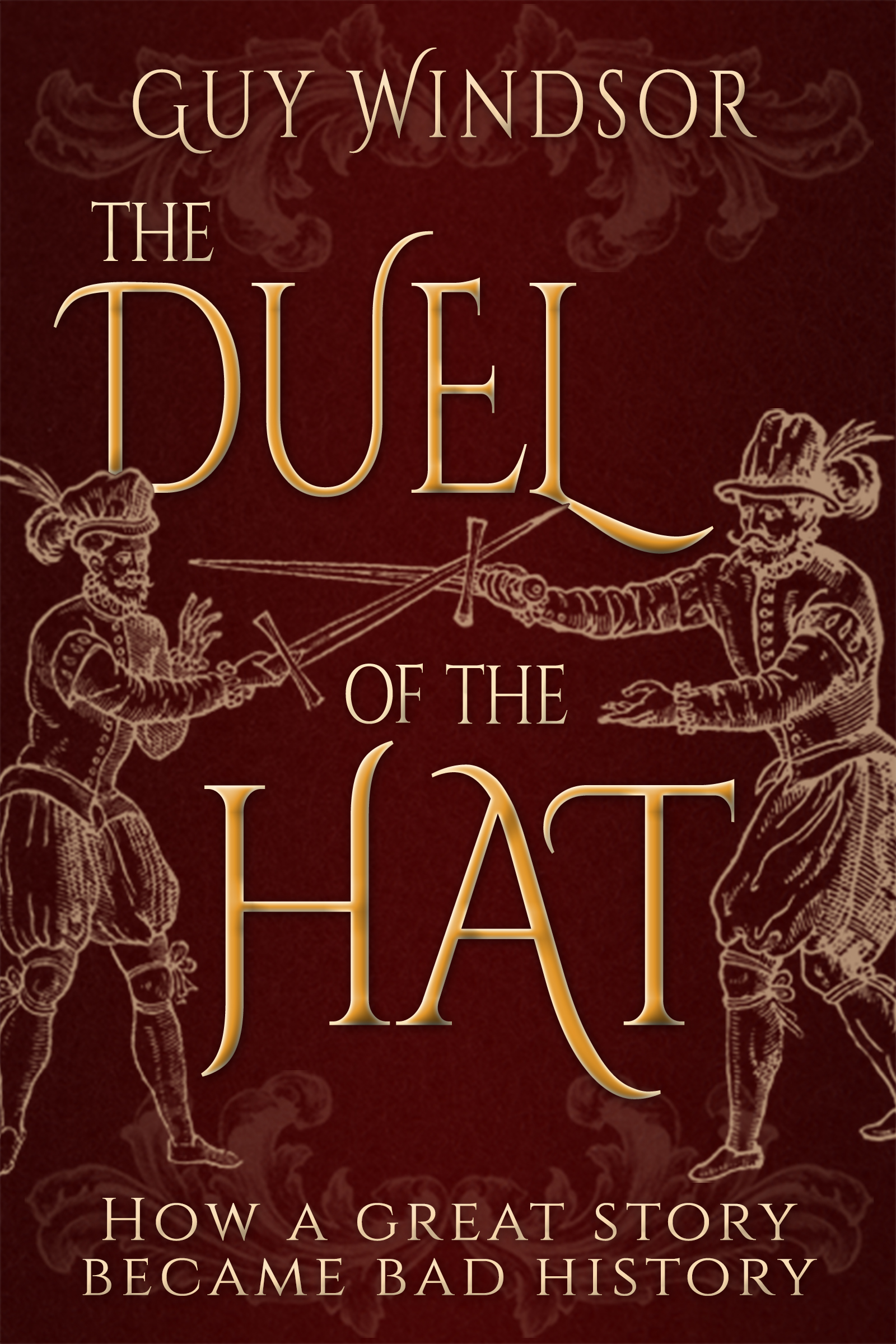
Sometime around 1597, in the French countryside, four men fought a particularly savage duel over a hat. Two died, one was horribly wounded, and the survivor rode away wearing the hat that had started the whole business.
The story was too good to forget. Over the next three centuries, historians and storytellers retold it, embellished it, and sometimes got it spectacularly wrong. People who died in the original account somehow survived in later versions. Details changed, new incidents appeared, and the distinction between historical fact and a good story became increasingly difficult to maintain.
In researching my book, The Duel of the Hat: How a Great Story Became Bad History, I went back to the original sources to find out what actually happened, and how the story changed over time.
I’ve collected the four most important accounts here so you can examine the evidence for yourself. They’re all in French, and all in the public domain. I’ve added cover pages with bibliographical details and, where necessary, tidied up the scans to make them easier to read.
1. Vital d’Audiguier (1617)
Le Vray et Ancien Usage des Duels
The original account.
Vital d’Audiguier was a contemporary of the men involved in the duel, and knew at least some of them personally. His account, published in 1617, is the earliest known detailed description of the fight, and the foundation on which all the later versions were built.
His narrative is vivid, violent, and full of extraordinary details. It is also the closest thing we have to a primary account of what happened.
The relevant passage is Chapter XXXVII, pages 470–496, entitled Autre Duel de la Garde Valon, & du Bazanez, sous le mesme Roy. I’ve included the complete surviving work in the PDF, with the relevant chapter identified on the cover page.
Vital_d’Audiguier_Vrays_et_Ancien_Usage_1617_complete
2. Émile Colombey (1861)
Histoire anecdotique du duel dans tous les temps et dans tous les pays
The story gets mangled.
Colombey’s short account, published more than two centuries after the duel, is a fine example of what can happen when a historical incident becomes an entertaining anecdote.
His version preserves some memorable details of the fight, but makes a rather significant mistake about who survived it. He also attributes subsequent events to a man who was already dead.
It’s a useful illustration of the difference between repeating a story and investigating it.
The PDF contains the relevant extract from his book.
Emile_Colombey_1861_Histoire_Anecdotique_du_duel
3. Henry d’Audiguier (1865)
Un Duel en Province, published in the Revue des Provinces, August and September 1865.
An ambitious attempt to recover the history.
Henry d’Audiguier took the story much further, researching the families, biographies, and historical circumstances of the men involved. His article appeared in two instalments and is considerably longer than Vital’s original account.
He uncovered a great deal of genuinely useful information, but also introduced interpretations and details that require careful checking. His work became an important source for subsequent historians.
The PDF combines both instalments into one document. The first comes from my own copy of the journal; the second was supplied by le CRES du château de Fontainebleau, to whom I’m very grateful. This article has not been digitised before.
Henry_d_Audiguier_Un_Duel_en_Province_1865_complete
4. Dr Paul Morély (1906)
À propos d’une histoire de duel survenue sous Henri IV au château de Valon en Quercy (1597)
Another historian takes up the case.
Writing in 1906, Dr Paul Morély revisited the duel with particular attention to the identities, families, and later lives of its participants.
He drew heavily on Henry d’Audiguier’s work, as well as genealogical and local historical sources. His article is therefore valuable both for the additional information it offers and for showing how earlier historical interpretations were carried forward.
The PDF contains the complete article.
Paul_Morely_1906_A_Propos_d’un_Histoire_de_Duel
So what actually happened?
That’s the question I set out to answer in The Duel of the Hat: How a Great Story Became Bad History.
The book reconstructs the events leading up to the duel, identifies the participants, examines the extraordinary violence of the fight itself, and follows the survivors and their families afterwards.
It also traces how the original account changed in the hands of later writers, separating what the evidence supports from what subsequent historians assumed, misunderstood, or invented.
It’s a story about swordfighting, honour, violence, and a very expensive hat. But it’s also about how we know what we think we know about the past.
Get The Duel of the Hat at Swordschool.Shop
Whether you’ve already read the book and want to check my work, or are simply curious about the original sources, I hope you find these documents useful.
If you spot something I’ve missed, please let me know.
These historical texts are in the public domain. The PDFs are provided free of charge for research, reference, and general historical curiosity.