One of the pleasures of researching historical swordsmanship is finding that people hundreds of years ago were dealing with exactly the same problems we have today.
For example: how do you get the point of your sword to go exactly where you want it to?
I’ve recently been looking at Nouveau traité de l’art des armes (New Treatise on the Art of Fencing) by Nicolas Demeuse, published in Liège in 1778.
Demeuse was a fencing master and a bodyguard to the Prince-Bishop of Liège. His book sets out the principles of fencing and, as the title promises, the simplest ways of putting them into practice. It’s a useful addition to our collection of eighteenth-century sources, not least because it gives us another perspective on how fencing was taught in the period.
And it includes this fun illustration:
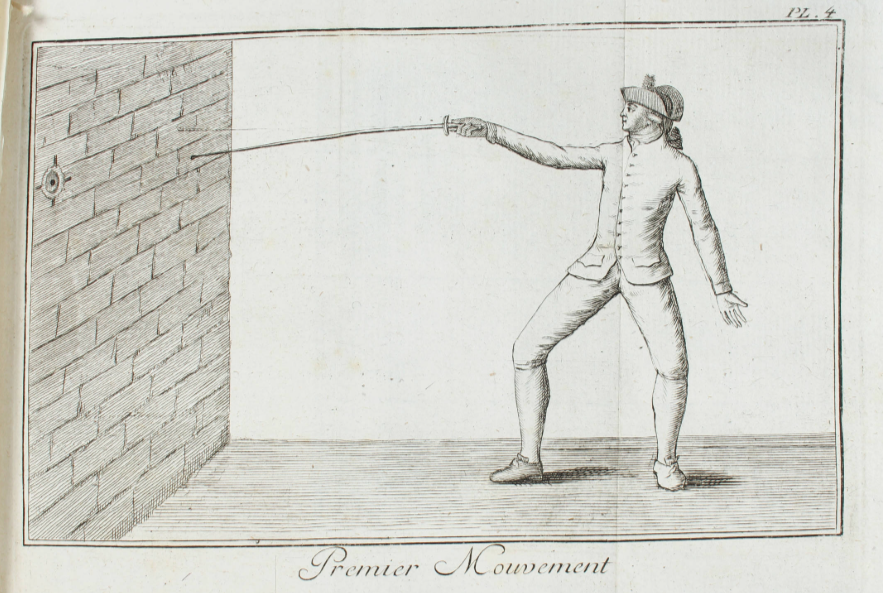
I thought it would be fun to share the relevant passage in my English translation. You can find the transcription at the end of this post (because most readers won’t need it). You can also find the complete book here, though be warned it’s a fairly crap scan, and the fold-out images weren’t folded out when the scan was done.
What Demeuse actually says
This is a first-draft translation, so don’t shoot me if there are errors:
CHAPTER III
On the Lunge
There are three principal movements for bringing the sword’s thrust to its target. First, position yourself as described above when discussing the first position, extend your arms to assume the proper guard, and direct your gaze towards both the target and the sword point. Do not waver in any way: maintain all your points of support and your balance firmly, bending both knees and settling securely into your guard, without discomfort or constraint, and without moving your left foot from its place.
The first movement required is to raise your right forearm to forehead height, with your fingernails upwards, your elbow turned inwards and your shoulder well drawn back. Let your left arm fall casually, four inches from your left thigh, opposite the seam of your breeches, but in such a way that it nevertheless displays strength and energy, reflecting those of the body.
[Page 33]
The word “casually” is used here to indicate that a person under arms should display no constraint or discomfort—nothing, in short, that might appear either excessively swaggering or stiff.
The second movement is performed by straightening the left knee very swiftly, without the body making the slightest movement—that is, without disturbing its position.
These two movements are essentially connected. Neither must disturb the other; they must remain perfectly coordinated. That is to say, they must constitute a single action, performed with as much ease, freedom and speed as steadiness.
The third movement consists of lunging while incorporating all the movements, or the combined action, of the first two. Observe that the foil’s point must reach whatever target is intended before the right leg extends into the lunge. To achieve this, straighten the left knee with as much speed as assurance, so that the thrust arrives like lightning. Link these three movements so that they constitute, so to speak, a single movement [Page 34] and form a single action, invariably maintaining the posture and positions described when discussing the first movement.
Having accurately performed these three essential movements, recover to guard, shifting your body slightly onto your left hip so as not to burden the part of the body working to recover, while maintaining all the other parts in the same position. Bend your left knee to allow your body to return easily and firmly to position, lifting your foot just clear of the ground, without dragging it or making any suggestion of a stamp.
Lunge at the pad, or target, placed on the wall, to become accustomed to establishing your balance, to train your body in this, and to avoid the faults you would inevitably acquire without this exercise. Its purpose is to unite the different movements discussed above into a coordinated whole, without which you will never learn to fence, for they are its essential foundation.
It is chiefly through this exercise that you learn to keep your body in perfect equilibrium and maintain your balance without wavering, and acquire [Page 35] steadiness in the lunge, accuracy of visual judgement, dexterity of hand, firmness in the legs, and ease in recovering to guard with suppleness as well as precision.
After this exercise, which cannot be repeated too often for the reasons already given, instruction in performing the various fencing actions may begin.
Why I find this interesting
It’s easy to get caught up in the complicated parts of historical fencing: the guards, the parries, the footwork, the tactical decisions, and the bewildering variety of things you can do with a sword.
But all of that rests on some very basic skills.
If you’re trying to hit someone with the point of your sword, you need to be able to put that point precisely where you intend. Preferably without having to think at all about how to do it. This isn’t just a question of scoring hits. Good point control makes your fencing more effective, and also makes you a safer training partner.
It’s actually quite unusual for a fencing source to talk about training skills: we normally just get a bunch of techniques, and sometimes some theory. We don’t have to adopt every historical training method uncritically, but there’s a great deal to learn from how our predecessors approached the same practical problems when they deign to tell us how to go about it.
What particularly interests me here is that Demeuse isn’t treating the wall target merely as an exercise in accuracy. He’s using it to develop the entire movement: balance, coordination, control of the sword, and recovery to guard. And he’s quite explicit that students should practise this before moving on to more complicated fencing actions. It’s an excellent example of a historical fencing master explaining not just what to practise, but why.
And sometimes it’s worth trying an old exercise simply because it looks like fun.
Try it yourself
You can download Demeuse’s complete treatise above. If this has whetted your appetite for working on your accuracy, I’ve also got something rather more practical for you.
My Hit What You Aim At: Point Control for Historical Fencers webinar is available as a recorded workshop.
It includes two complete webinar recordings, four hours of instruction and Q&A, and a detailed workbook covering historical examples, training theory, practical exercises, and instructions for making your own point-control targets. I only came across Demeuse after creating the workbook, so he’s not in there yet. I’ll add him in a future update.
Most of the exercises can be done on your own, with very little equipment. And although I demonstrate primarily with the smallsword, the principles apply just as well to rapier, sidesword, longsword, foil, and other thrusting weapons.
Because whatever sword you use, you should be able to hit what you aim at.
Get the Point Control workshop here.
Transcription:
CHAPITRE III.
De l’Alongement.
IL y a trois mouvemens principaux pour rendre le coup d’épée à son but : 1°. Il faut se placer, comme nous l’avons dit ci-devant, en parlant de la premiere position, déployer les bras pour prendre sa garde réguliere & fixer la vue en même tems au but & à la pointe de l’épée, sans vaciller en aucune façon, c’est-à-dire en gardant fermement tous ses points d’appui ou ses à plombs, en pliant les deux jarrets, pressant l’appui de la garde, sans gêne & sans contrainte, & sans que le pied gauche bouge de sa place.
Le premier mouvement requis, est de lever l’avant-bras droit à la hauteur du front, d’avoir les ongles en haut, le coude en-dedans, l’épaule bien cavée & que le bras gauche tombe négligemment à quatre pouces de distance de la cuisse gauche, vis-à-vis la couture de la culotte, mais de façon néanmoins qu’il y paroisse de la force & de l’activité & se ressente de celles du corps.
[Page 33]
On se sert ici du mot négligemment, pour marquer qu’il ne doit paroître dans l’homme sous les armes aucune contrainte, aucune gêne, rien enfin qui puisse paroître ni trop fanfaron ni guindé.
Le second mouvement se fait en tendant le jarret gauche avec beaucoup de célérité, sans néanmoins que le corps fasse le moindre mouvement, c’est-à-dire qu’il se dérange de sa position.
Ces deux mouvemens ont un rapport essentiel entre eux. L’un ne doit aucunement déranger l’autre, ils doivent conserver identifiquement l’ensemble, c’est-à-dire qu’ils ne doivent faire qu’un seul & unique tems qui doit s’exécuter avec autant d’aisance, de liberté, & de vélocité que de fermeté.
Le troisieme mouvement consiste à prendre son alongement en réunissant à celui-ci toutes les motions ou l’ensemble des deux premiers ; observant que la pointe du fleuret doit arriver au but quelconque, avant que la jambe droite ne s’alonge. A cet effet il faut tendre le jarret gauche avec autant de rapidité que d’assurance, afin que le coup arrive comme un éclair.
En liant ces trois mouvemens de façon qu’ils n’en fassent pour ainsi dire qu’un seul [Page 34] & ne forment qu’un tems, conservant invariablement l’attitude & les formes que nous avons dites en parlant du premier mouvement.
Après avoir exactement exécuté ces trois mouvemens essentiels, il faut se remettre en garde, jettant le corps un peu sur la hanche gauche, pour ne pas charger la partie du corps qui travaille pour se remettre en garde, & maintenir toutes les autres dans la même position. On plie le genou gauche pour donner au corps l’aisance de se replacer avec fermeté, en levant le pied au rez de terre, sans le traîner & sans qu’il fasse aucun signe d’appel.
On s’alonge sur le plastron, ou but, placé à la muraille, pour s’habituer à prendre ses à plombs, pour y styler le corps & éviter les défauts que l’on contracteroit infailliblement, sans cet exercice ; pour réunir les différens mouvemens, dont nous avons parlé & en faire un ensemble, sans lequel on ne saura jamais tirer des armes, car ils en sont l’essentiel & la base.
C’est essentiellement d’après cet exercice que l’on apprend à tenir le corps dans un parfait équilibre, à conserver sans vacillation ses à plombs, qu’on acquiert de la [Page 35] fermeté dans l’alongement, de la justesse dans le coup d’œil, de la dextérité dans la main, de la solidité sur les jarrets & de l’aisance à se remettre en garde avec autant de souplesse que de précision.
Après cet exercice qui ne peut être trop répété, pour les raisons que nous avons dites, on peut commencer à montrer à exécuter les différens coups des armes.