Guy's Blog

Guy frequently keeps this blog updated with thoughts, challenges, interviews and more!

Category: Writing, Teaching & Methodology

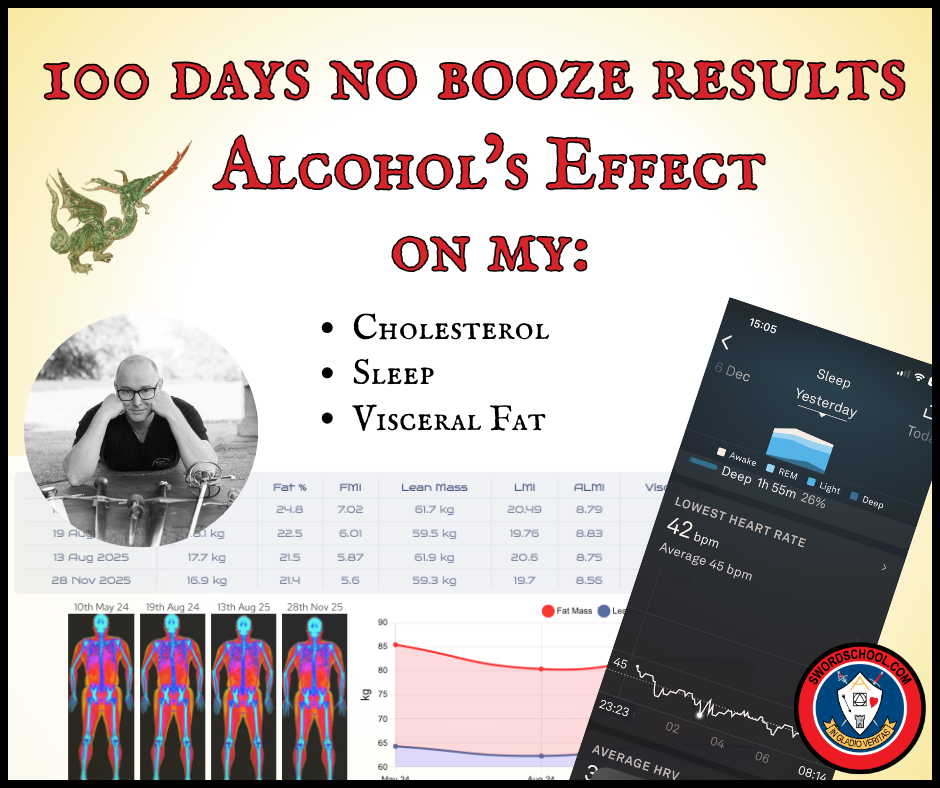
100 days no booze banner image with Guy Windsor, dexa results, oura ring results

I stopped drinking alcohol on August 19th, aiming for 100 days. In the end, I reached 103 days without booze, and without much effort. This post unpacks my 100 days no booze results, including cholesterol, visceral fat, sleep, heart rate, and the strange mysteries of my DEXA scans.

If you want the background and the halfway-point update, you can read that here — but let’s jump into the results.

Weight and Waist: The Simple Home Measurements

So what happened?The only measurements I can reasonably make at home are overall weight and waist circumference. Those have both improved.

  • Weight: 81.2kg 78.7kg
  • Waist: 91cm 88cm

Not bad results, but not stellar. I did once lose 10kg in three weeks

Two noticeable effects:

•Reflux definitely improved

•Sleep did not noticeably improve

But the most important finding wasn’t from any measurement device:

My wife and daughters all agreed I was much less irritable when not drinking.

That’s definitive.

The two main metrics I was trying to improve were cholesterol levels, and visceral fat. I was hoping for improved sleep and thus more creative juice too.

Cholesterol and Triglycerides

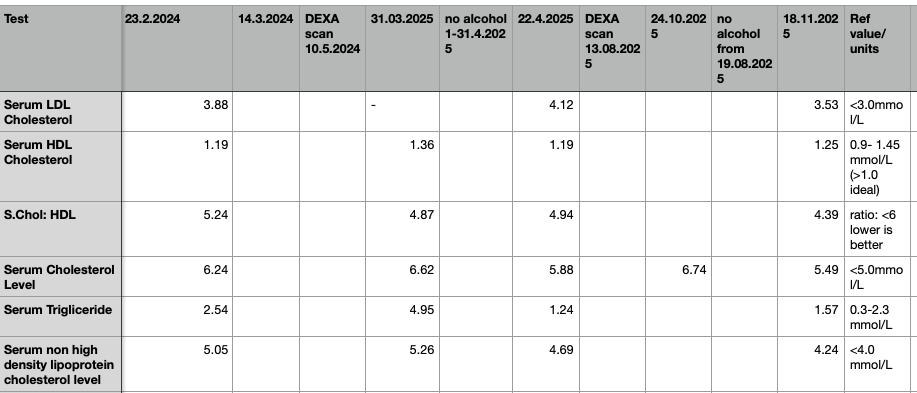
Let’s start with cholesterol. Here are the results over the last year:
spreadsheet with my cholesterol test results as affected by booze intake

Back on 31 March, my triglycerides were so high the lab couldn’t even calculate LDL. After just three weeks without alcohol, everything had improved dramatically by 22 April.

The 100 Days No Booze Results

After the full 100 days:

•LDL: down from 4.12 3.53

•Triglycerides: up slightly from 1.24 1.57, but still well within reference range

These numbers fluctuate, and any single blood test is just a snapshot — like a photo of a busy street rather than a full documentary. But overall:

The trend is clear: not drinking alcohol helps my cholesterol and triglycerides.

These things are not an exact science: there are too many variables affecting cholesterol levels on any given day. Any blood test is a snapshot of a moment in time, like a photograph of a busy street. But the trend seems positive. From a cholesterol and triglycerides perspective, it’s clear that cutting out alcohol helps me a lot.

A Coffee Cholesterol Surprise

Two weeks before the final blood test, I learned that diterpenes in unfiltered coffee can raise cholesterol. Since then I’ve switched to paper-filtered coffee. This may have helped too.

Visceral Fat: The Most Interesting (and Confusing) Results
page from my DEXA scan results

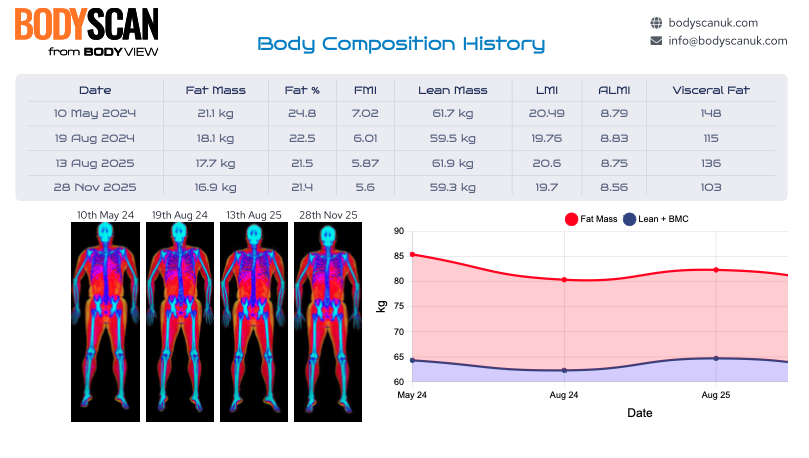
Now the visceral fat. It was baffling to me that at my previous DEXA scan in August, my overall body fat was down quite a bit, but my visceral fat had jumped back up from 115 to 136. This latest scan, on November 28th, was even weirder. According to the weighing scales at the DEXA clinic, I’d lost a total of 1.8kg exactly.

My visceral fat is down to 103 cm2. (Visceral fat is measure in cm2 because it’s a calculation of the area of the cross-section of your torso at the navel. So if you cut me in half with a very sharp sword at my navel and measured the total area of fat, it would be 103cm2 out of a total of about 730)

Here's the pdf of the entire scan results: Guy_Windsor_2025-11-28-report

This is excellent, and what I was hoping. But here’s the thing. A bottle of wine is about 700 calories. I was averaging a bottle a day. So over 100 days, my overall calorific intake was down by about 70,000 calories (not counting the extra food I would have also eaten, because drinking with food tends to increase how much you eat). Fat stores about 9000 calories per kilo, so that’s about 7.8kg of fat.

But I’d lost a total of 785g. What the actual? That’s maybe 10% of what one might reasonably expect.

The rest of my weight loss came from “lean tissue”, mostly in the torso. 1.929kg from my trunk to be exact. That’s obviously not muscle (or at least mostly not muscle). There simply isn’t that much muscle to lose- and I’m stronger now than I was in August, including in my so-called “core”. So that’s either fluid, or organ mass, with perhaps some of it being gut contents (though my bowels were fine both that day and for the previous scan).

I also don’t understand how I can be 1.8kg lighter, having lost 2.631kg of lean mass and 785g of fat. That’s a total of 3.416kg… so where’s the extra 1.616kg? I certainly haven’t added that much to my bones! And I wasn’t bloated during the previous scan.

This was baffling enough that I contacted the company, and after a bit of email back and forth got on a call with one of their technicians. He pointed out that in my previous scans the DEXA total mass measurement agreed quite closely with the impedance scale measurement, except for my August 2025 scan, where it disagrees by just over 2kg. The simplest explanation is that the technician on the day recorded my weight wrong: he put 80.6kg in when it should have been closer to 82 (the DEXA recorded it at 82.298).

It’s normal for the DEXA scan to calculate total body mass about 2-400 grammes higher than the scale weight. But not 1.7kg high. And that 1.7kg is very close to the 1.6kg discrepancy in these figures. So if we correct that weight measurement, the numbers basically add up.

Here’s another mystery. According to the scan, I’ve gained 98g of lean mass (probably muscle) in my right leg… but lost 718g from my left leg! Without any noticeable change in relative strength (and yes, I am right handed and footed, but I do all my training on both sides, and in August, they were basically equal).

So, getting back to the actual point of the scan: it does seem that cutting alcohol cuts my visceral fat, but does nothing at all for my other fat. And it’s somehow fucked my left leg, even though it feels fine.

That was Friday, day 102 of my 100 days. So I had a small glass of wine that evening, and a few more on Saturday (my wife’s birthday), and a lot more on Sunday (my birthday). My reflux did not approve, but it was worth it.

Alcohol vs. Heart Rate: Oura Ring Data

Leaping down off the wagon like that gave me an opportunity to double check alcohol’s effect on sleep, so just for fun I put on my Oura ring and measured my heart rate. If you’re familiar with my Oura woes, I don’t take anything it measures seriously except heart rate, temperature, and HRV. It certainly can’t tell the difference between me lying in bed trying to sleep and me actually sleeping. But I do think it measures heart rate pretty well.

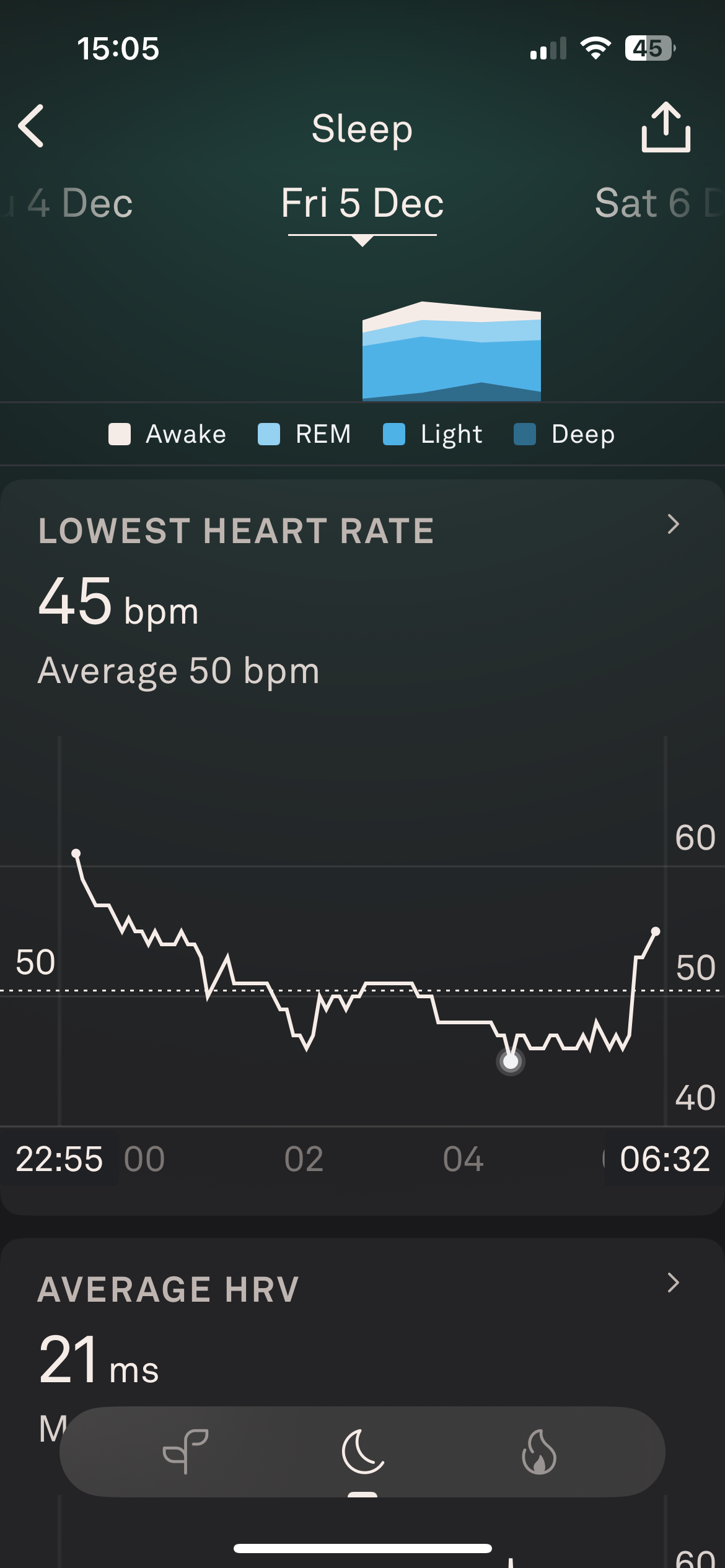
Here’s what the graphs look like. In each case I went to bed sober, and stopped drinking by 7pm, four hours before lights out.
Friday:
Friday night with a little booze: hr lowest 45 average 50

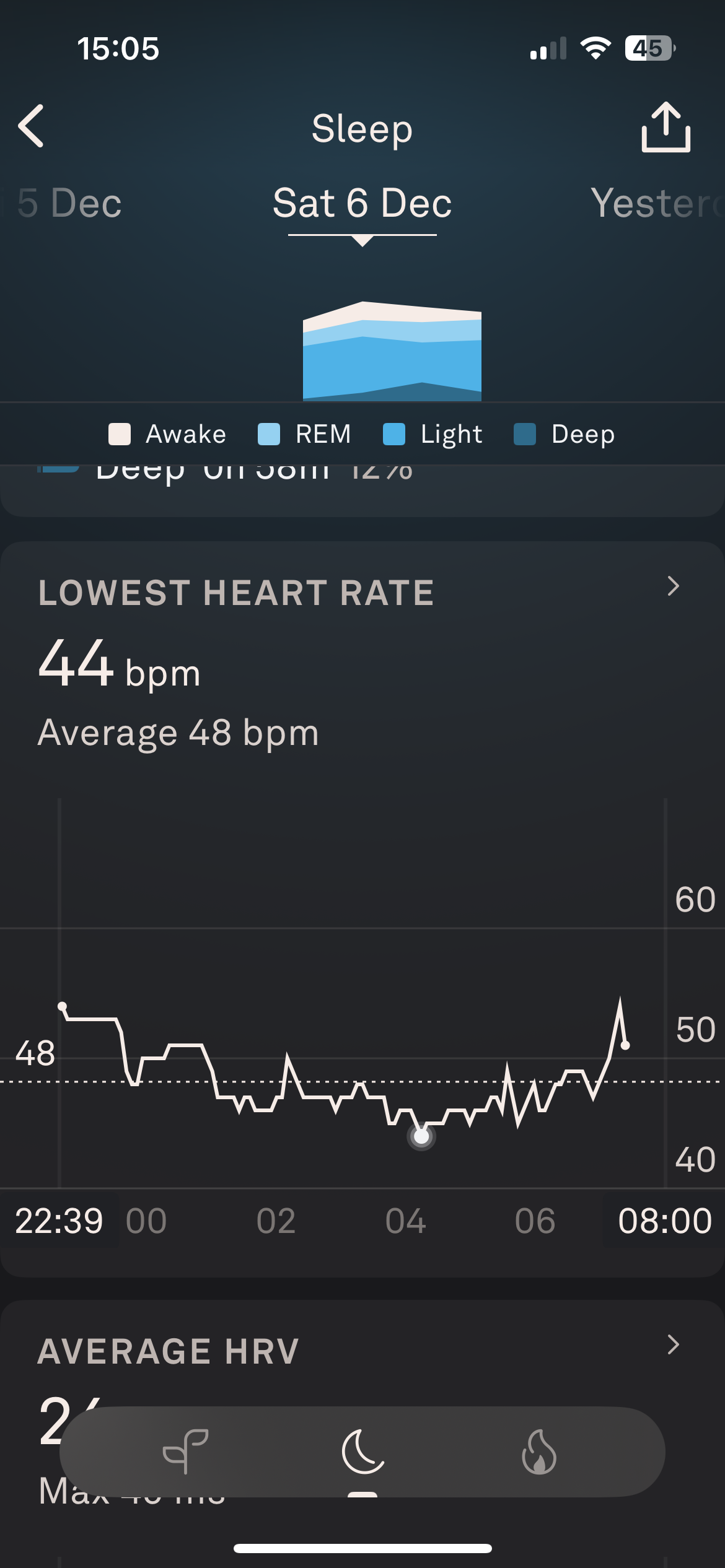
Saturday:Effect on HR with some alcohol on the Saturday: hr lowest 44, average 48.

Sunday:

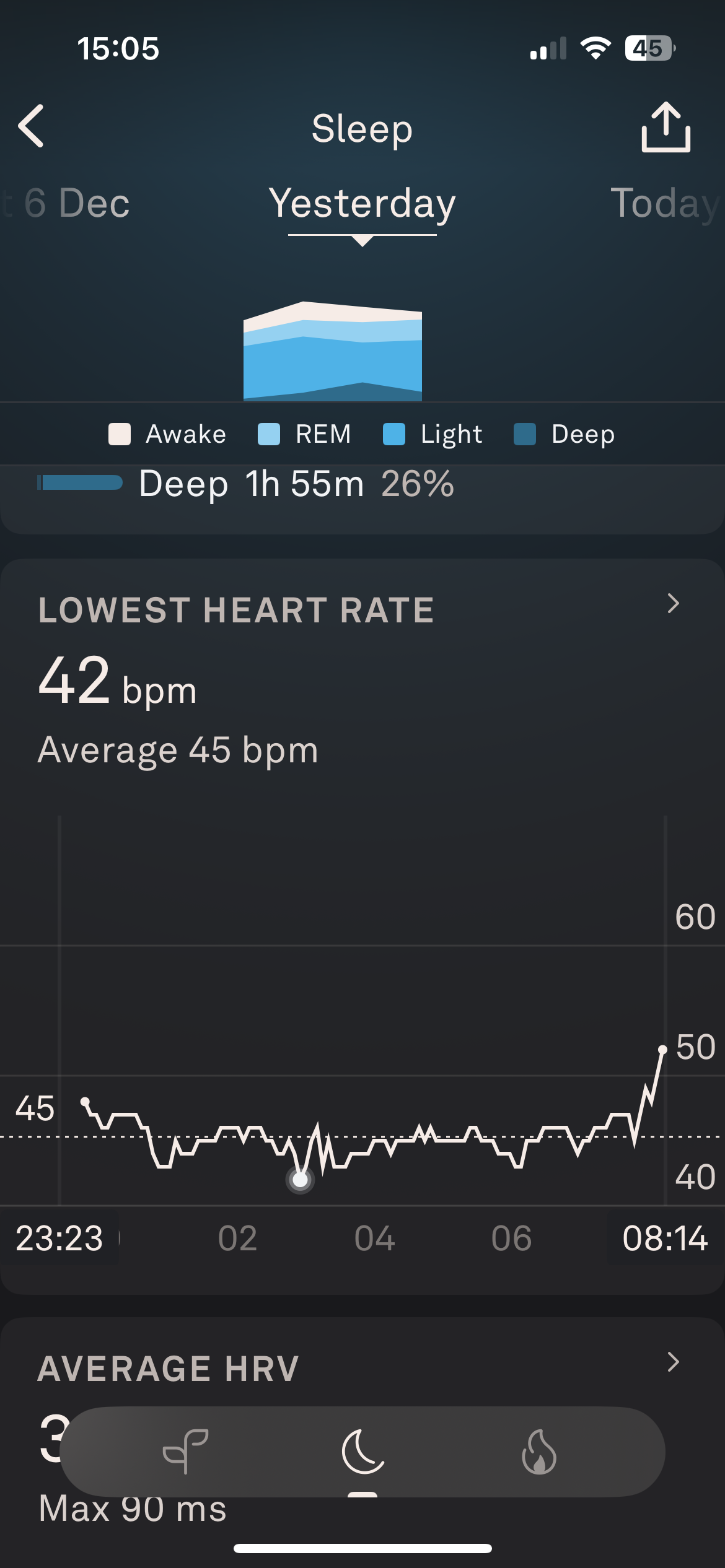
Sunday no alcohol, so HR average 45, lowest 42.

So whether I actually feel better or not, it’s really obvious that my heart prefers me to not drink at all. I mean, average HR 45, lowest 42, that’s pretty decent. Generally speaking, any night when I haven’t drunk any alcohol, it’ll average something below 50, and get down to 45 or below.

Just for fun: here’s what it looked like after I got accidentally shitfaced at my friend’s party. Last booze in about 4pm, I think.
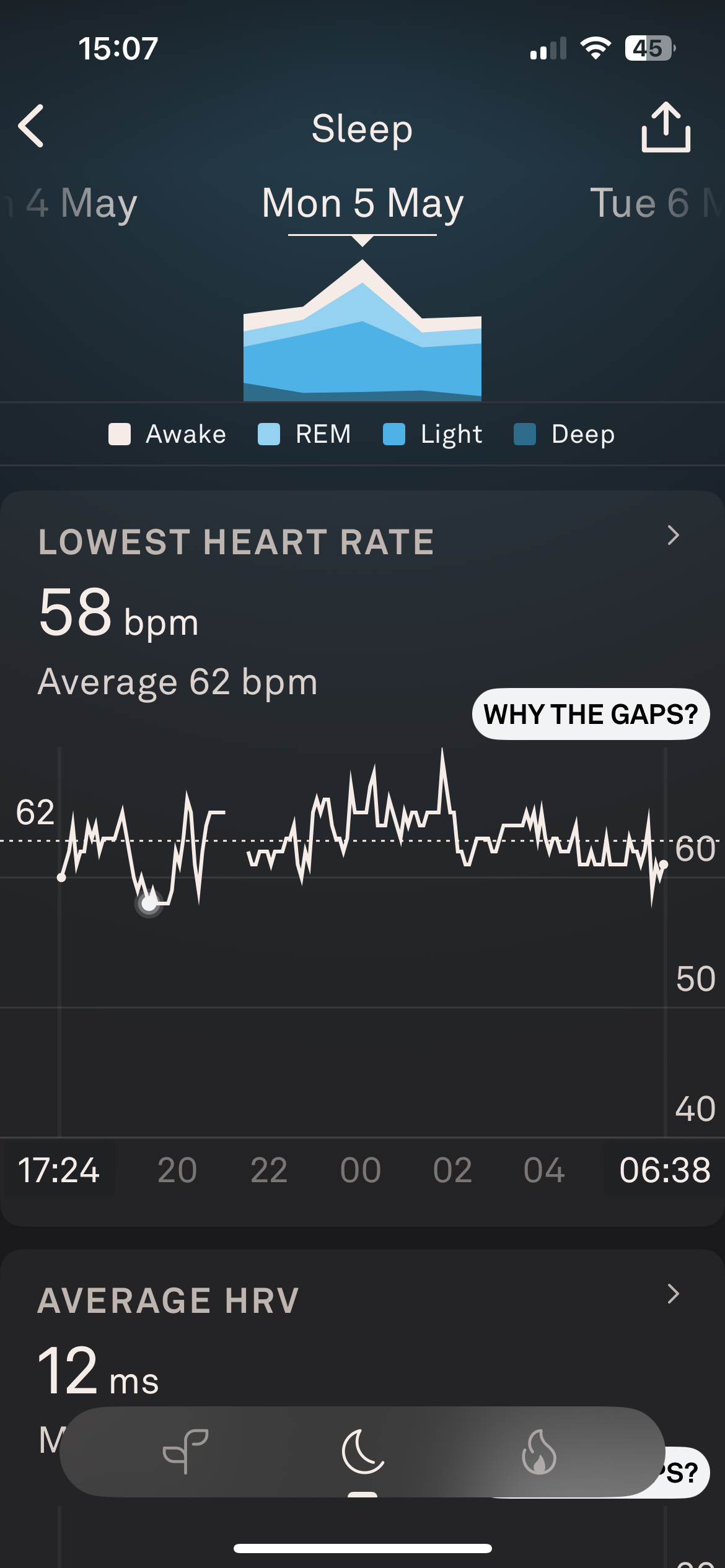
party time: average HR 62!


What 100 Days Without Alcohol Really Changed

Putting aside the data inconsistencies, the genuine results are:

Positive effects

  • Major improvement in visceral fat
  • Lower LDL cholesterol
  • Overall waist reduction
  • Less irritability (confirmed by independent household authorities)
  • Significantly lower resting heart rate on sober nights

Little or no effect

  • Sleep quality (subjective)
  • Subcutaneous fat

Negative effects:

  • None.

So what am I going to actually do now?

I’d like to get my body fat percentage below 18. Here’s how I’ll approximate that:

1. Waist measurement down from 88 to 86cm.

2. Weight down from ~79kg to ~76kg.

Approach:

1. Restrict booze. Generally speaking, no drinking unless it’s a special occasion. Tuesday is not a special occasion.

2. Go slow-carb. It worked very well for me before, let’s try it again. Being careful to maintain protein intake, and continue with weight training, to preserve muscle mass.

3. Cycle on and off, cutting weight (which gets rid of fat and a bit of muscle), and bulking up (which adds muscle and a bit of fat).

4. Fast occasionally. I normally have about 15 hours between last calorie in at night and first in the morning anyway (just because it’s more comfortable for me). Increasing the fasting time to 18 hours is not hard, so I’ll think about doing that more often, with an occasional 24 hour fast, or even longer. I train too much to want to fast too often- I’m concerned about losing muscle mass.

4. Track weight, waist, and strength. If my waist is down and my strength is up, I’ll call that a success, whatever the scales or DEXA says.

December is not the month for this, so I’ll play around with various things as convenient, and get consistent and serious about it on January 2nd. Another 100 days no booze, with a strict slow-carb diet (no starch, no sugar, lots of veg and protein), will take us to April 12th. I will probably make exceptions to the no-booze thing, but only for very special occasions. There is a world of difference between two glasses of wine in a fancy restaurant every couple of months, and two glasses of wine before dinner every evening.

Final Thoughts on 100 Days No Booze Results

The headline takeaway is simple: Alcohol has a strong negative effect on my visceral fat, cholesterol, irritability, and sleeping heart rate.

It doesn’t magically melt fat off me, but it clearly improves a bunch of meaningful health indicators.

The basic idea behind all of my training and health related activities is this:

Find out what works for you, then do that.

Both of those components are hard. Healthcare professionals can tell you what the current-ish state of the science suggests should work for most people most of the time, but they aren't much good at targeting what works for you specifically. The only way to know what works for you is to try it, and track the results.

Then, having discovered that doughnuts make you fat, or alcohol is bad for you, or whatever it is, you have to figure out how to incorporate that insight into your daily life. That can be simple and easy, or it can be really hard, especially when it involves going against mainstream cultural expectations. Even if the intervention is simple, it may not be easy. I'm lucky in that this one was both simple and quite easy, but many others I've tried are a lot harder.

My book The Principles and Practices of Solo Training covers this approach in depth and detail. If you've enjoyed these alcohol posts, you'll probably enjoy that book. And we have a sale on until the end of the year: use the code GUYSBIRTHDAY25 for 25% off any digital product, and BIRTHDAYPRINT10 for 10% off any print product, at swordschool.shop.

I share this kind of thing on my newsletter quite often, so sign up below to stay informed.

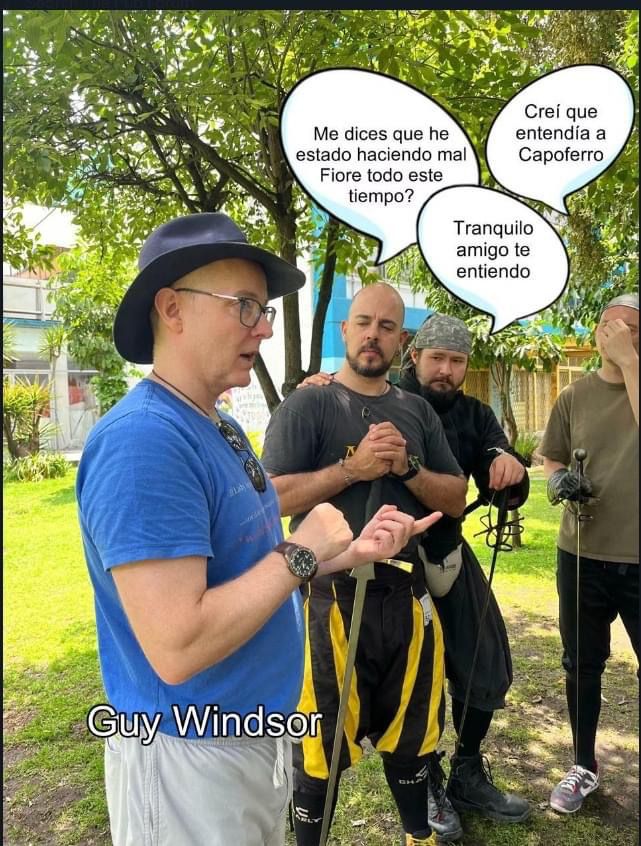
Guy with three Mexican students, all with thought bubbles. Mexico City 2024

7 Countries. 4 Continents. 6 books. Two online courses. And one really good idea (I think).

It’s kind of absurd to summarise an entire year in a single blog post, especially such a busy and yet somehow still productive year as the last 12 months have been, but I need to get a handle on what my actual choices were. It’s all very well to say you prioritise x or emphasise y, but looking back you may well find that you actually prioritised z.

It seems that this year I’ve prioritised pushing books out the door (sometimes faster than they should be), and travelling as much as I can handle. Leaving aside family travel (such as starting the year on holiday in Italy with my wife and kids, taking my wife to Porto for a weekend, and the whole family to Spain for a summer holiday, and visiting my mum in Scotland (which is a whole other country)), in 2024 I went to:

  • Helsinki, in February and again in May, teaching seminars for the Gladiolus School of Arms (which I’ll be doing again in mid-January 2025)
  • Singapore in April, to teach seminars for PHEMAS
  • Wellington, New Zealand, in April, to teach a seminar for a friend’s club (I segued through Melbourne on my way home to catch up with friends)
  • The USA: Lawrence, Kansas to shoot video with Jessica Finley, Madison Wisconsin to teach a couple of seminars, and Minneapolis likewise
  • Potsdam, Germany, for Swords of the Renaissance
  • Mexico City for the Panoplia Iberica, and then Queretaro for a smaller event.

That’s a total of 73 nights away from home for work trips. Damn. I’ve loved it, and will be doing some travelling in 2025, but both my daughters have major exams coming up in June (A-levels for one, GCSEs for the other), so I need to be home for much of at least the first half of the year.

Publishing

In January 2024 I published From Your Head to Their Hands: how to write, publish, and market training manuals for historical martial artists. Perhaps the nichiest book I’ve ever written, but it was there in my head in between editing drafts of the wrestling book (see below), so I got it out of my head and into your hands. See what I did there?

In March I published the long-awaited and technically “first” volume in the From Medieval Manuscript to Modern Practice series: The Wrestling Techniques of Fiore dei Liberi. Only 4 years after what will become the third volume (The Longsword Techniques of Fiore dei Liberi). It took me that long because the pandemic stopped me from going to Kansas to shoot the supporting video material with Jessica Finley. Well, that’s my excuse and I’m sticking to it. It was also just bloody hard to write.

The second volume (on the Dagger Techniques of Fiore dei Liberi) should be out in early 2025, and at that point I’ll re-cover the Wrestling and Longsword volumes and make them look and behave more like a book series.

Proof if ever you needed it that there’s no need to do things in order.

In August I published Get Them Moving: How to Teach Historical Martial Arts. This is another super-nichey book. I’m not aiming at the mass market here, just clearing things out of my head so I can get on with other things. Books do that: they simply insist on being written and published, and won’t let me alone until I’ve got them out the door.

I also managed to edit all the new material for my Medieval Dagger Course, which I had shot in Kansas. I also have a bunch of longsword material to publish, and an entire course on German Medieval Wrestling (Jessica Finley’s work).

In September I published the celebratory 20th Anniversary edition of my first book, The Swordsman’s Companion, and I’ve made the ebook free on all platforms. The book is hopelessly out of date as regards interpretation, but it’s an interesting window into the state of the art as it was in 2004. And it got a lot of people into historical martial arts.

In November we published the magnificent facsimile of the Getty manuscript, with my complete translation. Unfortunately that ran into some bizarre technical problems after the first 50 or so orders had come through, so at the time of writing we are fixing the problem and reprinting the books. I also created a companion volume which includes the complete transcription as well; it’s not intended as a standalone, but it is finished and has been sent out to all the buyers of the facsimile, so I guess that counts as two more books, taking the year’s total to a somewhat absurd 6. If you consider that my first book came out 20 years ago, and in that time I’ve written and published about 18 books: a full third of them in this year alone.

Of course, publishing comes after writing, and a lot of this year’s output were mostly or at least partly written over the last few years; they just happened to be ready all at once.

My podcast The Sword Guy hit 200 episodes in December 2024, and I’ve decided to pause a while to think about what I want to do for the next 20, 50, or 100 episodes.

Business stuff

I had two main goals for 2024: to figure out how to open up my platform to other instructors, and to create partnerships with other businesses serving the HMA community. I’ve made progress on both those fronts.

Esko Ronimus’s course “Introduction to Bolognese Swordsmanship” went live on courses.swordschool.com in October this year. This is different to the collaborations I’ve done before (such as Jessica Finley’s Medieval Wrestling course) because I was not directly involved in creating it. I didn’t direct the shoot, edit the video, or take part in the production in any way. I just provided a platform to host it on, and some advice on structuring the course and marketing it. So far both Esko and I are happy with the results, and I’m open to requests from other instructors…

If you’ve bought a sword from Malleus Martialis in the past year you may well have got a discount code for one or other of my online courses, or a code to get one of my ebooks for free. This kind of thing is good for Malleus (they can offer more to their customers at no cost to themselves, and make an affiliate fee on any course sales), good for the customer (they get free or discounted stuff they are likely to be interested in), and me (I get some of the course sales money, and someone who may not know my work becomes familiar with it, and may go and buy a bunch more of my books). So if you’re in the business, and want to set something up, let me know.

Research stuff

This year there has been one significant change to my interpretation of Fiore’s Armizare: the three turns of the sword. This doesn’t change much about how we actually do things, but it affects the underlying theory behind the art, and solves a mystery that has been plaguing us for decades. Full credit to Dario Alberto Magnani. You can listen to the entire conversation here.

It also meant updating my translation of the Flower of Battle: I deleted one word. A very critical word. “Also”. Yes, it makes a difference.

Plans for 2025

I came back from Mexico with one clear vision of a problem to solve. Namely, I travel about a lot giving seminars, and so I get to see a lot of students, but only every now and then, and many of them I’ll never see again. This is unsatisfying. I don’t get to see the long-term effects of the things they have learned from me. I don’t get to see them develop over time. Of course there is some continuity, especially when I go back to teach at clubs regularly, but it’s not ideal for either me or the students.

So what to do about it? The thing that blows the students’ minds most consistently are insights into swordsmanship mechanics. Ask Leon in Mexico or Rigel in Singapore about the rapier guard quarta, and how stringering works. The look of utter startlement on students’ faces when they get it is the absolute best thing. I’m thinking about creating an online course that goes into the absolute fundamentals (ie the most important but least flashy) of how sword mechanics work, and making it free: but required for anyone signing up to one of my seminars when I travel. This will let me cover a lot more stuff in the class itself, and prepare them better to actually make use of the insights. And it will hopefully bring them more into my orbit, make them more likely to show up on swordpeople.com with good questions, more likely to come to the next seminar, etc.

I also want to create an online course on Vadi’s longsword (might as well shoot my interpretation of the entire manuscript while we’re at it) [Update: we did! We created the Vadi longsword course, the Vadi dagger course, and filmed my interpretation of every play, which you can find on the Syllabus Wiki when it's properly updated, hopefully by Feb 2026], publish the dagger volume of From Medieval Manuscript to Modern Practice [Update: we did! you can find it here], maybe shoot the video for the armoured combat and/or mounted combat volumes, and finish The Armizare Workbook Part Two (which has been more than half written for over a year… but is still stuck in hard-drive purgatory). Part One came out in 2022, and I meant to get Part Two out in mid ’23. Oh well. [Update: we did not get round to shooting the armoured or mounted plays, or publish part 2 of the workbook. Sorry.]

I’m planning to make all of the supporting video for From Medieval Manuscript to Modern Practice (so, clips of every play from Folio 1 to Folio 31v of the Getty ms) free online. They are currently only visible through the links in the books. But making them open to all should help my fellow scholars, and also provide advertising for the books. Another win-win. [Update: Which indeed we won! They are all up on our vimeo account, and will be built into the wiki asap.]

The key thing to remember here is that planning is vital but plans are useless. There is no way to predict the future, and all sorts of things might get in the way of any or all of my intentions for the year. But having a think about what I want to accomplish, and why, makes it much more likely that I’ll be able to look back on 2025 with some degree of satisfaction. Let’s see what actually happens…

I recently got my latest book, The Theory and Practice of Historical European Martial Arts, back from the editor, and am working through it. There are always last-minute changes to make, but they are usually minor additions or rephrasings. This time, there is one major change: I have decided to stop using the term HEMA altogether. It stands for Historical European Martial Arts, and a sad and disgusting number of white supremacists, nazis, and other scum have latched on to the “European” bit (at the expense of the historical, the martial, and the artistry) and are bringing the term into appalling disrepute. I will not share examples of this behaviour because I see no good reason to spread poison, but trust me, it’s out there.

The Nazis in Germany in the 30s did the same thing to all sorts of elements of European culture, from co-opting Norse mythology, to taking a perfectly innocuous symbol (the swastika, which you will see on monuments and book covers before the 1930s) and making it forevermore associated with evil incarnate.

The principles and practices I cover in the book are by no means only applicable to European styles and sources. They could be used for any art— indeed, my friend and colleague Dr. Manouchehr Moshtagh Khorasani is using the same sort of approach in his reconstruction of historical Persian martial arts. So the “European” bit is entirely unnecessary, and seems to promote division rather than unity. I don’t practice the arts I do just because they are European.

It’s not as if there was any such thing as a general European martial art anyway, other than perhaps gunnery; I teach Italian rapier, Italian medieval knightly combat, French smallsword, German sword and buckler, and so on. Every source comes from a specific time, place and culture; to call them European would be uselessly general.

So fuck them. They can have the HEMA label. The E is redundant. We could call what we do Historical Swordsmanship, but that would exclude the boxers, knife fighters, WWII combative practitioners (the only style I can think of that definitely killed Nazis!), wrestlers, jousters and all the rest that don’t use swords. We could call it Western Martial Arts, though the “Western” is perhaps misleading too; Polish sabre is Eastern European; to me it would feel odd to call it “Western”, though it is when considered in relation to Asian martial arts.

In the interests of specifying the historicity of what I do, its martial nature and its artistic beauty, I’m calling my book The Theory and Practice of Historical Martial Arts, and dropping all references that would seem to imply these arts are valuable because they are European.

In the global fight against fascism that faces us today, it is probably the tiniest, feeblest, blow. But we have to start somewhere. I don’t think we can reclaim the term HEMA any more than we can reclaim the swastika, but it’s just a four letter acronym. It’s what we do that counts, not what we call it.

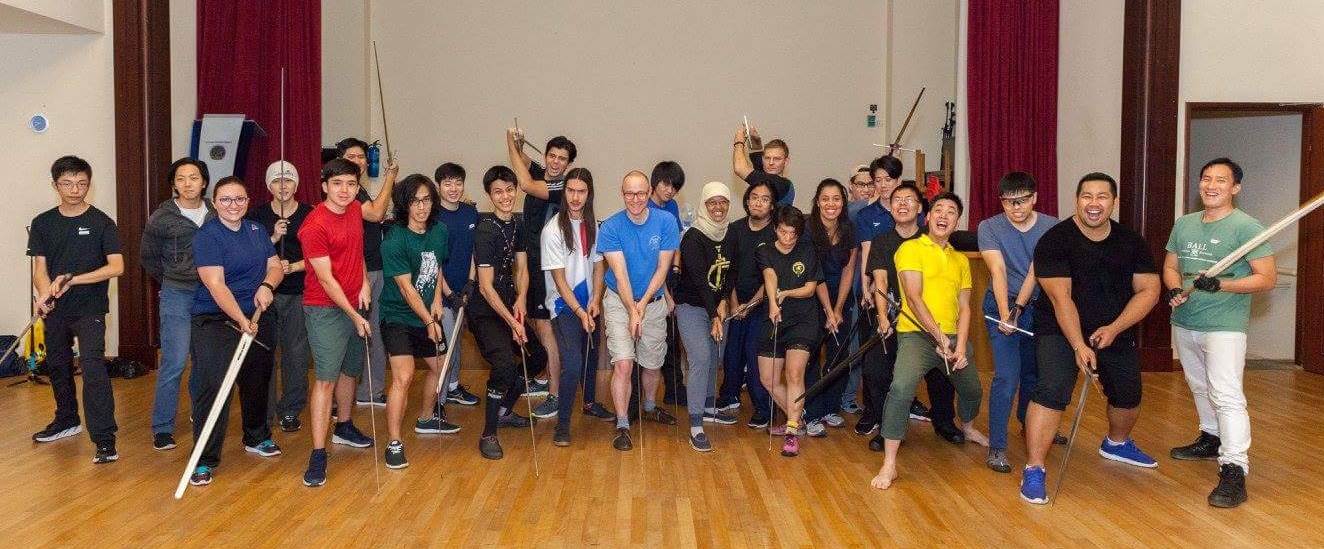
In case there were any doubt about my stance on this, here’s a photo of a class I taught recently. Race, sex, religion, country of origin? Irrelevant. Community fostered by a shared joy in the Art? Priceless.

UPDATE: There has been a ton of commentary on this on various social media platforms, which can be distilled down to the following stances:

  1. Yay! Glad Guy said that.
  2. Okaay, but we must FIGHT to keep the term HEMA and not yield the E to the fascists
  3. Fascists are bad, but this is not helping at all
  4. There are fascists in HEMA? Where?
  5. Are you calling ME a fascist? (for the record, I'm very carefully not naming anyone)
  6. Guy is a dick.

Let me point out that the only action I am taking is re-naming my book, and adjusting the content to reflect the fact that historical martial arts are not all European. I take the point that my proposed course of action may not be effective (time will tell); and I also understand that many decent people are very invested in the term HEMA. Personally, I'm not and have never been; when I started out we called what we did Historical Swordsmanship, or Western Martial Arts. I think my point stands that HEMA is not a very good descriptor for the Art, and I'm sympathetic to the “don't give the fascists an inch” standpoint. But nothing I've seen so far has lead me to want to change my mind (and undo the last few hours of edits!).

Regarding the last point, I'd rather be hated for who I am than respected for who I'm not. If trying to do something to counteract the far right loses me the respect of some people, then I'd rather not have their good opinion. If you approve of the sentiment but not the tactics, then by all means, let's talk tactics.

One of the many joys of having kids is their charming misconceptions about how the world really works. For example, both my daughters love driving my car. When bringing them home from daycare, as we get off the public road and onto our parking area, I often take them one at a time onto my lap, where they can steer the car while I work the pedals and the gear stick. It causes howls of outrage when I interfere with their steering- but more often than not it is necessary to avoid collision with a tree or someone’s parked car. And when the car is finally parked in our spot, whichever little angel was last in command will proudly boast “I did it ALL BY MYSELF!” blithely oblivious of my input. In a three-year-old, it’s charming. In a grown-up, it’s obnoxious.

If I chose to edit out a whole lot of data, I could tell you this story about how I’m a self-made man. The company I founded and run operates on three continents, my school was built up from nothing by the sweat of my brow, and dammit, I did it ALL BY MYSELF.

Um, no. Strictly speaking, the first two statements are true: my company, my school, does operate on three continents. And there was a lot of my sweat involved in getting the school off the ground. But my role was actually not so different to my three-year-old deciding that she wants to drive the car, being allowed to do it, and actually working pretty hard to steer the thing.

Yes, founding the school was my idea. Yes, I am solely responsible for the quality of training, the syllabus, the development of the art. But from before the school was even thought of, I was getting an awful lot of help. My parents, of course, didn’t just keep me from starving or dying of exposure- they also went to enormous lengths to have me (and my siblings) educated. My country paid most of the costs of my higher education, up to degree level (I got an MA from Edinburgh back when tuition was free so long as you passed all your exams). This education was of course critically important for developing research skills, and giving me the freedom to train martial arts seven days a week. My interest in swordsmanship was supported and enhanced by the company of like-minded souls in the Dawn Duellists’ Society that I helped to found back in 1994. The first treatise I ever discovered and made publicly available, Donald Mcbane’s The Expert Sword-man’s Companion, I found in the State-owned and paid for National Library of Scotland, that had looked after it for a couple of centuries.

So, all by myself, right?

Then I decided to move to Finland and open a school. I borrowed ten thousand pounds from my bank, which my parents guaranteed. My girlfriend managed to find affordable training space for our first classes through the Helsinki city sports facilities. A friend of mine in England created a website for me, for free (thanks again, Andrew). Two of my best friends in Finland at the time (and still today, thankfully), were the best martial artist I had ever met, and the best blademaker in the world (at least I think so. He would disagree). So there was little real risk in setting up the school, as if it failed, I would still have learned something, and I would have the rest of my life to pay back my parents.

But I did it on my own, yes?

Then, on day one, there were students. Lots of them. People who gave me the benefit of the considerable doubt, and enthusiastically supported the school with their presence, their money, and their time. Some of them are still training today. A few months after opening the school, I felt the need to go to the USA to teach and train- my friends at ISMAC gave me a teaching spot, to begin building my international reputation, my newfound colleagues welcomed me with open arms and a ready blade, and back home a student who happened to have extensive prior martial arts training took on the responsibility of keeping classes running while I was away. Students who arranged to host and maintain the website, students who helped find our permanent training space, students who arranged demonstrations and other events.

But, dammit, all by myself, no?

As the school developed, and as my books were written (yes, mostly by myself, but if you compared the first drafts to the finished products, and could see the editorial work done by my peers, you’d realise how much of their success is owed to other people’s work), students from far and wide came to me for training, and help setting up their own local branches. I have never yet deliberately created any branch outside Helsinki- I don’t have the time or the inclination. But the widespread international character of the school, and its spread within Finland, is beyond doubt- and entirely due to the efforts of the local students.

Students have been pouring time and effort and skill into the school since it started. Ilkka created our current website. And took the photos for and laid out my second and third books. At the insistence of my students, I created a formal syllabus. I didn’t really want to, as it is a ton of work. But I am so glad they demanded it, as it has spawned one of the best projects yet: the syllabus wiki. I did not create the wiki. That was Jaana. I did not even buy the video camera. Dozens of people from around the world contributed to an Indiegogo campaign to raise funds for equipment and other costs.

The associations that the school’s students have created, and which are essential to the wellbeing of the school, require management and entail legal responsibilities that the serving board members willingly take on. Without the associations, much of the grant money the school has benefited from wouldn’t be coming in.

But I did this ALL BY MYSELF!

I could go on in this vein indefinitely. But my point is: I and my school have benefited hugely from political and economic factors that we have done nothing to create, and since its inception the school has inspired hundreds of students to support the Art, and the school, in all sorts of ways. My job as I see it is to provide the environment in which training can happen, and to lead the research and development side of things. I take enormous pride in the school and its success. But let me be clear: I can’t take all the credit. I didn’t do it all by myself. I just happen to be the most visible element, the tip of an iceberg of good luck, goodwill and hard work.

“You remember that which you are ready to learn.”

I say this a lot.

I was teaching a one-off intro class last night which included a very basic cutting drill (donna destra-longa-zenghiaro-longa-donna; i.e. mandritto fendente, roverso sottano) and having established the pattern of movement, then drew their attention to various aspects of it: first initiating with the sword; then the line of the blows; then edge alignment. This lead me to say “learning a new drill is not practice. Using a drill you can remember to develop a specific skill is.” (or words to that effect.) This struck me as something that bears repeating, not least because for most of my students most of the time, learning new stuff feels like learning, and practising stuff you already know doesn't. When really, it's the other way round. Assuming, that is, you've been taught how to use the drills you know.


Search

Recent Posts

Categories

Categories

Tags