Guy's Blog

Guy frequently keeps this blog updated with thoughts, challenges, interviews and more!

Tag: Mindset

One of the things I’m enjoying most about learning to fly is being an absolute beginner, and making beginners’ mistakes. Such as:

  • Getting my radio check and airfield information call in to the office (we don’t have a tower at this airfield), and wondering why I couldn’t get a reply even though the radio seemed to be working just fine. Turns out I had the volume turned down too low.
  • Having successfully landed the plane (yay! That’s the critical bit), when taxiing back towards the place where the planes are parked, my tail got caught in a bit of cross-wind, and I ended up getting the plane stuck in the rough grass between taxi-way and runway. That meant getting out and pushing while the instructor (Clive) drove us out. Clive has been (gently) mocking my “gardening skills” ever since. He also spent the rest of the taxi-way ride rolling a cigarette, manifesting complete confidence in my ability to go not gardening again. Planes on the ground are steered entirely with the feet, so he could actually have steered us out of trouble if necessary, but it’s fascinating to see how something I do all the time in class to essentially trick my students into relaxing, is being done to me, and I can see it and understand it, and it still works. I don't roll cigarettes, but I try to exude a sense of absolute confidence in my students.
  • Forgetting to check under my wing before turning in that direction. Instructor says ‘make a right turn’, and I just start doing it, instead of following correct procedure and actually checking for myself that it’s safe to do so and we’re not about to bump into something. Not that there’s much likelihood of that, where we are, but it’s essential to check, just like checking your mirrors before making a turn in a car. Incidentally, I had no problem with that in the previous lesson (on turns), but this lesson was on the stall,* and so the turns weren’t the focus. I was thinking about the stall, not the turn, and so forgot something essential that I had been fine with previously.

And, most interestingly for me, for the first five lessons I had practically no questions. I didn’t know enough to know what to ask. That phase seems to have passed and I am now pestering my instructors with all sorts of questions. It’s also instructive to note that there are many things that have been explained to me such that I understood them just fine, but couldn’t hold on to the idea until I’d seen it again, usually after a practical exercise in the plane that demonstrated the idea in action. Being able to follow the logic of an explanation is not the same thing as remembering, which is also not the same thing as really knowing and understanding.

I cannot overstate how useful this is to me as an instructor. It has been a very long time since I was last a real beginner at something; most of the new things I’ve learned over the last decade or so have been somehow related to things I’m already competent at, which changes things completely.

The instructors at Skyward are all nice; they don’t berate you for mistakes, just encourage you to learn. I think they’ve been a bit surprised by how I’m not at all embarrassed by making a mistake- I know many of my beginners often are embarrassed. Beginners taxi planes into the long grass, forget to check under their wing before a turn, fail to turn the radio volume up, and do all sorts of other silly things. It’s the beginner’s job to pay attention and do their honest best to do follow instructions. That’s it. It’s the instructor’s job to make sure that the beginner’s mistakes are survivable, and this is as true in martial arts as it is in flying.

I hope that all my beginners have felt that they were free to fail because I was there to create a safe space for them to fail in. But it’s been so long since I was last truly in their position that while I could be nice to them, I didn’t really understand their situation any more. In the past I have been a bit baffled by a lack of questions in a beginners’ group, or when this thing they could do just fine last time was now going wrong. I hope I met that with kindness before, but now I can meet it with comprehension too.


*A stall in an aircraft is what happens when the angle that the wing is meeting the air (the “angle of attack”) gets too steep, or there is not enough air flow, so the smooth flow of air over the top surface of the wing breaks up into turbulent eddies, and you lose lift. You fix it by putting the stick forward a bit, to lower the angle of attack (and gain some speed). It has nothing to do with the engine conking out- that’s a whole other problem.
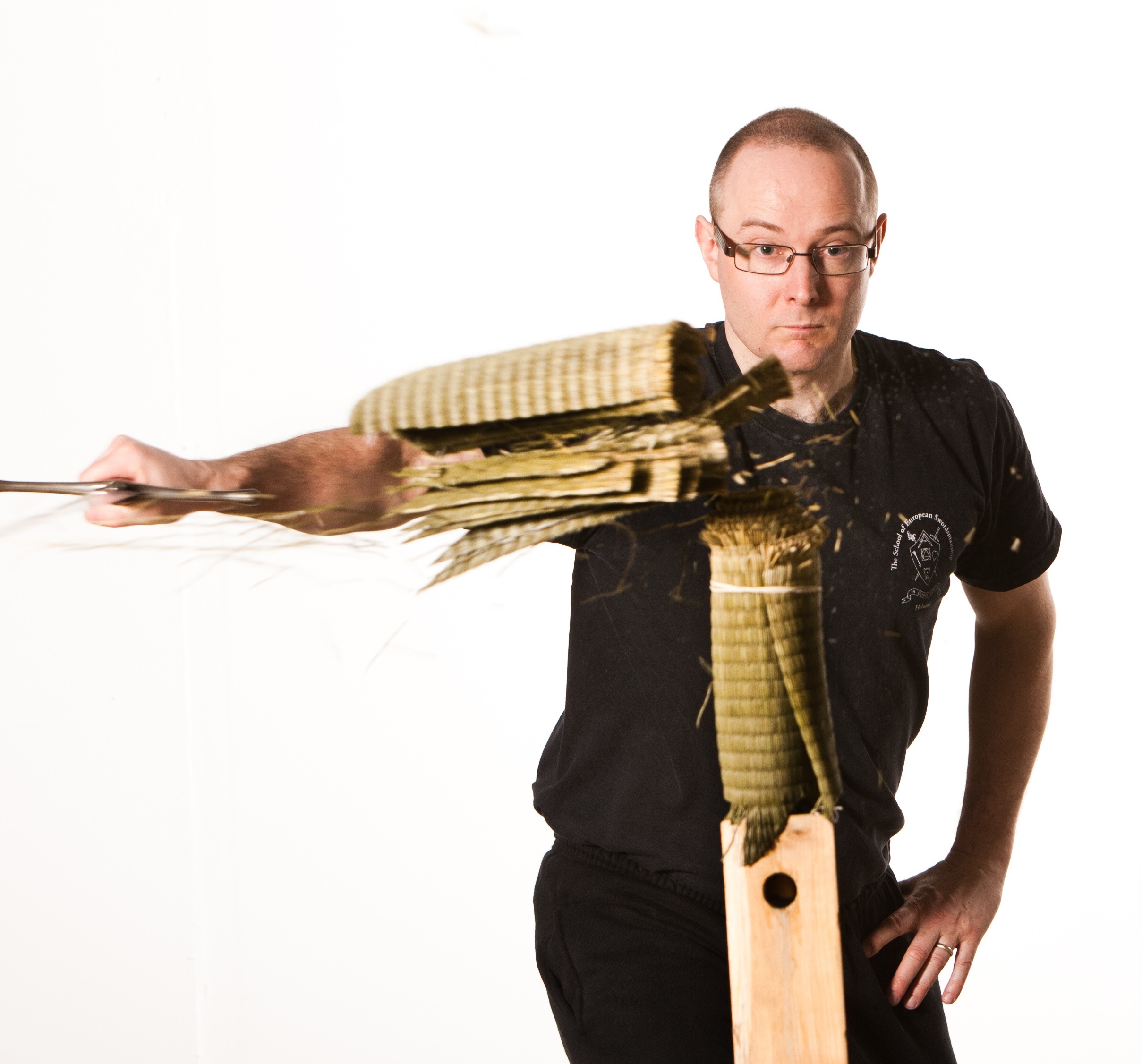
Swordsmanship: Guy Windsor cutting a tatami mat horizontally with a sharp longsword

For many of us, there is no need to even think about why we would train in the Art of Swordsmanship. It is simply an irreducible desire, like the way many people want to have kids. But we all know someone for whom our passion for the sword is inexplicable, just as we all know someone who does not want to be a parent. I thought I would write this rather difficult post so that you know why I have chosen the path of the sword, and if it resonates with you, you can direct the baffled in your life here for enlightenment.

Let us begin with a wide focus: why martial arts at all? Some have practical uses, sure: those living on meaner streets will have use for self-defence skills. But most martial arts, if they convey those skills at all, are very inefficient at it. Some martial arts, or combat sports at least, offer a career path that includes fame and riches. An Olympic gold medal, perhaps. But that is not true of ours.

I train martial arts because they can offer moments of utter transcendence. The ineffable made manifest. This is traditionally described as “beyond words” or “indescribable” but as a martial artist and a writer, that would feel like a cop-out. I will take this feeling and wrestle it down onto the page, or at least give it my best shot:

It is a moment when every atom in your body is exactly where it should be. Every step you have taken on life’s path makes sense, is part of a coherent story. The pain of every mistake is made worthwhile by the lessons they contained. There is a feeling of physical power without limit; strength without stiffness; flow without randomness; precision without pedantry; focus without blinkers; breadth and depth; massive destructive capability but utter gentleness; self-awareness without self-consciousness; force without fury; your body alive as it has never been, all fear and pain burned away in a moment of absolute clarity; certainty without dogma; an overpowering love, even for your enemies, that enables you to destroy them without degrading them. It is, for a religious person, the breath of God within you. For an atheist, a moment of attaining perfection as a human being.

And I can, in theory at least, get that feeling every time I pick up a sword. In practice, I've been there a dozen times. And a lesser version of it, a breath or a hint of it, almost daily.

The Illusion of Mastery

It is, of course, an illusion. Even in that moment of grace, you are not perfect, or invulnerable. And this is where the discipline of a serious art saves you from the wishy-washy hippy shit of some other “spiritual paths”. It is so easy to slip, to believe your own hype, and simply essential that the moment you do so, reality comes crashing in like a sword to the head. The rigour of a true martial art contains at its heart a continual examining of your skills. This can come in all sorts of forms: I tend to use pressure drills and freeplay, but the critical component is the existence of an objective external test: “Does this work?”,  with a clear yes/no feedback mechanism in place.

In many ways, the books from which we draw our art are that mechanism: the benchmark against which you measure the correctness of what you do. This academic aspect is I think unique to historical martial arts, and it requires that we are able to articulate in reasoned argument why we do anything a particular way. This adds a mental dimension, a way of thinking clearly and logically, making arguments supported by evidence, that is the antithesis of the “feel that energy, man” hippy shit I refer to above.

Morality in Swordsmanship

There is also the question of morality. The moral dimension to swordsmanship comes from the lethal nature of the art. It is, originally, for killing people. Some systems emphasise self-defence, but the knightly arts were for professional warriors. You kill people because that’s your job. Much like a modern soldier, who must only distinguish between legal and illegal orders. If the order is legal, and obeying it means killing people, well, that’s what they train for. I’m not suggesting that any part of that is easy, especially distinguishing legal orders from illegal ones, but at base, it is simple. Do, or do not.

But for us, training exists in an artificial space that allows us to deeply examine the morality of the martial arts. (I’ve written elsewhere about training as a holo-deck for the philosophy of ethics.)We are training a killing art, so we must ask ourselves this question: in what circumstances, if any, is it acceptable to take life? This is why I have no interest in non-lethal arts. They simply lack this moral aspect. Especially combat sports, where your opponent has chosen to compete with you in a fair fight, and so long as you both follow the rules, there is no question of right or wrong at all.

Is Swordsmanship healthy?

Bodily health is also an issue. We have no choice but to live in this carcass until it stops working. There is just no way round the fact that you either figure out how yours works, and get the best out of it (it is a stunningly fabulous machine) or you ignore it until it fails.  I don’t train to stay healthy— I stay healthy so I can train. All of my students know that I put maintenance and conditioning at the heart of our training, and I spend about 90% of my own training time, and about 40% of my teaching time, working on mechanics. Most of my students come to me a bit broken in the beginning. Poor posture, bad wrists, a dodgy knee, excessive weight, whatever. We work together to develop good habits, mostly by paying attention to posture, breathing, and joint strength training, and of course, diet.

This has a way of both preparing the student for the physical training, and of keeping them grounded when the magic starts to happen. For many students, the sword has hooked them out of physical lassitude and ill-health and into a more active, healthier life. It is certainly part of the core mission of the School. Our the training is healthy— our one golden rule is everyone must finish class healthier than they started it. And because we are interested in process, not outcome, it is literally irrelevant how fit a student is when they start. Only the attitude they bring to training matters. (If you're interested in my approach, The Principles and Practices of Solo Training is the book for you.)

And this is another reason why I am not interested in combat sports. They have a pretty high threshold for physical fitness, which means that you have to start quite fit (and young!) if you wish to get really good at them. There is a genetic lottery (every sport has an ideal body type) and luck plays a huge part too. Read Bounce, by Matthew Syed, for more on this. Combat sports also have a very high risk of injury. So the students who need hooking off the couch and into a healthy life are barred from admission. The ones who need it least are the only ones who can have it.

Why Swordsmanship, really?

So why the sword? All of these spiritual, mental, moral and physical benefits can be accomplished with other weapons, or with no weapons at all. There is no good reason, though I could rationalise it at length. We could talk about flow states, ala Mihaly Csikszentmihalyi: swordsmanship practice is most certainly a way to bring “order to consciousness” (as opposed to entropic chaos). We could talk about the social aspect, how good it is to find, coming to the salle, that you are not the only sword-obsessed loony out there. But fundamentally, some people are just drawn to the magic of steel. It resonates in them. Many students remember the first time they heard the clash of blade on blade, and how their heart leapt.

I train because I feel it. Oh Lord, I feel it in my very bones. But how I train is utterly rational. Together, the martial and academic truth-testing keep me from flying away with the fairies. The physical training keeps my body strong and agile. The mental training keeps my mind clear and focussed. The moral aspect leads me to consider the meaning and value of every part of my life.

So when someone asks you “Why practice Swordsmanship?”, perhaps the best answer is “how the hell do you manage without it?”

So, that's my reason. What's yours?


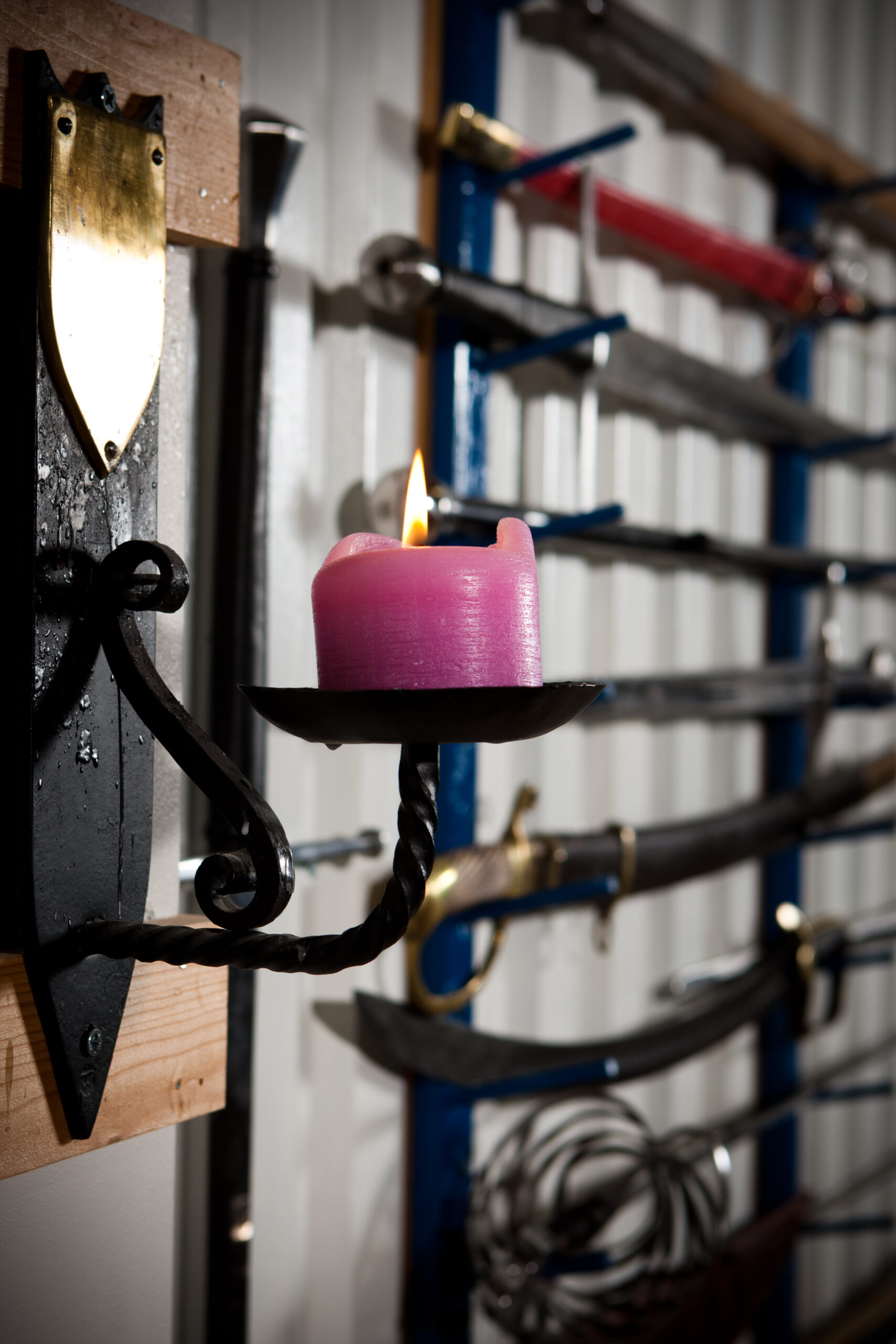
A pink candle burning in front of a rack of swords

There are many reasons why people are afraid to begin training swordsmanship, or indeed choose to follow any path, and many reasons why those who have begun the journey may quit. What follows is by no means an exhaustive list, but it contains some of the more common problems that I have encountered, and my own solutions to them. These worked for me (so far); your mileage may vary.

Fear of Failure

Perhaps the biggest step I have ever taken in which fear of failure was a major issue was opening the school. My friends at the time could tell you that I projected two possible outcomes to my mad move to Finland. One, I’d be back in six months with my tail between my legs. Two, it would fly. I chose to view the whole thing as a lesson. In other words I was going to Finland to learn something. I did not know what the lesson would be. If the school failed, if I failed, then that was the lesson.

I comforted myself with the knowledge that no matter how badly it failed, so long as I was honest and gave it all that I had, the worst possible outcome (other than serious injury) was bankruptcy and embarrassment. The culture and time I was lucky enough to be born into would not allow me to starve, nor would I be hauled off to debtors prison. Really, there was nothing to fear except my own incompetence.

Fear of success

At its root this is a fear of change. If I succeed in the thing I am setting out to do, what then? What if I actually become the person I wish to become, who am I? My solution to this was to set up my school and my training in such a way that success was impossible. There is no end goal or end result. There is only process. My mission in life is deliberately unattainable: to restore our European martial heritage to its rightful place at the heart of European culture. Of course that cannot be achieved alone, and there is no reasonable expectation of it being accomplished in my lifetime.

There is no question that European martial arts have come a long way in the last thirty years or so, and my work has been a part of that, but another excellent aspect to this goal is even if we could say it was accomplished in my lifetime, nobody would ever suggest that I did it. So fear of success is not a problem, as success is impossible.

Putting outcomes ahead of process

The most common problem I have had in my career choices to date is putting outcome before process. When I went to university to get my degree, I was more interested in training martial arts than is studying English literature, and so though I got my degree, I didn’t at the time get that much out of it. I wanted the outcome, not the process.

As a swordsmaship instructor I am a much better reader than I ever was as a literature student. Then when I went to be a cabinetmaker, again I was interested in having made the furniture more than in actually making it. Sure, I enjoyed parts of the process very much. But I did not have that dedication to perfection in process that marks a really good cabinetmaker. Ironically, now that I do it for a hobby, I enjoy the process of it a lot more.

In a similar vein to step two (fear of success) teaching swordsmanship is the only thing I have ever done where I have truly been more concerned with process them with outcome. Which is why I am a much better swordsmanship instructor than I ever was a cabinetmaker.

Writing books is another process/outcome issue. I enjoy writing books quite a bit. I absolutely hate the editing and polishing and publication process. Hence the errata. By that point outcome is everything— I just want that fucking book done and out. This is why I don’t usually think of myself as a writer. When I write, good enough is good enough. In my swordsmanship, good enough is shit, perfection is the minimum standard. Never got there, never will, don’t care, get it perfect anyway. It truly bugs me when my left little toe is in not quite the right place when I am waiting in guard.

So far, in the thousands and thousands of hours I have put into it, there have been perhaps 3 whole minutes where it felt perfect. But that’s only because my faculties of judgement were not developed enough to spot the imperfections. So, while I am deeply dissatisfied with the outcome, i.e. my current level, I am actually quite pleased with how far I have come: the process so far.

Being a swordsmanship instructor is the only thing I have ever done (other than parenting) where I am emotionally capable of perfectionism. (I will never be satisfied with my parenting skills, but am eternally satisfied with the outcome, my angel children, because of who they are, not anything they may or may not do.)

The external validation trap

This is related to the outcome/process problem. External validation tends to come from outcomes rather than processes. People bringing me one of my books to sign is hugely gratifying, and validates the outcome of all that work. But if you only write books in the hope of people asking you for autographs, the books are likely to be crap. And who wants an autograph on a crap book?

I get around this problem by thinking of my books as steps towards the overall goal of establishing European martial arts at the heart of European culture. This makes even the production of books part of a larger process. And because they are mission-oriented, I have the emotional energy reserves to demand a certain standard in them, if not quite the standard I demand of my basic strikes. (For the gold standard in books, see here!)

The external validation trap is one reason why I tend to prefer martial arts that have no belts or ranks, as it is too easy for me to care about the next belt rather than actually mastering the art. Ironically, the best outcomes are usually the result of the best processes. So the best way to get great outcomes is to forget about them and focus on the process.

Time and attention

It is not enough to want to want it. I wanted to be the sort of person who was a great cabinet-maker, but I wasn't, and didn't want it enough to become so. I only have a certain amount of energy to give, and it is what I actually choose to do that indicates what is truly important to me. The only currencies that actually matter are the ones you can’t make more of: time and attention. How one spends these vital currencies is of course influenced by the problems outlined above.

My priorities are: family first, school second, then everything else.

Within “school” it goes: teaching, research/writing, training, admin. As I see it, the school is the emergent property of the students, the teachers, and the syllabus coming together in a suitable space. My students make it all possible, they are the base, so their needs come first. The research and writing is for them, so we have an art to train. The training I do is so that I have something to show them. Admin, running the business side of things, is so far down the list it’s pathetic. I only do it so the school can keep running. Because it’s the school (students, research, and syllabus), that actually further the mission.

But as has happened more than once: if the shit hits the fan at home, I abandon the school to take care of itself, and put all my attention on the family. Of course. My mission as husband and father outranks my personal mission in life.

So, the solution to the problem of insufficient time and attention is to prioritise. Decide based on what you actually spend time doing what is truly important to you, and focus on that. It is ok to give up things you don't care about. And ok to have hobbies you just fool around with.

It is also ok, admirable even, to take an indirect route, such as becoming a banker to make tons of money to put into a noble cause. But don't squander your life on stuff you don't care about. “Follow your passion” is often bad advice, but “commit to the things you are willing to spend the time getting really good at because you believe they are fundamentally important”, is not.

This post has rambled on long enough, but clearly I need to write up “the perfectionist’s survival guide” and “mission-oriented thinking” and “why 50% of my income goes on having a salle” and of course, “I am fearful, so I study boldness”. Stay tuned and thanks for reading!

Guy bleeding from a head wound with DDS friends
Guy in about 1999 bleeding from a sparring injury

Swordsmanship practice is inherently dangerous. The study of risk has been developed to the nth degree over the last five hundred years or so. For an excellent overview, see Against the Gods, the remarkable story of risk, by Peter Bernstein. (Thanks to my friend Lenard Voelker for sending me a copy!).

Risk Assessment

The assessment of risk may be described as assigning probabilities to events that have not yet occurred. If they have happened before, then we can see how many times over a given period, and use that data to evaluate the likelihood of it happening again.

For example, if it has snowed at Christmas 20 times in the last 100 years, you can state with some confidence that there is about a 1 in 5 chance of it happening again this year.

But many of the events we fear have no measurable risk- either because they have not happened (yet), or we have an insufficient pool of data to draw meaningful probabilities from. So they are uncertain, but have no definite probability. This distinction was drawn by Milton Keynes (and explained by Niall Ferguson on p 343 of his book The Ascent of Money).

The risk we all fear is a training accident leading to serious injury or death. In the wider world of swordsmanship practice, all of the serious accidents (which I define as requiring hospitalisation) have occurred in either competitive freeplay, or outside the bounds of a formal school (such as on the re-enactment field).

So while we know that there is a possibility of such accidents occurring in the salle, they have no definable risk as the incidence is so low. They are instead uncertain. Given the thousands of hours spent in swordsmanship training worldwide every year, and how few accidents occur, it is reasonable to assign a low probability of serious injury or death. Assuming that we do not relax our safety standards in response to this, then we can assure prospective scholars of the art that “this is dangerous, but pretty safe”.

Cars are also pretty safe these days. Airbags, crumple zones, safety glass, seat belts, all reduce the likelihood of serious injury or death in the case of a collision. But they do nothing to prevent collisions in the first place, and encourage a false sense of security. Cocooned in hi-tech armour, we ride invulnerable to our deaths. I think a shiny steel spike sticking out of the steering wheel to impale the driver at the merest fender-bender would do wonders to improve road safety.

Consuming Risk

When a risky activity becomes safer, human beings tend to consume that risk. Safer cars are driven faster. Better healthcare encourages unhealthy lifestyles. The Munich taxi experiment is an excellent example. Given better brakes, drivers went faster (see here). So protective equipment in swordsmanship offers the comforting illusion of safety. Given good protective equipment we take more risks. Yes, armour works. But tell that to the French knights at Agincourt.

Abalanced approach to swordsmanship training requires at least some time spent face to face with the naked possibility of your own death. A sharp sword, aimed at your unprotected face, in careful pair drills with a trusted, highly trained partner under competent supervision. There is nothing like a sharp steel point inches from your eyes to cut through the illusory safety of a fencing mask.

My favourite quote on this comes from Viggiani’s Lo Schermo (1575) (as translated by Jherek Swanger: note he does not translate “spada da marra”, which is a kind of blunt steel practice sword):

ROD:… but now it is time that we begin to practice, before the hour grows later: take up your sword, Conte.
CON: How so, my sword? Isn’t it better to take one meant for practice?
ROD: Not now, because with those practice weapons it is not possible to acquire valor or prowess of the heart, nor ever to learn a perfect schermo. CON: I believe the former, but the latter I doubt. What is the reason, Rodomonte, that it is not possible to learn (so you say) a perfect schermo with that sort of weapon? Can’t you deliver the same blows with that, as with one which is edged?
ROD: I would not say now that you cannot do all those ways of striking, of warding, and of guards, with those weapons, and equally with these, but you will do them imperfectly with those, and most perfectly with these edged ones, because if (for example) you ward a thrust put to you by the enemy, beating aside his sword with a mandritto, so that that thrust did not face your breast, while playing with spada da marra, it will suffice you to beat it only a little, indeed, for you to learn the schermo; but if they were spade da filo, you would drive that mandritto with all of your strength in order to push well aside the enemy’s thrust. Behold that this would be a perfect blow, done with wisdom, and with promptness, unleashed with more length, and thrown with more force, that it would have been with those other arms. How will you fare, Conte, if you take perfect arms in your hand, and not stand with all your spirit, and with all your intent judgment?
[53R] CON: Yes, but it is a great danger to train with arms that puncture; if I were to make the slightest mistake, I could do enormous harm. Nonetheless we will indeed do as is more pleasing to you, because you will be on guard not to harm me, and I will be certain to parry, and I will pay constant attention to your point in order to know which blow may come forth from your hand, which is necessary in a good warrior.

This says it all!
You can find Jherek’s translation here.

In case it is not obvious from the small sample here, Rodomonte/Viggiani's student the Conte is clearly an accomplished swordsman already, there is no suggestion of equipping beginners with sharps. As Manciolino (an ardent proponent of using blunt steel swords, as am I) put it in Book Six of his Opera Nova (as translated by Tom Leoni, and available from here):

“I now wish to show how wrong those are who insist that good swordsmanship can never proceed from practice with blunted weapons, but only from training with sharp swords. …

It is far preferable to learn to strike with bated blades then with sharp ones; and it would not be fair to arm untrained students with sharp swords or with other weapons that can inflict injury for the purpose of training new students to defend themselves.”

(with thanks to Ilkka Hartikainen for digging out and typing up the reference.)

Quite: “untrained students” find blunt steel sufficiently threatening that there is no need to make the swords sharp, and indeed it would be grossly irresponsible to do so. Highly trained and experienced students tend over time to take the blunt steel less and less seriously, and need to be reminded that swords are weapons.

Likewise, the more armour you wear, the less vulnerable you are, and the less vulnerable you feel, which tends in most people to actually increase the risk of injury as this safety margin, and a bit more, is consumed.

So have a think about the risks you are taking, and how your equipment may or may not encourage you to consume greater risks.

Search

Recent Posts

Categories

Categories

Tags