Guy's Blog

Guy frequently keeps this blog updated with thoughts, challenges, interviews and more!

Category: Training & Practice

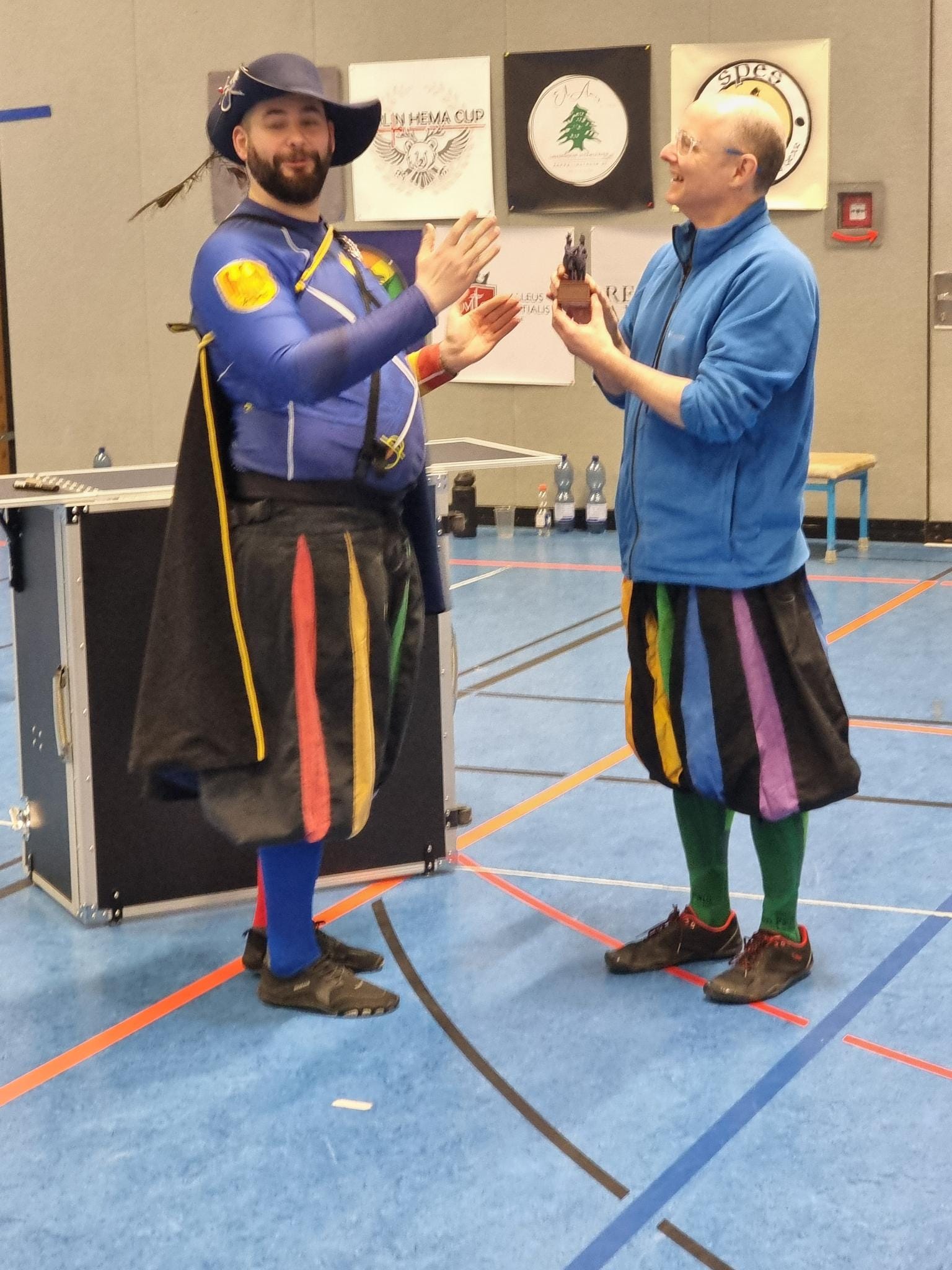
Stephan giving Guy Windsor a statuette prize for teaching a class in the worst time slot at the Torneo di Spada hema tournament
Receiving the prize for “because someone had to teach the slot”.

I'm not known as a tournament fencer these days. Indeed it's been well over 20 years since I last officially competed. But one of the great benefits of interviewing so many people on The Sword Guy is that they spark ideas in me that then get acted on. My conversation with Martin Hoeppner included a lengthy discussion of tournament rulesets, and cemented my pre-existing opinion that his club holds great events (I’ve taught at their Swords of the Renaissance four years in a row). A few weeks later I interviewed Maciej Talaga about an academic article he wrote on medieval physical culture, and we got talking about the benefits of tournaments for historical martial artists.

This got me really thinking… I have a decent amount of tournament experience from sport fencing in the 80s and early 90s, but the last time I entered a tournament was in (if I recall correctly) 2003. It was a rapier tournament, in Italy, and I won it. But I had been a professional instructor for two years by this point. If I win, so what? Being a competent fencer is part of my job. If I don’t, then what does that say about my right to teach?

Bear in mind this was a very, very, long time ago.

There are some major equipment issues with modern tournaments: most don’t allow steel gauntlets (I absolutely will not use any of the synthetic gauntlets currently on the market, for the simple reason that they prevent me from holding my sword correctly), and most probably wouldn’t allow my That Guy’s Products mask. In situations where cuts to the head with a heavy weapon are likely, anything built on a fencing mask foundation are simply inadequate.

I understand that creating equipment requirements for a tournament is a nightmare job for the organisers; it’s much easier if you can insist on established brands and models. But the restriction on steel gauntlets extends back to well before the time that companies were making synthetic gauntlets, and organisers were requiring things like lacrosse gloves because “steel gauntlets are dangerous”. Which in an activity that involves swinging steel bars at people’s heads seems at best misguided.

(I think I need to do a deep dive into sparring gear for longswords and other heavier swords… interested?)

I’d heard about the Torneo di Spada through attending Swords of the Renaissance, and checked with them that my mask and gauntlets were allowed. They are!* And they very kindly lent me some of the extra bits of kit (such as forearm guards) that I don’t have. They also asked me to teach a class on the Sunday afternoon, which made the whole thing even easier to approach.

I flew in to Berlin on Friday night, and on Saturday geared up and got stuck in. The first day was sidesword. This was perfect for me because I’m not a sidesword instructor. I haven’t taught a class in Bolognese fencing since maybe 2007, so I could go into it with no particular expectations. My goals were simple:

1. to break the seal on my tournament fencing,

2. evaluate my current level of training,

3. and, most importantly, to embody the spirit of the Art of Arms.

Bolognese Sidesword Tournament

How does one embody the spirit of the Bolognese Art of Arms? In the 16th century duels were very often public affairs. Your reputation is on the line, as well as your skin. The most important thing is to fence boldly.**

The ruleset was simple: hits to the head score 3 points, to the lower leg 2 (hence the need for shin guards), and anywhere else only 1. This is to reflect the opinion of Antonio Manciolino in his 1531 Opera Nova, in which the author writes that the head is the most noble target (a common opinion at the time), and that the lower leg should count higher because it’s so hard to hit without getting hit yourself.***

Every bout consisted of three scoring passes, so the maximum possible points in a bout was 9.

The twist was that the ranking is primarily based not on the points, but on how many passes you survive untouched. Winning 9-3, where you get 3 points in every pass and your opponent gets one, is useless; it’s better for your ranking to win 3-0.

A tournament-minded fencer will then be very cautious, and if they can’t stop the attack, at least go for a double.

To my mind though, to properly embody the spirit of the art, I needed to march in and hit them in the head, with style and control, but absolutely no dicking about at the edge of measure trying to not get hit. So that’s what I did.

The results? In my pool of 8, I had 7 bouts (21 passes), and scored 37 points, of which 33 were from hits to the head. But I had only 5 clean passes. That put me 21st out of 25 fencers. (Where the ratio of clean passes was the same, ranking was decided on points.)

I was delighted. My points per bout were the highest overall (37 out of 7, so 5.3). The next best was 38 out of 8 bouts, so 4.8. The next highest number of head hits was 7 to my 11. And several people complimented me on my fencing style.

Of course, if it was the points that counted, not the clean passes, the other fencers would have been motivated to go for head shots too, they would probably have scored a lot higher: the comparison isn’t really fair, but it is illustrative.

The Rapier Tournament

The second day was the rapier tournament. My goal was the same: to embody the spirit of the art. But the art was different. When it comes to rapier, I’m a Capoferro man, so the year is 1610, the duel is private, the top priority is going home in a whole skin. Fencing to first blood is fine: murder is an option not an obligation. So my fencing was totally different. Not just the style, but also the incentives.

The clean passes ranking was the same. Points were scored so that thrusts to the head or body were 3 points, cuts to the head 2, and cuts or thrusts anywhere else just one.

Fencers could choose rapier, or rapier and dagger, but they had to agree (so, both fencers had the same weapons). I always gave my opponent the choice, because I want their best game. In the end I think I used a dagger in three of my bouts.

In the qualifying pools I had 9 bouts (27 passes) and scored 19 clean passes, so a 70% success rate. I only scored 42 points, of which only 5 hits were to the head. This put me at the top of the rankings for all 30 fencers (the next best was 63%), but lots of fencers scored more points than me.

I conclude from this that the clean-passes ranking system rewards a private-duel mindset and approach.

Safety First

Unfortunately I wasn’t careful enough with one of my opponents. I knew he was wild, but after the halt was called he was chambered to cut me in the head. I stopped at the halt, and so didn’t parry his full-force horizontal cut to the right side of my head. As I was not expecting heavy head cuts in a rapier pool, I was wearing my regular fencing mask (it’s a bit better for face thrusts), with the usual HEMA overlay. This is totally inadequate to deal with that kind of blow, and he rung my bell. He also got a red card.

I sat down for a bit, and thought about my options. I had no obvious signs of concussion: vision and balance were fine. My last three opponents were all relative beginners, and not prone to hard hitting, and I didn’t want to drop out, so I fenced them very carefully (I got three clean passes in all three bouts).

There was about half an hour before the pools all finished up and the rankings to go on to the next round were announced. At the end of that time, over an hour after the blow, my head still hurt.  When it comes to brain injury a second hit in the same place is orders of magnitude more dangerous than the first one. And the “champions pool” would have no easy fights in which I could be reasonably certain to prevent my opponent from catching me in the same place. If I had a student in that situation I would not let them continue, so I withdrew.

The organisers and my fellow fencers were all entirely understanding and supportive of my decision. And I should say here explicitly that there was no malice or bad sportsmanship involved in the situation. I should have recovered under cover, not just stopped dead.

I should also say that none of the three medal winners were in my pool, so it could be that I would have ranked less well if I’d had stronger opponents. I don’t want you to think that coming first in the qualifying pool means terribly much. Had I continued I probably had a 50% shot at a medal.

Fitness

At the end of my first bout on the first day I was breathing quite hard. This was odd, because the bout wasn’t that challenging or athletic. It could only be tournament pressure. This was excellent! It meant I had a chance to practice controlling my level of arousal. I cycled in some breathing exercises, and got my breathing and heart rate back down to reasonable levels, and had no fitness difficulties at all for the rest of the weekend.

I could feel my thighs and shoulders a little bit on Sunday morning, but nothing significant.

More critically, my recently-recovered knees were fine, and so were my back and neck. So it seems that my physical conditioning is working really well. Hurrah!

The only point of stiffness or soreness on the Monday morning after the whole weekend was over, was the front of my ankles. A completely weird place to feel a bit of fencing, so I’ll try to figure out what caused that.

I’m being extremely cautious about my head. No alcohol (which I’m off at the moment anyway), and I won’t engage in anything where I’m likely to be hit in the head for a good long while. A minor head trauma is like priming your immune system for anaphylaxis. You have to avoid the stimulus if you don’t want a severe response.

The Tournament Fencer

Quite a few of the fencers there were clearly in it for the tournament. For them, winning the tournament itself was the goal. Medals matter. This generates a fencing style that is like a cross between sports epee and a bit of kendo, with lots of jigging about at the edge of measure and a very fast tag with the sword.

You can tell the competitors because they ask questions about the rules (what exactly counts as stepping out of the ring? Does my foot have to touch the ground? The whole foot? What if it’s just my heel?). They also use their ‘video challenge’ right. In the finals, video challenges were allowed, one per fencer per bout. If the challenge was successful you can challenge again. This means that if you disagree with the judges, you can, in effect, argue with them.

To a tournament fencer, it really does matter who gets the points. It’s what they are there for. To lose a medal because the judge made a mistake would be intolerable.

I would die in a pit of fire before I ever issued a video challenge. If I failed to hit my opponent with such clarity and in such obvious control of their weapon that the blind, drunk, biased-against-me judge who has been bribed by the opposition,** still has to give it to me, then I don’t deserve the point. “Bad” judging (as in judging you disagree with) is part of the tournament challenge. The greater the challenge, the greater the learning opportunity.

It’s really useful to have people like that to fence against, because they are usually very good at hitting you, and in ways you may not expect because they look different to the canonical style. The hit is always right. If you fail to parry, that’s on you. Also, seeing how incentives affect behaviour allows you to learn to predict some of that behaviour. Another useful learning opportunity.

It’s illustrative of the difference that, while I think I won my first bout on Saturday 7-4, and I can work out some of my clean-pass scores, I don’t actually know what my scoring was in any of the bouts. I don’t think I looked at the scoreboard more than half a dozen times in the whole weekend. Because the points aren’t relevant to my aims.

This is not virtue. There is nothing wrong with being a tournament fencer, who needs to track their score because it matters. I’m just playing a different game.

Final thoughts

Firstly, thanks to Stephan, Anna, Martin, and the rest of the Schildwache Potsdam team. Especially those noble souls who gave up their weekend to judged and score. It’s a huge amount of work putting on a tournament like this, and you all made many young fencers very happy, and one old instructor too.

Secondly, thanks to all my opponents over the weekend. I hope you enjoyed fencing me as much as I enjoyed fencing you. I do wish I’d kept a record of everyone I fenced, but I failed to. If you recall our bouts, feel free to remind me either in the comments or by email.

Thanks also to Malleus Martialis for sending me a delicious sidesword at very short notice. I only signed up for the tournament in mid-December, then realised my old sidesword was not fit for modern competition use. So I contacted Eleonora at Malleus, and a shiny new sword was waiting for me when I got there.

One interesting quirk of the way the tournament was constructed was that fencers in each pool had to find their own opponents, and keep doing so until you’d fenced everyone in your pool. This means that your first interaction with your opponents is face to face, unmasked, and arranging a match together. I didn’t notice it at the time, but chatting with Stephan afterwards it was clear that this contributed something to the feeling of the event. We weren’t fencing against anonymous numbers. We were fencing our colleagues, peers, and friends.

Overall, I’m delighted by the results. I went there to play my game: to use the tournament environment to measure and develop my historical fencing skills against motivated and resistant opponents. Most particularly, to not get sucked in to the competitive fencing mindset, where scoring touches according to the rules is the only consideration.

There was one pass in the whole weekend where I decided to play tournament. In one of my rapier bouts it seemed that the only thing the judges could see was incidental arm touches. Bending my sword on my opponent’s chest was literally invisible. So in the last pass I flicked my point under my opponent’s guard from the edge of measure. Sure enough, point to me. Ugh.

So I stopped that and went back to embodying the Art of Arms as best I know how.

Notes

*The organisers have asked me to mention that “we allow steel gloves only under circumstances where we, as organisers, can be absolutely sure that they are of proper quality, well maintained, free of burrs and sharp edges, and without loose rivets.”

** For example,  Leonard Eckstein Opdycke’s translation of Castiglione’s Book of the Courtier, Book 1, paragraph 21: “ “Moreover I deem it very important to know how to wrestle, for it is a great help in the use of all kinds of weapons on foot. Then, both for his own sake and for that of his friends, he must understand the quarrels and differences that may arise, and must be quick to seize an advantage, always showing courage and prudence in all things.

Nor should he be too ready to fight except when honour demands it; for besides the great danger that the uncertainty of fate entails, he who rushes into such affairs recklessly and without urgent cause, merits the severest censure even though he be successful.

But when he finds himself so far engaged that he cannot withdraw without reproach, he ought to be most deliberate, both in the preliminaries to the duel and in the duel itself, and always show readiness and daring. Nor must he act like some, who fritter the affair away in disputes and controversies, and who, having the choice of weapons, select those that neither cut nor pierce, and arm themselves as if they were expecting a cannonade; and thinking it enough not to be defeated, stand ever on the defensive and retreat,— showing therein their utter cowardice. And thus they make themselves a laughing-stock for boys, like those two men of Ancona who fought at Perugia not long since, and made everyone laugh who saw them.”

“And who were they?” asked my lord Gaspar Pallavicino.

“Two cousins,” replied messer Cesare.

Then the Count said:

“In their fighting they were as like as two brothers;”

*** Specifically (in Jherek Swanger’s translation):

[40] Of two playing together, he who strikes in response is more praiseworthy than the one who strikes the first blow, because he reveals himself sooner to become enraged than to lose vigour after the received hit.

[41] It is not licit after the received blow to make more than one response stepping forward with a crossing step; the reason being that one must do well with all of one’s wit, since with that one can recover honour.

[42] The blow to the head, considering the excellence of that member, counts for three; and the blow to the foot is taken for two, having regard for the difficulty of making it so low.

[43] A valorous player is he who redoubles his blows.

****Just to be clear, the judges were of varying levels of experience and skill, but were all wearing any necessary eyewear, sober, honest, and unbiased to the point of spending endless amounts of time discussing what exactly happened because they really, really, wanted to be fair. And the only way to get skilled, experienced, judges is to give less-skilled, less-experienced judges the opportunity to practice. I have no complaints, and much respect for their time and effort.
We have to move.

If a shark stops swimming it dies- and if we stop moving it doesn’t take long before the problems mount up. We can get away with it for a bit longer than sharks, but sooner or later the bill comes due.

Swords are cool- cool enough to get people who have never even considered taking up a physical activity for fun before to actually start training. There are huge long-term health benefits to regular exercise, pretty much regardless of what that exercise is.

But no historical martial art is optimised for long-term health. It can’t be: the immediate needs of surviving the sword fight are more important than the possibility of eventually developing knee problems or back pain. 

The specific ranges of motion required by a given sword fighting style may be quite extreme (such as in a rapier lunge), but they will never be comprehensive: in no style ever do you do a gentle forward stretch with a curved back, or indeed arch as far back as you can sensibly go, or even just touch your heel to your arse to stretch your quads. Those ranges of motion are good for us, but not included in the martial arts themselves. 

I intend to be swinging swords around in various historical manners for decades to come, and I’m already 48. It is therefore necessary to have a physical practice aimed at filling in the gaps, and keeping this carcase in sufficiently good shape that I can be whacking my friends over the head with blades when I’m 90.

I also need to be able to teach my students how to do the same thing- and there’s the rub. Every body is different, and so every training regime should be tailored to the individual. And every body changes over time- ideally getting fitter and stronger, but at least not deteriorating any faster than we can help. Which means that you can’t just learn a routine now and stick with it forever, if you want the best results for the least effort.

I cover the fundamentals of how to train in my book The Principles and Practices of Solo Training and we follow those principles in class. But the book doesn’t include much in the way of specific exercises, because it was intended to lay out the principles, not cover every possible practice. The book will tell you how to train, and how to prioritise your training time, but it doesn’t tell you whether you should be doing push-ups or lunges right now.

To create our practice we need a comprehensive suite of exercises to select from, and the skill to choose from that suite wisely. We also need to know what it is we are training for at any given time. Here are some possibilities:

  • Pre-hab. Long-term injury prevention through movement, range of motion work, breathing and strength training. This is perhaps 50% of all my training.
  • Conditioning. Increasing our strength, speed, range of motion, or other attribute, through exercises of various kinds. This is about 40% of my training.
  • Warming up and warming down: preparing for a specific kind of movement (such as strength training, rapier footwork practice, a longsword tournament bout, or any other high-intensity activity), and promoting recovery afterwards. You may need to warm up for pre-hab or conditioning, of course.

A specific exercise such as an overhead press, or a push-up, or a hamstring stretch can be used in all three of these situations- but how we use it will differ. 

Structuring a Training Session

I run a Trainalong training session over Zoom three mornings a week, and usually structure them like so:

Section One: warm-up.

1. Running a diagnostic. Gentle joint rotations from toes to fingers, with a few squats and some gentle range of motion work. This tells me whether I need to pay attention to a specific area, and whether the session I had in mind is likely to be a good idea.

2. Full range of motion of the spine

3. Shoulder stability work

Section Two: conditioning

Focusing on my own areas of weakness, especially forearms.

1. Some kind of strength work, often bodyweight or kettlebells

2. Leg stability work such as seven-way legs, or kicking practice

3. Forearm conditioning

Section Three: skills practice

1. Some kind of footwork

2. Some kind of weapon handling (though often disguised as stick conditioning drills or bladebell exercises). These are often combined with the footwork, of course.

3. And/or breathing training, such as the Breathing Form.

Section Four: recovery

1. Some breathing

2. Some stretching, especially of the legs

3. Forearm and leg massage (which you may be familiar with from my free Human Maintenance course)

4. A very short meditation

5. Deliberately finishing.

Seeing it broken down like that doesn’t reflect the experience of it. The sections will blend into each other, and overlap- we may intersperse arm weights with footwork, for example. I very often include planks and other “core” work in with the spine range of motion or hip/knee stability exercises. The full-body survey at the beginning and the warm-down ending sequence tend to be quite consistent. I also adjust the training depending on my own health and current needs, and incorporating any requests that the students bring up on the day. 

Some of the weird stuff we do sometimes includes jaw relaxation exercises, toe yoga, and finger dexterity drills. 

I’ve attached a fairly comprehensive list of the exercises we do as a pdf below. Be warned, it’s just a list, and “Granny’s Scarf” may not mean anything to you just yet. But it should give you an idea of what I mean by ‘comprehensive’. 

What about the skill to choose wisely from the list?

That is primarily a matter of mindset. If you go into a session with the intention of finding out what your body needs, and then carefully doing that, you will probably avoid injury, and certainly become better at listening to your body. As every body is different, I encourage my students to adapt or adjust what we’re doing to suit them. I may be recovering from an injury or illness, and be doing some gentle recovery work when we’re twenty minutes in- you may need to be doing push-ups or kettlebells while I’m resting. While the class is doing Turkish Get-ups, a student with a knee problem may be doing her prescribed rehab exercises.

Levels of Difficulty

Every exercise can be done at various levels of difficulty. Let’s take the humble push-up for example:

1. Knees on the ground, go down an inch.

2. Knees on the ground, work up to going all the way down.

3. One leg extended

4. Full push-up position, hold

5. Working up to a full basic pushup

6. Different hand positions- three knuckle, two knuckle, one knuckle, prima, seconda, quarta, hands wide, long, staggered, etc.

7. Going for more repetitions

8. Slow push-ups (eg 30 seconds down, 30 seconds up)

9. Plyo push-ups, eg clap push-ups, or push-up-twisting-squat-jump-burpees

10. One-armed push-ups

11. One-armed push-ups with different hand positions

12. Plyo one-armed push-ups

And so on.

I may be working on 6, while one student is on 2, and another on 11. Literally every exercise has easier and harder versions, so can be adapted to anyone’s current level.

Join Us!

It is very relaxing to just show up and do as you are told for a while, and indeed having a personal trainer who knows you well and pushes you as needed would be great. But as martial artists, more is expected of us. We can’t be dependent on external forces to guide our training- we must take ownership and responsibility for our own development. And outside a one-to-one coaching session, no trainer can perfectly adapt the class to your needs. But you can. 

One way to learn to do that is to come to my Trainalong sessions. You can find them in our Sword People community.

 Everyone is welcome, whether you’re super-fit or not fit at all (yet). You won’t hold up the class (or be held up) because we are all moving at our own pace.

Useful resources on this topic:

You may find The Principles and Practices of Solo Training helpful.

I cover a lot of the exercises in the Solo Training course, though that course focusses primarily on weapons handling. https://swordschool.teachable.com/p/solo-training 

You can have a go with a sample session here:

You can download the exercises list here: Trainalong Curriculum

You may find my conversation with biomechanist Katy Bowman: Movement Matters.

Holding the sword correctly is safer

One of my students mentioned tendonitis problems in his wrist on the Swordschool Discord server this week. It’s probably caused by holding his sword incorrectly, which forces the small stabiliser muscles to do more work than they evolved for. He is by no means the first student I’ve seen with this problem.

It has been my experience that almost every sword student at any level in any style is either holding their sword incorrectly, or at the very least, there was room for improvement. This is partly due to most modern sword makers producing handles that are a bit too big (my friends at Arms and Armor have a post on this, here), or a bit too round; and partly due to most people simply not understanding how the mechanics of sword holding is supposed to work.

In essence, your grip strength and wrist stabilisation strength should be acting as back-up systems only: the sword should stay in your hand with almost no strength being used at all, and when you strike, the force coming back from the target should be routed through the bones of your hands and wrist, and thence through your body to the ground, with no need to tighten up on impact at all.

Seriously. Not at all. 

Have a look at this video of me hitting the wall target with a rapier, and bashing the tyre with a longsword. My hand is not just relaxed, it’s actually open, to demonstrate beyond reasonable doubt that grip strength is not required. 

I have been banging this drum for many, many, years now (I first posted that video in 2012!), and have written this up in many places, and posted endless video content about it, and yet still the sword world has crappy sword holding skills. This is for three reasons:

1. the sword handle is too big 

2. because this is very counter-intuitive

3. and also because most people are strong enough to fake it for a while; they think it’s correct, when actually their muscles are faking it for them. Until the pain in the first joint of the thumb kicks in. Or in the elbow. Or indeed anywhere along the chain from fingertip to toes. 

So how should you hold the sword? 

That depends on what kind of sword it is, and what you want to do with it. 

Generally, the sword is either held back in the hand, like so:

Guy Windsor Holding a sword, chambered grip


Or extended in the grip, like so:

Guy Windsor holding a sword in an extended grip


This is also how most chefs hold their kitchen knives when chopping and slicing.

Guy Windsor holding a kitchen knife slicing cucumber. Grip is extended.

There are exceptions: we do sometimes support the flat instead of the edge, like so:

Guy Windsor holding the sword thumb on flat


The sword is usually held back in the hand when it’s also held back near the body, and extended in the hand when the sword arm is extended from the body. Some longsword folk have half-understood this concept and hold their longsword in the extended grip even when the guard is chambered (such as in posta di donna). Some swords are almost always held in the extended grip; rapiers, foils, smallswords are good examples. The basic rule still applies- when holding the sword it should be supported by the bones, not tied in place by the muscles.

The extended grip does not depend on grip strength; you can perfectly well hold the sword with one finger, if it's aligned correctly, like so:


Guy Windsor holding a sword, fingers open.

I'm not recommending fighting like this, but it's worth making sure you're not depending on grip strength when holding the sword by opening the thumb, forefinger, ring finger, and little finger, and seeing what happens.

One common error is to extend the wrist, rather than extend the sword in the grip. You need to be able to distinguish between at least three positions of the hand relative to the forearm. Three-knuckle, two-knuckle, and one-knuckle. The easiest way to learn the differences between them is through “Eurythmic push-ups”. You can do them on a mat if you prefer, and you don’t actually need to do the push-up bit; just getting the feeling of the different wrist positions is very helpful.

Cocking the wrist between the ‘three-knuckle’ and ‘one-knuckle’ positions instead of allowing the sword to shift in the grip between the ‘chambered’ and ‘extended’ grips is another common cause of wrist problems.

Please pay attention, this may save you a lot of pain, as well as massively improve your general sword handling.

Holding the Longsword

I introduce the basics of how to hold a longsword in this video borrowed from my Solo Training course

Holding the Rapier

This footage from a rapier seminar I taught in 2012 goes into the correct grip for the rapier in some detail; you can watch the whole thing of course, or skip to about 22 minutes in, where we get into the grip.

If you are already having wrist problems, for any reason, you may find my Arm Maintenance course useful. It’s free, and bundled in with my Human Maintenance course. 

I am often asked by students if they are “ready” for a class with me. It's a common insecurity- nobody wants to feel that they are holding the class back, or be overwhelmed by a fire-hose of information. I actively seek out opportunities to be a beginner, partly so that I can better understand and empathise with the beginners who train with me. One such opportunity occurred earlier this year.

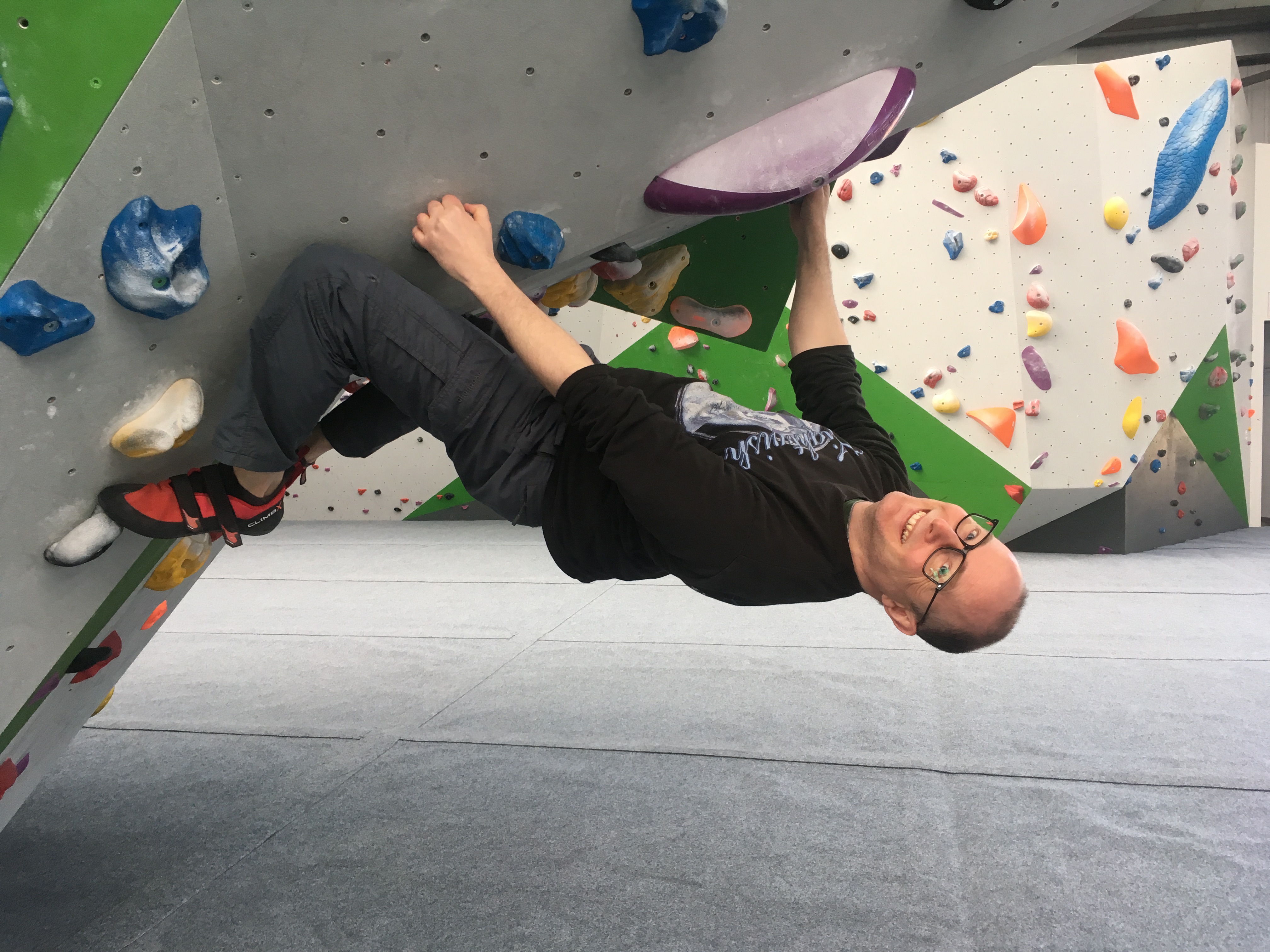
I started bouldering (indoor climbing on low routes, no ropes) a couple of years ago, and on January 20th 2020 took a class with Neil Gresham, at my club, Avid, in Ipswich. It was a great example of being in a too-advanced class way over my head. But it has been really useful, and while the specific insights regarding bouldering are probably not useful to you, the process of extracting the most value out of a class that is way beyond your current level will be.

There were 10 students, varying in experience from dazzlingly good (from my perspective), to my friend Katie and I (one year of about once a week). One person in the class had been climbing for only two months but was elegantly smashing routes I can’t do (yet), so Katie and I were definitely bottom of the class. Which is the best place to be- literally everywhere you look you can see someone more experienced doing something interesting.

You should never give up the opportunity to take a class with a great instructor just because you’re “not experienced enough”. Sure, your brain may fill up in the first ten minutes, but that’s ok, there are ways of capturing the rest of the class for future reference. I’ve been working on the insights from this climbing class for nearly a year now. Money very well spent! But that's only possible because I captured the class outside my brain, and then refiled it.

In short, the process is this:

1) expect to be out of your depth, and to stop taking in new information early in the class

2) take detailed notes (I use pen and paper with stick-man sketches, but any system that works for you by definition works)

3) write up your notes as soon as possible after the seminar. Ideally on the same day. Notes work to trigger memory, and the longer you leave it, the less effective the trigger will be

4) summarise the key points.

Here is my somewhat edited write-up of the seminar, with topics bolded so I can find them easily:

We began with some opening remarks, Neil introduced himself, and asked a couple of questions to get the feel of the class. Then we warmed up. The instruction was to do vigorous exercise for a few minutes to get the blood pumping. Wind sprints, burpees, and running were suggested. I did all of those, plus some monkey walks.

Then Neil lead us through some basic joint rotations; shoulders (as front crawl, then reversed), hip rotations (forward-back, then side). He advised to avoid passive stretching before climbing (I agree 100%).

Then it was shoes on, and to the wall. When warming up on the easy grades, here are the rules for improving footwork:

1. No sliding your foot down the wall onto the foothold.

2. No re-placing the foot after contact with the hold.

3. Silent feet.

4. Watch your foot until after you’ve made contact with the hold.

Goal: to improve precision in footwork that will help with harder climbs.

Practice. I spent some time on a green-grey (easiest) grade. It’s surprisingly hard to be that precise, even on really easy climbs. This one approach had me thinking two things:

  1. why the hell didn’t I think of that? It’s so very like how I teach swordsmanship footwork: use very basic drills to concentrate on foot placement.
  2. I’ve got my money’s worth already. Everything after this is a bonus.

Then we re-gathered, and Neil talked about arms.

  1. Keep them extended but not locked, as much as possible.
  2. Bent legs, straight arms.
  3. Keep the shoulders engaged though, so you’re not hanging on your joints.

Practice: back on the easy grades. Indeed, as he said, especially at the start, it’s tempting to step up onto the footholds, pulling yourself into the wall. It’s better to hang from the handholds, bending the legs as much as necessary.

Finally, grip: we re-gathered and Neil challenged us to climb easy routes using the minimal tension in our grips. “Use the friction of your skin” to hold on.

Practice: with precise feet and straighter arms and relaxed hands.

Summary: when warming up on the wall, use these rules to encourage precision and minimal strain when climbing. This mental focus will also help transition you mentally from normal life to climbing.

This was followed by a discussion of bouldering training sessions: either volume, or intensity. Volume sessions involve a lot of easier grade climbs. Intense sessions involve working on a few very hard (for you) problems.

Techniques for overhangs:

We went to a part of the wall that overhangs, and Neil talked about how to do it. Fundamentally: left foot goes to right holds, and right foot to left holds. This allows you to reach with an extended arm. No frog-clambering (my term, not his). This did make life a lot easier, where the holds were set up to allow it.

If you have a right foot on a right hold, or vice-versa, you can “flag”: if there’s space, reach through with the other foot inside the one on the hold. If the foot on the wall is too high for that, you can flag “outside”. This has a similar body placement effect to having your left foot on a right hold, etc.

Note: “avoid a pull-ups competition”. Good advice, especially for me. I tend to rely on strong arms more than is gracefully optimal.

Volume sessions: When doing a volume session, try a pyramid approach: start easy, get harder, hardest climbs at the mid-point of the session, then ease back down. (Same idea as our pyramids: 1 pull-up, 2 push-ups, 3 squats; 2,4,6 etc. Until you max out on one (e.g. 4 pull-ups). Then back down the pyramid: 3-6-9, 2-4-6, 1-2-3.)

“Project” sessions: warm up with 10-12 easier climbs, then pick 2-3 hard problems and work on them. Not too long on any one, or you’ll get tired. Rest: rule of thumb is 1 minute rest for every hand move.

Using the circuit board (a wall with graded routes that go in a circle round the wall, for endurance training): two approaches:

1. “Strength”: pick one hard circuit and go round once. Rest, etc.

2. “Endurance”: pick an easier circuit, and do laps (e.g. 3-4). This trains you for longer climbs, such as rope work outside.

I didn’t mention in class that I find going round once on the easiest circuit to be a sufficient challenge to my endurance! But I’ll work on it, starting by just doing a few moves after the end of the first circuit, to get out of the habit of automatically stopping at the end.

Supportive Conditioning”: for injury prevention. Assuming you’re not a gym rat (good call).

#1 most important exercise to prevent tendonitis: finger extensor training, opening the hand against resistance, e.g. using an exercise band. 3 sets of 20, 2-3 times per week. Yes this is useful but I think I should do a class on forearm maintenance for climbers. They all seem to get tendonitis! (You can find my forearm conditioning training here)

#2 easiest supportive conditioning: push-ups. 3 sets of 10-25, twice a week.

#3: TRX handles on straps (I’d use my gymnastics rings at home). 3 exercises shown, all knees on floor to start:

1. Push-ups

2. Pec fly, arms out to the sides at shoulder level, recover.

3. Plank, extending the arms out in front like diving into a pool, recover.

#1 stretch, after EVERY climbing session: hand flat on wall, shoulder height, fingers pointing down (extending the wrist). Extend other arm about shoulder height like in a pec fly, look out over your extended hand. Seems useful.

Other stretches recommended:

1. feet wide, knees wide, squat and push knees apart to open hips.

2. Standing, knee to chest, pull knee in to stretch hip.

Best takeaways:

1) After the usual warm-up, warming up on the wall with: precise feet, extended arms, and minimal grip.

2) Flag on overhangs.

3) Pyramid sessions.

4) Use circuits more.

5) Why have my rings been in a box in the shed for the last year?


And finally:

As you can see, that is a TON of information, way more than even the more experienced climbers will be able to remember the next day. How many sets of how many push-ups was it?

And here's the kicker. I'd accidentally left my notebook and pen at home, so I borrowed a pencil and a single envelope from the reception desk. Literally ALL of that was captured in note form, covering both sides of an ordinary envelope (about 4 inches by 9, or 10cm by 22). Notes do not have to be extensive to be useful.

The specifics I tried to capture were notable phrases (such as “avoid a pull-ups competition”), the overall pattern of the class (or I would certainly have forgotten entire sections), and as many specifics as possible (such as “finger extensor training, opening the hand against resistance, e.g. using an exercise band. 3 sets of 20, 2-3 times per week”). Then when writing out the notes, I added as much detail and experience as I could recall.

Experienced students are able to remember more than the less experienced simply because they can chunk the information, and fit it into pre-existing patterns in their heads. I didn't have the experience to chunk the information, nor the pre-existing patterns of climbing theory, terminology, and practice. But even though the class had way more information than I could possibly make use of at the time, and so way more than I'd be likely to remember, I could effectively use the class insights months later when I was ready for them, because I have a way to file them outside my brain.

This is actually better than videoing the class, because it depends on the write-up immediately afterwards. Information outside your brain is of no practical use. To be useful, it must be stored inside your brain. Having a video of the class will tend to let you believe that you have it all available, and so you'll forget to ever watch the video, and the information never breaches the world/brain barrier. But having dodgy notes on a scrap of paper that simply must be written up soon or it will become useless forces you to re-enter the information in another format, which massively improves retention. I saw and heard the class, and experienced the exercises, now I have to recall the class from notes and memory, and re-create it as text. That regurgitation process is absolutely key to getting your brain to hold onto the information.

I hope this is useful, and perhaps persuades at least one beginner to jump in the deep end and take a class above their level. Feel free to share.

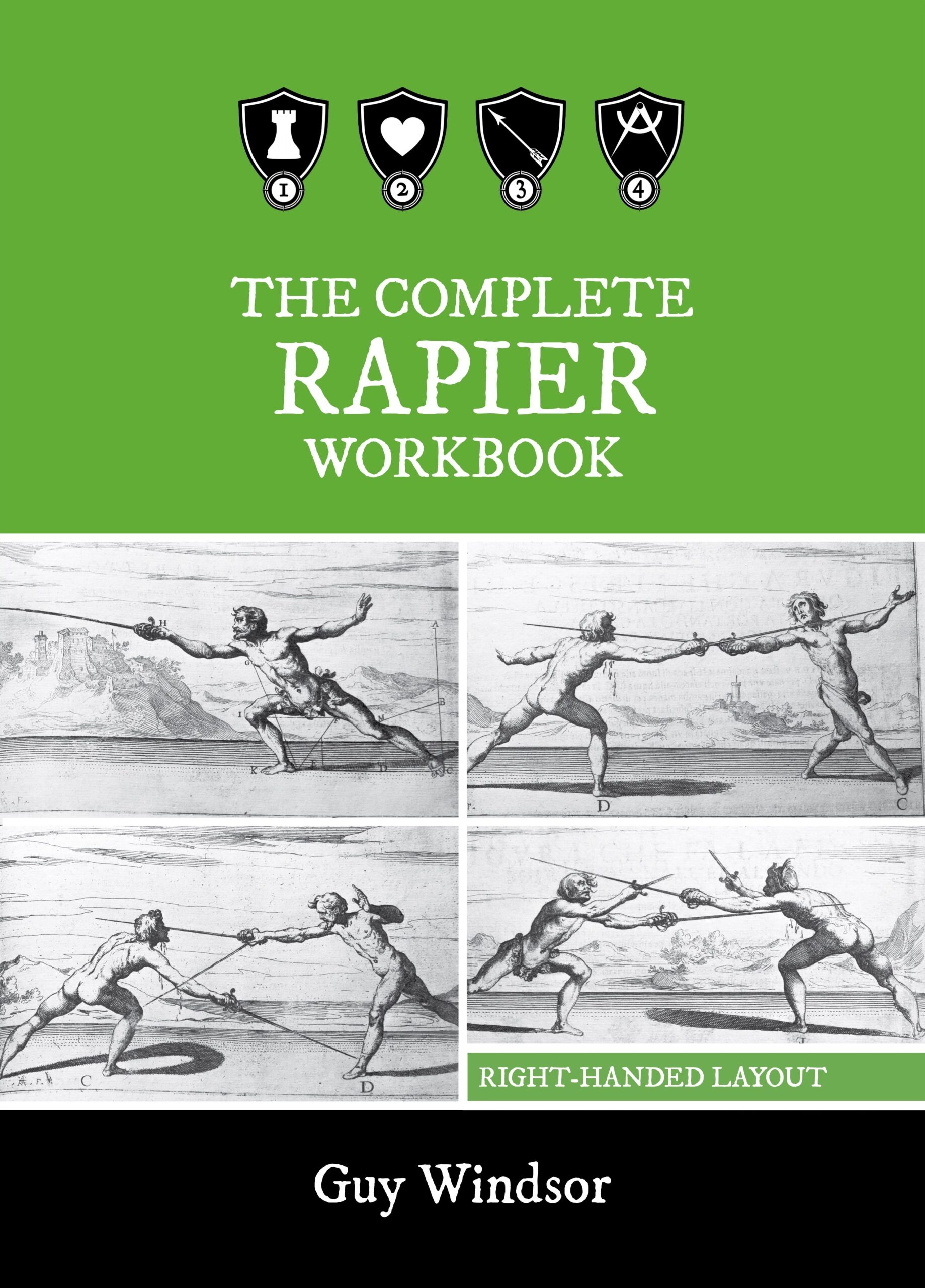
cover of complete rapier workbook which includes how to train swordsmanship

This post is borrowed from The Complete Rapier Workbook  and follows on from How to Train Swordsmanship (or anything else) Part One.

The “Rule of Cs”

The “Rule of Cs” determines how every drill can be practised.

1. In the beginning, you learn set drills by Co-operating in creating correct choreography.

2. Once the choreography is smooth, increase the difficulty by increasing intensity, or introducing a degree of freedom, with one player adjusting the difficulty for the other to learn at their most efficient rate—if it works all the time, ramp it up—if it fails more than twice in ten reps, ease off a bit.

This is called: Coaching correct actions.

3. Finally, the players each try within reason to make the drill work for them. This can be dangerous if it gets out of hand, so be careful, and wear full protection just in case. In practice, the more experienced fencer should get most of the hits, without departing from the drill. This is fine, and gives a good indication of whether your training regime is working. So: Compete.

Let’s stick with Plate 7 from Capoferro as our example and run through a specific series of degrees of freedom, and apply the Rule of C’s so you can see the idea in practice.

  • In the basic form of the drill, there are no degrees of freedom.
  • Set up the drill, but the one stringered can, at the moment of the stringering, attack by disengage, or feint. That is one degree of freedom.
  • Start out with the stringerer obliged to attack in both cases. This makes for a nice choreographical drill.
  • Once that is stable, then the stringerer will only attack if they believe they have the tempo. This is a second degree of freedom. The stringered’s job is then to sell the feint.
  • Now we must ask the question who is coaching who? Because if the stringerer is coaching the stringered, then they must adjust their response so that the stringered gets better at feinting. If it’s the other way round, then the stringered must adjust their feint so that the stringerer gets better at identifying feints from real attacks.
  • You can also play the drill competitively. Without changing the drill, but allowing these two degrees of freedom, you can compete with your partner. If you are stringering, you are just trying to get the tempo for the parry-riposte in one tempo; if you don’t get it, don’t go. Your partner will be trying to trick you into it, with the occasional feint. 

There is a significant risk of this getting out of hand; be mindful as you play the drill competitively that you must stick to the constraints of the drill that you have both agreed on. Otherwise you lose track of the rationale behind what you are doing, and mistakes creep in that are difficult to spot and to trace back to their source.

Coaching

I kind of dropped you in it in the previous couple of drills: I got you coaching without teaching you exactly how. So let’s have a look at that specific skill. In any drill you must have a clear definition of success. In a tournament bout, that’s winning within the rules. In a basic set drill, it’s making the choreography as correct as possible.

  • In a coaching environment, the student’s success is defined as getting measurably better at the target skill.
  • The coach’s success is defined as: the student is successful.

Be very clear on this before moving on. If the coach is doing their job properly, they will get hit over and over. Because in fencing, the student is successful if, and only if, they hit the coach, but do not get hit.

The coach’s job is to create an environment in which the desired action will work, and everything else will fail. Failure is defined as the student not hitting, and getting hit.

The coach is providing a feedback mechanism. If the student is performing the desired action at the desired level, then they will be reinforced by immediate success; if they do anything else, or do the desired action at an insufficient level, the student fails to hit, and gets hit. 

This is why a good coach can get preternaturally fast results, because they can create and control a perfect learning environment, in real time.

In a perfect world, every historical fencer would have access to a high-level coach and spend much of their time one-to-one with her. In the real world, that’s never going to happen, so you and your partner must learn the basics of coaching so you can help each other develop.

As with every other skill, you will get better with specific practice. So in this next drill, let’s be clear about who’s training whom. We are studying coaching, so it is the coach whose performance we really care about. We measure that performance by the improvement of the student.

Coaching the Attack by Disengage

I have been preparing you for this over the last couple of workbooks. Begin with the Buckler Game. The one holding the buckler is the coach. You’ve done this many times before, so pay attention to the mindset: the total focus on your partner’s improvement. This is the mindset you’ll need for the following exercise.

You’re going to improve your partner’s attack by disengage. This action occurs in almost every Plate in Gran Simulacro, so it’s quite important.

  1. Start by setting up a static, basic version of Plate 7 and Plate 16, steps one and two. You step in to stringer, your partner attacks by disengage. Make sure the choreography is there, and that you both know what you’re going to be working on.
  2. Then reduce the window of opportunity for the attack by disengage, by stepping into measure, and immediately back out again. Not fast, but no pause. The student has to time their attack for when you will be there in measure.
  3. Then follow their attack with a strike of your own, in any line. They must be recovering, and parrying if necessary, after their attack.
  4. Then have the student keeping measure with you, waiting for your blade action (taking the line with a stringering) before they attack by disengage.
  5. Finally, have the student keeping measure, and remaining defensive after their successful (or unsuccessful) attack.

The coaching exercises we’ll be doing in the rest of the book will generally follow this same pattern:

  1. Set up the basic, static, drill
  2. Reduce the window of opportunity for the target action, by either reducing the time it’s open, or providing mechanical resistance
  3. Add a step: make sure the student is getting out under cover after striking
  4. Add movement: have the student do the action while moving (so the drill doesn’t start with them standing still). Refer to “Who moves first?”
  5. Add both the step and the movement, so they have to do the target action while moving, and remain defensive after striking.

You can see this drill on video here:

We are scratching the surface here, but I hope you can see that this approach will turbo-charge your training by deliberately designing your success.

cover of complete rapier workbook which includes how to train swordsmanship

This post is borrowed from The Complete Rapier Workbook

How do you take things you already know, and make them actually work under pressure? How do you become a swordsman/swordswoman/swordsperson, not just a person who knows some sword moves? This is the heart of swordsmanship, and it’s most sophisticated element. The key skill to learn is how to coach, because that’s how your training partner will get better. And as they learn themselves, they can coach you.

This is the difference between evolution by natural selection and intelligent design. If you just fence, sure enough you will get better. Slowly, and in a haphazard way. But using a disciplined approach, you can deliberately work on your areas of weakness, find and enhance your natural areas of strength, and deliberately, intelligently, improve. 

Birds are amazing examples of the awesome power of evolution. But compare them to the history of powered flight. By the application of intelligent design, we got from a short hop of 120 feet in 1903, to the moon in 1969. Evolution can go suck eggs.

This is the kind of astonishingly rapid improvement that we are aiming for in every training session.

We get there by building a bridge between your current level (whatever that is) to where you wish to be: expert fencer.

This idea is the heart of my new workbook: Rapier part three: Developing Skills. Much of this blog post is adapted from the book.

It is relatively easy to teach set drills to a student or class. She does this, you do that. And it is relatively easy to set up a freeplay (sparring, fencing) environment that is reasonably safe. I have seen many groups and schools that have nice set drills, and freeplay quite a bit, but there is no real relationship between the two kinds of training, and nothing in between those two extremes. As a result, the things done in freeplay bear scant resemblance to the actions in the drills. In the new workbook I will show you how to build a bridge between set drills and freeplay. This is especially important for historical swordsmanship, as the manuals tend to show short, simple sequences (an attack and a defence, usually) which are easy to turn into drills, but very hard to pull off in friendly freeplay or against a resisting opponent.

In a nutshell, you need to be able to identify your areas of weakness, and fix them. We do the former by running diagnostic drills, and the latter by training at the optimal rate of failure. 

Run a Diagnostic

Almost any drill can be used as a diagnostic. The purpose of a diagnostic drill is to establish at what point you are failing. Taking Plate 7 as an example, by running through it you may find that you don’t remember the drill (solution: learn the choreography. Refer to the first workbook), or one part of the drill isn’t as good as it should be. Your disengage, for example. Or your parry. It doesn’t matter which, it only matters that you can find it. For this you need clear feedback mechanisms.

This approach can be applied to any weapon and any system, of course, but I’ll stick to rapier examples for now.

Feedback mechanisms

The best feedback mechanism is a partner who will invariably hit you when you make a mistake, and who you will invariably hit without getting hit, when you do something right. 

That partner is a coach.

But nobody is perfect, so your training will be slowed down by false positives (you hit with things that shouldn’t work, or your partner fails to hit you when you’ve left an opening), and false negatives, when you’re doing the right thing, but your partner prevents it from working in a way that isn’t useful for your development.

Secondary feedback mechanisms include video cameras, so you can see what actually happened, and verbal feedback from coaches and training partners.

Direct immediate accurate feedback is the holy grail of training. Quest for it.

The Optimal Rate of Failure

The optimal rate of failure in combat is zero. But in training, the optimal rate of failure is about two out of ten. Whatever you are doing should work 80% of the time, and fail the other 20%. If you are succeeding 100% of the time you’re not learning anything. If you’re failing much more than 20% of the time, you will get frustrated, and frustration is the enemy of learning.

The coach’s job is to keep the student training in that zone: and for the coach, the optimal rate of failure is zero. Because the coach isn’t supposed to be training: they are supposed to be the perfect feedback mechanism.

The rest of the workbook addresses exactly how to do that, like so:

  1. Addressing the common psychological impediments to learning swordsmanship.
  2. Building a bridge between set drills and freeplay. By deliberately layering up the complexity, we can improve faster.
  3. Learning to identify the problem areas.
  4. Learning how to modify drills to fix specific problems.
  5. Learning how to coach.

This post has been all about the theory of practice… if you've enjoyed this post but rapier isn't your thing, you might find the Theory and Practice of Historical Martial Arts interesting, or indeed the next post in this series: How to train Swordsmanship, part 2

safety-guidelines-cover

Safety Guidelines for the Practice of Swordsmanship

These safety guidelines come from my Recreate Historical Swordsmanship from Historical Sources Course (included in our Mastering the Art of Arms and Solo Training packages here) and have been adapted from guidelines in The Medieval Longsword, The Duellist's Companion, and The Theory and Practice of Historical Martial Arts. All of those books are included as downloadable pdfs in the additional course material.

Climb if you will, but remember that courage and strength are nothing without prudence, and that a momentary negligence may destroy the happiness of a lifetime. Do nothing in haste; look well to each step; and from the beginning think what may be the end.

Edward Whymper’s admonition, from Scrambles amongst the Alps, elegantly encapsulates the correct attitude to all potentially lethal activities. Substitute “practice swordsmanship” for “climb”, and there is the correct mindset for any swordsman, beginner or expert. Take it to heart before you start training with a partner.

When training with weapons you hold your partner's life in your hands. This is a sacred trust and must not be abused.

Disclaimer: I accept no responsibility of any kind for injuries you sustain while you are not under my direct personal supervision. During this course you will be taught how to create safe training drills, and I am certain that if you follow the instructions there is a very low likelihood of injury. But if I am not there in person to create and sustain a safe training environment, I cannot be held responsible for any accidents that may occur.

Principles

The basic principles of safe training are:

  1. Respect: for the Art, your training partners, the weapons, and yourself.
  2. Caution: assume everything is dangerous unless you have reason to believe otherwise.
  3. Know your limits. Just because it’s safe for somebody else, does not necessarily mean it’s safe for you. Never train or fence when you are tired, angry, or in any state of mind or body that makes accidents and injuries more likely.

Most groups that keep going for more than a year have a pretty good set of safety guidelines in place. Make sure you know what they are, and follow them.

My senior students routinely train with sharp swords, often with no protection. That’s not as dangerous as it sounds, when you remember that they have been training usually for 5+ years at that point, under my supervision.

Safety first: you cannot afford time off training for stupid injuries. Life’s too short. Whatever training you are doing must must must leave you healthier than you started it. You will not win Olympic gold medals this way, but you won’t end up a cripple either. The path to sporting glory is littered with the shattered bodies and minds of the unlucky many who broke themselves on the way. Don’t join them.

Every time I find myself teaching a group I don’t know, I tell them that the class will be successful from my point of view if everyone finishes class healthier than they started it. Most injuries in training occur either during tournament (highly competitive) freeplay, or are self-inflicted during things like warm-ups. In my school (and other classes) we have a zero tolerance policy on macho bullshit.

If any exercise doesn’t suit you, for any reason, you can sit it out, or do some other exercise. If you are sitting it out, a good instructor will ask you why, and help you develop alternatives or work up to the exercise in easy stages, but will never pressure you to do something that might injure you.

This is also true of work-related injuries, like forearm problems from typing, or the ghastly effects of sitting all day. By avoiding the things that will hurt you, you will naturally seek out the things that are good for you. Hungry? Avoid sugar, avoid processed foods, and lo! there’s a fresh salmon salad. Tired? Sleep is better than barbiturates, no?

This requires good risk-assessment skills (I recommend Against the Gods, the Remarkable Story of Risk, by Peter Bernstein) and the courage to take risks that truly serve your overall aims. A safe life is not worth living, but foolish risk-taking will not make your life meaningful.

Try adopting these key habits:

  • Before any new activity, do a risk/reward calculation. How risky is it, and how
    rewarding?
  • Practice saying no to training suggestions: even safe ones. Most people do stupidly
    risky things due to peer pressure. Being able to say no to your peers is perhaps the most important skill in reducing injury rates. If this is hard, make it a habit to decline at least one suggestion every session, until it’s easy.

Equipment

Without doubt the single most important bit of safety equipment is good common sense. Fence according to the limits of your equipment, exercise control and respect the weapon at all times, and you will never have a serious injury. Minor bumps and bruises come with the territory.

There were some masters who believed that the safest course is to fence with sharp weapons and no protection. This is how it was often done in the past until the invention of fencing masks (though there are tournament records and declarations as early as the 14th century that record the use of blunt practice weapons; King Rene d’Anjou’s treatise of 1470 is perhaps the best source). Such masters are right in theory, in that freeplay with sharps is the best way for students to learn absolute respect for the weapon, and the importance of absolute control. There are a few contemporary masters with whom I will fence like this, and there is nothing like it for generating a perfect fencing approach. But try explaining that to the insurance companies, or in the event of a slip, the police or coroner.

It was often said in the eighteenth century that you could tell a fencing master from his eye-patch and missing teeth. Never forget that even a blunt blade can break bones. When free fencing, or when practicing drills at speed, it is essential that you wear appropriate safety gear. You do this not for your own sake, though self-preservation does come into it, but for the bene t of your training partner. Your protection allows him to hit you safely.

Choosing protection is a very controversial subject. Too little, and you can end up badly hurt (even in practice). Too much, and you can’t fence properly. Firstly, it is important to establish what style of fencing you will be doing. If you are practising armoured combat, then buy the best fitting, best made armour that you can from an armourer who knows how you intend to use it and has seen what you want to do. This is the hardest style of fencing to appropriately regulate, because accurate technique requires you to go for the least armoured spots (throat, eyes, armpits, joints), but safety requirements obviously prohibit that.

As a general guideline, I recommend the following for most weapons.

  1. An FIE standard fencing mask. This allows you to thrust at the face (a very common target), and generally attack the head. This does have three major caveats. Firstly, it leaves the back of the head open, and you must be very careful not to strike at this target. An added apron of thick leather affords some protection. Secondly, it does not protect the head and neck from the wrenching force of over-vigorous blows. It is vital that you and your opponent learn control before engaging in freeplay. Thirdly it is designed to protect the face from high-speed, light, flexible weapons, not slower, heavier, rigid ones. So continually check them for wear, and make absolutely sure that your weapons are properly bated.
  2. A steel or leather gorget, or stiff collar, to protect the throat. Points can slip under the bib of a mask and crush the larynx.
  3. (For women) a rigid plastic chest guard.
  4. A point-resistant fencing jacket rated at least 500 newtons. Sturdy, preferably padded and/or armoured gauntlets, which should extend at least four inches past the jacket cuff to prevent points sliding up your sleeve. I have twice had fingers broken through unpadded mail gloves, and now use a pair of fingered gauntlets from Jiri Krondak, which cost about 150€.
  5. A padded gambeson, or a plastron. If you are making one yourself, bear in mind that it should be thick enough to take the worst out of the impact of the blows, and prevent penetration from a thrust. All openings should be covered. The collar should be high enough that thrusts coming under the bib of the mask do not make contact with your throat. A plastron must wrap around the ribs, and properly cover the collar bones and shoulders. I usually wear a fencing jacket and plastron (as pictured).
  6. A box for men (called a “cup” in the US). You only forget this once.
  7. Rigid plastic protectors for the knees and
  8. For the elbows, of the sort worn by in-line skaters (worn under the
    clothes for that period look if you prefer), will save a lot of pain, and some injury.
  9. Footwear: on the matter of footwear, few practitioners agree. In the longsword treatises, there are no heavy boots, and certainly no built-up heels.  For a completely historical style, it is necessary to wear completely accurate period clothing at least occasionally, because it can affect the way you move. It does not matter much what you wear on your feet provided that you understand grounding, body-mechanics and footwork, but attaining that understanding is much easier barefoot or in very thin flat soles. Excessively grippy soles can lead to joint injury as you may stop too suddenly, or get stuck when you should be turning (particularly in falls at close quarters). The dangers of wearing too slippery soles are obvious. In the salle I usually wear medieval shoes or ‘barefoot’ shoes (aka five-fingers, or ‘toe shoes’), and recommend a thin, flat sole regardless.

You can find our current equipment recommendations here.

The Sword

Training swords come in three main types. Authentic sharp reproductions, which are used for cutting practice and some pair work with advanced students, blunt swords that try to reproduce the handling characteristics of the sharps, and fencing swords that are designed to make fencing safer. These all have their pros and cons, and you should use the sword that’s right for your style and the kind of practice you will be doing.

It’s perfectly all right to use a wooden waster or something similar to start with, but do not imagine that there is any such thing as a safe training sword. Even modern sport fencing blades engineered for fencing sometimes break and puncture people, and anything heavy enough to reproduce the handling of a medieval or renaissance sidearm is going to be able to do damage.

Looking after your weapon is largely a matter of keeping it dry, clean, and free of stress risers (a stress riser is a weak point, usually a deep nick, which encourages the blade to fold at that point).

Occasional rubdowns with a moisture repellent oil and steel wool or scouring pad, followed by a coat of microcrystalline wax, should keep the blade and hilt clean (follow manufacturer’s recommendations if you have a gilt, blued or otherwise ornamented weapon). Do not be afraid to file down any large nicks, and file off any burrs: this is important from a safety perspective, as the blade is most likely to break at a nick, and burrs can be very sharp.

The edges of a blunt weapon should always be kept smooth enough that you can run your bare hand hard up the edge and not get scratches or splinters. Even the toughest and most cherished sword will not survive repeated abuse: the best guarantor of longevity for your sword (and yourself) is correct technique.

Rules of Engagement

Once you have agreed to fence with someone, it is important to agree on rules of engagement. This is partly to ensure safety, and partly to create an environment in which you can learn. The two most simple rules are these:

  1. Confine permitted actionss to the safety limits of your protective gear
  2. Confine permitted actions to the technical range of the least trained combatant. In other words, do not allow face-thrusts when wearing open helms, or throws when one of you is not trained to fall safely. The rules can be adapted further to develop specifi aspects of technique: for instance, you may not allow any close quarters work at all, or even restrict allowable hits to one small target. The idea is to come to a clear, common -sense agreement before facing off. You are only ready for no-holds-barred, totally “authentic” fight simulation, when you can enter such a fight with your judgement unimpaired.

Following the rules of engagement will not make you soft, nor will it dull your edge if it comes to the real thing; rather it it will develop self-control.

These rules apply to all fencing:

  1. Agree on a mutually acceptable level of safety.
  2. Wear at least the minimum amount of safety gear commensurate with rule 1. Confine allowable technique to those within the limits of your equipment.
  3. Confine allowable technique to the technical ability of the least trained
    combatant.
  4. Appoint either an experienced student or one of the combatants to
    preside over the bout.
  5. Agree on allowable targets.
  6. Agree on what constitutes a “hit”.
  7. Agree on priority or scoring convention in the event of simultaneous hits. Usually it is better
    to allow a fatal blow before a minor wound, but simultaneous hits should be avoided whenever possible.
  8. Agree on the duration of the bout either in terms of hits, such as first to five, or in real time.
  9. Acknowledge all hits against yourself. This can be done by raising the left arm, or by stopping the bout with a salute, or by calling “Halt!” and telling your opponent where and how you think she hit you.
  10. Maintain self-command at all times.

Safe Training

In my experience most injuries are self-inflicted. It is far more common for students to hurt themselves by doing something they shouldn’t, than to hurt their training partners. Here are a few simple guidelines for joint safety, which should be followed during all training. I am using the lunge as an example of a stressful action, but these principles apply to any physical action.

  1. The knee must always bend in the line of the foot. Knees are hinges, with usually a little under 180° range of movement. The do not respond well to torque (power in rotation). So whenever you bend your knees, in any style for any reason, ensure that the line of your foot, the line of movement of your knee, and the line of movement of your weight, are parallel. This prevents twisting and thus injuries. This one simple rule, carefully followed, eliminates all knee problems other than those arising from impact or genetic disadvantage.
  2. Whenever performing any strenuous task (such as lunging, or lifting heavy objects), tighten your pelvic floor muscles (imagine you need to go to the bathroom, but are stuck in a queue). This supports the base of your spine, and helps with hip alignment.
  3. Joints have two forms of support: active and passive. Passive support refers mainly to the ligaments, which bind the joint capsule together. This is basically set, and can’t be trained. When training your joint strength, with exercises or stretching, avoid any action that strains the joint capsule. Any action that causes pain in the joint itself should be modified or avoided, as it may damage the soft tissues (ligaments, tendons, cartilage). These tissues have a very poor blood supply and hence heal very slowly.
  4. Active support refers to the muscles around the joint, and these can be strengthened by carefully straining the joint with small weights and rotations. To strengthen a joint you must stress these muscles, without endangering the ligaments. Any competent physiotherapist can show you a range of exercises for building up the active support around your knees, wrists and elbows, where we need it most.
  5. Rest is part of training. Your body needs time to recover, and is stimulated by the stress of exercise to grow stronger. However, the body is efficient, and will withdraw support from any muscle group that is not used, even if for only a few weeks. So regular training is absolutely crucial.

If you can’t lunge without warming up, don’t lunge except in carefully controlled drills. Warming up is essential before pushing the boundaries of what your body can do.

If you find this advice sensible and useful, please feel free to share it as widely as you like!

If you would like these guidelines as a handy PDF, then drop your email in the box below and I'll send it to you.

I love the HEMA tournament scene. This will come as a surprise to many people, because I am not really involved with it in any direct way. In fact, I have seen people referring to me as “anti-tournament”.* Nothing could be further from the truth. Just because I am not personally interested in entering or organising tournaments, does not mean that I don’t understand their value.

My own tournament life extended from 1987, when I entered my first foil tournament, through to 2002, when I entered (and won) a rapier tournament in Italy. I did enter a tournament in 2026, which was interesting and useful, after a 23 year break. You can read about it here.)The sport-fencing scene is especially tournament-dominated. It is fair to say that tournaments are the only meaningful measure of success in that sport (and most others).

I was never a great sport fencer, but I won a local competition or two, and ended up in the last 8 in sabre at the Scottish Universities tournament in 1993. Tournaments were great if you did well, but it was equally possible that you would travel for hours, and wait around for hours, and get a few bouts in, then wait for more hours while your more successful teammates got to fence, and then travel for hours back home again. The ratio of time spent to fights fought always bugged me; you got far more bouts in far less time in less formal environments.

At school I was involved in organising our annual tournament, and so I have a pretty good idea what a huge amount of work it is to set up and run a tournament. That’s why I’ve never organised an open tournament in Finland; it’s way too much work for something I’m only peripherally interested in. But I do encourage my students worldwide to enter tournaments if they are interested, and it’s always nice to see a current or past student doing well in that environment. I do tell them not to expect to do very well though, as our training is not optimised for tournament success. (Perhaps I should write a post about how to train for tournaments sometime?)

8 things I like about the tournament scene

1) It provides a sense of community for a very widely distributed group of like-minded people. Other events do this too, but the advantage of the tournament scene is that anyone can show up and take part, with any background, and every competitor is (at least in theory) equal and welcome. Your club or style don’t determine your value.

2) It provides external validation for fencers who need it. This can hurt as much as it helps, because poor performance on the day can be hugely discouraging. In the long run, internal validation is much better, but most fencers go through a stage of needing to test themselves, and tournaments provide one easy way to do that.

3) It creates an easy-to-explain model of what we do for the casually curious. One of the most common questions I get asked is “do you have tournaments?” If I don’t want to explain exactly what I really do, then I can just say “yes, there’s a big international circuit now, though it’s not really my focus”. Saves me so much time. Tournaments also attracts media attention, because everyone understands them.

4) It creates a much, much bigger market of fencers with particular equipment needs: the current availability of (for example) longsword free-fencing kit is directly due to the tournament circuit that has developed. This is huge: those of us doing HEMA in the early 1990’s will remember that our equipment was a hodgepodge of sport fencing kit and some dodgy re-enactment or SCA gear. Without sport fencing, there would have been no masks. How much would that have slowed our progress?

5) It provides training opportunities for working under pressure, and developing attributes such as timing, measure, speed, and tactical sense.

6) It demonstrates the effect of rule-sets. One of the hardest things to explain to beginners is how much rule-set affect behaviour. Tournaments have clearly-defined and published rule-sets, and that determines more than any other factor what kind of actions work.

7) As we saw in this post, tournaments shine a spotlight on diversity. Who, exactly, is really welcome?

8) Most people like the idea of tournaments to give them something to train towards. So the sport-HEMA scene is always going to attract lots and lots of people. Excellent. For me and many others in the early nineties, sport fencing (and the SCA for many of my friends) provided our first entry into the sword world, but in the end proved frustrating. It was not real enough. So we left to create HEMA from scratch. The tournament scene provides a similar easy-entry route into the sword world. I look at the sport-HEMA scene as a massive pool of potential future historical-HEMA students and teachers.

4 limitations of tournaments

1) They serve no useful research purpose, unless you are studying historical tournament rule-sets and applying them. “It works/doesn’t work in tournaments” is just not a relevant statement when considering martial arts that have been developed for other purposes.

2) They privilege the gifted. In any sport, there is an optimum body type. As the tournament scene develops and the stakes get higher, we will start to see the different rule-sets privileging certain body types. Read The Sports Gene for super-detailed information on this phenomenon.

3) They are good for highlighting areas of weakness, but do not provide an ideal environment for fixing those weaknesses. From a training perspective, it’s more useful to be able to stop testing and start fixing immediately.

4) They privilege outcome over process. The people who “succeed” are by definition winning specific bouts. It doesn’t take into account how much they have improved or how hard they have worked. With a long enough head start, somebody could (in theory at least) win many tournaments without improving at all!

So, given how useful I think they are, and with the limitations I listed above taken into account, you might very well ask why I don’t take part? Here are my reasons:

Why I don't (usually) enter tournaments

1) I’ve been there and done that. In my current phase of training, formal tournaments are not an efficient learning environment for me. I can get just as much pressure from a demonstration bout, for instance, or from using sharp swords.

2) The stakes are not equal. I became a professional in 2001, and fought my last tournament in 2002. I won it. As a professional in a field of amateurs, I felt that I had robbed the top amateur of his deserved victory. If I win, so what? it’s my job. If I lose, then I have more to lose than the amateurs out there.

3) I don’t do things by halves. If I was to enter tournaments regularly, I’d take them seriously, and train for them seriously. But it’s not the combat environment I’m most interested in, so it’s not the one I want to train for.

4) It’s dangerous. The full-contact environment is one I enter only when necessary, because of the risk of injury. (Readers of The Seven Principles of Mastery will understand my attitude to injuries.) The tournament scene has an ok safety record, but is much more dangerous than most other training environments. All the broken bones I’ve seen since starting my school have come from one tournament or another. I’ll do it if I need to for my own training purposes, but not otherwise.

In conclusion then, I’m very pleased to see the worldwide development of the sport-HEMA scene. It grows the  wider sword community faster than any other factor: what’s not to love?

* I wrote about this in Swordfighting, pages 82-83.

Beginner you are not, hmmm? image from www.freepik.com
Beginner you are not, hmmm?

Beginners are the future of any martial art. And lucky too: the best learning environment is when you are the least knowledgeable person in the room. Anyone you train with can teach you something. It is more difficult to keep learning when you are surrounded by relative beginners, and this post is about how to do it. When I moved to Finland in 2001, I was by a mile the most experienced practitioner of Historical martial arts in the country. Literally everyone I crossed longswords with knew less about them than I did. This could easily have lead to stagnation, but I managed to keep learning by:

  • Cross-training 3-4 times a week with other martial arts, one-on-one with senior instructors; basically trading classes. The potential for contaminating my interpretation was huge, but the upside was I developed a lot as a martial artist.
  • Travelling a lot to international events, paying for it by teaching classes there. I treated these trips mostly as recruitment: when I saw an instructor I thought I and my students could learn from, I hired them over to teach seminars. We average about 3-4 such seminars a year.
  • Learning how to train usefully with beginners.

This post is about the last on that list. I will summarise the approach here.

1.    Be a perfect model. The rule of beginners is this: show it to them right a thousand times, and they will eventually copy it correctly. Show it to them wrong once, and they will copy it perfectly first time. I mean no disrespect. This is just true, and I’ve never seen a beginner for whom it wasn’t. So having beginners around demands that your every action is as perfect as you can make it. No pressure then.

2.    Work at your own level. One of the things beginners have to learn eventually is the terminology of the art. So on the beginners course we do things like call out the names of the steps (accrescere, discrescere, passare, tornare, etc.) and they have to do the named step. For more experienced students in the same class this could be unimaginably tedious, but should not be: they are expected to work at their own level. So while they are all doing the same thing, some are working on remembering the terms; some working on perfecting its mechanics; and some are working through possible applications, from power generation, to avoidance, to specific plays.

3.    Use the randomiser. In pair drills, the beginner will naturally get parts of it wrong. Excellent. A genuine randomiser! The attack may be too strong, too far away, too close, in the wrong line, anything. Your job is to effortlessly and spontaneously adapt the drill to the specific conditions of the attack you get, not the one you expected. This demands 100% focus on what is happening. When it is your turn to do what they just attempted, you have to demonstrate it perfectly according to the drill, of course. Your training alternates between 100% perfect tactical choices in real time, and 100% perfect mechanics in your own time. Sounds like 100% perfect training, no?

You should also note the following:

•    The attack is never “wrong”: you get hit only if you fail to defend.
•    Your correction of the attack will be much more convincing if it comes after the attack has failed, than if you just got hit.
•    Coach by modelling, not explaining. Beginners are not stupid, they are just not-yet-skilled. They need opportunities to practise, not a lecture.
•    This kind of training demands 100% focus on the specifics of the attack that you get, not the one you expect.
•    When training with beginners, you have an opportunity to go deep, making a few actions better. But you have less chance to go wide, using a broader range of actions (because this will bewilder the already overwhelmed beginner). When paired with more experienced students, you could take the chance to go wide if it doesn’t conflict with the overall class goals.

So relish the influx of new perfection-demanding random action generators, and relish the fact that in a decade or two, they may well be vastly better at this than you are now. But they will always remember and be grateful for the help you gave them when they were starting out. You may be helping to train the next Bruce Lee, or Aldo Nadi, or even Fiore dei Liberi.

If you find this useful, please share it with your friends!

***

Before every beginners course starts, it's a good idea to go over the principles of working with beginners with your regular class. Here's how I normally do it:

Teaching Students to Work with Beginners:
We began by setting the goal of the class: to teach the students present how to train usefully with the beginners. Usefully for the beginners too, but specifically usefully for themselves. I explain briefly the three principles above, and then we apply them. This class followed the normal structure: warm-up, footwork/mechanics, dagger, longsword handling, longsword pair drills.

Warm-up
Have the students warm themselves up, structuring the 12 or so minutes according to their own current needs. For some this will the first time they have done that. This gets them into the right state of mind: using familiar structures and content, but customising them to their own needs.

Footwork
We then do the basic footwork terminology drill: I call out the names of the steps and turns and they have to do the named action. Then I have them tell me what they should be working on during that drill. Some need practice at remembering the terms; some are working on perfecting its mechanics; and some were working through the applications. We then do the stick exercise, so they have to use the steps spontaneously.

Dagger
We start as usual with perhaps the first play of the first master, and model what you should do if the attacker is either too stiff (execute the play perfectly: it works just fine), or too hesitant to strike (ignore the attack, until they learn to actually strike the mask).
18th1stmaster

We might also cover the 18th play, what you should do if they are really really stiff. This should be accompanied by a quick verbal correction, and you modelling the attack for them.

Longsword handling, solo drills
Here we distinguish between a beginners course class, and a general basic class to which beginners can attend. (In my School, all beginners are entitled and encouraged to attend all basic classes.) On the beginners course, you should stick exactly to the drill that has been set, so that the only thing the beginners see is the thing they are supposed to do. So do that thing very, very well. It’s an opportunity to work on the basics. The constraint will highlight things to practise. This lead to the following immortal line:
“All of your problems, in the salle and out of it, stem from imperfect basics.”
In normal class, students are at liberty to train the exact drill as set, or any more basic form, or any more advanced form, unless they are specifically instructed otherwise. I expect students to train at their own level.

Longsword pair drills
In the class I'm thinking of, we had been working on the stretto form of first drill the previous week, so we took it up again. (For those not in my school: first drill begins with an attack that is parried; the stretto version begins with an attack that is counterattacked into. Let me point out here that it is not the counterattack that determines largo or stretto, it’s the nature of the crossing of the blades: for a fuller discussion and examples see the wiki.)

This allowed me to point out that the “basic” version is actually mechanically more complex than the “more advanced” version. The reason for learning the first one first is that it is tactically more basic, and easier to keep in mind. First parry, then strike. Parrying and striking all in one go is harder for most people (not all) to grasp. So we then looked at these two drills as:
•    Parry against the attack (first drill, largo form)
•    Attack against the attack (first drill, stretto form)
•    Which begged the question: what happens when a parry is parried?

Which is what happens all the time with beginners learning this drill. They attack as they are supposed to, but as you start to parry, they instinctively change their motion to put their sword in the way of yours. This leads to the two swords bound together, usually near the points, and suddenly the defender’s continuation as set in the drill makes no sense.
Of course, this type of bind is shown in the treatise: the first master of the zogho largo.

1stMasterZL So we looked at the book, and executed his plays as a response to a poor attack. And then used the attack as a means to draw out the defender’s sword to where it could be bound, and practised the same actions but with different intent. The attacker could bind the sword and take advantage of the crossing generated, or the defender, perceiving the change in the attack in time, could take advantage of the fact that the attack was no longer coming towards them, and execute the plays. This made the point that the difference between beginner’s mistake and advanced technique is often more about why you do it, than it is about how.
We completed this study with the variation on first drill that leads to the third play of the master of zogho largo crossed at the middle of the swords, where his scholar grabs the blade and strikes.

3rdplay2ZLBecause those that know might be about to angulate around the parry, or parry the riposte, while beginners might just be a bit stiff. So the attack could go one of three ways (bind the parry, proceed as in the basic form, angulate), and the defender was expected to effortlessly execute the proper response. And to think: beginners will give you all that variation, at genuinely random intervals, without even being asked to or trained! How fantastically useful is that?
We concluded the class, of course, with first drill, basic form, no variations, every action perfect. Because you have to show it to them right a thousand times…

Swordsmanship: Guy Windsor cutting a tatami mat horizontally with a sharp longsword

For many of us, there is no need to even think about why we would train in the Art of Swordsmanship. It is simply an irreducible desire, like the way many people want to have kids. But we all know someone for whom our passion for the sword is inexplicable, just as we all know someone who does not want to be a parent. I thought I would write this rather difficult post so that you know why I have chosen the path of the sword, and if it resonates with you, you can direct the baffled in your life here for enlightenment.

Let us begin with a wide focus: why martial arts at all? Some have practical uses, sure: those living on meaner streets will have use for self-defence skills. But most martial arts, if they convey those skills at all, are very inefficient at it. Some martial arts, or combat sports at least, offer a career path that includes fame and riches. An Olympic gold medal, perhaps. But that is not true of ours.

I train martial arts because they can offer moments of utter transcendence. The ineffable made manifest. This is traditionally described as “beyond words” or “indescribable” but as a martial artist and a writer, that would feel like a cop-out. I will take this feeling and wrestle it down onto the page, or at least give it my best shot:

It is a moment when every atom in your body is exactly where it should be. Every step you have taken on life’s path makes sense, is part of a coherent story. The pain of every mistake is made worthwhile by the lessons they contained. There is a feeling of physical power without limit; strength without stiffness; flow without randomness; precision without pedantry; focus without blinkers; breadth and depth; massive destructive capability but utter gentleness; self-awareness without self-consciousness; force without fury; your body alive as it has never been, all fear and pain burned away in a moment of absolute clarity; certainty without dogma; an overpowering love, even for your enemies, that enables you to destroy them without degrading them. It is, for a religious person, the breath of God within you. For an atheist, a moment of attaining perfection as a human being.

And I can, in theory at least, get that feeling every time I pick up a sword. In practice, I've been there a dozen times. And a lesser version of it, a breath or a hint of it, almost daily.

The Illusion of Mastery

It is, of course, an illusion. Even in that moment of grace, you are not perfect, or invulnerable. And this is where the discipline of a serious art saves you from the wishy-washy hippy shit of some other “spiritual paths”. It is so easy to slip, to believe your own hype, and simply essential that the moment you do so, reality comes crashing in like a sword to the head. The rigour of a true martial art contains at its heart a continual examining of your skills. This can come in all sorts of forms: I tend to use pressure drills and freeplay, but the critical component is the existence of an objective external test: “Does this work?”,  with a clear yes/no feedback mechanism in place.

In many ways, the books from which we draw our art are that mechanism: the benchmark against which you measure the correctness of what you do. This academic aspect is I think unique to historical martial arts, and it requires that we are able to articulate in reasoned argument why we do anything a particular way. This adds a mental dimension, a way of thinking clearly and logically, making arguments supported by evidence, that is the antithesis of the “feel that energy, man” hippy shit I refer to above.

Morality in Swordsmanship

There is also the question of morality. The moral dimension to swordsmanship comes from the lethal nature of the art. It is, originally, for killing people. Some systems emphasise self-defence, but the knightly arts were for professional warriors. You kill people because that’s your job. Much like a modern soldier, who must only distinguish between legal and illegal orders. If the order is legal, and obeying it means killing people, well, that’s what they train for. I’m not suggesting that any part of that is easy, especially distinguishing legal orders from illegal ones, but at base, it is simple. Do, or do not.

But for us, training exists in an artificial space that allows us to deeply examine the morality of the martial arts. (I’ve written elsewhere about training as a holo-deck for the philosophy of ethics.)We are training a killing art, so we must ask ourselves this question: in what circumstances, if any, is it acceptable to take life? This is why I have no interest in non-lethal arts. They simply lack this moral aspect. Especially combat sports, where your opponent has chosen to compete with you in a fair fight, and so long as you both follow the rules, there is no question of right or wrong at all.

Is Swordsmanship healthy?

Bodily health is also an issue. We have no choice but to live in this carcass until it stops working. There is just no way round the fact that you either figure out how yours works, and get the best out of it (it is a stunningly fabulous machine) or you ignore it until it fails.  I don’t train to stay healthy— I stay healthy so I can train. All of my students know that I put maintenance and conditioning at the heart of our training, and I spend about 90% of my own training time, and about 40% of my teaching time, working on mechanics. Most of my students come to me a bit broken in the beginning. Poor posture, bad wrists, a dodgy knee, excessive weight, whatever. We work together to develop good habits, mostly by paying attention to posture, breathing, and joint strength training, and of course, diet.

This has a way of both preparing the student for the physical training, and of keeping them grounded when the magic starts to happen. For many students, the sword has hooked them out of physical lassitude and ill-health and into a more active, healthier life. It is certainly part of the core mission of the School. Our the training is healthy— our one golden rule is everyone must finish class healthier than they started it. And because we are interested in process, not outcome, it is literally irrelevant how fit a student is when they start. Only the attitude they bring to training matters. (If you're interested in my approach, The Principles and Practices of Solo Training is the book for you.)

And this is another reason why I am not interested in combat sports. They have a pretty high threshold for physical fitness, which means that you have to start quite fit (and young!) if you wish to get really good at them. There is a genetic lottery (every sport has an ideal body type) and luck plays a huge part too. Read Bounce, by Matthew Syed, for more on this. Combat sports also have a very high risk of injury. So the students who need hooking off the couch and into a healthy life are barred from admission. The ones who need it least are the only ones who can have it.

Why Swordsmanship, really?

So why the sword? All of these spiritual, mental, moral and physical benefits can be accomplished with other weapons, or with no weapons at all. There is no good reason, though I could rationalise it at length. We could talk about flow states, ala Mihaly Csikszentmihalyi: swordsmanship practice is most certainly a way to bring “order to consciousness” (as opposed to entropic chaos). We could talk about the social aspect, how good it is to find, coming to the salle, that you are not the only sword-obsessed loony out there. But fundamentally, some people are just drawn to the magic of steel. It resonates in them. Many students remember the first time they heard the clash of blade on blade, and how their heart leapt.

I train because I feel it. Oh Lord, I feel it in my very bones. But how I train is utterly rational. Together, the martial and academic truth-testing keep me from flying away with the fairies. The physical training keeps my body strong and agile. The mental training keeps my mind clear and focussed. The moral aspect leads me to consider the meaning and value of every part of my life.

So when someone asks you “Why practice Swordsmanship?”, perhaps the best answer is “how the hell do you manage without it?”

So, that's my reason. What's yours?

Search

Recent Posts

Categories

Categories

Tags