I have always made sure that there are at least some women in the photos in all of my training manuals. This photo from The Swordsman's Companion is one of my favourite pictures ever:
Last weekend, teaching at Lonin in Seattle, one of the women students told me that the only reason she had started training was because she had seen the women in my books, and therefore felt it might be ok. She got her biggest, toughest-looking male friend to come with her, just in case, but she came. She’s now on the governing board of her club. I nearly cried when she told me this. Martial arts training should be for everyone who is interested, be they clumsy or deft, weak or strong, timid or bold, tall or short, without regard to their starting point. Everyone can get better with practice.
Later that day, I taught my first ever all-women class. It was a fascinating experience for me as a teacher, and also as the head of a large and very diverse school. In essence, I know nothing at all about the particular requirements women may have in training, so I asked them what they wanted, they told me, and I did my best to oblige. I am, after all, a consulting swordsman. I think the class went well, everyone seemed happy with it, and I’ve only had positive feedback about it so far. And it has got me thinking (again) about the whole issue of gender in martial arts. When I was a kid, one of my role models was Cynthia Rothrock. You can see her famous scorpion kick in this excellent Ameridote video:
At my school karate club we were taught by Mr and Mrs Williams. Either one of them could have kicked my head off. My first fencing coach was a woman, Gail Rudge. She was assisted by the captain of the fencing team, also a woman. Neither of them had any difficulty stabbing young Guy when needed. Which was rather a lot. This all means that I have never been infected with the foolish idea that women can’t do martial arts or swordsmanship to the very highest level.
In a perfect world, no kind of gender discrimination would exist, and so nobody would think to organise a women-only class. But mansplaining is a thing. So is “I couldn’t hit a girl”. So is copping a feel when you’re supposed to be grappling. So I can see that this kind of class could be preferable, at least to some women. I should also point out that Lonin is an extremely inclusive and friendly club, vastly more welcoming to people of all kinds than many others I have seen, so it’s not like they had a special need for this kind of class. But the women training there just decided to organise a semi-regular women’s class, and advertised it to the general public. Over 30 people showed up! Clearly, there was something about a mixed, general, beginners’ class that put these women off, and starting this class just removed that barrier.
A martial artist ought to be able to handle whatever opponents life throws at them. My primary reservation about women-only classes stems from the possibility that women’s training might become ghettoised, and women who train in these classes might never get to train outside them, or might choose not to, and so limit their own development. They should be an option, not a refuge.
But that’s a lot of ‘mights’. What I saw was people happily training, some of whom would not have got started without the psychologically and physically less intimidating option of the women’s class. And it’s probable that some of them will grow in the Art and become role-models for the next generation of swordfighters.
My sojourn in Italy ended when I left Lucca for the United States, on the very day of the Lufthansa pilot strike. After much kerfuffle and a comedy of errors (including the airport train in Newark that takes you from one terminal to another being out of action at 5am occasioning a walk outside to find a taxi to take me to the right terminal) I got across the world to Seattle. This is one of my favourite American cities, as regular readers of this blog will know, not least because it is home to some of my favourite people. I arrived at about 11.30 am, and was teaching the freeplay class for Lonin that evening; I was swaying on my feet a bit, so didn’t kit up and join in, but instead taught them how to use freeplay as a diagnostic tool. In fact, the imperfections we discovered that evening created the class plans for the rest of the weekend.
This was an unusual weekend seminar, in that instead of the normal two full days, we had a small group (about 10-12 folk) on Saturday morning, the full group (27 students) for a longer session that afternoon, then two more small group sessions on Sunday. This let us cover much more ground, and each small group effectively chose what they wanted to learn in each session. I’d highly recommend this format for similar events in the future.
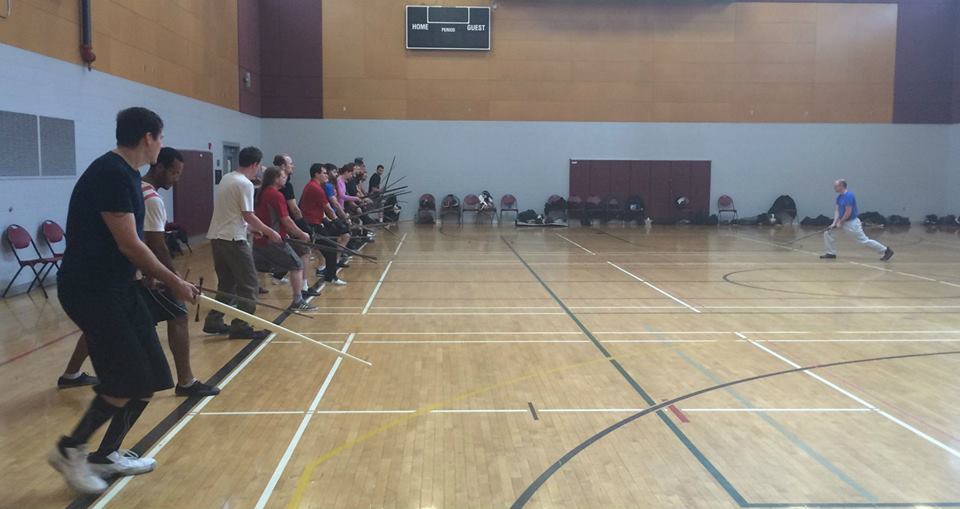
27 against one: seems fair to me.
It was deeply satisfying to see how the Lonin group has grown and developed since my last trip. I attribute this to the efforts of the individual students, of course, but that would not be enough on its own: I think they owe a great deal of their development to the determined, passionate and skilled leadership of Eric Artzt.
We had a full group dinner at a fabulous barbecue restaurant on the Saturday, and a smaller dinner party at Neal’s house on the Sunday. Neal’s lovely wife Ellen almost made me cry with a toast she gave; I don’t know that I’ve ever felt more welcome anywhere.
I also managed to catch up with my friend Mark Teppo, chief editor on the Mongoliad, and founder of his own, new, small press: Resurrection House. I had figured that with changes in flight schedules, and not having any swords or freeplay kit with me in Italy anyway, I might as well travel hand-luggage only: then Mark gave me the entire back catalogue of his press; 8 glorious books. Through my advanced packing skills (compared to which my swordsmanship is decidedly amateurish) I fit them all in. Chimpanzee just made it to the top of my reading list; I’m 4 chapters in and totally hooked. It’s brilliant. Buy it and read it! One interesting coincidence; Mark’s father is the man who developed the laser cleaning technology that has spruced up the cathedrals, leaning towers, and glorious artwork that we have been bathing in in Italy. I’d like to shake his hand. Because these artefacts deserve to be seen at their best, and this technology has massively reduced the costs of reviving them.
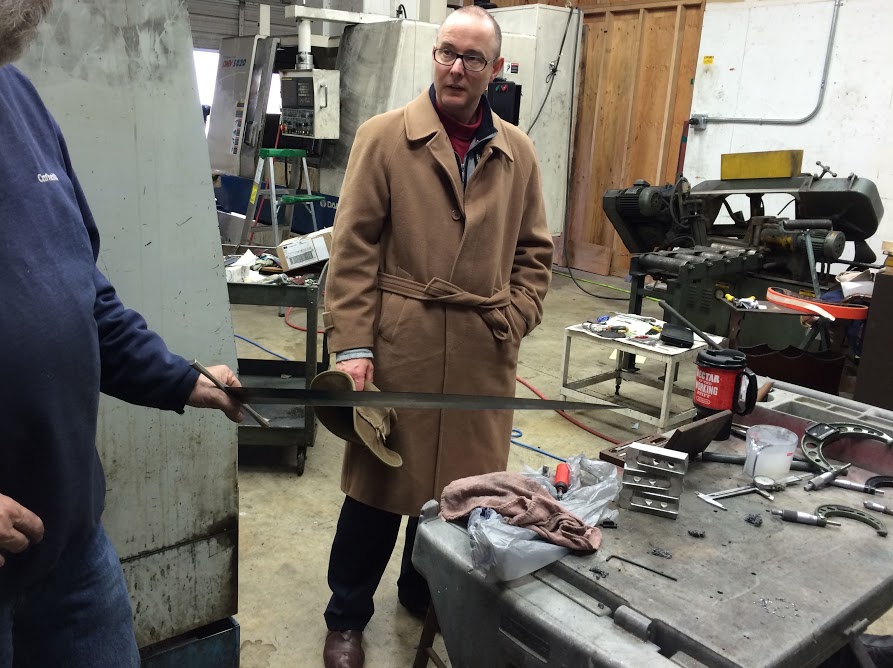
I also managed to catch up with the legendary Gus Trim, and see his workshop of doom. Seriously, this chap has the tools to outfit an entire zombie apocalypse.
Gus is a legend, and as such never appears on film. But that is his arm and beard.
Then on to Vancouver, and VISS. This was an utterly delightful event, except for the unfortunate tendency of shrines to yours truly popping up in all sorts of odd places. I AM NOT DEAD YET! As the students in my three-class seminar series found out.
I'm NOT DEAD!
They were a lovely group to teach, as they quickly picked up on the idea that I was there to teach them what they wanted to learn, rather than just run a class plan through them. Each class began with us deciding together what to cover, and at each point where a decision had to be made about where to go next, I consulted them. This lead to some interesting choices; I was not expecting to spend over an hour on longsword striking mechanics, but damn, that’s the best stuff!
The event was preceded by a two-day “Instructor Summit” (only Devon can get away with calling an event a Summit. Really, the man’s a marketing genius, and uses his powers only for good). This was very useful, not least as it was basically two days of instructors chatting about problems they have, and drawing on an enormous pool of knowledge and experience to solve them. There was absolutely no “do it my way”, but lots of “I solve that problem like this”. One of the things I liked best about it was that there were at least three instructors there who have been training longer than I have; a couple since before I was born. And still there was no jockeying for status, political bullshit, or anything other than peers interacting for the common good.
Most of us, in one place. A pub, naturally.
Other highlights of the event for me were:
An afternoon spent with Tom Leoni, with il Fior di Battaglia open on the table, and a couple of swords handy, discussing our variant interpretations of the crossing of the zogho stretto.
An hour spent exchanging mechanics exercises, and killer push-up variations, with Kaja Sadowski and Randy Packer. Randy also gave me one of the best compliments I have ever received; he credited my class on mechanics at 4W in Seattle 2004 with inspiring him to go into body mechanics in depth, which has resulted in his blog BoxWrestleFence, and the foundation of Valkyrie Western Martial Arts Assembly. Valkyrie just that week found a permanent 24/7 training hall.
A private lesson from Roland Cooper on the deadlift; I knew I was doing it sub-optimally (ie. wrong), but have now seen the light. He also gave me an amazing book: Starting Strength. Which I managed to pack.
Meeting the legendary Mark Mikita, of The Mikita School of Martial Art. This chap has been quietly and steadily teaching and training at the highest levels since about 1968. And the walls of his training hall are a work of art to behold. Seriously, it would be worth a trip to LA just to see them in person.
Meeting Marco Quarta, at last; I attended his lecture on the esoteric aspects of European swordsmanship, which combined his scholarly research into Alchemical sources, with his day-job as a research scientist in neurobiology.
Playing a public game of Audatia at the Gala party on Saturday, with Roland Cooper; we were ably assisted by a live Galeazzo, and a live Boucicault, who enacted with swords what we were doing with the cards. Of course, it ended with a kick to the nuts for the unfortunate Boucicault. Viva Italia!
I could go on with a lengthy discourse on meeting up with old friends (Steve, daaaahling!), making new ones, and in general having a wonderful time, but I’d be bound to leave someone out, and I’d hate to hurt anyone’s feelings. This was a lovely, lovely trip, and I’d like to thank everyone in Vancouver, especially the volunteers who made the event run like clockwork. One interesting point there; every single person who I complimented on the organisation replied not with “thank you”, but with “we have a really great team.” Nobody took personal credit for anything. It was amazing.
And a special thank-you to the Masons of Vancouver. They allowed the event to take place in their Masonic Lodge, trusting us to be respectful of their space. This was the first time in decades that they had allowed outsiders in, and I hope they found that we lived up to their expectations. I personally found the regalia and symbology of their ancient traditions inspiring, and clearly related, in part at least, to what we do as historical swordsmen.
The flight home to Italy was surprisingly uneventful; Vancouver to Montreal, Montreal to Munich (a Lufthansa flight. Nice of them to bother. Though it was late and I caught my connection only by the skin of my teeth; I’ve got to hand it to the Germans though: there was a special bus waiting to get us through security and passport control, then straight to the plane), Munich to Pisa, bus from Pisa to Lucca. And back home to my babies. For 18 hours, because the next day we left Lucca en famille, and flew back to Helsinki (Lucca-Pisa-Munich-Helsinki. I wasn’t tired at all). Our Italian adventure is not over though; we will be back!
I'm writing this blog post in Seattle, sitting at a table in my friend's house, with a gorgeous view over Lake Washington. Tomorrow I'm teaching a two day seminar for Lonin, then staying on to work with the CLANG team for a couple of days. When I arrived yesterday there was a boxful of my new dagger book, hot off the presses waiting for me. Hurrah! So, back to those beginners…
Last Tuesday marked week six of the beginners' course, and we had a full turnout. As I mentioned regarding last week's low turnout, sometimes that is just a concidence- it's rare for everyone to show up, and sure enough, this week we had 22 out of 24, with the missing pair dealing with a flood in their apartment block (a fair and acceptable excuse).
We began with the warm-up, including the swinging exercise as a way to examine initiation (what moves first), and our favourite three point push-ups. I also included the exercise in which you stand on your left leg, and move your right foot in a clockwise circle, and your right hand in an anticlockwise circle- good for establishing balance and coordination. I also had them go into a push-up position on their hands, then shift to their knuckles, and back to their hands (no actual push-ups yet, just the knuckle position). This establishes a reference point for the right wrist position for striking with the sword, without putting too much strain on them.
We then revised the 3 turns, 4 steps and 4 guards, and the four guards drill, before falling practice.
We then looked at making our partner fall to the ground from posta longa by simply turning their wrist: essentially extracting the mechanics of the disarm that they know, and putting it to use to create a (very artificial) takedown. From here we went straight into the first master dagger disarm, and then the fifth play of the first master (an arm break, where you grab the attacker's wrist and elbow). We then did that with one arm, aka the third play (ligadura mezana), and then applied the same mechanics to the takedown (7th play). By stringing the techniques together like this, the common mechanical thread is clear, and so picking up the techniques as variations on the same idea becomes pretty easy. we then looked at The Book, to see these techniques in context, after which the students picked the one they found the hardest to practice.
this allowed me to notice and correct a common, general error (as opposed to a technique-specific problem): the way they were doing the initial cover. They practiced that correction, then we finished up this section with the dagger disarm flowdrill.
All this took only 55 minutes. I remember teaching a comparative seminar with my colleagues Kaj Westersund, Ilpo Jalamo and Petteri Silenius, years ago, while they had decades of teaching experience and I only a few years. The thing that struck me was that somehow they could get their classes to do much more stuff in much less time than I could. I don't mean that they crammed their classes, just that the students were able to absorb and use more material in less time. It feels like I'm progressing as an instructor to see how much faster my students are picking up the material. It has a lot to do with how the material is organised and presented, I think.
Anyway, the class now picked up swords, we saluted and got started on mandritto fendente (donna-longa-zenghiaro), then roverso fendente (donna-longa-tutta porta di ferro). One round of each, and then part one of the cutting drill. Once the choreography was re-established, we did the series of grip handling drills that I taught them in week 4, and then went back into part one to practice keeping a relaxed grip in a set solo drill context, so using the drill as a place to go to practice a specific skill.
We then went through first drill, step-by-step. This was revision. What with all the new dagger material, I felt their capacity for new techniques was already stretched far enough.
This crop of beginners is remarkable for their training attitude- almost all stayed for a while after class, the last ones leaving at about 8.45 having spent much of that time actually training. Some even had the nerve to ask me for specific help, which resulted in me working one-on-one with them, not biting their heads off (rest of class take note).
As I'll still be in Seattle next Tuesday, Ilpo Luhtala will be covering the beginners'class, and I've asked him to spend much of the time on revision, but to include the 3rd and 4th plays of the first master of dagger. This to prepare the class for my taking them through second drill in one go in their final, eighth, session.