
Guy's Blog

Guy frequently keeps this blog updated with thoughts, challenges, interviews and more!

Tag: Philippo Vadi

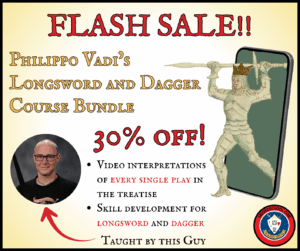
Flash sale on Philippo Vadi's longsword and dagger courses bundle

Would you like a complete interpretation and training method for Vadi’s Art of Arms, as found in his De Arte Gladiatoria Dimicandi?

Well now you can have it, with the Philippo Vadi courses bundle, which includes my Philippo Vadi Longsword Course, and my Philippo Vadi Dagger Course.

The courses also include all of Vadi's other plays, such as sword in armour, pollax, and spear.

Bought individually, these courses cost $850. The Bundle is only $600. And you can get 30% off until Wednesday (October 15th).


Click here to enrol, and use the code WELOVEVADI2025 at checkout to get the discount.

The Longsword course includes over 75 video lessons, across 8 modules:

  1. Introduction & Safety
  2. Footwork and Sword Handling – Warm-ups, footwork, grips, and mechanics
  3. The Blows of the Sword– Vadi’s blows, including drills based on the guards
  4. The 12 Guards – Every position explained and drilled
  5. Basic Training and Setting up the Plays – Solo and pair training to build a solid foundation
  6. The 25 Plays of the Longsword – All 25 plays from De Arte Gladiatoria Dimicandi, step-by-step
  7. Plays from Chapters 11 and 15 – Extra drills from Vadi's theory of fencing
  8. Skill Development – Fencing games, timing, and troubleshooting

Sample video:

The Dagger course includes over 55 video lessons, across 5 modules:

  1. Introduction & Safety
  2. Basic Training: Falling and Mechanics – Warm-ups, footwork, and mechanics
  3. Dagger Grips and Strikes
  4. The Dagger Plays from De Arte Gladitoria Dimicandi – Every play explained and drilled
  5. How to Train – Solo and pair training to build a solid foundation

Sample video:


Who This Bundle Is For

  • Beginners looking for a structured, complete introduction to longsword
  • Experienced martial artists who want to explore Vadi’s unique system
  • HMA students seeking historical accuracy and practical application
  • Anyone who’s ever dreamed of mastering the knightly art of the sword

What’s Included

  • Full lifetime access to all course materials
  • Train at your own pace, anytime, anywhere
  • Mobile and desktop friendly
  • Immediate start—no prerequisites required
  • Get Started Now

You don’t need fancy gear or years of experience to begin. Just a sword (or even a stick), a mask, a friend, some space, and the willingness to train.

Sound like your sort of thing? Go here and use the code WELOVEVADI2025 at checkout to get 30% off.
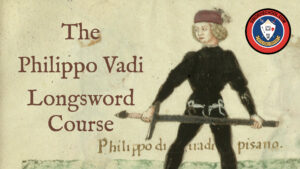
Philippo Vadi holding a longsword with the text "The Philippo Vadi Longsword Course"

It’s a great week for Vadi fans. My comprehensive new course “The Philippo Vadi Longsword Course” is now live on both Teachable and Swordpeople, and my friend Michael Chidester has also just launched his new crowdfunding campaign for a very high-end and beautiful facsimile of Vadi’s treatise, De Arte Gladiatoria Dimicandi.

This was a coincidence, and not ideal from a marketing perspective, but it does open up possibilities for co-operations and collaborations. For instance: Michael is offering a $25 discount (that’s over 10% off) on his facsimile for anyone who buys my course. We’re working out the technical details, and I’ll put the discount code in the course materials as soon as I have it.

Speaking of discounts- you can get 40% off the price of the course, in one payment or spread over ten equal payments, while the launch period lasts.

You can find the course here: https://swordschool.teachable.com/p/the-longsword-of-philippo-vadi?coupon_code=VADITASTICLAUNCH&product_id=6204895

If that discount code link isn’t working, go to courses.swordschool.com and use the code VADITASTICLAUNCH at checkout.

So what is the Vadi Longsword course, and what does it cover?

This isn't just another sword course. I've meticulously reconstructed Vadi's complete system from his treatise “De Arte Gladiatoria Dimicandi,” presenting it in a logical progression that takes you from complete beginner to confident practitioner.

Every martial art is a way of moving and a set of tactical preferences. In this course I have included a lot of movement drills, and a large range of technical and tactical drills: everything you need to become proficient in Vadi’s art. (Except the equipment (swords, masks, etc.) and a training partner (because that would be illegal). But I do expect you to share your course with at least one training partner.)
​You will get over 75 video clips, organised into 8 sections:

  1. Introduction & Safety
  2. Footwork and Sword Handling – Warm-ups, footwork, grips, and mechanics
  3. The Blows of the Sword– Vadi’s blows, including drills based on the guards
  4. The 12 Guards – Every position explained and drilled
  5. Basic Training and Setting up the Plays – Solo and pair training to build a solid foundation
  6. The 25 Plays of the Longsword – All 25 plays from De Arte Gladiatoria Dimicandi, step-by-step
  7. Plays from Chapters 11 and 15 – Extra drills from Vadi's theory of fencing
  8. Skill Development – Fencing games, timing, and troubleshooting

As you can see, we cover not only all of Vadi’s longsword plays, but also basic sword training, how to get into the plays tactically, and how to become skillful in their application.

Curious? Here’s a sample video, on one of my favourite Vadi-style sword exercises:

Here’s the discount link again: https://swordschool.teachable.com/p/the-longsword-of-philippo-vadi?coupon_code=VADITASTICLAUNCH&product_id=6204895

If that discount code link isn’t working, go to courses.swordschool.com and use the code VADITASTICLAUNCH at checkout.

I am not known for my sense of proportion when it comes to the Art I serve. OF COURSE everyone should train. OF COURSE it's more important than jobs or other distractions (I make an exception for children. Only for children). But the Art itself is based on proportion. For any action to work, it must be done in the correct time and measure. Both of these are not absolute dimensions, but proportional to the position and actions of the opponent.

In medieval times, up until comparatively recently, the units of measurement (yards, metres, pounds, kilos, etc.) would vary from country to country, even town to town. It was very difficult to establish absolute dimensions for anything. So all building plans and similar representations would be established proportionally, geometrically. Side x is twice the length of side y, etc.

This fits with fencing perfectly: as Vadi wrote:

La Geometria che divide e parte.

Per infiniti numeri e misure.

Che inpi di scientia le sue carte.


La spada e sotto posta a le sue cure.

Convien che si mesuri i colpi ei passi.

Acio che la scientia ta secure.


Geometry divides and separates

By infinite numbers and measures,

And fills her papers with science.

The sword is placed in her care,

So measure blows and steps together

So Science keeps you safe.

Geometry is the perfect science here because it does not deal in dimensions at all, just in relationships between lines. Measure and time are relative: to your opponent's actions and your own.
I am in the depths of a dip in typing speed thanks to learning to touch type and switching to the Dvorak layout (QWERTY is SO skeuomorphic, that once I took an interest in typing it started to bug the hell out of me, and a friend put me on to “‘,.PYF” instead) so this may be the last post for a while, as I work on technical exercises. Merry Christmas all!


The Fiore Extravaganza, a week-long immersion in medieval Italian martial arts, is now over. This year we spent much of our time working through Filippo Vadi's fencing theory, and his 25 longsword plays. This was in part to help with the commentary section of my upcoming Veni VADI Vici book, in part to satisfy the curiosity of the students present, and in part because it provided a set of key plays and concepts that bridge the gap between Fiore's longsword material other systems.

While it was clear that Vadi's presentation of the material is far less complete and far less well organised than Fiore's he nonetheless introduces some important concepts. In the first advanced class following the Extravaganza I summarised the critical insights like so:

1) Size matters. Vadi requires us to use a longer sword than the ones we see in Fiore. This has a huge impact on the appropriate responses to the crossing at meza spada. Video explanation to follow!

2) The blows of the mezo tempo “remain in a knot”. At the moment the default understanding seems to be that the “mezo tempo” equates to a counterattack with a half blow. That is just not how he is using the terms- they are instead the blows done from the meza spada crossing, in which your hands must remain in front of you and the sword going forwards turning around its midpoint or you get stabbed.

3) All of Vadi's longsword plays can be done from the meza spada crossing, which is analogous to Fiore's crossing in zogho stretto.

4) The solutions Vadi talks about when crossed at the middle of the swords are very similar to those found in Liechtenauer; and depend in large part on the sword being some inches longer than the ones illustrated in Fiore. He describes actions that are very similar to certain windings (e.g. “the arms play above the head”), and actions like zucken.

5) Vadi's longsword guards are not always created by blows, and though he makes little real use of them, he includes guards that we do not see in Fiore or the Liechtenauer system, but which appear in the later Bolognese.

6) His solution to avoiding the complexity of the plays from the meza spada (zogho stretto) is exactly as Fiore's- parry from the left with a good roverso and strike.

The Extravaganza ended, as always, with a tournament. The format was agreed beforehand by those participating, and unlike last year we went for the two teams approach. The participants were divided into the A team (seniors) and the B team (juniors). We started with two rounds in which the B team members challenged the A team member of their choice, at the weapon of their choice. This guaranteed every B team member at least two good fights. If the B team member won either of their fights, they got into the final. Those B team members that did not get into the final were organised into a pool and all fought each other, giving them more experience. The winner of the pool also won a place in the final.

The finalists, so the original A team plus successful B-team members, were organised by rank and experience, and fought a winner-stays-on elimination. Number one fought number 2, winner fought number 3, winner fought number 4, etc etc. The spectators got to pick the weapons used. So the most experienced person would have to beat every other finalist to win- the least experienced had to win only one fight to take the tournament. Janne Kärki of the Kuopio branch won in fine style, winning four matches in a row. His prize was a bout with me, which we both enjoyed thoroughly.

All in all, a fantastic week of research, training, and fighting. Well done all who took part!

Search

Recent Posts

Categories

Categories

Tags