Guy's Blog

Guy frequently keeps this blog updated with thoughts, challenges, interviews and more!

Tag: health

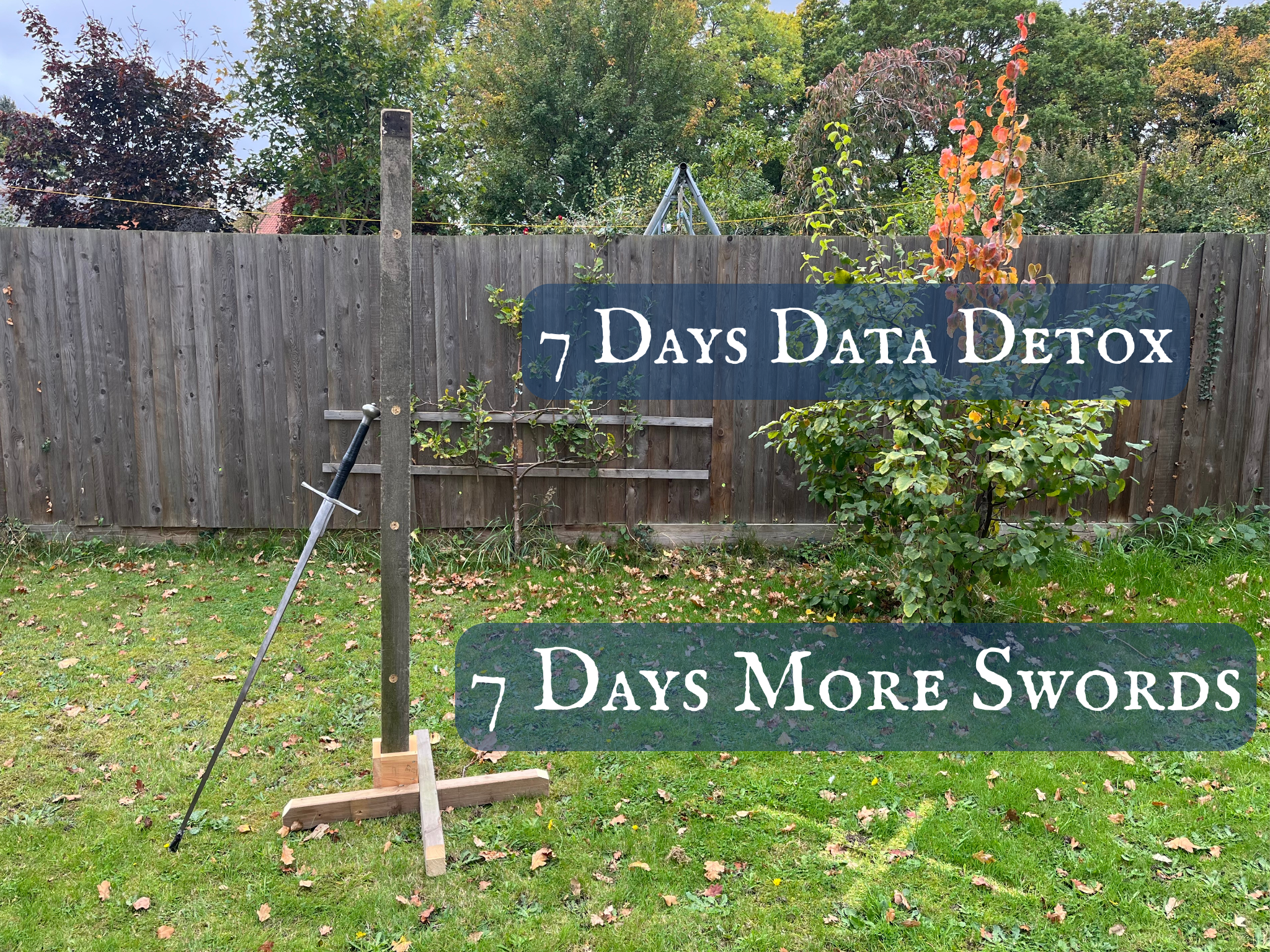
My pell on its new base, with a longsword leaning against it, put together during my 7 day data detox.

I spent the first week of October on a data detox. No emails, no whatsapp, no socialz, no scrolling. It’s been a lovely mental break. My initial reason for trying this was to allow my inner visionary to be heard, as per this post

The single biggest surprise is how little I missed it. I was really looking forward to it, and enjoyed the lack of distraction very much indeed. Days one and two were very relaxing. For reasons I can’t pin down, but which may be related to withdrawal, I was grumpy as hell for days three and four. Oddly though I didn’t have any urge to get online, so I don’t think it was withdrawal exactly. Then things perked up immensely on days 5-7, and I got a bunch of things done that I’ve been meaning to get round to. More on that below.

Filling the Void

So what filled the void created by the data detox? That gaping chasm of boredom and ennui that our marvellous machines cover up with clicks and scrolling?

1. I’ve thought a lot. It’s actually nice to be back in my own head a bit more.

2. I’ve did a lot more actual sword practice, in addition to my usual physio/fitness/strength stuff.

3. Coincidentally (I think, because these were planned ages ago) I went to the actual theatre, and met friends for lunch in the pub (yes I’m still off booze, 50 more days to go), and been to a talk (given by Roland Allen, of The Sword Guy and A History of Thinking on Paper fame). All analogue, real people in a room together, offline goodness.

I should point out that I was not religious about this. I used my wife’s laptop to print out crosswords, and fired up my phone to be able to navigate to drop off my daughter at a friend’s house for a party (I don’t have a paper map of the area, which I should!). But outside some very sensible exceptions, I’ve kept the phone turned off, and did not check any messaging apps or email when I did turn it on. The computer was not turned on at all.

I finished making my mum’s birthday present, put a new base on my pell so it stops falling over when it’s windy (see the photo above), and rearranged my study such that I could get my point control wall target up (it needs a sturdy wall to hang on, and room in front and to the sides for footwork). 
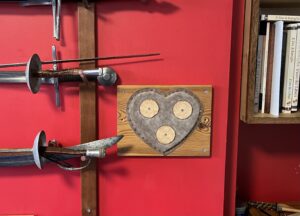
Wall target put up during my 7 day data detox. Leather and wood, on a red wall.

I also planned a new launch, thought about the overall structure of my business, and got a bunch of CEO stuff done. I don’t think my visionary woke up particularly, so I need to think about how to make that happen.

One of the things I’ve been thinking about is how we have all sorts of social rules and norms around other addictive behaviours, such as drinking and smoking. If someone offered you a glass of wine at 11am you might say “it’s a bit early for me”. Because these days it’s normal to avoid drinking during the day. Likewise smoking. It used to be everywhere, all the time. But now it would be very very rude to light up inside someone’s home without asking, and most smokers would automatically go outside.

But watch any TV show from the 80s and just about every rich person is having a drink at 10am, and everyone rich or poor is smoking indoors at all hours. These healthier rules around smoking and drinking are relatively new, and relatively unconnected with legislation.

I do well with rules if they’re my own. (I do much less well with other people’s rules.) Both phones and computers are incredibly useful. But they are inherently built for distraction. So here are my rules for using my computer and my phone.

Rules for the Computer

1. Be a cat. I’ve borrowed this from Jaron Lanier’s excellent 10 Arguments for Deleting All Your Social Media Accounts Right Now. Cats don’t try to please people. They just pursue their own agenda, and allow the people in their life to serve their needs. If a cat wants stroking, you’ll know. The computer belongs to me. It’s a critically important tool for writing books, editing video, running my business, and communicating with people.

But it’s been warped by the internet into also being a major source of distraction. So I will approach my computer the way a cat approaches the humans that feed it. I’ve always had all notifications turned the hell off, but that doesn’t stop me from getting distracted.

2. Decide what I want to do before waking it up. That could be work on the next book, or some critical business task like paying a freelancer, or emailing someone about something. Then do that thing first. After my week away I have a long list of things to do, including drafting this blog post, that comes ahead of checking my emails. Happy to report I’m following my own rules.

3. Unless I have a good reason, don’t open any communications app before 2pm. Exceptions include scheduled zoom sessions (running a trainalong or doing crosswords with my mum are both good reasons), or if I’m expecting a time-critical message about something actually important.

4. Turn off all comms apps at or before 5pm. Exceptions as per rule 3. And take at least one full day per week off all comms. I think probably Thursdays, which I generally keep free anyway. 

5. Be a cat. It’s worth an extra rule to be reminded of the first one.

What do I want my Fondleslab Distraction Engine (aka “phone”) for?

There are many excellent things about the phone that I want to keep, that I missed during the data detox. In no particular order they are:

  • Camera
  • Podcast player
  • Music player
  • Sound recorder (when recording videos etc.)
  • Maps/navigation
  • Payments
  • Wallet for tickets, boarding passes, etc.
  • Calendar
  • The Sword People app for keeping in touch with my sword people and posting sword photos
  • Calculator
  • Notes app for when I don’t have a notebook or pen with me. Rare, but it happens.
  • StrengthLog app for tracking weights workouts
  • Family Whatsapp channel. I’d like to move it to Signal, but I don’t think we’d get everyone on board with it (my siblings, their kids, my kids, it’s actually quite a lot of people).
  • Some friends prefer Signal, so I have that for talking with them. 
  • One dear friend, and my godson only really use Discord, so I have that too.

But other than those excellent things, why would I want to be continually distracted?


Rules for the Fondleslab Distraction Engine

1. Be a really fucking grumpy cat.

2. Delete all addictive apps. No games, nothing that makes me likely to scroll (Ebay, Vinted, Chrono24, etc.). No emails. I have the accounts still there in the system settings, but I’ve turned off the email function. That way if I need to be able to check email on my phone for some reason, it’s easy to turn back on, but it’s not on by default.

3. Turn off all notifications. All of them. Especially badges (those red things that flag the app's icon). I’ll check the apps when I want to. The phone still rings if you call me, but that’s it.

4. WhatsApp, Messenger, etc. are strictly friends and family only. I have SwordPeople for work-related messaging. (Feel free to sign up there if you want to be able to message me outside email.)

5. Switch off the phone completely for at least one full day per week. So e.g. turn it off in the evening, and not turn it on until the morning of the day after next.

Final Thoughts on the Data Detox

I’m also thinking about getting a new phone number, and relegating the current one to a no-data phone, so I can use it for two-factor authentication, and as my “business” number, and keep my other number entirely private, so only people I’ve actually given it to will have it. My current number is clearly on too many databases, given the number of spam calls and texts I get.

I’m not alone in fighting this fight. Useful resources are the aforementioned Jaron Lanier’s 10 Arguments. Also Cal Newport’s Deep Work, and for non-algo-poisoned tech solutions, the Creative Good forum has all sorts of options and suggestions. Once you have all this distraction-free time you'll need to learn to prioritise, so you may find my post about deciding what to focus on helpful.

It's worth explicitly stating that I welcome emails from my students, readers, friends, family, and even some newsletters and other things. Email isn't the problem. It's letting it spill out of a confined space to take over my brain that’s the problem. The same is true for messaging apps generally. I've broken the cycle of reflexively checking for anything new coming in with my seven days off, so now I need to keep that cycle broken. Or I'll end up having a (metaphorical) whisky and a cigarette for breakfast again.
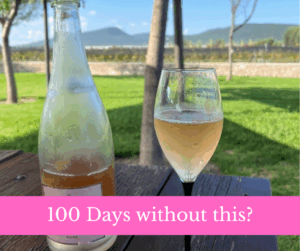
wine glass and bottle, scenery background, no alcohol 100 days

As I posted on Sword People last week, I'm taking 100 days off alcohol. Why would I do that?

The DEXA Scan: an uncomfortable truth

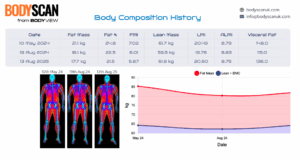
I was in London a couple of weeks ago for a family reunion, and took the opportunity to wiggle along for another DEXA scan (at BodyScan UK). My last was a year ago. On the positive side, I’ve put on about 2.4kg of ‘lean mass’ (the scan can identify fat, bone, and ‘lean mass’, which is everything that isn't fat or bone), mostly in the upper torso. And my overall fat percentage has come down from 24.8% in May 2024, to 21.5% now. Great.

But my genetics put the remaining fat mostly in my viscera, the absolutely worst place to have it. I had 148

cm² (which is a weird way to measure a volume, but hey) in May '24, down to 115cm² in August '24, but as the muscle piled on (yay!) it brought some fat with it (as it almost always does), and it all went round my organs, so it's back up to 136cm². Boo.

Dexa scan body composition history for Guy Windsor

Subcutaneous fat isn’t such a big health problem, in reasonable amounts. But visceral fat is bad for inflammation, blood lipids, diabetes risk, the works. And it seems that’s where I store it.

I've uploaded the results as a pdf here, in case you're interested in the actual numbers: Guy_Windsor_DEXA_2025-08-13-report


So why cut alcohol specifically?

I’m not a big believer in calorie restriction as the main driver of fat loss, because while the laws of thermodynamics are absolute, your body is insanely complicated, and has all sorts of ways of adjusting your metabolism to lose or put on weight depending on various triggers. What you eat, and when, is as important as how much. And don't get me started on gut biome. I first really understood this when I accidentally lost 10kg in three weeks. But if there are a bunch of unnecessary calories coming in from somewhere, that's the obvious place to start.

For me the biggest source by far of “empty” calories is alcohol. My natural state is to have a glass of wine or two while cooking, and another glass or three while having dinner, and maybe a dram afterwards, pretty much every day. I normally get through about 7 bottles of wine a week minimum, without hangovers or other obvious ill effects. I think my soul is mostly Italian!

When I went alcohol-free for a month this Spring (thanks to a bad cholesterol test), I lost about 2kg and 4cm around my waist. It messed with other things though- I didn’t get a word written in all that time, other than newsletters. And I didn’t feel any particular energy benefits. Though I ought to have been sleeping better, I wasn’t waking up full of beans and ready to face the day any more so than usual.

But, several credible sources (the folk I listen to most on these subjects are Dr. Peter Attia, and Dr. Rhonda Patrick) suggest that the real benefits to cutting booze come around the three month mark. Kevin at BodyScan said the same thing. So I’ve decided to take 100 days off alcohol. I started on August 19th. Day 100 is November 26th, four days before my birthday.

Why not just cut back?

It's very hard to measure a small amount every now and then. Sure, I bet I could get most of the benefits if I just had one glass of wine on a Friday night. I've previously established with sleep monitors that a glass of wine with dinner has no measurable effect on my sleep (I eat early). But then what happens to the rest of the bottle? How much wine is that really? What if I swapped out the wine for a dram of Lagavulin? It's just much easier to measure “no booze” than figure out “some booze”. And from a self-control issue, it takes very little effort (for me) to have decided to not drink at all, than to stop at one. The hard part is making the decision to stop. Now that's done, thanks to bastard DEXA, it's really no big deal (for me).

I know that other people have much more serious issues with alcoholism or other addictions, so please don't read this as minimising their struggles. And I can think of several life events that could occur that would lead to me immediately abandoning this experiment in favour of getting blootered. So no judgement.

The Pros and Cons of alcohol restriction

You may find the pro/con analysis I do for any intervention a useful rule of thumb, so here goes.

Cons first (always):

1. Is there any known, or likely, health downside? If someone were to suggest going without vegetables for 100 days, or going without protein, or going without exercise, or without in-person social interaction, I’d want to see an awful lot of peer-reviewed studies suggesting that it was a good idea. But there is no known health benefit (that actually stands up to scrutiny) of consuming alcohol. So I won’t be sacrificing any useful nutrients. The polyphenols in wine? I get way more of them from blueberries and dark chocolate.

2. The most common downsides of any intervention are time and money. Exercise costs time. Supplements cost money. Cutting out alcohol saves money and takes no time.

3. Alcohol has been a major component of Western culture since at ancient times. The slaves that built the pyramids were fed a kind of beer. 2600 years later Jesus's first miracle was turning water into wine. 2000 years on, not much has changed. Just about every major event is marked with booze of some kind. We drink with friends, we drink to celebrate success, to commiserate in disaster, to raise a toast or to drown a sorrow. Wine, beer, spirits of every kind have been part of our culture (and many others) since forever, and there is a huge amount of artistry that goes into creating a perfect wine to go with your steak, or the smokiest of single malts. That's the only thing that makes this in any way difficult: the sheer number of times already (it's been less than a fortnight!) when I've had to risk being thought anti-social to decline an offered drink. People who like to drink (like me!) can take this as a critique of their current habits. Nothing could be further from the truth. But cutting out alcohol does carry a social risk.

I worked out that the last time I went 100 days with no booze I was 13. It’s been nearly 40 years since I last tried this, and it’s just an experiment, not a moral position.

So the worst-case scenario is I get no noticeable benefit (but save some money), and lose out on some gustatory delight, and some people will find me stand-offish. I can live with that, for SCIENCE. I don't judge other people by what they choose to drink, so have no interest in the judgements of those that do.

Pros:

1. There is good reason to suppose that I’ll cut the visceral fat down, because it’s happened before (between my first two DEXA scans, in May and August 2024 which established a clear correlation between waist size and visceral fat quantity), and because of the waist reduction this year, in just 33 days of no alcohol.

2. There ought to be improvements in sleep quality. This is very hard to measure, and regular readers will know that I’ve tried several different sleep trackers and found problems with all of them. The only metric that seems at all reliable is heart rate. With alcohol, my heart rate is higher and more erratic when sleeping; without it, it’s lower and steadier. I've confirmed this many times since getting my first sleep tracker in 2017.

3. It’s a clear break from a habit I know is not healthy, and a fairer test of sobriety. I wouldn’t necessarily judge the effects of a diet or exercise program after just a month, so it seems reasonable to give no booze a fair crack of the whip.

The best case scenario is that I get amazing health and vitality benefits from this. But that will raise the issue of do I go back or not? I’ll have to entirely re-think the place that alcohol plays in my way of life. So I’d be lying if I said I wasn’t kind of hoping that it doesn’t help much.

It’s important to keep any test to just one variable. If I replaced booze with doughnuts I could reasonably expect to not lose any visceral fat. So I’m giving myself a couple of weeks to let my usual dietary rules slip a bit (I had four slices of my daughter’s banana bread after dinner last Sunday, with marmalade) but once I’m back from Swords of the Renaissance this weekend I’ll be pretty careful about keeping the rest of my diet as it was.

And finally…

I intend to report back here (maybe even with another DEXA scan) in due course. But I keep my friends on Sword People, and my newsletter subscribers updated on all sorts of things, including my various health experiments. Join us there, or sign up for the newsletter (or both!).

And let me just re-iterate: I'm running a health experiment. I have no moral problem with alcohol, and I don't think of myself as an alcoholic. If alcohol is damaging your health, or getting in the way of your goals, feel free to try 100 days off, or better yet get professional help. But it says nothing about your moral worth whether you drink or not.

Update at 50 Days

50 days into this experiment: so far, so good. The hard part was making the decision. Once it was decided, not drinking is normal. There are open bottles of booze in the house, but no temptation. Every now and then I fancy a drink, but the urge passes quickly. This was as true on day 1 as it is on day 50.

The closest thing to an exception has been a couple of social events in pubs, where I had a low-alcohol (0.5% or lower ABV) beer. I’ve done that twice. I don’t think it matters particularly, but I’ve decided to be careful in the last 50 days to stay off even that.

My weight is down about a kilo and a half (3.5lb), and my waist is down about 2cm. These are averages: weight fluctuates a lot during the day and from day to day: have a glass of water and you gain half a pound or so. Eat more fibre the day before and there’s more water held in your gut. So I measure weight and waist every day, and average them up over the week. Waist is especially problematic to measure, as it’s me with a tape measure, trying to be consistent about exactly where on my body I’m putting it, and exactly how tight, at what point in my breathing cycle. Sucking in my gut gets me down to 84, expanding as much as possible gets me to 96 (which is significantly smaller than my relaxed measurement in May 2024). So I’m not treating these figures as hard or accurate, but they are a reasonable guide to progress.

The oddest thing about this is that all of the weight and waist gains occurred in the first 25 days; they have been basically stable since then. Though I suppose it’s possible I’ve been losing fat and gaining muscle (or the other way round) since then. My weight training is the most reliable guide to muscle mass until the next DEXA scan, and I’m getting gradually stronger (as one would expect), so I doubt I’m losing significant muscle mass. I’m also careful to keep my protein intake quite high (about 1.5g/1kg of body mass, so about 120g/day for me).

I’m not sure if I’m sleeping better or not. I don’t wake up feeling any more rested than I did before, but I have several times slept a lot longer than I used to, for no apparent reason. I’m hoping that my brain is adapting to the lack of booze and getting better at staying asleep, but it’s too early to tell. Sleeping longer means I’m waking up later, so my usual habit of getting an hour or so of writing in before the house wakes up isn’t happening, but that’s ok; I seem to be productive enough.

On balance, this has been underwhelming in terms of health gains so far. I was expecting significantly more benefits already, given that I’ve come down from drinking an average of a whole bottle of wine every day. But who knows, maybe the next 50 days will hold some surprises.

This experiment is an example of my overall guiding principle of training: figure out what works for you, then do that. Both of those aspects are challenging: how do you figure out what works for you? And how do you maintain the practice of applying it? I go over all these things and more in The Principles and Practices of Solo Training.

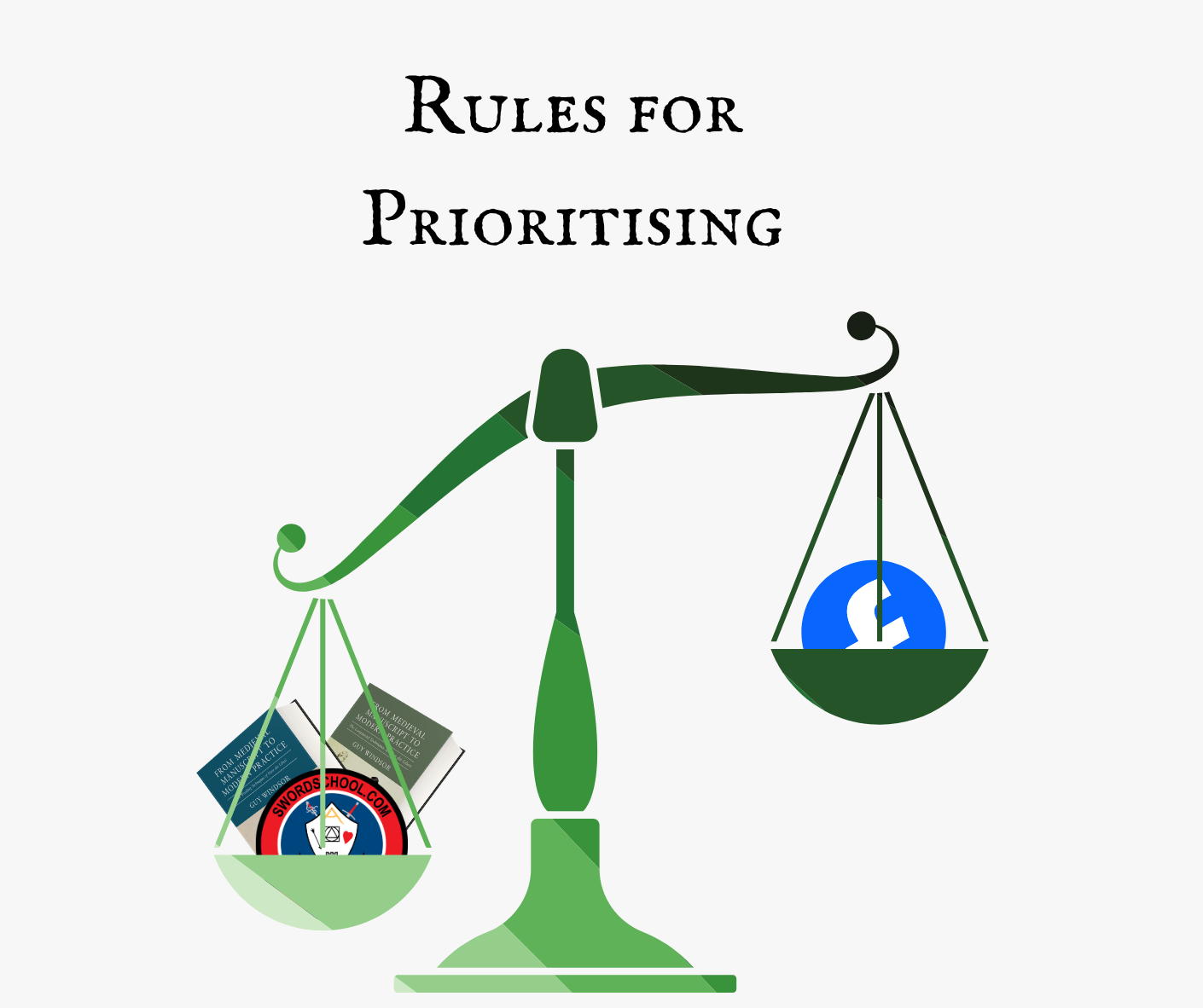
Scales showing Swordschool.com and two of Guy Windsor's books outweighing the Facebook icon. Rules for Prioritising text above.

In “Following my own advice” I described how I try to get something important done every day before checking emails, because prioritising the important over the apparently urgent is key. In that post I rather blithely referred to concentrating on ‘creating assets’, and loosely defined assets as “anything that adds value to your life. Value in this case is usually either money, or reputation, or both.”
I’ve had a lot of interesting feedback on the post, mostly through my mailing list (feel free to join below), and one point that came up more than once is that I didn't define ‘assets’ clearly enough, so I thought I’d go through in detail what I think I should be spending my time on.
You spotted how I carefully did not say “you should be spending your time on”, right? As ever, take my advice with a sceptical mind, and discard anything that doesn’t work for you. One big caveat: being self-employed means I have a dick of a boss who never gives me time off or a raise, but I can choose literally anything to work on. That's both a blessing and a curse.
Here is the Master Asset List, my top three assets, in order of priority.

1. Prioritising Mental Health

Every experience you will ever have is mediated and experienced by your consciousness. There is no experience so blissful that you can’t be miserable during it, and no experience so awful that bliss is impossible. Perhaps the best single resource on this is Sam Harris’ book Waking Up, closely followed by Mihaly Csikszentmihalyi’s book Flow. The key elements to my mental health are:
1. My relationships (primarily wife and children, other family and close friends, everyone else).
2. Meaningful work. Like writing this blog post. Or the next book. What makes it meaningful for me is its ability to transform other people’s lives for the better.
3. Meditation. I meditate every day, and have been doing so (with more or less regularity) for many years. The last year or so has been especially difficult, and one of my coping strategies has been to get a lot stricter about doing my meditation every day. It helps. I’ve written a short guide to getting started if you want to try it out.
4. Fun. Much underrated, but it is critically important to kick back and have fun often. Never underestimate the power of silly.

All the rest of these assets listed below are only relevant or useful because they affect my state of mind. It’s easier to be mentally healthy when you’re physically healthy and not worried about money.

2. Prioritising Physical Health

“If you haven’t got your health, you haven’t got anything.” Count Rugen was a villain, but he spoke truth here. Physical health rests on three foundations: sleep, what you eat, and how you move.

Sleep: The best single source on sleep matters (and sleep does matter!) is Matthew Walker’s Why We Sleep. In short, the more and better you sleep, the longer you live. Good sleep is really the ultimate time management strategy because it a) buys you more time because you live longer and b) makes your waking hours vastly more productive.  There are so many factors affecting sleep that it would take a whole book to go into them (like Dr. Walker’s!), but I’ll summarise the main things that have helped me:

  • Avoid caffeine for at least 12 hours before bedtime. Yes, 12 hours. I only drink coffee at breakfast. Caffeine kills deep sleep.
  • Avoid alcohol, or at least get it all out of your system before bed. Alcohol kills REM sleep.
  • Keep the bedroom dark, cool, and quiet.
  • Stop eating at least 3 hours before bed. A full stomach affects sleep quality.
  • Nap, but not too long or too late. eg 30-60 minutes at 2pm.
  • All screens off at least an hour before bed, and screens after 8pm are set to ‘Night Mode’, cutting down on blue light. This last may not be very important (the scientific consensus has changed since the first draft of this), but if you're avoiding screens you're also avoiding emails, social media, etc., which will tend to keep you awake.

I could go on, but you get the picture. As with everything, experiment to see what works for you. I track sleep with the OURA ring when necessary, but you can use other tools, or just notice how you feel in the morning. Top tip: if you need an alarm to wake up, you haven’t slept enough.

Diet: I’ve written up my approach to diet in lots of places, including here, here, and here; and it can be summed up as:

  • learn to cook
  • avoid sugar
  • eat lots of vegetables
  • pay attention to high quality fats, and
  • fast every now and then.

That's a very big topic dismissed in a few lines, so do check out those links if you're interested.

Exercise: How you move… hmmm, I wonder what kind of exercise a professional swordsman would recommend… ok, start with looking after your joints (here’s a free course on knee maintenance), and carry on by finding any physical activity that you enjoy, and do it regularly. That could be walking the dog, ballet, rock-climbing, trapeze, anything. Some activities are better adapted for long-term health than others, but if health is your priority you can probably avoid most of the damage that might be done during the less conservative activities. I’m a big fan of breathing exercises, as you probably know; they are the foundation of my movement practice, and they are specifically designed and intended for promoting health.
An imperfect plan that you actually follow is way better than a perfect plan that you abandon, so it’s much more important to find something fun that keeps you moving, than it is to find the ‘perfect’ health-giving exercise. Moving your body should not be a chore.

I cover all these aspects of physical health in my book The Principles and Practices of Solo Training.

3. Money

Once your mental and physical health are being attended to, then the next big thing is money. Money worries are truly toxic to your mental health, and can poison every aspect of your life. Think of those bankers jumping out of windows during the Great Depression, all because some numbers on a bit of paper were not the way they wanted them. Weird, huh? But real. Just choosing not to worry is an option, of course, but it's much easier for most people to actually do something to reduce expenditure and increase income. Incidentally, my favourite money blog is Mr Money Moustache. He's refreshingly unapologetic.
I should point out that I am by no means rich- I can count on the fingers of one hand the number of months since I became an adult in which I had enough cash in the bank to cover the next month’s bills in advance. This is because I have always, always, put time-rich ahead of money-rich, on the grounds that you can always make more money but when time is spent, it’s gone for good. My first salary as a cabinet maker was £6000 per year. I learned fast enough to double that in two years. Woohoo! And swordsmen these days don’t make much cash either.
But, and here’s the big BUT. Since the beginning of 2015, I’ve been effectively living off passive income. My books and courses generate about enough money to live on, month by month. People buy my books and courses while I’m asleep. And, given that I’ve never made a lot of money, I’ve never become addicted to a large and regular income, so it took relatively little time or effort to get to the point where my assets were generating enough income to cover all normal expenses. This means that I am now much freer to choose the things I spend my time on. Like taking all day Wednesday off this week because it's my daughter's birthday and she has stuff planned from dawn 'till dusk.

In short, my work priorities are:

  1. do I think it's important, in terms of serving the art?
  2. will it be good for my reputation?
  3. will it force me to acquire new skills?
  4. will it produce passive income?
  5. is it scalable?

Let's take those one at a time:

Work Priorities

1. Serving the art: In my experience, every single time I've tried to be ‘businesslike' and put what should be a sensible business move in place it's gone horribly wrong. But when contemplating a course of action if I can look into my heart and say ‘yes, this will serve the art', then it's always turned out ok (even if it hasn't made any money).

2. Reputation: Not every asset generates income: some generate opportunity. When The Swordsman's Companion was published in 2004, it made me no money at all (there’s a story there, but after suing the publisher, part of the settlement included a mutual non-defamation agreement. Make of that what you will). But that book put me on the map as an instructor. I suddenly started getting invited to events to teach, which massively broadened my horizons. Students from all over the world started to get in touch, having heard of me because they found my book in a bookshop somewhere. My Singapore branch came into being because Chris Blakey and Greg Galistan stumbled upon my book in the Borders Bookshop there. And when the rights reverted to me in 2012, I self-published it, and now it pays the mortgage.

3. Acquire skills: Time spent working on skills is never wasted, especially skills that you learn for their own sake rather than for a specific objective. Because whatever skill you are learning, you are simultaneously learning how to learn, and, more importantly, if you’re learning for its own sake you are putting process over outcome. Let’s say I learned to speak German because I wanted a job in Germany. If I learned German but didn’t get the job, the time would have been wasted, and I wouldn’t take full advantage of being able to talk to Germans in their own language, to read German books and watch German films. But if I learned German for its own sake, and it happened to lead to a job, well that’s a bonus.
A skill become an asset when they add value to your life. I really cannot think of a single skill I’ve ever regretted learning. And I can think of several that I learned ‘just because’, that then turned out to be professionally useful. Martial arts being the obvious example- I didn’t even think of turning professional until 2000, and I had about 15 years of training under my belt by then!

4. Passive income: There is nothing wrong with being paid for your time. And nothing wrong with being productive. But even in the classic model of employment, you’re supposed to retire at some point and live off your pension. Your pension is created by investments that pay you a passive income. This is how people in professions like dentistry can end up retiring in comfort- they make a good income per hour, being paid by the hour, but use a big chunk of that active income to buy assets (such as stocks and funds) that produce a passive income.
A passive income is defined as income that requires no work on your part whatsoever. If you are packing and shipping your own books, that’s not passive income. If you have to be in a specific place, or awake at a specific time, to get paid, that’s not passive income. When I am faced with a choice between producing something I can get paid once for (a woodworking commission, a writing commission, private lessons, seminars etc), or producing something that will generate a passive income stream, even a small one, then I will tend to choose the latter.
Perhaps the most outrageous examples of this choice comes from the original Star Wars movie. Carrie Fisher sold her image rights outright for a sizeable chunk of money. Over a thousand dollars, I think, way back in the 70s when that was worth something. Alec Guinness got paid royalties. Guess which one did better? There was a lot of luck involved, but if you don’t have passive-income producing assets that might go all Harry Potter on you, then it cannot ever happen.
Let’s put some numbers on this. In 2016 The Swordsman's Companion made about 10,000 dollars in income for me (it was my best-selling book by a margin!). To generate similar returns, I would need at least 200k in traditional assets. Here’s an article on how that would work. If anyone wanted to buy that book off me outright, I’d therefore ask for at least 200k. Nobody in their right mind would offer me that much, so the book stays with me. Folk might stop buying it tomorrow. But folk might still be buying it in 50 years time. There is no way to know, and that is true of any asset. Stock markets crash like Italian drivers. There is no such thing as a perfectly safe investment- even cash loses value over time. My mother in law saved for a pension for 30 years- and just before she was due to retire, the fund (Eagle Star) crashed and she lost the lot. Nothing is safe, so the only sane course is diversification, which is why you can buy my books on any platform, in any format- so long as people still want to read about how to train with swords, they will be able to buy my books on the subject.

5. Scalable: A scalable asset is one which you create once, and can sell an infinite number of times. I have spent most of my working life producing non-scalable assets. Back when I was a cabinet maker, I would work for hours and hours on a piece of furniture, which was then sold. As a martial arts teacher, I would teach a class, which existed only in that moment. I got paid for that moment, but that was it. There is nothing wrong with this model if you have the energy to work full time forever, and never get sick. A non-scalable asset might produce passive income, but you can still only sell it once. A house that you rent out is a good example. It can be an excellent passive income stream, but you can only rent the house out to one tenant or group of tenants at a time.
A book is scalable- you write it once, and when it’s published people can buy as many copies of it as they want. You don’t have to write each reader a new book. An online course is scalable too; create it once, sell it as many times as you like.

Ideally, my most productive time is spent prioritising serving the art, building my reputation, learning skills, and producing scalable assets that produce passive income.

So, that's how prioritise my time; how do you prioritise yours?

“If you haven’t got your health, you haven’t got anything!”

Truer words were never spoken, certainly not by Count Rugen anyway.*

Way back in the dawn of time when I began training martial arts, I was enraptured by the idea of martial arts training being a balance between breaking people and fixing them, by the notion of the martial artist as a healer as well as a warrior. This is one of the reasons I was drawn to T’ai Chi; it is usually associated with healthy practice. And it’s why I was so taken by Tai Shin Mun kung fu (you can read more about that here). I literally owe my career to the not-so-tender ministrations of their instructor, Num, who fixed my wrists for me back in 2000.

This is the background behind my obsession with mechanics and correct movement. Not so much for martial efficiency, though it certainly does that, but more because I want to be able to train until I die (sometime in my early 100s). I am blessed with a crap skeleton, which creaks and breaks and sends lances of agony up my spine if I fail to keep up my practice, or if I practice just a little bit wrong. Blessed because it has forced me to learn absolutely correct movement, which has in turn allowed me to share that knowledge with my students, freeing many of them from long-term pain, and undoing, or at least halting, the damage caused by poor mechanics.

I cannot abide the idea of anyone who needs this knowledge not having free access to it, certainly not for such a poor reason as lack of funds, so I have extracted the essentials from my footwork course, shot some extra footage, and put together a short ‘keep my knees working forever’ course. The course is 100% free and without strings attached. I want you to be healthy. Go, be healthy.

http://swordschool.teachable.com/p/free-course-knee-maintenance

I am also planning a weapons-handling course, which will include forearm conditioning and maintenance. I’ll release the essential health component of that course free too, so you can keep your arms working properly despite the depredations of computers and couches.

It was my birthday yesterday, and I intended to launch this then (I approve of the Hobbit custom of giving presents on your birthday), but I was sadly too busy opening presents, drinking wine, and generally having fun, so it's an early Christmas present instead.

*if you don't know who Count Rugen is, you very badly need to drop what you're doing and watch the Princess Bride. See here:

safety-guidelines-cover

Safety Guidelines for the Practice of Swordsmanship

These safety guidelines come from my Recreate Historical Swordsmanship from Historical Sources Course and have been adapted from The Duellist's Companion, The Swordsman's Companion, and The Swordsman's Quick Guide part 1: The Seven Principles of Mastery. All of those books are included as downloadable pdfs in the additional course material.

Climb if you will, but remember that courage and strength are nothing without prudence, and that a momentary negligence may destroy the happiness of a lifetime. Do nothing in haste; look well to each step; and from the beginning think what may be the end.

Edward Whymper’s admonition, from Scrambles amongst the Alps, elegantly encapsulates the correct attitude to all potentially lethal activities. Substitute “practice swordsmanship” for “climb”, and there is the correct mindset for any swordsman, beginner or expert. Take it to heart before you start training with a partner.

When training with weapons you hold your partner's life in your hands. This is a sacred trust and must not be abused.

Disclaimer: I accept no responsibility of any kind for injuries you sustain while you are not under my direct personal supervision. During this course you will be taught how to create safe training drills, and I am certain that if you follow the instructions there is a very low likelihood of injury. But if I am not there in person to create and sustain a safe training environment, I cannot be held responsible for any accidents that may occur.

Principles

The basic principles of safe training are:

  1. Respect: for the Art, your training partners, the weapons, and yourself.
  2. Caution: assume everything is dangerous unless you have reason to believe otherwise.
  3. Know your limits. Just because it’s safe for somebody else, does not necessarily mean it’s safe for you. Never train or fence when you are tired, angry, or in any state of mind or body that makes accidents and injuries more likely.

Most groups that keep going for more than a year have a pretty good set of safety guidelines in place. Make sure you know what they are, and follow them.

My senior students routinely train with sharp swords, often with no protection. That’s not as dangerous as it sounds, when you remember that they have been training usually for 5+ years at that point, under my supervision.

Safety first: you cannot afford time off training for stupid injuries. Life’s too short. Whatever training you are doing must must must leave you healthier than you started it. You will not win Olympic gold medals this way, but you won’t end up a cripple either. The path to sporting glory is littered with the shattered bodies and minds of the unlucky many who broke themselves on the way. Don’t join them.

Every time I find myself teaching a group I don’t know, I tell them that the class will be successful from my point of view if everyone finishes class healthier than they started it. Most injuries in training occur either during tournament (highly competitive) freeplay, or are self-inflicted during things like warm-ups. In my school (and other classes) we have a zero tolerance policy on macho bullshit. If any exercise doesn’t suit you, for any reason, you can sit it out, or do some other exercise. If you are sitting it out, a good instructor will ask you why, and help you develop alternatives or work up to the exercise in easy stages, but will never pressure you to do something that might injure you.

This is also true of work-related injuries, like forearm problems from typing, or the ghastly effects of sitting all day. By avoiding the things that will hurt you, you will naturally seek out the things that are good for you. Hungry? Avoid sugar, avoid processed foods, and lo! there’s a fresh salmon salad. Tired? Sleep is better than barbiturates, no?

This requires good risk-assessment skills (I recommend Against the Gods, the Remarkable Story of Risk, by Peter Bernstein) and the courage to take risks that truly serve your overall aims. A safe life is not worth living, but foolish risk-taking will not make your life meaningful.

Try adopting these key habits:

  • Before any new activity, do a risk/reward calculation. How risky is it, and how
    rewarding?
  • Practice saying no to training suggestions: even safe ones. Most people do stupidly
    risky things due to peer pressure. Being able to say no to your peers is perhaps the most important skill in reducing injury rates. If this is hard, make it a habit to decline at least one suggestion every session, until it’s easy.

Equipment

Without doubt the single most important bit of safety equipment is good common sense. Fence according to the limits of your equipment, exercise control and respect the weapon at all times, and you will never have a serious injury. Minor bumps and bruises come with the territory.

There were some masters who believed that the safest course is to fence with sharp weapons and no protection. This is how it was often done in the past until the invention of fencing masks (though there are tournament records and declarations as early as the 14th century that record the use of blunt practice weapons; King Rene d’Anjou’s treatise of 1470 is perhaps the best source). Such masters are right in theory, in that freeplay with sharps is the best way for students to learn absolute respect for the weapon, and the importance of absolute control. There are a few contemporary masters with whom I will fence like this, and there is nothing like it for generating a perfect fencing approach. But try explaining that to the insurance companies, or in the event of a slip, the police or coroner. It was often said in the eighteenth century that you could tell a fencing master from his eye-patch and missing teeth. Never forget that even a blunt blade can break bones. When free fencing, or when practicing drills at speed, it is essential that you wear appropriate safety gear. You do this not for your own sake, though self-preservation does come into it, but for the bene t of your training partner. Your protection allows him to hit you safely.

Choosing protection is a very controversial subject. Too little, and you can end up badly hurt (even in practice). Too much, and you can’t fence properly. Firstly, it is important to establish what style of fencing you will be doing. If you are practising armoured combat, then buy the best fitting, best made armour that you can from an armourer who knows how you intend to use it and has seen what you want to do. This is the hardest style of fencing to appropriately regulate, because accurate technique requires you to go for the least armoured spots (throat, eyes, armpits, joints), but safety requirements obviously prohibit that.

As a general guideline, I recommend the following for most weapons.

  1. An FIE standard fencing mask. This allows you to thrust at the face (a very common target), and generally attack the head. This does have three major caveats. Firstly, it leaves the back of the head open, and you must be very careful not to strike at this target. An added apron of thick leather affords some protection. Secondly, it does not protect the head and neck from the wrenching force of over-vigorous blows. It is vital that you and your opponent learn control before engaging in freeplay. Thirdly it is designed to protect the face from high-speed, light, flexible weapons, not slower, heavier, rigid ones. So continually check them for wear, and make absolutely sure that your weapons are properly bated.
  2. A steel or leather gorget, or stiff collar, to protect the throat. Points can slip under the bib of a mask and crush the larynx.
  3. (For women) a rigid plastic chest guard.
  4. A point-resistant fencing jacket rated at least 500 newtons. Sturdy, preferably padded and/or armoured gauntlets, which should extend at least four inches past the jacket cuff to prevent points sliding up your sleeve. I have twice had fingers broken through unpadded mail gloves, and now use a pair of fingered gauntlets from Jiri Krondak, which cost about 150€.
  5. A padded gambeson, or a plastron. If you are making one yourself, bear in mind that it should be thick enough to take the worst out of the impact of the blows, and prevent penetration from a thrust. All openings should be covered. The collar should be high enough that thrusts coming under the bib of the mask do not make contact with your throat. A plastron must wrap around the ribs, and properly cover the collar bones and shoulders. I usually wear a fencing jacket and plastron (as pictured).
  6. A box for men (called a “cup” in the US). You only forget this once.
  7. Rigid plastic protectors for the knees and
  8. For the elbows, of the sort worn by in-line skaters (worn under the
    clothes for that period look if you prefer), will save a lot of pain, and some injury.
  9. Footwear: on the matter of footwear, few practitioners agree. In the longsword treatises, there are no heavy boots, and certainly no built-up heels.  For a completely historical style, it is necessary to wear completely accurate period clothing at least occasionally, because it can affect the way you move. It does not matter much what you wear on your feet provided that you understand grounding, body-mechanics and footwork, but attaining that understanding is much easier barefoot or in very thin flat soles. Excessively grippy soles can lead to joint injury as you may stop too suddenly, or get stuck when you should be turning (particularly in falls at close quarters). The dangers of wearing too slippery soles are obvious. In the salle I usually wear medieval shoes or ‘barefoot’ shoes (aka five-fingers, or ‘toe shoes’), and recommend a thin, flat sole regardless.

The Sword

Training swords come in three main types. Authentic sharp reproductions, which are used for cutting practice and some pair work with advanced students, blunt swords that try to reproduce the handling characteristics of the sharps, and fencing swords that are designed to make fencing safer. These all have their pros and cons, and you should use the sword that’s right for your style and the kind of practice you will be doing.

It’s perfectly all right to use a wooden waster or something similar to start with, but do not imagine that there is any such thing as a safe training sword. Even modern sport fencing blades engineered for fencing sometimes break and puncture people, and anything heavy enough to reproduce the handling of a medieval or renaissance sidearm is going to be able to do damage.

For specific details on choosing a sword, please see Choosing a Sword, which is included in the additional material on this course.

Looking after your weapon is largely a matter of keeping it dry, clean, and free of stress risers (a stress riser is a weak point, usually a deep nick, which encourages the blade to fold at that point).

Occasional rubdowns with a moisture repellent oil and steel wool or scouring pad, followed by a coat of microcrystalline wax, should keep the blade and hilt clean (follow manufacturer’s recommendations if you have a gilt, blued or otherwise ornamented weapon). Do not be afraid to file down any large nicks, and file off any burrs: this is important from a safety perspective, as the blade is most likely to break at a nick, and burrs can be very sharp. The edges of a blunt weapon should always be kept smooth enough that you can run your bare hand hard up the edge and not get scratches or splinters. Even the toughest and most cherished sword will not survive repeated abuse: the best guarantor of longevity for your sword (and yourself) is correct technique.

Rules of Engagement

Once you have agreed to fence with someone, it is important to agree on rules of engagement. This is partly to ensure safety, and partly to create an environment in which you can learn. The two most simple rules are these:

  1. Confine permitted actionss to the safety limits of your protective gear
  2. Confine permitted actions to the technical range of the least trained combatant. In other words, do not allow face-thrusts when wearing open helms, or throws when one of you is not trained to fall safely. The rules can be adapted further to develop specifi aspects of technique: for instance, you may not allow any close quarters work at all, or even restrict allowable hits to one small target. The idea is to come to a clear, common -sense agreement before facing off. You are only ready for no-holds-barred, totally “authentic” fight simulation, when you can enter such a fight with your judgement unimpaired.

Following the rules of engagement will not make you soft, nor will it dull your edge if it comes to the real thing; rather it it will develop self-control.

These rules apply to all fencing:

  1. Agree on a mutually acceptable level of safety.
  2. Wear at least the minimum amount of safety gear commensurate with rule 1. Confine allowable technique to those within the limits of your equipment.
  3. Confine allowable technique to the technical ability of the least trained
    combatant.
  4. Appoint either an experienced student or one of the combatants to
    preside over the bout.
  5. Agree on allowable targets.
  6. Agree on what constitutes a “hit”.
  7. Agree on priority or scoring convention in the event of simultaneous hits. Usually it is better
    to allow a fatal blow before a minor wound, but simultaneous hits should be avoided whenever possible.
  8. Agree on the duration of the bout either in terms of hits, such as first to five, or in real time.
  9. Acknowledge all hits against yourself. This can be done by raising the left arm, or by stopping the bout with a salute, or by calling “Halt!” and telling your opponent where and how you think she hit you.
  10. Maintain self-command at all times.

Safe Training

In my experience most injuries are self-inflicted. It is far more common for students to hurt themselves by doing something they shouldn’t, than to hurt their training partners. Here are a few simple guidelines for joint safety, which should be followed during all training. I am using the lunge as an example of a stressful action, but these principles apply to any physical action.

  1. The knee must always bend in the line of the foot. Knees are hinges, with usually a little under 180° range of movement. The do not respond well to torque (power in rotation). So whenever you bend your knees, in any style for any reason, ensure that the line of your foot, the line of movement of your knee, and the line of movement of your weight, are parallel. This prevents twisting and thus injuries. This one simple rule, carefully followed, eliminates all knee problems other than those arising from impact or genetic disadvantage.
  2. Whenever performing any strenuous task (such as lunging, or lifting heavy objects), tighten your pelvic floor muscles (imagine you need to go to the bathroom, but are stuck in a queue). This supports the base of your spine, and helps with hip alignment.
  3. Joints have two forms of support: active and passive. Passive support refers mainly to the ligaments, which bind the joint capsule together. This is basically set, and can’t be trained. When training your joint strength, with exercises or stretching, avoid any action that strains the joint capsule. Any action that causes pain in the joint itself should be modified or avoided, as it may damage the soft tissues (ligaments, tendons, cartilage). These tissues have a very poor blood supply and hence heal very slowly.
  4. Active support refers to the muscles around the joint, and these can be strengthened by carefully straining the joint with small weights and rotations. To strengthen a joint you must stress these muscles, without endangering the ligaments. Any competent physiotherapist can show you a range of exercises for building up the active support around your knees, wrists and elbows, where we need it most.
  5. Rest is part of training. Your body needs time to recover, and is stimulated by the stress of exercise to grow stronger. However, the body is efficient, and will withdraw support from any muscle group that is not used, even if for only a few weeks. So regular training is absolutely crucial.

If you can’t lunge without warming up, don’t lunge except in carefully controlled drills. Warming up is essential before pushing the boundaries of what your body can do.


If you find this advice sensible and useful, please feel free to share it as widely as you like!

If you would like these guidelines as a handy PDF, then drop your email in the box below and I'll send it to you.


SQG7 Breathing Cover

Everybody breathes, but some do it better than others. Breathing training is the foundation of my martial practice, and as with everything else I do, I'm happy to teach it to you. The topic for the latest instalment of The Swordsman's Quick Guide  was chosen by my student Cecilia Äijälä, and she picked Breathing Training. I was delighted when she did so, because it forced me to get on and write up my training methods.

This book comes in three packages:

1.The Book, with Video

This package includes:

  • the book in epub, pdf and kindle format with links to the videos,
  • plus a separate download of all the video clips to teach you the exercises,
  • plus an embedded epub with the video clips built in.
  • It also includes a £10 discount voucher for the course.


I want this book

2.The Book with Audio and Video

This package includes:

  • the book in epub, pdf and kindle format with links to the videos,
  • plus a separate download of all the video clips to teach you the exercises,
  • plus an embedded epub with the video clips built in,
  • plus the audiobook,
  • plus mp3 recordings of the instructions for the individual exercises,
  • plus two bonus exercises (video).
  • It also includes a £25 discount voucher for the course.


I want this one!

3. The Breathing Course

The course is a carefully designed progression of exercises, spread out over six weeks (you can pace it as you wish, and do it faster or slower). Each week begins with a lesson, in which you will learn the exercises for the week. The week then continues with a shorter practice session, which you repeat ideally every day for the next six days. In the final week, you will learn how to create 5 minute, ten minute, and twenty minute practice routines, so that you will always be able to find time to do some practice.

The course material  includes everything in the other two packages, so all of the book, audio, and video files. The course is available now, but the lesson and practice routine videos are not completed yet. Week one is ready, and all of the book with all of its audio and video material too. Weeks 2-4 have been shot, and I'm editing them right now. The rest of the course material will be uploaded by October 1st.

http://swordschool.teachable.com/courses/breathing-basics

I released this to my email list yesterday (they get just about everything first!) with a healthy 50% discount. If you would like the same treatment, you can sign up to my list below, and I'll send you the same discount links. These links expire on Friday 9th September, so if you're interested, now's your best chance to save a packet.


I'm working on the latest instalment of The Swordsman's Quick Guide, which will cover my foundational breathing exercises. The book is already out to my test readers who have kindly volunteered to wade through the sewage of extraneous verbiage and excessive punctuation in search of the faintest glimmer of useful text. My fellow writers will recognise that moment when first draft hits first readers…

I intend to release this book with a lot of extra material, such as video of all the exercises and audio clips so you can play the instructions into your ears, leaving your eyes and hands free. This is completely new territory for me so I don't expect it to be very good right away. The only way that I know of to get better at anything is to do it, get feedback on the results, then do it again. A tiny amount of that feedback can happen internally- I can usually spot the utter crap and kill it before it escapes. But it's far more effective, I find, to ask the community that the work is intended for to try it out and let me know what works and what doesn't.

To that end, here are two clips, one for “Walking Breathing” and one for “How to Stand”. This is the worst way to encounter the material – out of context of the book it goes with. If it survives, in other words if you can follow it, then it's robust enough. Please listen to the clips, and let me know in the comments on this page, or by email to me at guywindsor@gmail.com, whether it works for you. Is it clear? Can you follow the instructions?

Walking breathing exercise:

[audio-clammr mp3=”https://www.guywindsor.net/blog/wp-content/uploads/2016/08/Walking-breathing-02082016.mp3″]

How to Stand:

[audio-clammr mp3=”https://www.guywindsor.net/blog/wp-content/uploads/2016/08/Breathing-How-to-Stand-02082016-10.43.mp3″]

So, how was it? Posting the most amusing comment will get you a free copy of the book when it's done, but the most helpful will get the book package with audio clips and audiobook. Carry on!

Everybody gets sick or injured every now and then, and I’ve had a pretty rough winter so far in that regard which has got me thinking about how I train when sick. In this post I’ll lay out my general principles for dealing with the problem and let me apologise in advance if it ever comes across as me whining about the flu. I really don’t mind getting ill, and I’m generally very lucky with my health.

Let’s start with the overarching principle: health comes first. This is directly drawn from one of my Seven Principles of Mastery “no injuries”. (You can find The Seven Principles of Mastery as a standalone booklet on various platforms, and it's included in my Theory and Practice of Historical Martial Arts). If training makes you worse, don’t do it! (You’d be amazed how often that rule is broken by people who should know better.) I train for the long-term benefits, not for the short-term buzz.

Injuries

With injuries, the trick is to modify your training to encourage recovery. My latest injury, just before Christmas (of course!) was yet another round of problems with my thoracic and cervical spine; every time I pressed even a small kettlebell above my shoulder, the right side of my neck would seize up in agony. No fun. So I went to the physio, and together we worked out a series of mobility and stability exercises that should restore mobility to the stuck bits, and restore stability to the hyper-mobile bits, and after three weeks of not being able to lift so much as a tennis ball over my head, I was back in business. So I immediately starting hoisting my biggest bell over my head, and the problem came right back. Or, that’s what I would have done when I was younger and stupider. Instead, I stalked my strength like it was a skittish colt. I very, very gently made sure that the full range of the motion was available, then slowly, slowly, added weight back on, all the while paying attention to keeping up the exercises that had restored the movement. The slightest twinge, and I’d stop. Now, three goddam months later, I’m back where I was three months ago.

But if I’d rushed it, I’d still be injured.

For impact injuries and soft-tissue injuries, the goal is the same but you need to pay attention to the difference between ‘good pain’ and ‘bad pain’; good pain you ignore; bad pain, indicating that the injury is being aggravated, you avoid.

The mnemonic I use here is “fuck it, but don’t poke the bear”. Specific neurological pain (such as my neck issue), or pain that indicates an injury is getting worse, is like a sleeping grizzly: the goal is to keep it asleep until it dies of starvation. But all the rest? Fuck it.

Sickness

So what about sickness? I have a very strong sense of the difference between a “walking cold” and a “systemic cold”. A walking cold is one with local symptoms; I might cough, or have a sore throat, or a headache, or whatever else, but the rest of me is basically ok. A systemic cold is when I can’t distinguish the boundaries of the illness, my whole body feel wretched. My goal with a walking cold is to prevent it becoming systemic. Here the principle I follow, along the lines of “no injuries”, is to pay close attention to how I feel right after doing any particular activity. Energy up is good, energy down is bad. “Avoid fatigue” might be another way to put it. So a little light stretching to preserve range of movement, leaving me feeling a bit better is ok; but if doing a push-up makes me feel tired, I’ll stop doing push-ups.

You read that right. Yes, there are times when I stop doing push-ups. Rare, but it does happen.

My first indication that my bout with tag-teaming viruses this winter was something I should pay attention to was when my cold shower in the morning left me feeling chilled to the bone, not invigorated. And yes, I did stop doing them, and gently worked my way back to them.

I’ve noticed that when my system is under attack from some horrid virus I do best by avoiding anything that elevates my heart rate more than a few extra beats per minute. So I might do one light lift, and stop. Swing a sword for a minute or so, and stop. Over the last few months when I’ve been hit by virus after virus (I’ve not been 100% well a single day since Christmas), I haven’t touched the deadlift bar. But I’ve been practising my deadlifts for a couple of minutes about three times a week, using just a stick. So the technique and range of motion is there, and, just last Friday, started back by picking up about half the weight I maxed out on last time I did them properly (before Christmas). Don’t poke the bear.

Most of the time, when I’m ill, it’s a walking cold; I can move around a bit, do light stuff, and not get sicker. But when or if it goes systemic, I have to be super-careful, and usually I don’t train at all, just the very lightest of moving about so my spine won’t seize up completely. Specific symptoms respond differently to different exercises. For example, I had a really bad cough for about three weeks in February; during that time, my Wim Hof breathing had to stop because it made me cough. But I could manage the Crane ok. When the cough morphed into a sinus nastiness, the kind where your entire skull becomes completely filled with nothing but snot, Wim Hof breathing was ok and so were some light kettlebells, but some of my meditation practices brought on bad headaches so I cut them out.

The last time I was at WMAW, in 2013, I had a bad walking cold; I was sick as a dog, coughing and feeling like shit, but I could move around. I had travelled all the way to America to fence with my peers. But I didn’t have a single bout with anyone, because I could feel it might trigger the walking cold to become systemic. That’s how seriously I take this.

Health comes first. As Count Rugen says to Prince Humperdinck, “If you haven’t got your health, you haven’t got anything”.

And if you don't know who they are, start here.

Woodworkers, depicted at the tomb of Rekhmire, from http://www.osirisnet.net/tombes/nobles/rekhmire100/e_rekhmire100_06.htm

I like reading about lifestyles I have no intention of emulating, but might learn something from. Such as the “travel the world for ten years with only one pair of underwear” minimalist types. It's all very “I've got an ultralight laptop and that's all I need”. Which is fine if you're only a writer or programmer or something like that. But as a writer who is also a swordsman and even a woodworker, it's not really a practical lifestyle choice. To do the things I want to do, I need swords, and tools. But one of the many things I've learned from people like Tynan, Tim Ferriss, and other techno-nomads is the joy of travelling handluggage only. On my last two long trips (Italy-USA-Canada-Italy; Finland-New Zealand-Australia-Finland) I travelled with only hand luggage. No sword bag (bliss! there are swords everywhere I go these days, so bringing my own makes no sense), no suitcase, just what I could fit into a 10kg carry-on bag. It's amazing how much crap I used to lug about, and now don't need to bother with, and do not miss.

So of course, in the run-up to moving to the UK in a few months, I'm shedding stuff like crazy. I just bought a decent document scanner (NeatDesk, second hand from a friend), so I can bin almost all of my papers. I'll be clearing out some of my books (I got rid of 18 boxes-full in the last year alone: which made no visible difference at all. I am, after all, a reader first and writer second). But at the end of the day, some stuff matters.

My glue pot. It will outlive us all!

Take this glue pot for instance. It's made of cast iron, in a form that goes back to the middle ages at least, though this pot is only about 100 years old. I bought it from Fred Murray himself, proprietor of Murray's Tools, an amazing tool shop in Edinburgh, just after I completed my first month of professional experience in William Trist's antique restoration workshop, where I first encountered this utterly brilliant glue. Hot glue, scotch glue, hot animal glue, hide glue; it has many names. And an indefinite shelf life if kept dry, and is still holding furniture together that was made by the ancient Egyptians. Show me any other glue which has been product-tested for, oh, two and a half millenia or so?

Ancient Egyptian glue pot

I love this pot. It represents proper, old-school, traditional craftsmanship. It's been with me for twenty years. I bought it from a man I liked, who sold it to me at a lower price than he could have got for it because he knew I'd be using it for its proper purpose.

I'm not selling it, giving it away, or leaving it behind. It came over in my hand luggage about a decade ago, and it's coming back with me, probably the same way. From a practical perspective, I can do without it; I fixed a friend's sideboard with hot animal glue a couple of years ago, melting the stuff in a bain-marie improvised out of a plastic cup and a saucepan. I could buy a modern pot, with electronic heat control so the glue never gets too hot. But life should never be simply a matter of practicality, and sentimental value is vastly more important than financial value, I would say.

The things you own, own you, if you can't walk away from them. I could walk away from most of the objects in my life. Almost all my swords, for instance. I really do view most of them as expendable resources, things that wear out eventually, and are easily replaced. But the ones made for me by a friend, those are not really replaceable. Even if they are no longer useful. But the list of things I just don't want to do without is surprisingly short.

That glue pot? That's mine. Or am I it's?


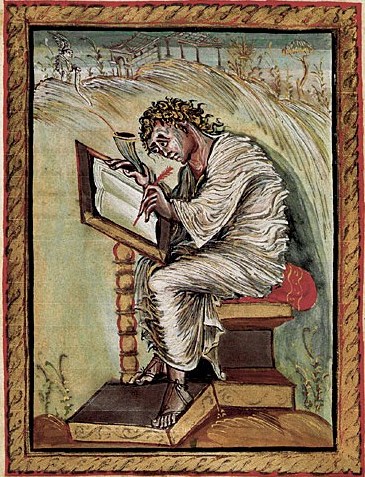
Medieval scribes had crap posture too!

medieval scribe writing with bad posture

Image from: http://www.booktryst.com/2012/03/medieval-scribes-gripe-about-writing.html

One of the challenges of my new lifestyle is that I don’t have class three or four times a week to keep me to a fitness regime. Before I could make the switch in my head from swordsman-writer to writer-swordsman, I had to figure out how I was going to prevent myself from becoming a weak and overweight lush who was always drunk by lunchtime. Because that’s what writers are like, no?

*Guy ducks and runs away from the many, many, uber-fit sword-swinging writers he knows*

Well, maybe not all writers, but I certainly have the capacity for it.

You may have read about my morning routines for beating jet-lag. I have developed and adapted those for preventing a condition that I will christen “writer’s blimp”. The trick, the key insight, is that this is about developing the sort of habits that will lead to my desired result, rather than coming up with a prescriptive regime. This routine has four steps:

1. Meditation

When I wake up in the morning, I usually go straight into an awareness-of-breathing or mindfulness meditation (guided or otherwise). This lasts from 5-20 minutes, depending on all sorts of things, not least the time. Ideally, I wake up naturally an hour or so before my kids do, which does actually happen about once a week. But one of the greatest privileges of my self-employed (and parental) status is that I almost never have to set a morning alarm. So I don’t set an alarm to be up in time to meditate before breakfast, because if I don’t have time to do it before the kids go to school, it’s #1 on my todo list after the house has quieted down.

2. Breathing

Then I usually do three rounds of Wim Hof breathing; if I’m too late to meditate before the kids come in, then I do this anyway. In the second round, while my lungs are empty, I get up and do some squats and push-ups. Then after breathing in, I do some gentle stretches, push-ups, that sort of thing, guided by how my body feels. Or I might do some of my classic breathing exercises. You know, like the ones in this book.

3. Engage with strength

I usually then do a couple of clean-and-presses on each arm with a 16kg kettlebell, some squats with a 16kg kettlebell cleaned in each hand, followed by a couple of double overhead presses with the 16kg bells, followed by some clean and presses with a 24kg kettlebell. Maybe some Turkish Get-Ups if I’m feeling energetic. This takes about 5 minutes, and engages just about every muscle in the body. If there’s time and I feel like it, I go for longer and do more.

4. Cold Shock

Shower next; for a long time I used to have a hot shower, then finish cold. Then I went to cold-hot-cold, again for several months, maybe a year or more; I didn't really track it. Now I treat hot water as a delicious luxury for when I really feel like it, and so usually shower on full cold only. It is very invigorating.

5. Paying attention to food

I always sit down for breakfast with the kids, but I don’t usually eat anything. If I’m hungry, I’ll eat some protein and fat (such as half a tin of sardines and a tomato); I try to avoid any starches or fast carbs first thing. (But oh! Peanut butter and banana on toast with brown sugar sprinkled on! Pancakes with bacon and maple syrup! Nutella with anything! I do miss them all, so they are weekend-only fare.) I almost always have a cup of coffee, and sometimes make it “bulletproof”: a chunk of organic butter, a dash of MCT oil, and whizz it with a hand-blender. It doesn’t taste very nice, if I’m honest (if you take milk in your coffee you’d probably like it more), but it does seem to delay the need to eat lunch, and it may help a bit with mental sharpness. I'm considering changing the pattern to eating in the morning, but last-calorie-in by 6pm, to give me the necessary metabolic cleansing time. Dr Rhonda Patrick suggests 14 hours as a useful minimum in this handy podcast. Dig into that if you want the details (and yes, she's a proper scientist). I have noticed that having an earlier eating window makes jet-lag recovery much faster.

When I settle down to work, it often means doing my 20 minutes or so of meditation, and sometimes some exercise (breathing exercises, kettlebells, that sort of thing) first. My feeling is that I need to maintain a solid baseline of fitness, strength, and agility, so that my body doesn’t deteriorate, and I can still do all the things I want to do (like beat the crap out of people with a sword practice swordsmanship to a high level).

Then I start writing. If I’m working on the first draft of a new book (as I am right now), then I hit my word count, and either keep going, or stop and do something else (edit a different book; do some marketing; write a blog post; empty my inbox). I don’t usually even open my inbox before hitting my word count. I also almost always have my phone on silent*, and check it when I’ve done what I need to do. This period of maximum productivity lasts for about one to four hours from about 08.30.

Ergonomics are really important; this is why I only usually work at home in my carefully set-up study.

I’m done working by lunch, which is always very short on fast carbs of any kind, but long on vegetables. The kids get home from school between 12.30 and 2.30, depending on the day, and I try to avoid being buried in my laptop when they’re here. Of course, these days they often don’t want their old man messing up their very important games, so I might do some work or reading in the afternoons, but it’s not guaranteed.

By 6pm, right when I would have normally been starting a class, I’m free! To cook dinner for the kids, for example, have a glass of wine with my wife, for another example. The day usually ends with my wife and I watching something on TV before bed, and it’s usually sufficiently easy watching that I can get of the sofa and do twenty minutes or so of stretching while we watch it. Assuming I’ve been careful with starch and sugar all day, then I’ll usually eat whatever I want in the evening.  [I think I need to do a proper blog post on diet and weight control. Hmmm. Ok, done.]

So, in a day when I don’t set aside any real time for training, I’ve meditated, done some breathing exercises, done probably 20-50 push-ups, 10-20 pull-ups (there's a pull-up bar in my office; every time I go get a cup of tea, go to the loo, or am procrastinating, I'll do a couple), 5 minutes of kettlebells, and 20-30 minutes of stretching, and watched what I ate. Any part of this can be expanded without having to create a new habit. In other words, if I feel that my flexibility is suffering, I can extend my evening stretches, and add more range of motion stuff in the morning, without having to suddenly find time to stretch. The time is already assigned. If  I think I’m getting weaker, I can add a minute or two to the kettlebell part. For example, I went to the physiotherapist yesterday because my always-dodgy spine started acting up; I've now got some totally specific corrective exercises to do regularly throughout the day… no problem; they are slotted in in place of the pull-ups. If you are interested in the specific exercises I use to keep my arms from going into tendonitis spasm, see my free course on arm maintenance, and my free course on looking after your legs, both included in my free Human Maintenance course.

I am blessed with a metabolism that puts on weight very easily if I don’t watch what  I eat, a spine that produces agonising spasms if I don’t exercise it regularly, and pathetic little wrists that will swell up with tendonitis if I neglect my forearm maintenance for even a few days. This means that I am obliged to keep reasonably fit, or it all goes to hell very fast. It also means that I have had to learn how to do so, or I break. In this case, inherent weakness really has been a virtue.

So, that’s what I’m doing to remain a martial artist while becoming a full-time writer. What do you do?

*Here is a list of the things I might be doing that a phone-call might interrupt. In no particular order: writing something you might want to read one day if I ever get round to finishing it what with all these interruptions; editing video; training; breathing exercises; meditating; eating; playing with my kids; sleeping; bathroom stuff; thinking; writing up my notes; lying on the sofa doing nothing; watching a movie; sharpening a pencil; doing woodwork; cooking; talking to my wife; planning stuff; and that's me just getting started on this list. So, really, why would I want to answer the phone? The chances of it being either really time-critical, or something I really want to hear, are pretty small. Most of my phone calls are scheduled in advance by email, so I know not to be doing something else when the phone rings. Wife, kids, parents, siblings and very close friends get a pass. Everyone else? make an appointment 🙂

Search

Recent Posts

Categories

Categories

Tags