Guy's Blog

Guy frequently keeps this blog updated with thoughts, challenges, interviews and more!

Tag: capoferro

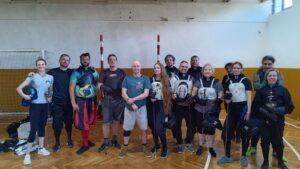
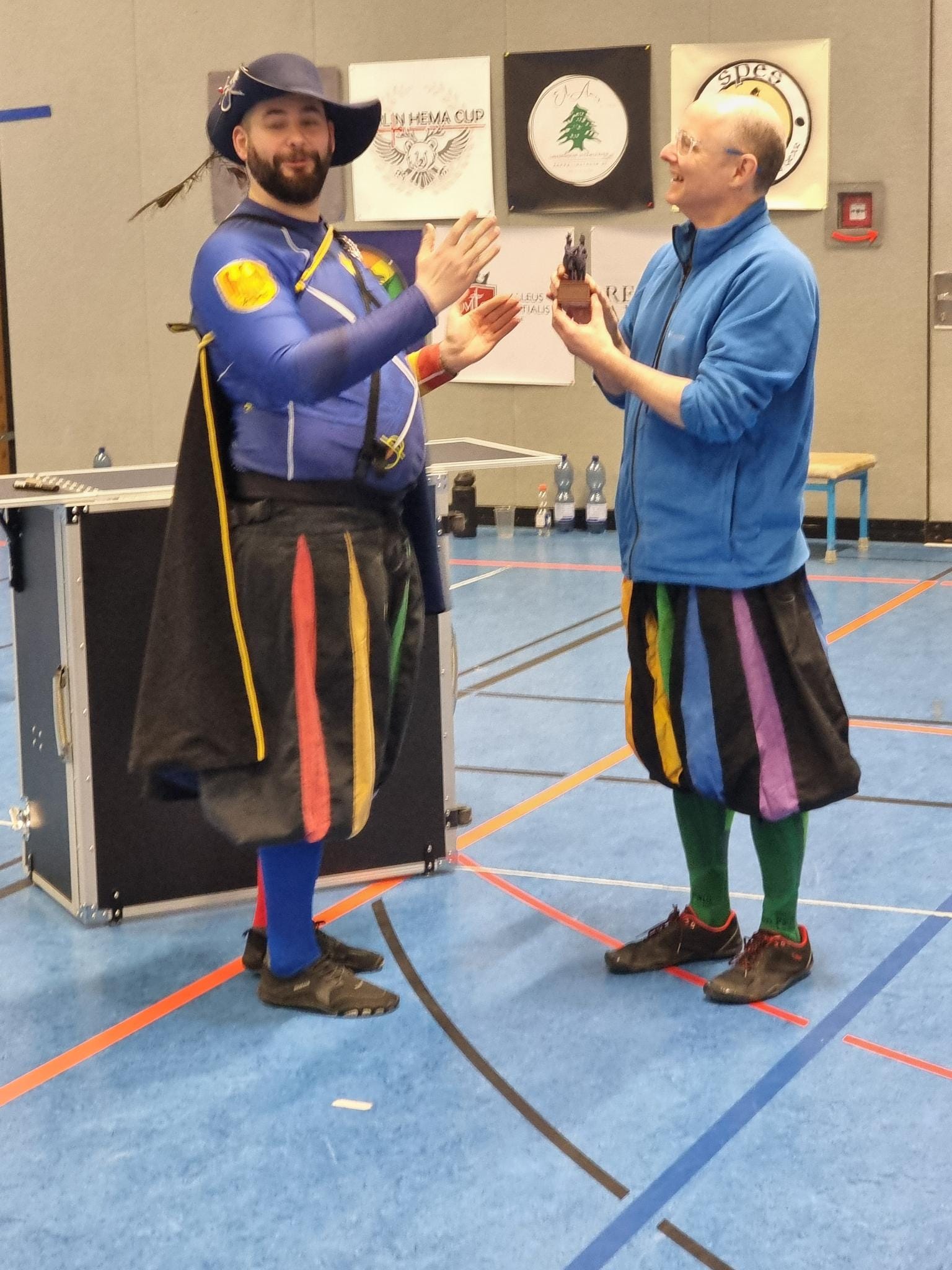
Stephan giving Guy Windsor a statuette prize for teaching a class in the worst time slot at the Torneo di Spada hema tournament
Receiving the prize for “because someone had to teach the slot”.

I'm not known as a tournament fencer these days. Indeed it's been well over 20 years since I last officially competed. But one of the great benefits of interviewing so many people on The Sword Guy is that they spark ideas in me that then get acted on. My conversation with Martin Hoeppner included a lengthy discussion of tournament rulesets, and cemented my pre-existing opinion that his club holds great events (I’ve taught at their Swords of the Renaissance four years in a row). A few weeks later I interviewed Maciej Talaga about an academic article he wrote on medieval physical culture, and we got talking about the benefits of tournaments for historical martial artists.

This got me really thinking… I have a decent amount of tournament experience from sport fencing in the 80s and early 90s, but the last time I entered a tournament was in (if I recall correctly) 2003. It was a rapier tournament, in Italy, and I won it. But I had been a professional instructor for two years by this point. If I win, so what? Being a competent fencer is part of my job. If I don’t, then what does that say about my right to teach?

Bear in mind this was a very, very, long time ago.

There are some major equipment issues with modern tournaments: most don’t allow steel gauntlets (I absolutely will not use any of the synthetic gauntlets currently on the market, for the simple reason that they prevent me from holding my sword correctly), and most probably wouldn’t allow my That Guy’s Products mask. In situations where cuts to the head with a heavy weapon are likely, anything built on a fencing mask foundation are simply inadequate.

I understand that creating equipment requirements for a tournament is a nightmare job for the organisers; it’s much easier if you can insist on established brands and models. But the restriction on steel gauntlets extends back to well before the time that companies were making synthetic gauntlets, and organisers were requiring things like lacrosse gloves because “steel gauntlets are dangerous”. Which in an activity that involves swinging steel bars at people’s heads seems at best misguided.

(I think I need to do a deep dive into sparring gear for longswords and other heavier swords… interested?)

I’d heard about the Torneo di Spada through attending Swords of the Renaissance, and checked with them that my mask and gauntlets were allowed. They are!* And they very kindly lent me some of the extra bits of kit (such as forearm guards) that I don’t have. They also asked me to teach a class on the Sunday afternoon, which made the whole thing even easier to approach.

I flew in to Berlin on Friday night, and on Saturday geared up and got stuck in. The first day was sidesword. This was perfect for me because I’m not a sidesword instructor. I haven’t taught a class in Bolognese fencing since maybe 2007, so I could go into it with no particular expectations. My goals were simple:

1. to break the seal on my tournament fencing,

2. evaluate my current level of training,

3. and, most importantly, to embody the spirit of the Art of Arms.

Bolognese Sidesword Tournament

How does one embody the spirit of the Bolognese Art of Arms? In the 16th century duels were very often public affairs. Your reputation is on the line, as well as your skin. The most important thing is to fence boldly.**

The ruleset was simple: hits to the head score 3 points, to the lower leg 2 (hence the need for shin guards), and anywhere else only 1. This is to reflect the opinion of Antonio Manciolino in his 1531 Opera Nova, in which the author writes that the head is the most noble target (a common opinion at the time), and that the lower leg should count higher because it’s so hard to hit without getting hit yourself.***

Every bout consisted of three scoring passes, so the maximum possible points in a bout was 9.

The twist was that the ranking is primarily based not on the points, but on how many passes you survive untouched. Winning 9-3, where you get 3 points in every pass and your opponent gets one, is useless; it’s better for your ranking to win 3-0.

A tournament-minded fencer will then be very cautious, and if they can’t stop the attack, at least go for a double.

To my mind though, to properly embody the spirit of the art, I needed to march in and hit them in the head, with style and control, but absolutely no dicking about at the edge of measure trying to not get hit. So that’s what I did.

The results? In my pool of 8, I had 7 bouts (21 passes), and scored 37 points, of which 33 were from hits to the head. But I had only 5 clean passes. That put me 21st out of 25 fencers. (Where the ratio of clean passes was the same, ranking was decided on points.)

I was delighted. My points per bout were the highest overall (37 out of 7, so 5.3). The next best was 38 out of 8 bouts, so 4.8. The next highest number of head hits was 7 to my 11. And several people complimented me on my fencing style.

Of course, if it was the points that counted, not the clean passes, the other fencers would have been motivated to go for head shots too, they would probably have scored a lot higher: the comparison isn’t really fair, but it is illustrative.

The Rapier Tournament

The second day was the rapier tournament. My goal was the same: to embody the spirit of the art. But the art was different. When it comes to rapier, I’m a Capoferro man, so the year is 1610, the duel is private, the top priority is going home in a whole skin. Fencing to first blood is fine: murder is an option not an obligation. So my fencing was totally different. Not just the style, but also the incentives.

The clean passes ranking was the same. Points were scored so that thrusts to the head or body were 3 points, cuts to the head 2, and cuts or thrusts anywhere else just one.

Fencers could choose rapier, or rapier and dagger, but they had to agree (so, both fencers had the same weapons). I always gave my opponent the choice, because I want their best game. In the end I think I used a dagger in three of my bouts.

In the qualifying pools I had 9 bouts (27 passes) and scored 19 clean passes, so a 70% success rate. I only scored 42 points, of which only 5 hits were to the head. This put me at the top of the rankings for all 30 fencers (the next best was 63%), but lots of fencers scored more points than me.

I conclude from this that the clean-passes ranking system rewards a private-duel mindset and approach.

Safety First

Unfortunately I wasn’t careful enough with one of my opponents. I knew he was wild, but after the halt was called he was chambered to cut me in the head. I stopped at the halt, and so didn’t parry his full-force horizontal cut to the right side of my head. As I was not expecting heavy head cuts in a rapier pool, I was wearing my regular fencing mask (it’s a bit better for face thrusts), with the usual HEMA overlay. This is totally inadequate to deal with that kind of blow, and he rung my bell. He also got a red card.

I sat down for a bit, and thought about my options. I had no obvious signs of concussion: vision and balance were fine. My last three opponents were all relative beginners, and not prone to hard hitting, and I didn’t want to drop out, so I fenced them very carefully (I got three clean passes in all three bouts).

There was about half an hour before the pools all finished up and the rankings to go on to the next round were announced. At the end of that time, over an hour after the blow, my head still hurt.  When it comes to brain injury a second hit in the same place is orders of magnitude more dangerous than the first one. And the “champions pool” would have no easy fights in which I could be reasonably certain to prevent my opponent from catching me in the same place. If I had a student in that situation I would not let them continue, so I withdrew.

The organisers and my fellow fencers were all entirely understanding and supportive of my decision. And I should say here explicitly that there was no malice or bad sportsmanship involved in the situation. I should have recovered under cover, not just stopped dead.

I should also say that none of the three medal winners were in my pool, so it could be that I would have ranked less well if I’d had stronger opponents. I don’t want you to think that coming first in the qualifying pool means terribly much. Had I continued I probably had a 50% shot at a medal.

Fitness

At the end of my first bout on the first day I was breathing quite hard. This was odd, because the bout wasn’t that challenging or athletic. It could only be tournament pressure. This was excellent! It meant I had a chance to practice controlling my level of arousal. I cycled in some breathing exercises, and got my breathing and heart rate back down to reasonable levels, and had no fitness difficulties at all for the rest of the weekend.

I could feel my thighs and shoulders a little bit on Sunday morning, but nothing significant.

More critically, my recently-recovered knees were fine, and so were my back and neck. So it seems that my physical conditioning is working really well. Hurrah!

The only point of stiffness or soreness on the Monday morning after the whole weekend was over, was the front of my ankles. A completely weird place to feel a bit of fencing, so I’ll try to figure out what caused that.

I’m being extremely cautious about my head. No alcohol (which I’m off at the moment anyway), and I won’t engage in anything where I’m likely to be hit in the head for a good long while. A minor head trauma is like priming your immune system for anaphylaxis. You have to avoid the stimulus if you don’t want a severe response.

The Tournament Fencer

Quite a few of the fencers there were clearly in it for the tournament. For them, winning the tournament itself was the goal. Medals matter. This generates a fencing style that is like a cross between sports epee and a bit of kendo, with lots of jigging about at the edge of measure and a very fast tag with the sword.

You can tell the competitors because they ask questions about the rules (what exactly counts as stepping out of the ring? Does my foot have to touch the ground? The whole foot? What if it’s just my heel?). They also use their ‘video challenge’ right. In the finals, video challenges were allowed, one per fencer per bout. If the challenge was successful you can challenge again. This means that if you disagree with the judges, you can, in effect, argue with them.

To a tournament fencer, it really does matter who gets the points. It’s what they are there for. To lose a medal because the judge made a mistake would be intolerable.

I would die in a pit of fire before I ever issued a video challenge. If I failed to hit my opponent with such clarity and in such obvious control of their weapon that the blind, drunk, biased-against-me judge who has been bribed by the opposition,** still has to give it to me, then I don’t deserve the point. “Bad” judging (as in judging you disagree with) is part of the tournament challenge. The greater the challenge, the greater the learning opportunity.

It’s really useful to have people like that to fence against, because they are usually very good at hitting you, and in ways you may not expect because they look different to the canonical style. The hit is always right. If you fail to parry, that’s on you. Also, seeing how incentives affect behaviour allows you to learn to predict some of that behaviour. Another useful learning opportunity.

It’s illustrative of the difference that, while I think I won my first bout on Saturday 7-4, and I can work out some of my clean-pass scores, I don’t actually know what my scoring was in any of the bouts. I don’t think I looked at the scoreboard more than half a dozen times in the whole weekend. Because the points aren’t relevant to my aims.

This is not virtue. There is nothing wrong with being a tournament fencer, who needs to track their score because it matters. I’m just playing a different game.

Final thoughts

Firstly, thanks to Stephan, Anna, Martin, and the rest of the Schildwache Potsdam team. Especially those noble souls who gave up their weekend to judged and score. It’s a huge amount of work putting on a tournament like this, and you all made many young fencers very happy, and one old instructor too.

Secondly, thanks to all my opponents over the weekend. I hope you enjoyed fencing me as much as I enjoyed fencing you. I do wish I’d kept a record of everyone I fenced, but I failed to. If you recall our bouts, feel free to remind me either in the comments or by email.

Thanks also to Malleus Martialis for sending me a delicious sidesword at very short notice. I only signed up for the tournament in mid-December, then realised my old sidesword was not fit for modern competition use. So I contacted Eleonora at Malleus, and a shiny new sword was waiting for me when I got there.

One interesting quirk of the way the tournament was constructed was that fencers in each pool had to find their own opponents, and keep doing so until you’d fenced everyone in your pool. This means that your first interaction with your opponents is face to face, unmasked, and arranging a match together. I didn’t notice it at the time, but chatting with Stephan afterwards it was clear that this contributed something to the feeling of the event. We weren’t fencing against anonymous numbers. We were fencing our colleagues, peers, and friends.

Overall, I’m delighted by the results. I went there to play my game: to use the tournament environment to measure and develop my historical fencing skills against motivated and resistant opponents. Most particularly, to not get sucked in to the competitive fencing mindset, where scoring touches according to the rules is the only consideration.

There was one pass in the whole weekend where I decided to play tournament. In one of my rapier bouts it seemed that the only thing the judges could see was incidental arm touches. Bending my sword on my opponent’s chest was literally invisible. So in the last pass I flicked my point under my opponent’s guard from the edge of measure. Sure enough, point to me. Ugh.

So I stopped that and went back to embodying the Art of Arms as best I know how.

Notes

*The organisers have asked me to mention that “we allow steel gloves only under circumstances where we, as organisers, can be absolutely sure that they are of proper quality, well maintained, free of burrs and sharp edges, and without loose rivets.”

** For example,  Leonard Eckstein Opdycke’s translation of Castiglione’s Book of the Courtier, Book 1, paragraph 21: “ “Moreover I deem it very important to know how to wrestle, for it is a great help in the use of all kinds of weapons on foot. Then, both for his own sake and for that of his friends, he must understand the quarrels and differences that may arise, and must be quick to seize an advantage, always showing courage and prudence in all things.

Nor should he be too ready to fight except when honour demands it; for besides the great danger that the uncertainty of fate entails, he who rushes into such affairs recklessly and without urgent cause, merits the severest censure even though he be successful.

But when he finds himself so far engaged that he cannot withdraw without reproach, he ought to be most deliberate, both in the preliminaries to the duel and in the duel itself, and always show readiness and daring. Nor must he act like some, who fritter the affair away in disputes and controversies, and who, having the choice of weapons, select those that neither cut nor pierce, and arm themselves as if they were expecting a cannonade; and thinking it enough not to be defeated, stand ever on the defensive and retreat,— showing therein their utter cowardice. And thus they make themselves a laughing-stock for boys, like those two men of Ancona who fought at Perugia not long since, and made everyone laugh who saw them.”

“And who were they?” asked my lord Gaspar Pallavicino.

“Two cousins,” replied messer Cesare.

Then the Count said:

“In their fighting they were as like as two brothers;”

*** Specifically (in Jherek Swanger’s translation):

[40] Of two playing together, he who strikes in response is more praiseworthy than the one who strikes the first blow, because he reveals himself sooner to become enraged than to lose vigour after the received hit.

[41] It is not licit after the received blow to make more than one response stepping forward with a crossing step; the reason being that one must do well with all of one’s wit, since with that one can recover honour.

[42] The blow to the head, considering the excellence of that member, counts for three; and the blow to the foot is taken for two, having regard for the difficulty of making it so low.

[43] A valorous player is he who redoubles his blows.

****Just to be clear, the judges were of varying levels of experience and skill, but were all wearing any necessary eyewear, sober, honest, and unbiased to the point of spending endless amounts of time discussing what exactly happened because they really, really, wanted to be fair. And the only way to get skilled, experienced, judges is to give less-skilled, less-experienced judges the opportunity to practice. I have no complaints, and much respect for their time and effort.
I flew to Belgrade last week to attend the Sword and Balkan event. I arrived on Thursday evening and spent Friday exploring downtown Belgrade to get a sense of Serbian culture. I’ll write that up properly next, but in the meantime: if you’re visiting Serbia, do not skip the National Museum on Republic Square…

The event began on Saturday morning, and right from the start it felt different. We were all invited to break off a piece of bread, dip it in salt, and eat it (I just had the salt, being allergic to wheat). This symbolic act made us part of the family—and that sense of familial warmth and camaraderie set the tone for the whole weekend. Literally everyone I interacted with was relaxed, friendly, and there to enjoy some good swordy fun. It was especially nice to catch up with Francesco Lodà after more than 20 years!

The event’s principal organiser, Željko Glumac, was a game designer before devoting himself fully to swords—and I’ve never encountered a more gamified (in the best possible way) fencing event. There was a creative and intricate token system: participants earned tokens through various activities and could use them to bid for spots in the final tournament, choosing weapons like rapier, smallsword, and so on. You could win tokens from fellow fencers in challenges—unless, when revealing your secret team card (Fiore, Hutton, etc.), it turned out you were on the same team! When challenging instructors, they would award you 1–3 tokens based on the quality of your fencing (regardless of the score).

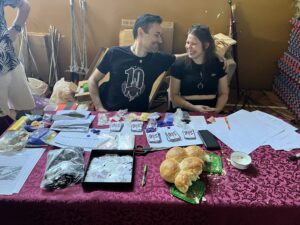
No wonder the reception table looked like this:

The reception table with bread, salt, and a lot of gaming tokens

That’s Željko on the left.

I knew Željko is a Capoferro man, but I also knew he’d be swamped with organisational duties, so I kidnapped him early Saturday for a quick fencing match. It was a joy. Sometimes fencing feels like an argument between people who don’t speak the same language—but this was a vigorous and friendly conversation between two native speakers of the same dialect.

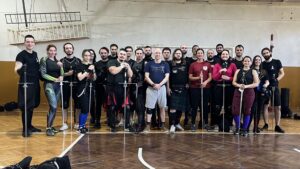
My class that morning was Skill Development with the Longsword. About 26 students attended, with a wide range of experience levels. They were all a pleasure to teach, and I think everyone got something useful from it.

Guy Windsor with longsword students at Sword and Balkan in Belgrade 2025

I’d twisted my right knee on Wednesday morning, so I was being careful—short lunges, no unnecessary pressure—but still managed to get in two bouts after lunch. First, with Thomas Tassie on smallsword (a quick fencer with a lovely circular parry in quarte), and then with Branislav Petrović, another Capoferro fencer. He hit me with Capoferro’s scanso della vita—a rare thing to see in freeplay! But a little later I got him back with the same technique, which may have been my personal fencing highlight of the weekend.

By evening I was fairly worn out, but I really enjoyed chatting with Viktor, Veronika, and Elay. Fortunately, V and V are early-to-bed types like me, so they gave me a lift back to the hotel and we turned in around 11:15. But I must say—those Serbs understand carnivory at a high level.

On Sunday morning, I did a thorough physio session to keep the knee and neck issues at bay, and then fenced with Karl Rapp from Vienna. We hit each other quite a bit—but he managed to catch me twice with the same move: a thrust to the flank after covering my blade with his left hand. Son of a bitch! (In the best possible way.) It was a delightful bout, swiftly followed by another with Viktor Kachovski—good thing we both got to bed at a decent hour!

That day I taught a smaller class, Skill Development with the Rapier, which meant we could go deeper into the subject. Again, the group included both beginners and veterans with over a decade of experience, and again, everyone was a joy to teach. Special thanks to Pavle Ilijašević (in the red and black poofy pants) for demonstrating with me—with sharps!

Guy Windsor with rapier students, sword and balkan 2025

After lunch (and a bit of tech wrestling with the projector), I gave an hour-long lecture on syllabus design. I think it went well—when I formally ended the session, the room stayed for another 45-minute Q&A, mostly on pedagogy. I sometimes ask the audience to vote on the best question of the session. This time, Daniel won the prize (a Swordschool patch) for getting me going on teaching mixed-level classes.

You may have noticed the total lack of photos or videos of me fencing. That’s because I was having too much fun to remember I even own a phone.

The event wrapped up with the challenge tournament. I was absolutely knackered by this point, but it was clearly enormous fun for everyone involved—team members cheering each other on and nobody taking it too seriously.

All in all, a thoroughly delightful event. Željko and his team got the tone exactly right—and everything else flowed from there.

This post is intended to be useful to the attendees at the recent seminar I taught with Chris Vanslambrouck in Madison, Wisconsin. It may also be of interest to folk who couldn't make it.

First up, huge thanks to Heidi Zimmerman who organised the seminar. It literally couldn’t have happened without her. And thanks also to Chris Vanslambrouck, who co-taught the seminar, with related plays from Meyer. Given that there was also a lot of Meyer technique being taught that weekend, it’s a miracle we covered so much ground, so hats off to the students. I’ve assembled a list of the material we covered, some planned, some answers to questions posed by the students.

Saturday: Fiore Longsword

We started with the most  basic blows, and saw how they created the guards.

The blows were:

  • Mandritto fendente
  • Roverso fendente
  • Mandritto sottano
  • Roverso sottano
  • Thrust

You can find a more complete version of the drill we used here:

And the guards they created were:

  • Posta di donna destra,
  • Posta di donna lasinestra,
  • Posta longa,
  • Tutta porta di ferro,
  • Dente di zenghiaro, coda longa

You can find all the guards here: https://swordschool.com/wiki/index.php/The_12_guards

We then did a parry and strike from donna, against the mandritto fendente, and a parry and strike from dente di zenghiaro, against the same blow. The latter is the beginning of our Second Drill:


This lead us to the universal counter-remedy: the pommel strike (as shown in the 8th play of the master of coda longa on horseback).

We then defended against thrusts with the Exchange of thrusts:

Then Breaking the thrust:

In the afternoon session we covered the rear-weighted guards (donna and fenestra), and briefly went over the 3 turns (volta stabile, meza volta, tutta volta), and the four steps (accrescere/discrescere; passare/tornare).

We then did a not-very-deep mechanical dive into the guard bicorno, including how to use it to prevent an exchange, and as a feint. This included an introduction to the woman in the window drill:


We finished up our survey with the 4 corners drill: https://swordschool.com/wiki/index.php/Four_corners_drill

All of this material can be found in book form in The Medieval Longsword, as an online course here.

Capoferro Rapier

The following day, Sunday, we did a pretty thorough overview of Capoferro's rapier. We began with basic footwork:

  • passes,
  • lunge,
  • step,
  • lean

Which you can find here:

Then played Hunt the debole (to get an idea of what the sword is supposed to be doing- keeping you safe!).

We then worked through Plate 7 (stringer on the inside, thrust through the left eye):


And plate 16 (stringer on the outside, thrust to the neck):

Plate 8 (slip the leg)

Plate 10 (enter against the cut),

Plate 13 (the scannatura)

And plates 17 and/or 19, the avoidances of the right foot or waist:

We also did a pretty deep dive on the mechanics of the lunge. We didn't video the Madison seminar, but I covered the lunge in a similar way in this seminar:


We also looked at the mechanics of passing, specifically the difference between the passing foot pointing forwards or out to the side.

Then we constructed a mechanically sound seconda position, starting from first principles. I covered this in a blog post, here: Function First, then Form

We then went through my system for teaching students the basic skill of parrying with the dagger, in four stages. You can find the four stages on this wiki page: https://swordschool.com/wiki/index.php/Rapier_and_dagger_drills

And we then applied those skills in executing Plate 23:

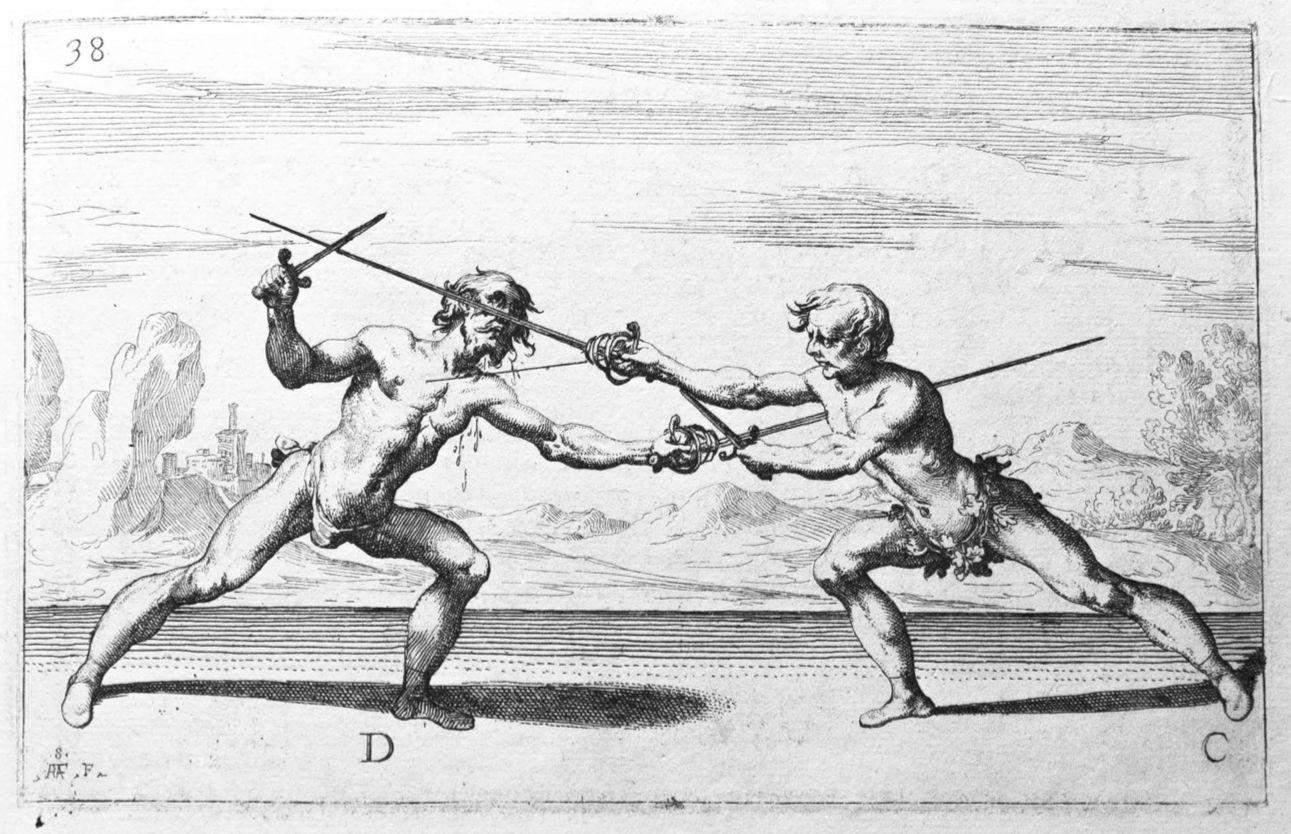
And then had a look at murdering left-handers in Plate 38:

All of this rapier material is covered in the Complete Rapier Workbook, and in the new Duellist’s Companion 2nd edition. If you prefer an online course, you can find it here: https://swordschool.teachable.com/p/rapier

Thanks again to the lovely Heidi for organising it, Chris for introducing us all to Meyer, and to the most excellent students.

I’m just back from the International Rapier Seminar, held in Warsaw last weekend. It was an absolute blast, so the first order of business is a heartfelt dziękuję/gracias/thank you to the organisers, especially Lorenzo Braschi for inviting me (he was the very man who introduced me to the mighty porrón in Spain in 2012), and to Karol for driving all the way out to the Ryanair airport to get me, which was only marginally closer to Warsaw than it is to my house.

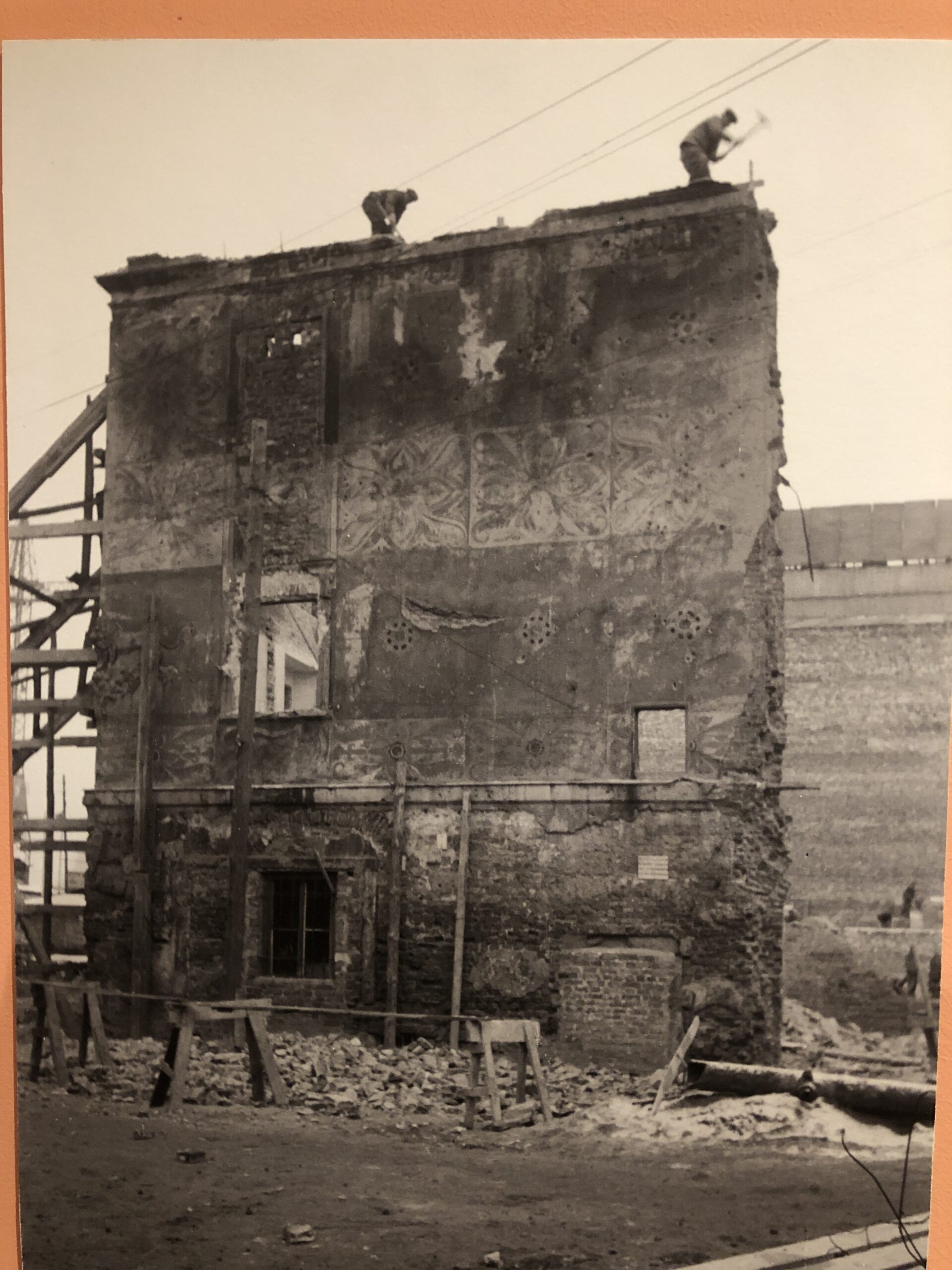
The event kicked off at 5pm on the Friday, so I spent the day in Warsaw being a tourist, mostly at the Warsaw Museum, which had a special exhibition on the reconstruction of Warsaw after the Nazi’s wantonly destroyed it (as in, 65% of the city completely levelled, 80% badly damaged) after the Uprising of 1944. I didn’t know much about the city before I got there, and it frankly blew me away. The sheer scale of the clearing and rebuilding beggars the imagination, especially when you realise it was done with picks, shovels, and horse-drawn carts, in a country ravaged by the war.

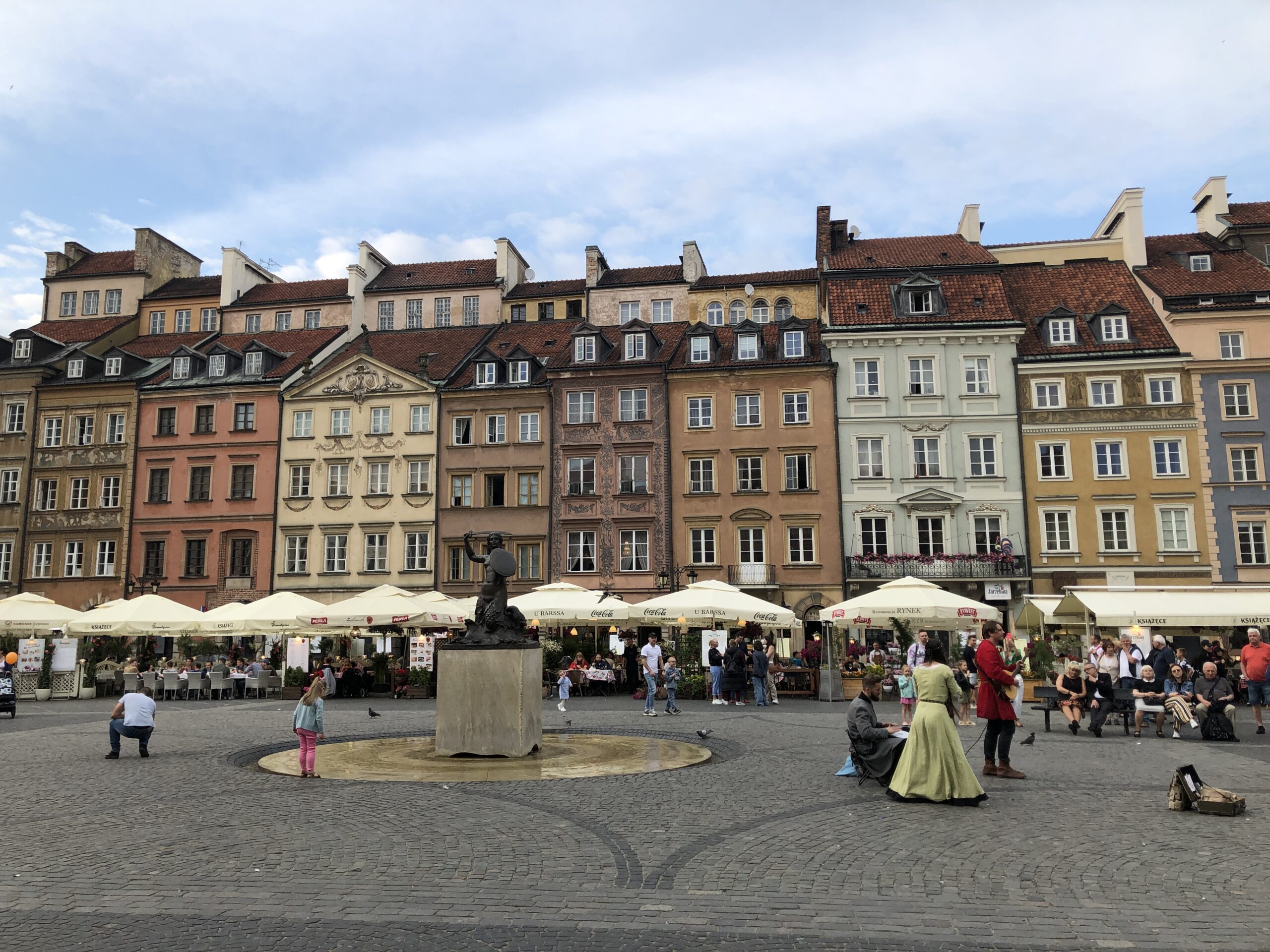
Walking around the old town, you wouldn’t immediately guess that the buildings were built 70 years ago.

The event began with a get-together, a bit of sparring and lots of chatting, and I got to meet a student I’ve been interacting with pretty much weekly since 2020 (hi Jas!). I taught two classes on the Saturday: How to Train, followed immediately by How to Teach. I can summarise them for you like so:

1. Run a diagnostic, fix the weakest link, run the diagnostic again

2. Generate the optimal rate of failure in your student/s.

Simple, yes. Easy? Not so much. But that’s why we practice, right? The classes were well attended, and I think well received. During the afternoon I dropped in and out of watching classes by the other instructors, and got to fence with Emilia Skirmuntt, she of episode 75 of the podcast. Plus a great catch-up with Alberto Bomprezzi, whom I haven’t seen since my trip to Spain in 2012, and meeting Jorge from Mexico who persuaded me to part with my proof copy of The Duellist’s Companion Second Edition.

There may or may not have been much carousing and revelry that evening…

Sunday was given over to the tournament, which had two excellent features: it didn’t occupy all the space, and I didn’t have to do any work on it. So I spent the day fencing people! Elmar, Radek (who went on to win the tournament, congratulations!), Chris, Heikki (the one Finn at the event), Cornelius, and Martin. Each bout was different, each one delightful in its own way. If I had them to give, I’d give out the special technical “this feels like fencing a specific historical system” award to Martin (organiser of Swords of the Renaissance, which I attended last year and will return to in September this year). We were both really tired (these events are exhausting), but there were moments when it felt like Capoferro and Fabris might not have been ashamed of us. Another highlight was working with Damian on grounding and mechanics. He’d asked for it in my class the day before, but we didn’t have time to go into sufficient detail. There's no substitute for working one-on-one with students.

I was too knackered by the heat to fence everyone I wanted to, so Pedro Velasco and Tomasz Kraśnicki, here’s your rain-check for my first two bouts next time!

The great thing about all the bouts, and the event itself really, is that it was all very collegial. There was plenty of competitive spirit, but none of the personality-driven jockeying for status etc. that can make fencing unpleasant. That’s down to the attendees, in part, but also to the spirit of the event itself, for which the organisers should be thoroughly applauded.

Dinner on Sunday night was a blast too; most of the attendees had gone home, but on my table at a restaurant in a square in the old town, there were 8 people, no two of them from the same country. We had the USA, UK, Denmark, Serbia, Bosnia, Finland, Denmark, and Italy represented. If I went on a bit much about flying and woodwork, then Marc, Nic, Nicole, and Vicky, my apologies. Blame the vodka! But to be fair, they did ask…

And breakfast on Monday involved an hour-long chat with Ton Puey, Chris Lee-Becker, and Pedro Velasco. I think that a huge part of the value of events like these is the unscheduled serendipitous interaction with colleagues and friends. I also found at least two new guests for the podcast whom I had never heard of before the weekend!

My main takeaways from this trip are 1) I should do more of them and 2) I need to work on my fencing fitness. My legs are killing me!

As is now traditional, the day after an event like this I'm flooded with Facebook friend requests, which is lovely, but I don't use Facebook. So, if you'd like to find me on social media, come to swordpeople.com and say hello!

Holding the sword correctly is safer

One of my students mentioned tendonitis problems in his wrist on the Swordschool Discord server this week. It’s probably caused by holding his sword incorrectly, which forces the small stabiliser muscles to do more work than they evolved for. He is by no means the first student I’ve seen with this problem.

It has been my experience that almost every sword student at any level in any style is either holding their sword incorrectly, or at the very least, there was room for improvement. This is partly due to most modern sword makers producing handles that are a bit too big (my friends at Arms and Armor have a post on this, here), or a bit too round; and partly due to most people simply not understanding how the mechanics of sword holding is supposed to work.

In essence, your grip strength and wrist stabilisation strength should be acting as back-up systems only: the sword should stay in your hand with almost no strength being used at all, and when you strike, the force coming back from the target should be routed through the bones of your hands and wrist, and thence through your body to the ground, with no need to tighten up on impact at all.

Seriously. Not at all. 

Have a look at this video of me hitting the wall target with a rapier, and bashing the tyre with a longsword. My hand is not just relaxed, it’s actually open, to demonstrate beyond reasonable doubt that grip strength is not required. 

I have been banging this drum for many, many, years now (I first posted that video in 2012!), and have written this up in many places, and posted endless video content about it, and yet still the sword world has crappy sword holding skills. This is for three reasons:

1. the sword handle is too big 

2. because this is very counter-intuitive

3. and also because most people are strong enough to fake it for a while; they think it’s correct, when actually their muscles are faking it for them. Until the pain in the first joint of the thumb kicks in. Or in the elbow. Or indeed anywhere along the chain from fingertip to toes. 

So how should you hold the sword? 

That depends on what kind of sword it is, and what you want to do with it. 

Generally, the sword is either held back in the hand, like so:

Guy Windsor Holding a sword, chambered grip


Or extended in the grip, like so:

Guy Windsor holding a sword in an extended grip


This is also how most chefs hold their kitchen knives when chopping and slicing.

Guy Windsor holding a kitchen knife slicing cucumber. Grip is extended.

There are exceptions: we do sometimes support the flat instead of the edge, like so:

Guy Windsor holding the sword thumb on flat


The sword is usually held back in the hand when it’s also held back near the body, and extended in the hand when the sword arm is extended from the body. Some longsword folk have half-understood this concept and hold their longsword in the extended grip even when the guard is chambered (such as in posta di donna). Some swords are almost always held in the extended grip; rapiers, foils, smallswords are good examples. The basic rule still applies- when holding the sword it should be supported by the bones, not tied in place by the muscles.

The extended grip does not depend on grip strength; you can perfectly well hold the sword with one finger, if it's aligned correctly, like so:


Guy Windsor holding a sword, fingers open.

I'm not recommending fighting like this, but it's worth making sure you're not depending on grip strength when holding the sword by opening the thumb, forefinger, ring finger, and little finger, and seeing what happens.

One common error is to extend the wrist, rather than extend the sword in the grip. You need to be able to distinguish between at least three positions of the hand relative to the forearm. Three-knuckle, two-knuckle, and one-knuckle. The easiest way to learn the differences between them is through “Eurythmic push-ups”. You can do them on a mat if you prefer, and you don’t actually need to do the push-up bit; just getting the feeling of the different wrist positions is very helpful.

Cocking the wrist between the ‘three-knuckle’ and ‘one-knuckle’ positions instead of allowing the sword to shift in the grip between the ‘chambered’ and ‘extended’ grips is another common cause of wrist problems.

Please pay attention, this may save you a lot of pain, as well as massively improve your general sword handling.

Holding the Longsword

I introduce the basics of how to hold a longsword in this video borrowed from my Solo Training course

Holding the Rapier

This footage from a rapier seminar I taught in 2012 goes into the correct grip for the rapier in some detail; you can watch the whole thing of course, or skip to about 22 minutes in, where we get into the grip.

If you are already having wrist problems, for any reason, you may find my Arm Maintenance course useful. It’s free, and bundled in with my Human Maintenance course. 

Creating a working syllabus is hard. Where do you start? What comes next? How do you know when you’re ready to move on to the next thing? I find it helps to remember that there is no one correct answer, because the optimum structure for the syllabus depends on its goals, and the specific aptitudes and experience of the student. 

The latest instalment of my Rapier workbook series (Rapier Part Two: Completing the Basics) contains the following technical content:

  • Plate 8: voiding the front leg
  • Plate 9: passing to attack (off-hand forwards)
  • Plate 10: dealing with cuts to the head
  • Plate 11: voiding low, and acting in contratempo
  • Plate 17: voiding with the front foot
  • Plate 18: passing to attack (off-hand back)
  • Plate 19: voiding with the waist
  • Capoferro’s three tempi (half, full, and one-and-a-half)
  • Changing direction

That is a lot of material, and hard to remember, so I used the structure of the Rapier Footwork Form to organise it. This way, by the end of this book, you will have a series of actions clearly stuck in your head, which will act as an aide-memoire for all the plates that you know (including everything in the previous book: plates 7, 13 and 16). By running through the Form at the beginning of every training session, you will cover every major action in the system, and be reminded of the areas where you are strongest, and those that need most work.

You can see the form here:

I have also included some essential repetition from the previous book, notably the discussion on safety, and advice on how to use the book, because I know from experience that some readers will ignore “you need to read part one first”, and those things must be read before training. 

Some people just want to learn how to sword fight. Others want to learn how to do the academic research side of historical swordsmanship. And some want to do both. These workbooks are obviously directed towards the “just teach me to sword fight” crowd, but I encourage all my students (and that includes you!) to at least be familiar with the primary source for your art, in this case, Gran Simulacro. 

So what is form? and what it is for? Fundamentally, form is the mechanism we use for creating a narrative of the system within the students’ brains. You can think of a form as a string of pearls. In the beginning, each pearl is just one technique or action. It’s a tiny little seed pearl. But with practise, and a broadening understanding of the Art, each pearl becomes the locus for other concepts and actions to be stored. A single action acts as a trigger for a cascade of related actions. Form is therefore a set of chapter headings, under which you can store everything you ever learn about swordsmanship with the rapier; and once you have filled out each chapter, you have an index to your entire knowledge base.

I cannot state this too strongly: the Form is just the beginning. It is not the be-all and end-all. When you write your own chapters, it becomes The Book of your rapier knowledge and skill. Once that is established you can simply run through the Form at any time and identify the weakest link. Start working on that link, using the “attached” training material, then re-run the Form to see whether what you have been working on is still the weakest link. The Form is therefore a diagnostic tool, an aide-memoire, a mechanics exercise or a guide to the system; in fact, it is the core of your practice. This workbook is about writing those chapter headings, and then filling in those chapters.

The major pitfall of this approach is that the organisation of the material in the Form has more to do with training space constraints and what felt good when designing it (“where do I want to go from here?”) than it does with any overtly logical structure. It does not, for example, follow the order of the plates in Gran Simulacro. Nor is it arranged according to difficulty. You may find yourself wanting to re-arrange things. That’s fine: the structure is (as with all forms) at least partly arbitrary. You only need to have this canonically correct if you are following my school’s syllabus and intending to grade within it. Otherwise, take this and make it your own! 

When I was a kid, I spent some time casting little lead soldiers. It was magic: you heat up the lead in a pan until it melts, pour it into the mould and wait for it to cool down, and out comes a cavalry officer, rifleman or whatever. We then had to trim off the inevitable little leaks and the rather large riser (the extra bit where you pour the metal in, called a “sprue” in the US). Then the figures were ready for painting. You can think of the Form in a similar way. The actions of the person doing the Form are moulded by the actions of the (imaginary or real) opponents, as well as by the overall training goals. As with the casting process, there are artefacts to be taken into account: little bits of metal that don’t really belong, or some turns or steps that you wouldn’t normally use but are necessary to keep the Form in the right shape. So long as you know what the Art should look like and what the applications are, or what a Royal Horse Guards trooper from 1815 is supposed to look like, the Form is useful. As soon as the mould (your understanding of which actions do what) gets sloppy, the Form becomes a shapeless, pointless mess. 

So here is a rule to be followed whenever you think about any kind of Form: 

Application first, Form second. 

We do this in class. When teaching the Form to students, we absolutely always do pair-drill (or handling drill) first, then the same actions solo, and then we add it to the Form. We never, ever, have students practising actions that they don’t know at least one application for, and we distinguish very clearly between a play or technique and a handling drill or skill-development exercise.

This post is an adapted extract from the new workbook. You can find the whole book here.

Or if you prefer learning from video classes, you should try my free Rapier Beginner's Class mini-course.

If you find the ideas here interesting, you may also like this post:

The Dragon: how to write forms or kata for martial arts training

I was recently contacted by a reader asking about teaching left handed students. It’s a common and relatively complex problem, so rather than confine my answer to an email I thought I’d post it here.

The Question

How do you teach left-handers?

Why it’s a problem

Left handers are relatively rare (about 10% of the population, including my dad and my sister), and most of the historical martial arts treatises we work with don’t say much about them. Capoferro has one plate of rapier and dagger showing how to murder a leftie:

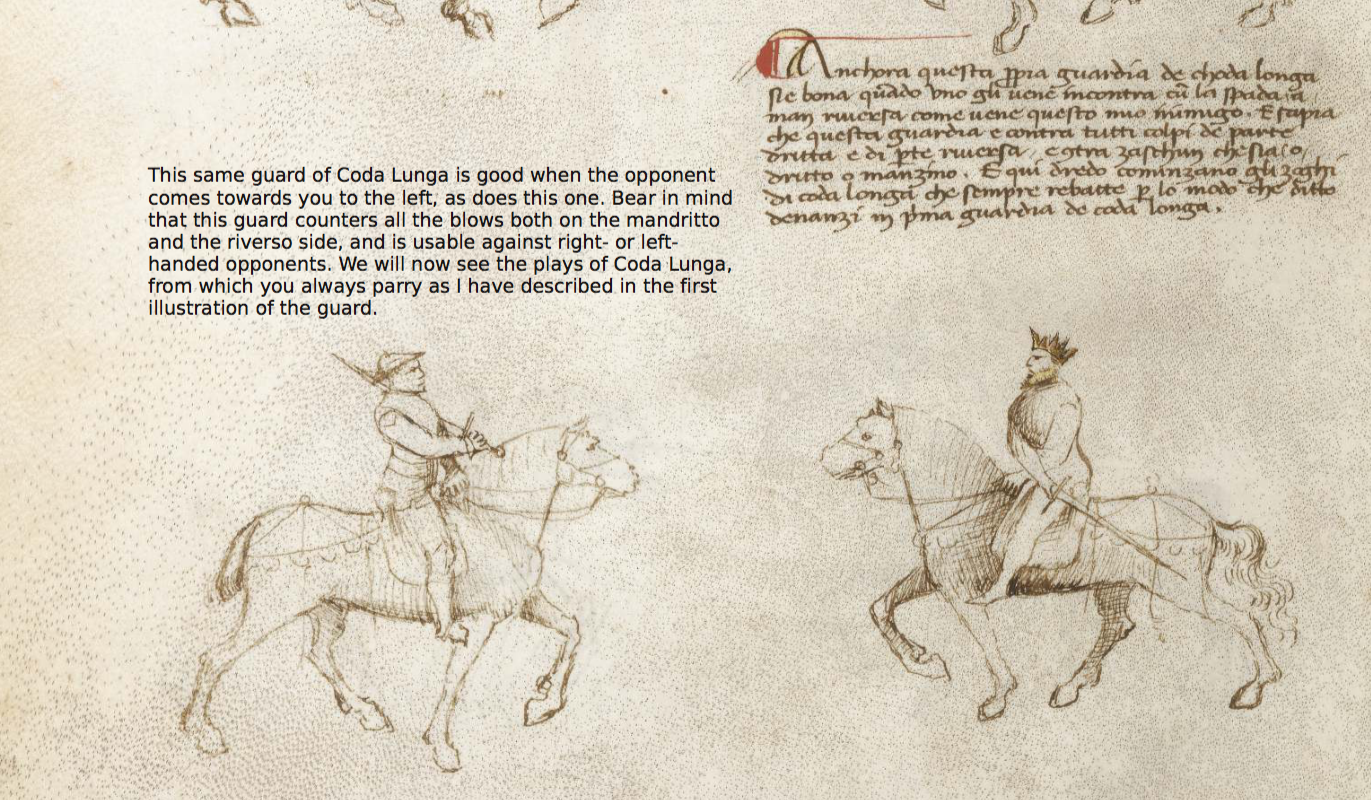
Fiore mentions that the guard of coda longa on horseback works against right or left handers (click on the image to expand it, and you can read the text and the translation by Tom Leoni):

Perhaps the biggest section of any treatise dealing explicitly with lefties is in Jeu de la Hache, but it’s still a small proportion of the overall material.

So what’s the problem?

The problem is that many of the techniques we recreate from the sources simply don’t work the same way as shown in the books when done cross handed. In addition, right handers don’t see many left-handers, so in combat sports generally, left handers tend to be far more common at the top levels than they are in the general population. This is entirely due to familiarity. Everybody knows how to handle righties- we see them all the time. (For an interesting book that also addresses this in some detail, see The Professor in the Cage, which is well worth reading if you have any interest in martial arts…)

The question is about teaching lefties, not fighting them, so I’ll address that. (If you want my best advice for fighting left handers it’s this: fight them a lot. You’ll get better at it.)

What difference does handedness make?

In blade on blade actions, not much. Principally, inside and outside are not symmetrical [For those unfamiliar: if the sword is in your right hand, everything to the left of the blade as you see it is ‘inside’, and everything to the right is ‘outside’.] If we are both same-handed and our blades are crossed, we will both be either on the inside or on the outside of each other’s blades. But when one of us is differently handed, if you are on my inside, I’m on your outside, and vice-versa. This means that some targets are different, and the angles of attack may be different. But usually, the rules regarding how to attack remain the same. For example, I would only push your elbow if I’m on the outside of your arm. That doesn’t change; what changes is how I would get to your outside, and which of my hands may be able to reach your elbow.

In wrestling at the sword, it makes a great deal more difference.

Tricky to pull off cross-handed. Trans. by Tom Leoni.


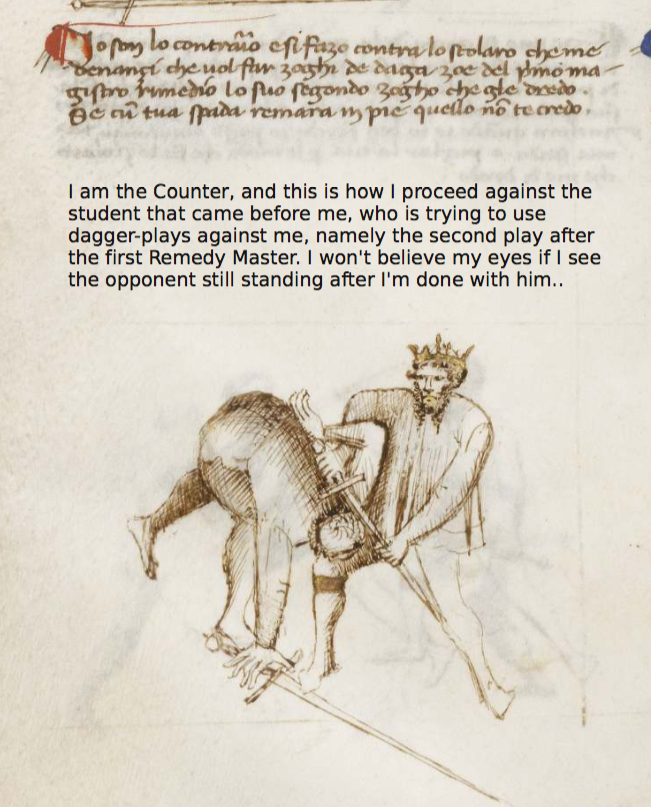
This wrap, for instance, only works well using the opposite arm (eg left against right) and from the inside of the wrapped person’s arm. Because this is over both arms, it can be used cross-handed, but you won't get the same control of the sword arm.

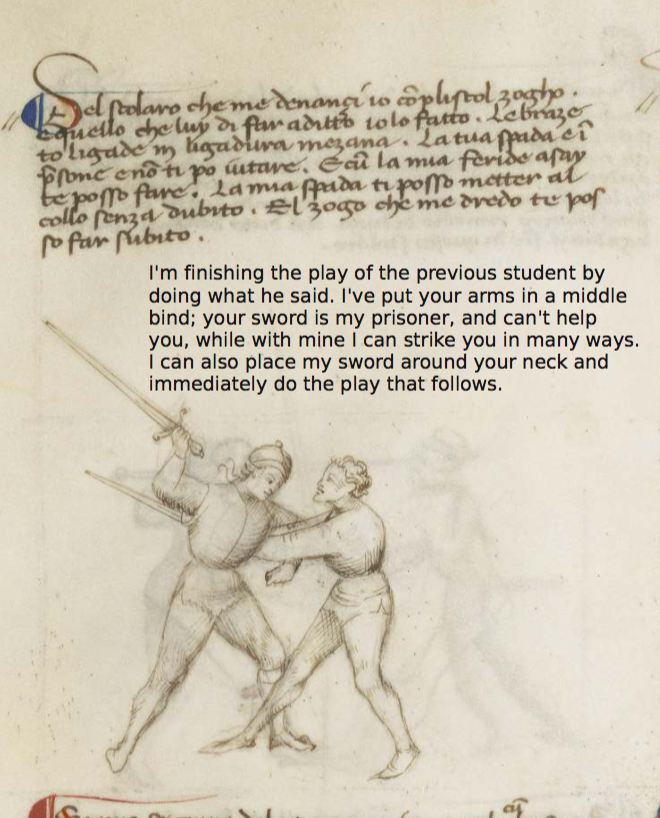
Likewise this counter rarely occurs cross-handed at the longsword, because the preceding wrap would have to be done by the sword arm, which is unusual (though you can see it in I.33, f.18.v).

Ligadura sottana, 15th play of the zogho stretto. Trans by Tom Leoni


I include specific examples of techniques adapted from symmetrical drills to cross-handed versions in chapter seven of The Medieval Longsword. In case you don't have it to hand, I've extracted it for you here:

Medieval Longsword sample Cross-handed

So that's the problem. What's the solution? There are several approaches you can take:

Approaches to the problem:

1) make everyone train right handed. I think this is a bad idea if your goal is to produce great practitioners, but if your goal is to perfectly reproduce the plays of a specific treatise, in which everyone is right-handed, then it makes sense. When Christian Tobler began researching German medieval sources, he switched from his natural left handedness to do everything right handed because it was much easier than converting everything.

2) make everyone train both sides. I think this is advisable up to a point- I would expect all my senior students to be able to do all our basic drills and actions with either hand, and any professional instructor to be able to demonstrate anything within their art with either hand. But it’s probably not the best way to train beginners.

3) create specific ‘cross-handed’ variations of every major drill or exercise you use. I think this is essential. The basic drills usually assume two right-handers. Two left-handers can do exactly the same drill, it’s just mirrored. The problems only start when there are a right hander and a left hander training together. I include set forms for the cross handed version of every basic drill in my syllabi.

Advice to instructors:

  • If your syllabus is lacking cross-handed drills, create them. You can do this by setting up the drill and seeing where you (as a lefty) get stuck. Then following the basic principles of the art, solve the problem. When the problem is solved, incorporate that solution into the ‘cross-handed version’.
  • When you have a lefty in class, it’s your job to make sure that they learn the standard form of the drill (i.e. with a fellow left hander, which may have to be you), as well as the cross handed forms. Also, you should take advantage of their presence to accustom your other students to dealing with cross-handed situations.
  • As the instructor, you can always require the senior students to reverse their handedness (so lefties become righties, and vice versa), which gives  everyone else the chance to face the less-common situation.
  • Start with the simplest drills- make sure that you can do all the solo drills in your syllabus with your left hand, and can see what they should look like in your students when they are left handed.
  • Set up a basic pair drill, and see what happens. At any given point, the left-hander should be behaving normally for them. Never ask them to attack differently or switch hands for the convenience of the right hander (unless they are very experienced and the righty is a beginner).

I hope that's helpful! Feel free to make any suggestions or ask questions in the comments below.

For more on how to teach, you may find these posts useful:

How to get started teaching historical martial arts

How to teach a basic class

Perhaps the most famous fencing treatise of the 1600s, Ridolfo Capoferro's Gran Simulacro is a wonderful book, and an essential read for all fencing scholars. Characteristically, he spells his name as both Capoferro, and Capo Ferro, in the book itself; just one of it's many interesting quirks! It covers fencing theory, rapier alone, rapier and dagger, rapier and cloak, and rapier and shield. You can download your free copy of the treatise from here.

You are welcome to the RAW image files too (at about 25mb per image), just contact spada.press and we'll arrange to share them with you. The book is free, but you are welcome to drop some money into the (virtual) tin; once the book has raised enough money to pay for production costs, we will gladly produce an affordable printed facsimile. Please note that this book is in Italian.

Further reading:

Translations: William Wilson and Jherek Swanger (free):  Capoferro

Tom Leoni, The Art and Practice of Fencing.

ed. Jared Kirby: Italian Rapier Combat

For an instruction manual on how to fence in Capoferro’s style, please my The Duellist’s Companion.

Last weekend I attended the excellent Smallsword Symposium. I am unusual amongst HEMA instructors in that I do lots of different styles; Armizare, of course, but also I.33 sword and buckler, Capoferro rapier, and even the glorious smallsword. The smallsword was my first historical fencing love, way back in the early nineties, and the first treatise I found and distributed was Donald McBane's Expert Swordman's Companion in the National Library of Scotland. My first two books, The Swordsman's Companion and The Duellist's Companion  were named in its honour.

Anyhow, I digress. The point is, smallsword is bliss, and much under-appreciated in the HEMA world, so it was an especial pleasure to attend an event given over wholly to its elegant viciousness. The event was well run, and well attended, with people coming from Norway, Canada, Germany and even Ipswich, as well as the local contingent from (mostly) the Black Boar Swordsmanship School, which organised the symposium. The Black Boar was founded by two ex-DDS members, Phil Crawley and Ian Macintyre, who I had a hand in training back in the bad old days. My (fencing) kids are all growed up! And having kids of their own…

The format of the event was interesting; just two tracks, beginning with a very basic introductory class for newbies, well taught by Sue Kirk, with a more advanced ‘let's get cracking with a bunch of skills training' class run by Phil running at the same time. This got everybody off on the right foot, and paved the way for the classes that followed. These were mostly ‘have a go at this cool new system' type classes, such as Tobias Zimmerman's survey of Schmidt, and Ragnhild Esbenson's survey of McBane. There were also a few concept classes, such as Milo Thurston teaching proprioception using blindfolds, Martin Dougherty (author of several swordy books) teaching attention to technical detail, and my own ‘how to find and fix any technical problem' class.*

The event included a tournament, and I must say it was amazingly well organised. Simply, the contestants are randomly split into four pools and told to establish a winner in 90 minutes by whatever means they agree on. Absolutely no top-down requirements, just tell us who won. Then the four finalists fence off in pairs. The two losers fight for third place, the two winners for first and second. It worked incredibly well, and I saw some lovely smallsword fencing.

One additional highlight for me was meeting Marco Danelli, the swordmaker. I have often been asked about his swords, and have had to reply ‘they look nice in the pictures but I've never handled one'. Now I can say “dear god, buy one!” No wonder he has a two-year waiting list. I also got to see a couple of Andrew Feest's swords, though sadly not Andrew himself, and oh my, they were both extremely pretty and handled delightfully. Mm-mmm, swordmaking is alive and well in Brighton, I can assure you.

All in all, an excellent weekend, and I look forward to coming back next year. On the Monday we went to Glasgow to handle antique swords, but that's a story for another blog post. One of the swords had HORNS! Stay tuned…

*For the benefit of those that were there (or even those that weren't), let me briefly summarise my class:

  1. Run a diagnostic, find the weakest link. E.g. I'm vulnerable to attacks below the sword arm.
  2. Fix the weakest link, using the method below.
  3. Run the diagnostic again.

The method for fixing the weakest link goes like this:

  1. Distinguish between technical and tactical problems. Technical = I did the right thing but it failed. Tactical = I did the wrong thing. This was a technical class so this process is for technical problems.
  2. Model the problem: recreate it with a partner.
  3. Slow it down until you can get the action right.
  4. Gradually increase the pressure/complexity/difficulty until it starts to fail.
  5. Train it at the level where it works 8-9 times out of 10. 10 out of 10, increase pressure; 7 or less, reduce pressure.
  6. If you can't get it to work, then analyse it in terms of a) timing b) measure c) grounding/structure d) flow/movement. The weakness will be in there.

This class was largely unfamiliar with grounding so we covered that in some detail, with the net result that most of them shifted the way they hold their swords. Success!

In the last 15 minutes we looked at applying the process to tactical problems. It's not much different, it just requires selecting the correct action. For example, learning to identify a feint.

  1. Model the problem: recreate it with a partner.
  2. Slow it down until you can use the correct action (in the case of a feint, a second parry).
  3. Gradually increase the pressure/complexity/difficulty until it starts to fail. Complexity is created by the ‘coach' in the drill either feinting or doing a real attack, forcing you to adapt your actions to theirs.
  4. Train it at the level where it works 8-9 times out of 10. 10 out of 10, increase pressure; 7 or less, reduce pressure


A spot of rapier and cloak in the morning?

I have the enormous privilege of owning an original copy of Salvatore Fabris’s Sienza e Pratica d’Arme, printed in 1606. I bought it from Sr. Roberto Gotti, of Brescia, in 2014. It is in incredibly good condition, and an excellent, clean print. It is still in its original binding. The value of the book comes from two things: the information it contains, and the artefact itself. I own the artefact, it is mine, mine, mine, and woe betide anyone who tries to take it from me. But I believe the information it contains belongs in the public domain. This book is yours. So I asked my friend Petteri Kihlberg to photograph it, and I am releasing those photos (with his permission) free and with no strings attached. If you choose to use them for some commercial purpose (such as printing an edition for sale), then I ask as a matter of courtesy that you give credit where it’s due, but I do not insist on it. I've set it to “pay what you want”, and would be grateful for any donation you choose to give; the more money I have, the more fencing treatises I'll buy, all of which will go online for free.


I want this!

I own this book, but the information it contains is part of your birthright as a human being. I hope you will enjoy it, share it, and make something beautiful with it.

Please share this post so that everyone who wants a copy of the book can get one.

And don't miss my other free books! Marozzo's 1568, Girard's 1740, Seven Principles of Mastery, and many more.

Search

Recent Posts

Categories

Categories

Tags