Guy's Blog

Guy frequently keeps this blog updated with thoughts, challenges, interviews and more!

Category: Training & Body Mechanics

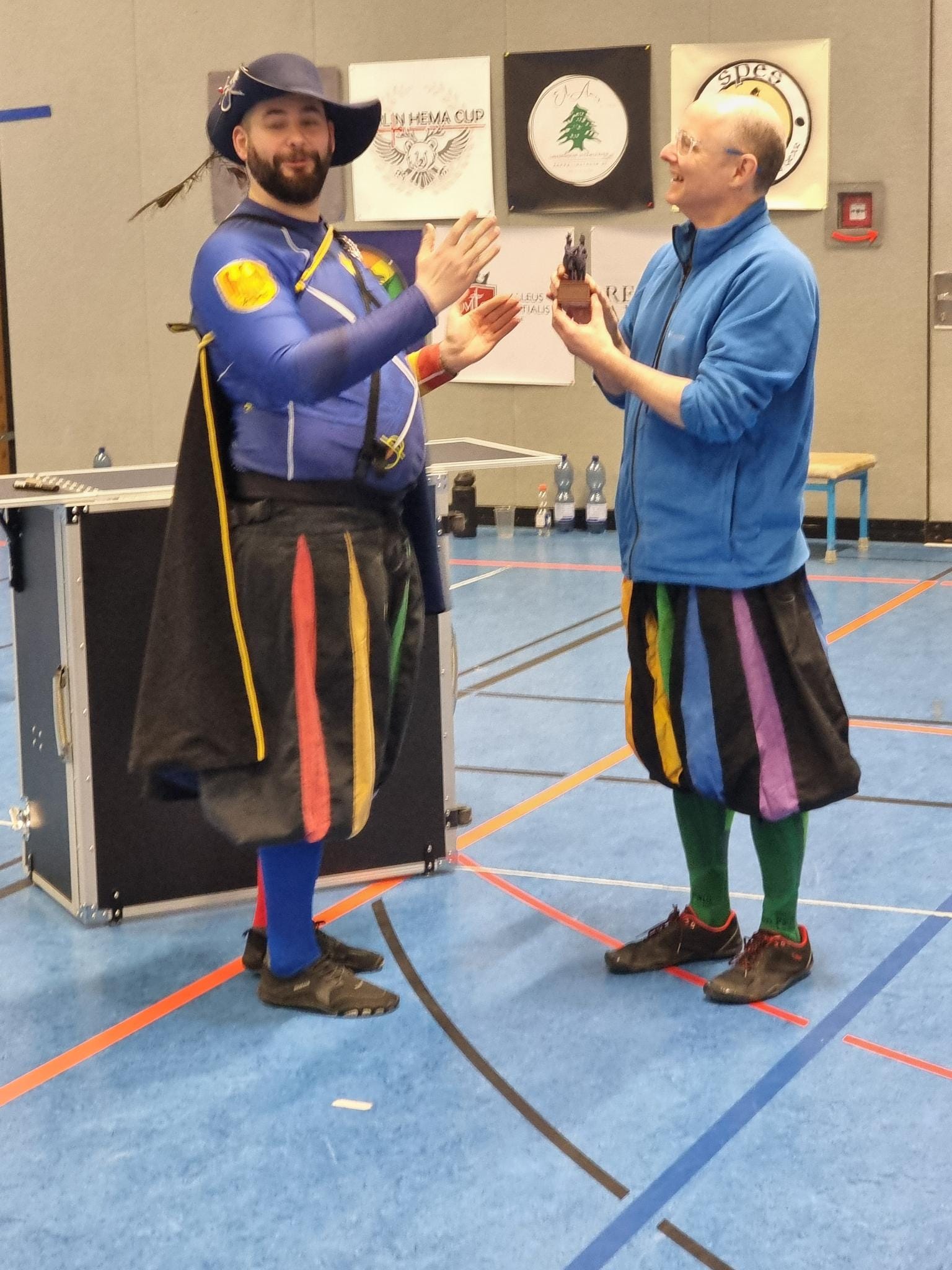
Stephan giving Guy Windsor a statuette prize for teaching a class in the worst time slot at the Torneo di Spada hema tournament
Receiving the prize for “because someone had to teach the slot”.

I'm not known as a tournament fencer these days. Indeed it's been well over 20 years since I last officially competed. But one of the great benefits of interviewing so many people on The Sword Guy is that they spark ideas in me that then get acted on. My conversation with Martin Hoeppner included a lengthy discussion of tournament rulesets, and cemented my pre-existing opinion that his club holds great events (I’ve taught at their Swords of the Renaissance four years in a row). A few weeks later I interviewed Maciej Talaga about an academic article he wrote on medieval physical culture, and we got talking about the benefits of tournaments for historical martial artists.

This got me really thinking… I have a decent amount of tournament experience from sport fencing in the 80s and early 90s, but the last time I entered a tournament was in (if I recall correctly) 2003. It was a rapier tournament, in Italy, and I won it. But I had been a professional instructor for two years by this point. If I win, so what? Being a competent fencer is part of my job. If I don’t, then what does that say about my right to teach?

Bear in mind this was a very, very, long time ago.

There are some major equipment issues with modern tournaments: most don’t allow steel gauntlets (I absolutely will not use any of the synthetic gauntlets currently on the market, for the simple reason that they prevent me from holding my sword correctly), and most probably wouldn’t allow my That Guy’s Products mask. In situations where cuts to the head with a heavy weapon are likely, anything built on a fencing mask foundation are simply inadequate.

I understand that creating equipment requirements for a tournament is a nightmare job for the organisers; it’s much easier if you can insist on established brands and models. But the restriction on steel gauntlets extends back to well before the time that companies were making synthetic gauntlets, and organisers were requiring things like lacrosse gloves because “steel gauntlets are dangerous”. Which in an activity that involves swinging steel bars at people’s heads seems at best misguided.

(I think I need to do a deep dive into sparring gear for longswords and other heavier swords… interested?)

I’d heard about the Torneo di Spada through attending Swords of the Renaissance, and checked with them that my mask and gauntlets were allowed. They are!* And they very kindly lent me some of the extra bits of kit (such as forearm guards) that I don’t have. They also asked me to teach a class on the Sunday afternoon, which made the whole thing even easier to approach.

I flew in to Berlin on Friday night, and on Saturday geared up and got stuck in. The first day was sidesword. This was perfect for me because I’m not a sidesword instructor. I haven’t taught a class in Bolognese fencing since maybe 2007, so I could go into it with no particular expectations. My goals were simple:

1. to break the seal on my tournament fencing,

2. evaluate my current level of training,

3. and, most importantly, to embody the spirit of the Art of Arms.

Bolognese Sidesword Tournament

How does one embody the spirit of the Bolognese Art of Arms? In the 16th century duels were very often public affairs. Your reputation is on the line, as well as your skin. The most important thing is to fence boldly.**

The ruleset was simple: hits to the head score 3 points, to the lower leg 2 (hence the need for shin guards), and anywhere else only 1. This is to reflect the opinion of Antonio Manciolino in his 1531 Opera Nova, in which the author writes that the head is the most noble target (a common opinion at the time), and that the lower leg should count higher because it’s so hard to hit without getting hit yourself.***

Every bout consisted of three scoring passes, so the maximum possible points in a bout was 9.

The twist was that the ranking is primarily based not on the points, but on how many passes you survive untouched. Winning 9-3, where you get 3 points in every pass and your opponent gets one, is useless; it’s better for your ranking to win 3-0.

A tournament-minded fencer will then be very cautious, and if they can’t stop the attack, at least go for a double.

To my mind though, to properly embody the spirit of the art, I needed to march in and hit them in the head, with style and control, but absolutely no dicking about at the edge of measure trying to not get hit. So that’s what I did.

The results? In my pool of 8, I had 7 bouts (21 passes), and scored 37 points, of which 33 were from hits to the head. But I had only 5 clean passes. That put me 21st out of 25 fencers. (Where the ratio of clean passes was the same, ranking was decided on points.)

I was delighted. My points per bout were the highest overall (37 out of 7, so 5.3). The next best was 38 out of 8 bouts, so 4.8. The next highest number of head hits was 7 to my 11. And several people complimented me on my fencing style.

Of course, if it was the points that counted, not the clean passes, the other fencers would have been motivated to go for head shots too, they would probably have scored a lot higher: the comparison isn’t really fair, but it is illustrative.

The Rapier Tournament

The second day was the rapier tournament. My goal was the same: to embody the spirit of the art. But the art was different. When it comes to rapier, I’m a Capoferro man, so the year is 1610, the duel is private, the top priority is going home in a whole skin. Fencing to first blood is fine: murder is an option not an obligation. So my fencing was totally different. Not just the style, but also the incentives.

The clean passes ranking was the same. Points were scored so that thrusts to the head or body were 3 points, cuts to the head 2, and cuts or thrusts anywhere else just one.

Fencers could choose rapier, or rapier and dagger, but they had to agree (so, both fencers had the same weapons). I always gave my opponent the choice, because I want their best game. In the end I think I used a dagger in three of my bouts.

In the qualifying pools I had 9 bouts (27 passes) and scored 19 clean passes, so a 70% success rate. I only scored 42 points, of which only 5 hits were to the head. This put me at the top of the rankings for all 30 fencers (the next best was 63%), but lots of fencers scored more points than me.

I conclude from this that the clean-passes ranking system rewards a private-duel mindset and approach.

Safety First

Unfortunately I wasn’t careful enough with one of my opponents. I knew he was wild, but after the halt was called he was chambered to cut me in the head. I stopped at the halt, and so didn’t parry his full-force horizontal cut to the right side of my head. As I was not expecting heavy head cuts in a rapier pool, I was wearing my regular fencing mask (it’s a bit better for face thrusts), with the usual HEMA overlay. This is totally inadequate to deal with that kind of blow, and he rung my bell. He also got a red card.

I sat down for a bit, and thought about my options. I had no obvious signs of concussion: vision and balance were fine. My last three opponents were all relative beginners, and not prone to hard hitting, and I didn’t want to drop out, so I fenced them very carefully (I got three clean passes in all three bouts).

There was about half an hour before the pools all finished up and the rankings to go on to the next round were announced. At the end of that time, over an hour after the blow, my head still hurt.  When it comes to brain injury a second hit in the same place is orders of magnitude more dangerous than the first one. And the “champions pool” would have no easy fights in which I could be reasonably certain to prevent my opponent from catching me in the same place. If I had a student in that situation I would not let them continue, so I withdrew.

The organisers and my fellow fencers were all entirely understanding and supportive of my decision. And I should say here explicitly that there was no malice or bad sportsmanship involved in the situation. I should have recovered under cover, not just stopped dead.

I should also say that none of the three medal winners were in my pool, so it could be that I would have ranked less well if I’d had stronger opponents. I don’t want you to think that coming first in the qualifying pool means terribly much. Had I continued I probably had a 50% shot at a medal.

Fitness

At the end of my first bout on the first day I was breathing quite hard. This was odd, because the bout wasn’t that challenging or athletic. It could only be tournament pressure. This was excellent! It meant I had a chance to practice controlling my level of arousal. I cycled in some breathing exercises, and got my breathing and heart rate back down to reasonable levels, and had no fitness difficulties at all for the rest of the weekend.

I could feel my thighs and shoulders a little bit on Sunday morning, but nothing significant.

More critically, my recently-recovered knees were fine, and so were my back and neck. So it seems that my physical conditioning is working really well. Hurrah!

The only point of stiffness or soreness on the Monday morning after the whole weekend was over, was the front of my ankles. A completely weird place to feel a bit of fencing, so I’ll try to figure out what caused that.

I’m being extremely cautious about my head. No alcohol (which I’m off at the moment anyway), and I won’t engage in anything where I’m likely to be hit in the head for a good long while. A minor head trauma is like priming your immune system for anaphylaxis. You have to avoid the stimulus if you don’t want a severe response.

The Tournament Fencer

Quite a few of the fencers there were clearly in it for the tournament. For them, winning the tournament itself was the goal. Medals matter. This generates a fencing style that is like a cross between sports epee and a bit of kendo, with lots of jigging about at the edge of measure and a very fast tag with the sword.

You can tell the competitors because they ask questions about the rules (what exactly counts as stepping out of the ring? Does my foot have to touch the ground? The whole foot? What if it’s just my heel?). They also use their ‘video challenge’ right. In the finals, video challenges were allowed, one per fencer per bout. If the challenge was successful you can challenge again. This means that if you disagree with the judges, you can, in effect, argue with them.

To a tournament fencer, it really does matter who gets the points. It’s what they are there for. To lose a medal because the judge made a mistake would be intolerable.

I would die in a pit of fire before I ever issued a video challenge. If I failed to hit my opponent with such clarity and in such obvious control of their weapon that the blind, drunk, biased-against-me judge who has been bribed by the opposition,** still has to give it to me, then I don’t deserve the point. “Bad” judging (as in judging you disagree with) is part of the tournament challenge. The greater the challenge, the greater the learning opportunity.

It’s really useful to have people like that to fence against, because they are usually very good at hitting you, and in ways you may not expect because they look different to the canonical style. The hit is always right. If you fail to parry, that’s on you. Also, seeing how incentives affect behaviour allows you to learn to predict some of that behaviour. Another useful learning opportunity.

It’s illustrative of the difference that, while I think I won my first bout on Saturday 7-4, and I can work out some of my clean-pass scores, I don’t actually know what my scoring was in any of the bouts. I don’t think I looked at the scoreboard more than half a dozen times in the whole weekend. Because the points aren’t relevant to my aims.

This is not virtue. There is nothing wrong with being a tournament fencer, who needs to track their score because it matters. I’m just playing a different game.

Final thoughts

Firstly, thanks to Stephan, Anna, Martin, and the rest of the Schildwache Potsdam team. Especially those noble souls who gave up their weekend to judged and score. It’s a huge amount of work putting on a tournament like this, and you all made many young fencers very happy, and one old instructor too.

Secondly, thanks to all my opponents over the weekend. I hope you enjoyed fencing me as much as I enjoyed fencing you. I do wish I’d kept a record of everyone I fenced, but I failed to. If you recall our bouts, feel free to remind me either in the comments or by email.

Thanks also to Malleus Martialis for sending me a delicious sidesword at very short notice. I only signed up for the tournament in mid-December, then realised my old sidesword was not fit for modern competition use. So I contacted Eleonora at Malleus, and a shiny new sword was waiting for me when I got there.

One interesting quirk of the way the tournament was constructed was that fencers in each pool had to find their own opponents, and keep doing so until you’d fenced everyone in your pool. This means that your first interaction with your opponents is face to face, unmasked, and arranging a match together. I didn’t notice it at the time, but chatting with Stephan afterwards it was clear that this contributed something to the feeling of the event. We weren’t fencing against anonymous numbers. We were fencing our colleagues, peers, and friends.

Overall, I’m delighted by the results. I went there to play my game: to use the tournament environment to measure and develop my historical fencing skills against motivated and resistant opponents. Most particularly, to not get sucked in to the competitive fencing mindset, where scoring touches according to the rules is the only consideration.

There was one pass in the whole weekend where I decided to play tournament. In one of my rapier bouts it seemed that the only thing the judges could see was incidental arm touches. Bending my sword on my opponent’s chest was literally invisible. So in the last pass I flicked my point under my opponent’s guard from the edge of measure. Sure enough, point to me. Ugh.

So I stopped that and went back to embodying the Art of Arms as best I know how.

Notes

*The organisers have asked me to mention that “we allow steel gloves only under circumstances where we, as organisers, can be absolutely sure that they are of proper quality, well maintained, free of burrs and sharp edges, and without loose rivets.”

** For example,  Leonard Eckstein Opdycke’s translation of Castiglione’s Book of the Courtier, Book 1, paragraph 21: “ “Moreover I deem it very important to know how to wrestle, for it is a great help in the use of all kinds of weapons on foot. Then, both for his own sake and for that of his friends, he must understand the quarrels and differences that may arise, and must be quick to seize an advantage, always showing courage and prudence in all things.

Nor should he be too ready to fight except when honour demands it; for besides the great danger that the uncertainty of fate entails, he who rushes into such affairs recklessly and without urgent cause, merits the severest censure even though he be successful.

But when he finds himself so far engaged that he cannot withdraw without reproach, he ought to be most deliberate, both in the preliminaries to the duel and in the duel itself, and always show readiness and daring. Nor must he act like some, who fritter the affair away in disputes and controversies, and who, having the choice of weapons, select those that neither cut nor pierce, and arm themselves as if they were expecting a cannonade; and thinking it enough not to be defeated, stand ever on the defensive and retreat,— showing therein their utter cowardice. And thus they make themselves a laughing-stock for boys, like those two men of Ancona who fought at Perugia not long since, and made everyone laugh who saw them.”

“And who were they?” asked my lord Gaspar Pallavicino.

“Two cousins,” replied messer Cesare.

Then the Count said:

“In their fighting they were as like as two brothers;”

*** Specifically (in Jherek Swanger’s translation):

[40] Of two playing together, he who strikes in response is more praiseworthy than the one who strikes the first blow, because he reveals himself sooner to become enraged than to lose vigour after the received hit.

[41] It is not licit after the received blow to make more than one response stepping forward with a crossing step; the reason being that one must do well with all of one’s wit, since with that one can recover honour.

[42] The blow to the head, considering the excellence of that member, counts for three; and the blow to the foot is taken for two, having regard for the difficulty of making it so low.

[43] A valorous player is he who redoubles his blows.

****Just to be clear, the judges were of varying levels of experience and skill, but were all wearing any necessary eyewear, sober, honest, and unbiased to the point of spending endless amounts of time discussing what exactly happened because they really, really, wanted to be fair. And the only way to get skilled, experienced, judges is to give less-skilled, less-experienced judges the opportunity to practice. I have no complaints, and much respect for their time and effort.
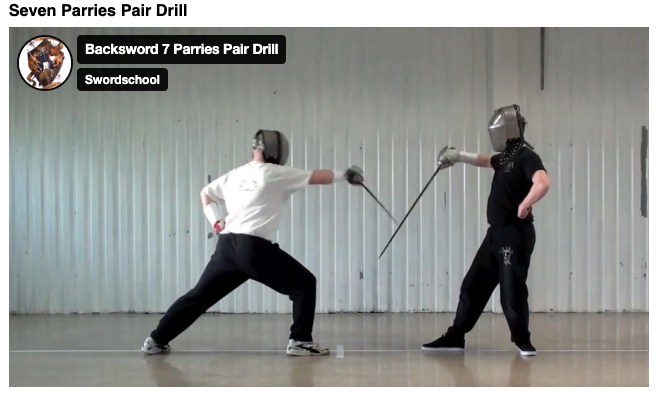
Screenshot of backsword or singlestick drill

Last Saturday I taught a singlestick seminar. Singlestick is an odd system for me because it’s the one area of swordsmanship where I am not tied hand and foot to a single source. Having been thoroughly pasted by Terry Brown and his students, I am under no illusions about my current competence with this weapon. It is a part of the syllabus that is left over from a time 10 years ago or more when it was one of my best weapons to fence and teach.

It is unique in that it is the only system I teach where we use wooden weapons and allow a sporting approach. Historically, the singlestick (a yard long ash stick with a leather basket covering the hand) was a training tool for the military broadsword, and a separate sporting system in which bouts were ended with a bleeding head wound. (There is a lovely description of this in chapter two of Tom Brown’s School Days, which you can download free from Project Gutenberg. I have copied and pasted the relevant section below this post.)

We spent the day working on the material that is intended for the steel backsword, such as this Seven Parries drill:

By the last hour of the seminar all the students seemed pretty exhausted. We had covered the basics of the system, in static drills and more lively “make it work” exercises, and had used some freeplay to expose what needed practice. So it was clearly time for a change of pace. To me, that means lots of running about and push-ups.

To start with, I had the benches brought out (long, low school-gym type things) and placed end to end, and the students freeplayed on them- it made for some very conservative footwork!

We then used the benches as a barrier. One student at each end, on opposite sides. The rules are- keep moving forwards, don’t get hit. The idea is to make it similar to two cavalrymen attacking each other. This lead to a LOT of double hits (and hence a lot of push-ups). This in no way accurately simulates mounted combat, but it gives a small insight into the problem of fighting people who are moving past you.

Then I added a second mask, held in the left hand, in about the position of the imaginary horse’s head. Strikes could be done to either the man or the mask. Very silly, but again a window onto a problem. If your horse gets his eyes cut out, what do you do?

Then everyone spread out fight to one hit, last man standing. The last man of course got to choose how many push-ups everyone else did. Precious little teamwork, lots of backstabbing.

To this we added blackpowder pistols. Sort of. Everyone got one rubber dagger, which they could throw. No reloading (i.e. Picking up a spent dagger and throwing it again). Again lots of backstabbing, shooting from behind, missing, and general hilarity. And the question was raised- when to shoot, if you only have one shot?

The role of singlestick within the school syllabus is to provide a low barrier to entry weapon, where beginners can freeplay safely with minimum kit and maximum fun. It goes against the grain a bit to be so cavalier with a historical system, but there is no doubt of the usefulness of the occasional descent into silliness.

The Singlestick bout from Tom Brown’s School Days, by Thomas Hughes

And now, while they are climbing the pole in another part of the field, and muzzling in a flour-tub in another, the old farmer whose house, as has been said, overlooks the field, and who is master of the revels, gets up the steps on to the stage, and announces to all whom it may concern that a half-sovereign in money will be forthcoming to the old gamester who breaks most heads; to which the Squire and he have added a new hat.

The amount of the prize is sufficient to stimulate the men of the immediate neighbourhood, but not enough to bring any very high talent from a distance; so, after a glance or two round, a tall fellow, who is a down shepherd, chucks his hat on to the stage and climbs up the steps, looking rather sheepish. The crowd, of course, first cheer, and then chaff as usual, as he picks up his hat and begins handling the sticks to see which will suit him.

“Wooy, Willum Smith, thee canst plaay wi' he arra daay,” says his companion to the blacksmith's apprentice, a stout young fellow of nineteen or twenty. Willum's sweetheart is in the “veast” somewhere, and has strictly enjoined him not to get his head broke at back-swording, on pain of her highest displeasure; but as she is not to be seen (the women pretend not to like to see the backsword play, and keep away from the stage), and as his hat is decidedly getting old, he chucks it on to the stage, and follows himself, hoping that he will only have to break other people's heads, or that, after all, Rachel won't really mind.

Then follows the greasy cap lined with fur of a half-gipsy, poaching, loafing fellow, who travels the Vale not for much good, I fancy:

“For twenty times was Peter feared

For once that Peter was respected,”

in fact. And then three or four other hats, including the glossy castor of Joe Willis, the self-elected and would-be champion of the neighbourhood, a well-to-do young butcher of twenty-eight or thereabouts, and a great strapping fellow, with his full allowance of bluster. This is a capital show of gamesters, considering the amount of the prize; so, while they are picking their sticks and drawing their lots, I think I must tell you, as shortly as I can, how the noble old game of back-sword is played; for it is sadly gone out of late, even in the Vale, and maybe you have never seen it.

The weapon is a good stout ash stick with a large basket handle, heavier and somewhat shorter than a common single-stick. The players are called “old gamesters”—why, I can't tell you—and their object is simply to break one another's heads; for the moment that blood runs an inch anywhere above the eyebrow, the old gamester to whom it belongs is beaten, and has to stop. A very slight blow with the sticks will fetch blood, so that it is by no means a punishing pastime, if the men don't play on purpose and savagely at the body and arms of their adversaries. The old gamester going into action only takes off his hat and coat, and arms himself with a stick; he then loops the fingers of his left hand in a handkerchief or strap, which he fastens round his left leg, measuring the length, so that when he draws it tight with his left elbow in the air, that elbow shall just reach as high as his crown. Thus you see, so long as he chooses to keep his left elbow up, regardless of cuts, he has a perfect guard for the left side of his head. Then he advances his right hand above and in front of his head, holding his stick across, so that its point projects an inch or two over his left elbow; and thus his whole head is completely guarded, and he faces his man armed in like manner; and they stand some three feet apart, often nearer, and feint, and strike, and return at one another's heads, until one cries “hold,” or blood flows. In the first case they are allowed a minute's time; and go on again; in the latter another pair of gamesters are called on. If good men are playing, the quickness of the returns is marvellous: you hear the rattle like that a boy makes drawing his stick along palings, only heavier; and the closeness of the men in action to one another gives it a strange interest, and makes a spell at back-swording a very noble sight.

They are all suited now with sticks, and Joe Willis and the gipsy man have drawn the first lot. So the rest lean against the rails of the stage, and Joe and the dark man meet in the middle, the boards having been strewed with sawdust, Joe's white shirt and spotless drab breeches and boots contrasting with the gipsy's coarse blue shirt and dirty green velveteen breeches and leather gaiters. Joe is evidently turning up his nose at the other, and half insulted at having to break his head.

The gipsy is a tough, active fellow, but not very skilful with his weapon, so that Joe's weight and strength tell in a minute; he is too heavy metal for him. Whack, whack, whack, come his blows, breaking down the gipsy's guard, and threatening to reach his head every moment. There it is at last. “Blood, blood!” shout the spectators, as a thin stream oozes out slowly from the roots of his hair, and the umpire calls to them to stop. The gipsy scowls at Joe under his brows in no pleasant manner, while Master Joe swaggers about, and makes attitudes, and thinks himself, and shows that he thinks himself, the greatest man in the field.

Then follow several stout sets-to between the other candidates for the new hat, and at last come the shepherd and Willum Smith. This is the crack set-to of the day. They are both in famous wind, and there is no crying “hold.” The shepherd is an old hand, and up to all the dodges. He tries them one after another, and very nearly gets at Willum's head by coming in near, and playing over his guard at the half-stick; but somehow Willum blunders through, catching the stick on his shoulders, neck, sides, every now and then, anywhere but on his head, and his returns are heavy and straight, and he is the youngest gamester and a favourite in the parish, and his gallant stand brings down shouts and cheers, and the knowing ones think he'll win if he keeps steady; and Tom, on the groom's shoulder, holds his hands together, and can hardly breathe for excitement.

Alas for Willum! His sweetheart, getting tired of female companionship, has been hunting the booths to see where he can have got to, and now catches sight of him on the stage in full combat. She flushes and turns pale; her old aunt catches hold of her, saying, “Bless ‘ee, child, doan't ‘ee go a'nigst it;” but she breaks away and runs towards the stage calling his name. Willum keeps up his guard stoutly, but glances for a moment towards the voice. No guard will do it, Willum, without the eye. The shepherd steps round and strikes, and the point of his stick just grazes Willum's forehead, fetching off the skin, and the blood flows, and the umpire cries, “Hold!” and poor Willum's chance is up for the day. But he takes it very well, and puts on his old hat and coat, and goes down to be scolded by his sweetheart, and led away out of mischief. Tom hears him say coaxingly, as he walks off,—

“Now doan't ‘ee, Rachel! I wouldn't ha' done it, only I wanted summut to buy ‘ee a fairing wi', and I be as vlush o' money as a twod o' feathers.”

“Thee mind what I tells ‘ee,” rejoins Rachel saucily, “and doan't ‘ee kep blethering about fairings.”

Tom resolves in his heart to give Willum the remainder of his two shillings after the back-swording.

Joe Willis has all the luck to-day. His next bout ends in an easy victory, while the shepherd has a tough job to break his second head; and when Joe and the shepherd meet, and the whole circle expect and hope to see him get a broken crown, the shepherd slips in the first round and falls against the rails, hurting himself so that the old farmer will not let him go on, much as he wishes to try; and that impostor Joe (for he is certainly not the best man) struts and swaggers about the stage the conquering gamester, though he hasn't had five minutes' really trying play.

Joe takes the new hat in his hand, and puts the money into it, and then, as if a thought strikes him, and he doesn't think his victory quite acknowledged down below, walks to each face of the stage, and looks down, shaking the money, and chaffing, as how he'll stake hat and money and another half-sovereign “agin any gamester as hasn't played already.” Cunning Joe! he thus gets rid of Willum and the shepherd, who is quite fresh again.

No one seems to like the offer, and the umpire is just coming down, when a queer old hat, something like a doctor of divinity's shovel, is chucked on to the stage and an elderly, quiet man steps out, who has been watching the play, saying he should like to cross a stick wi' the prodigalish young chap.

The crowd cheer, and begin to chaff Joe, who turns up his nose and swaggers across to the sticks. “Imp'dent old wosbird!” says he; “I'll break the bald head on un to the truth.”

The old boy is very bald, certainly, and the blood will show fast enough if you can touch him, Joe.

He takes off his long-flapped coat, and stands up in a long-flapped waistcoat, which Sir Roger de Coverley might have worn when it was new, picks out a stick, and is ready for Master Joe, who loses no time, but begins his old game, whack, whack, whack, trying to break down the old man's guard by sheer strength. But it won't do; he catches every blow close by the basket, and though he is rather stiff in his returns, after a minute walks Joe about the stage, and is clearly a stanch old gamester. Joe now comes in, and making the most of his height, tries to get over the old man's guard at half-stick, by which he takes a smart blow in the ribs and another on the elbow, and nothing more. And now he loses wind and begins to puff, and the crowd laugh. “Cry ‘hold,' Joe; thee'st met thy match!” Instead of taking good advice and getting his wind, Joe loses his temper, and strikes at the old man's body.

“Blood, blood!” shout the crowd; “Joe's head's broke!”

Who'd have thought it? How did it come? That body-blow left Joe's head unguarded for a moment; and with one turn of the wrist the old gentleman has picked a neat little bit of skin off the middle of his forehead; and though he won't believe it, and hammers on for three more blows despite of the shouts, is then convinced by the blood trickling into his eye. Poor Joe is sadly crestfallen, and fumbles in his pocket for the other half-sovereign, but the old gamester won't have it. “Keep thy money, man, and gi's thy hand,” says he; and they shake hands. But the old gamester gives the new hat to the shepherd, and, soon after, the half-sovereign to Willum, who thereout decorates his sweetheart with ribbons to his heart's content.

“Who can a be?” “Wur do a cum from?” ask the crowd. And it soon flies about that the old west-country champion, who played a tie with Shaw the Lifeguardsman at “Vizes” twenty years before, has broken Joe Willis's crown for him.


Entering the Fray with Vigour

Guy Windsor striking at a pell with a longsword, entering the fray

One of the benefits to running an intermediate level class first thing every Monday evening, is that I get to put the seniors under a bit of pressure, make them work outside their comfort zones, and see what cracks. If a classful of students have difficulty with the same thing, it's a pretty clear indication that their training is at fault.

This occurred recently, when saying goodbye to a well liked and respected student who was returning home to Germany. Goodbye Swordschool style generally involves a bit of violence, and in this instance we had him face the entire class one at a time, such that they entered measure and attacked, and he just had to defend himself. Over and over again 🙂

We call this drill Holding the Field.

It became abundantly obvious very quickly that most students had no clue about entering the fray (or entering measure) in style. They could walk up, set themselves in guard, and launch, and God knows they can bugger about on the edge of measure forever. But marching forward swinging a sword and be in the right place to attack without pause, and without creating a tempo in which the defender could reasonably enter, was beyond them. Clearly, there was a gap in the basic syllabus. So I immediately created a set of drills to fix it. They are:

Three ways to practise entering the fray

1) On the pell: start from way out of measure, i.e. from across the salle, and enter smoothly, with full blows, moving only forwards, and arrive in the right measure with the right movement to strike the pell in perfect control (of course). This puts a strain on the imagination, and requires constant tiny adjustments to familiar movements to be in exactly the right spot to strike.

2) Add a step before step one of a basic drill. So, the defender stands still and waits, the attacker normally starts from a set guard. In this version, he has to precede the attack with a pass into measure with a blow that chambers the actual attack (e.g. the attack is mandritto fendente; chamber it with a roverso fendente). Once this sort of thing is comfortable, we must guard against false times and creating tempi for the enemy, and so the defender can strike if the chambering action leaves the attacker open.

In practice this means chambering with an action that is differently timed to a normal strike, in which the sword is at maximum extension as you arrive in measure. That would leave you standing still with the sword leaving the centre, in measure- a gift to the opponent. So instead the sword tends to travel past its maximum extension earlier, so as you arrive in measure it is coming back to the centre.

3) Add a step before step 2 of a basic drill: so the defender steps into measure with a blow that creates the starting defensive guard of the drill: the attacker uses that motion as his tempo to strike. So the defender has to be able to enter measure and respond to the attacker's attempt to take time on him.

This can all be done with other weapons, but its natural home is the longsword. This also prefigures the use of assalti in the Bolognese system, which can serve as set ways to enter boldly to the fray. You can just walk up to someone and start the fight, but it is psychologically advantageous to do so boldly, dramatically, and hopefully terrify them into immobility by your martial vigour. And now we have a way to practice that.

The key idea is to get away from static drill openings, and into a more dynamic way of training.

Update: this blog post was the initial stimulus to my “Who Moves First” multiplier, familiar from The Medieval Longsword: a training manual and others of my works.

Learning about safety in historical martial arts: the hard way.

I have often remarked in class that I have broken bones in training so that my students don't have to. In other words, the safety regulations we have were arrived at through my getting hurt and figuring out ways to avoid it happening again. One of my favourite such examples occurred at a training session at the Dawn Duellist's Society, a historical fencing club I helped to found back in 1994. I had challenged a dozen or so folk to duel at the weapons of their choice. My last fight of the evening was with the redoubtable Kieran Robb, who was a) very tired and had to be persuaded to fence (mistake no.1) b) using a flamberge bladed longsword (mistake no. 2). I was also tired (mistake no.3) and was using just a normal fencing mask with no back-of-the head protection (mistake no 4.).

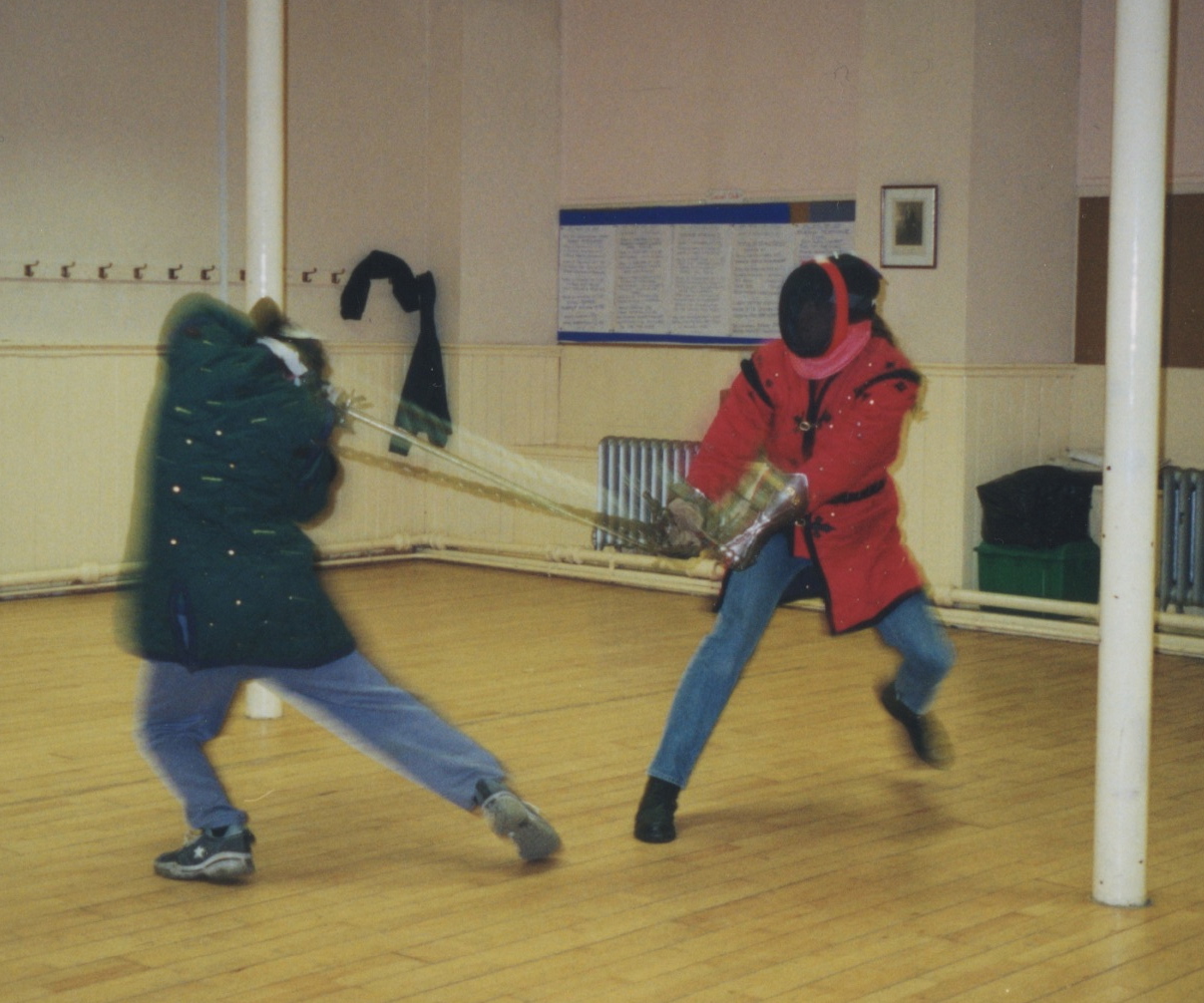
Merrily I attacked and lo, he stepped offline, parrying my blow and letting it go by, and his sword crashed into the back of my head. The moment was caught on camera.


learning about safety in historical martial arts- the hard way! Kieran hitting Guy in the head

That's Kieran on the right, in red, me getting whacked on the left, in green.

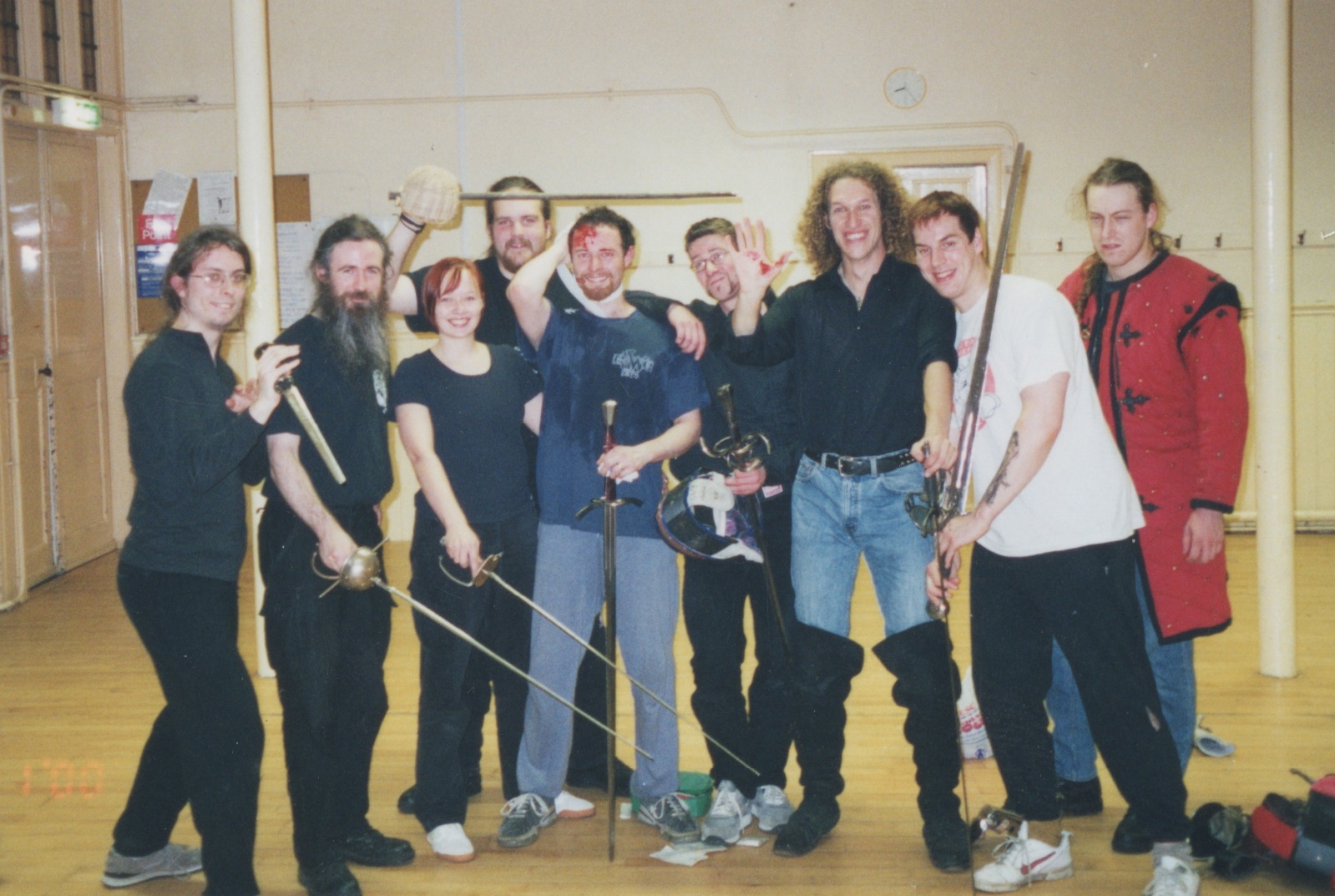
Assessing the damage. After this shot I tootled off to casualty for three staples in my scalp. But not before assembling a group shot with all my opponents of the evening, holding the weapon we fought at:

A happy crew despite a bleeding head wound. Safety in historical martial arts is paramount!


This was an important evening for me as it established in my own mind my willingness to take serious physical risks in pursuit of the art- and of the need for better safety standards for the school I was planning to open. My decision to open a school was made in September 2000, this photo was taken in October, and the school opened in March 2001. Not long after this I got a broken finger playing around with longswords- while my steel gauntlets were in my bag about 5 feet away. We had no proper rules, and so laziness and stupidity got me hurt, twice, in a couple of months. Doh.

But that got me thinking long and hard about how to prevent similar accidents happening to my students. I'm strict about wearing steel gauntlets when necessary. And though it would be another 8 years or so before Terry Tindill created his amazing historical martial arts mask, that's actually designed for weapons like longswords, I was aware from this beginning that normal sport fencing masks are simply inadequate for serious longsword sparring.


Search

Recent Posts

Categories

Categories

Tags