
Guy's Blog

Guy frequently keeps this blog updated with thoughts, challenges, interviews and more!

Category: Sources & Manuscripts

This is a great week for historical fencing. I spent three full days at the National Fencing Museum with a decent camera and a book-photography rig, taking hi-res images of the cream of their amazing collection of treatises, with the kind assistant of James Hester, and Malcolm Fare (whose collection this is).

I have 122 gigabytes of raw images, that will in due course be processed into a more web-friendly format, and put online for free into the public domain to be used by anyone as they please. You can find the currently available photos on my gumroad account with a little searching.

We have Hope: New Method (1707), Fencing Master (1687), and Advice to his Scholar (1729).

We have McBane (1728), Viggiani (1575), Sainct-Didier 1573), De La Touche (1670), Senese (1660).

And we have goddam Thibault (1628).

Plus eighteen other treatises, dating between 1540 and 1838. The ones I am most excited about are Senese, Viggiani, and Alfieri. But having both the 1610 AND the 1629 editions of Capoferro is pretty cool too. Not to mention the marginalia, like this detail from this copy of De La Touche:

And this is only about 10% of the museum’s collection.

There is a huge amount of work to do to crop, order, rotate, enhance, and otherwise process these files, and if anyone with the necessary skills would like to help, please do volunteer.

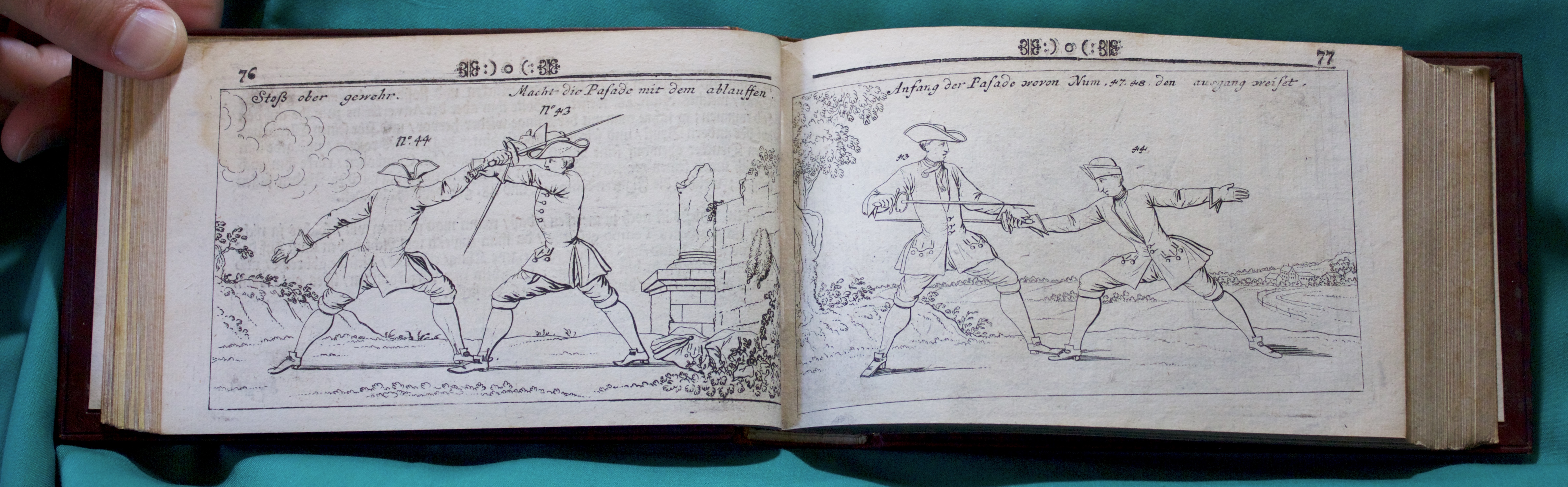
Most of these are in Italian, English, and French. But Spanish? We got Spanish: Narvaez, 1672. Russian? We got Russian. Ficher, 1796. And this is an especially good week for German-reading historical fencers, because we have Schmidt from 1713:

This work includes fencing:

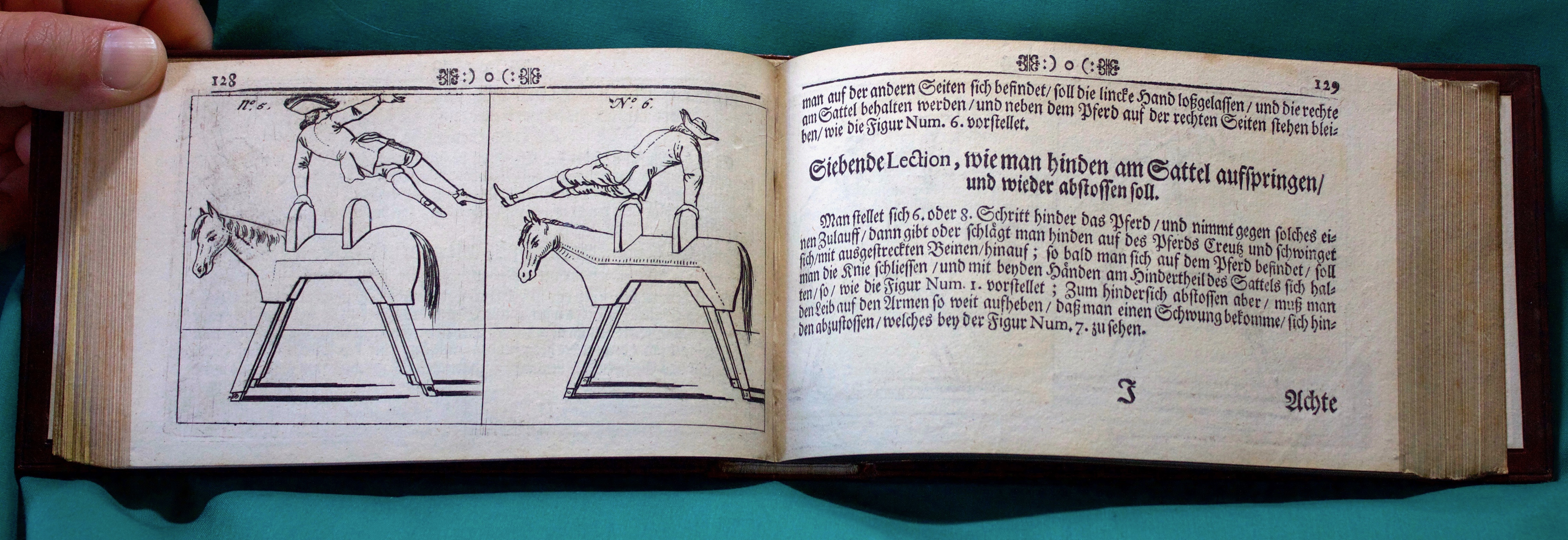
And even gymnastics, back when gym horses had heads and tails!
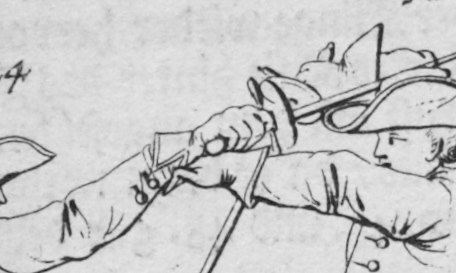
Note that these photos here have been heavily reduced in resolution to be transportable. The originals are breathtaking. I can’t do them justice in this format, but this close-up might give you an idea. Each photo is about 25mb in the raw format.
We have the 1600 Meyer.

And to cap it all, when I got home from the trip, I found a box waiting for me: full of the brand-new German edition of my The Medieval Longsword book.

This was translated by my student Frank Polenz, and published by Wieland-Verlag. You can find it here. The designer has done a stunning job of the interior, and frankly, I’ve never looked so good 🙂 You can see some interior shots on their webpage. Incidentally, Wieland have incorporated this book into their own series of “Schwertkampf” books, so don’t be mislead by the series number; it’s #2 in Mastering the Art of Arms, but #3 in Schwertkampf.

This will go very nicely with Der Mittelalterliche Dolch!

And in other news, I’m wrapping up the final edits to my re-translation of De Arte Gladiatoria Dimicandi, so it should be here by the end of the year…

Update: my new translation is called The Art of Sword Fighting in Earnest, published in early 2018. It includes an introduction, translation and commentary, and you can get it in fancy full-colour hardback with the facsimile built in, or in paperback in black and white, or indeed as an ebook.

I am not known for my sense of proportion when it comes to the Art I serve. OF COURSE everyone should train. OF COURSE it's more important than jobs or other distractions (I make an exception for children. Only for children). But the Art itself is based on proportion. For any action to work, it must be done in the correct time and measure. Both of these are not absolute dimensions, but proportional to the position and actions of the opponent.

In medieval times, up until comparatively recently, the units of measurement (yards, metres, pounds, kilos, etc.) would vary from country to country, even town to town. It was very difficult to establish absolute dimensions for anything. So all building plans and similar representations would be established proportionally, geometrically. Side x is twice the length of side y, etc.

This fits with fencing perfectly: as Vadi wrote:

La Geometria che divide e parte.

Per infiniti numeri e misure.

Che inpi di scientia le sue carte.


La spada e sotto posta a le sue cure.

Convien che si mesuri i colpi ei passi.

Acio che la scientia ta secure.


Geometry divides and separates

By infinite numbers and measures,

And fills her papers with science.

The sword is placed in her care,

So measure blows and steps together

So Science keeps you safe.

Geometry is the perfect science here because it does not deal in dimensions at all, just in relationships between lines. Measure and time are relative: to your opponent's actions and your own.
I am in the depths of a dip in typing speed thanks to learning to touch type and switching to the Dvorak layout (QWERTY is SO skeuomorphic, that once I took an interest in typing it started to bug the hell out of me, and a friend put me on to “‘,.PYF” instead) so this may be the last post for a while, as I work on technical exercises. Merry Christmas all!


The Fiore Extravaganza, a week-long immersion in medieval Italian martial arts, is now over. This year we spent much of our time working through Filippo Vadi's fencing theory, and his 25 longsword plays. This was in part to help with the commentary section of my upcoming Veni VADI Vici book, in part to satisfy the curiosity of the students present, and in part because it provided a set of key plays and concepts that bridge the gap between Fiore's longsword material other systems.

While it was clear that Vadi's presentation of the material is far less complete and far less well organised than Fiore's he nonetheless introduces some important concepts. In the first advanced class following the Extravaganza I summarised the critical insights like so:

1) Size matters. Vadi requires us to use a longer sword than the ones we see in Fiore. This has a huge impact on the appropriate responses to the crossing at meza spada. Video explanation to follow!

2) The blows of the mezo tempo “remain in a knot”. At the moment the default understanding seems to be that the “mezo tempo” equates to a counterattack with a half blow. That is just not how he is using the terms- they are instead the blows done from the meza spada crossing, in which your hands must remain in front of you and the sword going forwards turning around its midpoint or you get stabbed.

3) All of Vadi's longsword plays can be done from the meza spada crossing, which is analogous to Fiore's crossing in zogho stretto.

4) The solutions Vadi talks about when crossed at the middle of the swords are very similar to those found in Liechtenauer; and depend in large part on the sword being some inches longer than the ones illustrated in Fiore. He describes actions that are very similar to certain windings (e.g. “the arms play above the head”), and actions like zucken.

5) Vadi's longsword guards are not always created by blows, and though he makes little real use of them, he includes guards that we do not see in Fiore or the Liechtenauer system, but which appear in the later Bolognese.

6) His solution to avoiding the complexity of the plays from the meza spada (zogho stretto) is exactly as Fiore's- parry from the left with a good roverso and strike.

The Extravaganza ended, as always, with a tournament. The format was agreed beforehand by those participating, and unlike last year we went for the two teams approach. The participants were divided into the A team (seniors) and the B team (juniors). We started with two rounds in which the B team members challenged the A team member of their choice, at the weapon of their choice. This guaranteed every B team member at least two good fights. If the B team member won either of their fights, they got into the final. Those B team members that did not get into the final were organised into a pool and all fought each other, giving them more experience. The winner of the pool also won a place in the final.

The finalists, so the original A team plus successful B-team members, were organised by rank and experience, and fought a winner-stays-on elimination. Number one fought number 2, winner fought number 3, winner fought number 4, etc etc. The spectators got to pick the weapons used. So the most experienced person would have to beat every other finalist to win- the least experienced had to win only one fight to take the tournament. Janne Kärki of the Kuopio branch won in fine style, winning four matches in a row. His prize was a bout with me, which we both enjoyed thoroughly.

All in all, a fantastic week of research, training, and fighting. Well done all who took part!

Search

Recent Posts

Categories

Categories

Tags