I spent the first week of October on a data detox. No emails, no whatsapp, no socialz, no scrolling. It’s been a lovely mental break. My initial reason for trying this was to allow my inner visionary to be heard, as per this post.
The single biggest surprise is how little I missed it. I was really looking forward to it, and enjoyed the lack of distraction very much indeed. Days one and two were very relaxing. For reasons I can’t pin down, but which may be related to withdrawal, I was grumpy as hell for days three and four. Oddly though I didn’t have any urge to get online, so I don’t think it was withdrawal exactly. Then things perked up immensely on days 5-7, and I got a bunch of things done that I’ve been meaning to get round to. More on that below.
So what filled the void created by the data detox? That gaping chasm of boredom and ennui that our marvellous machines cover up with clicks and scrolling?
1. I’ve thought a lot. It’s actually nice to be back in my own head a bit more.
2. I’ve did a lot more actual sword practice, in addition to my usual physio/fitness/strength stuff.
3. Coincidentally (I think, because these were planned ages ago) I went to the actual theatre, and met friends for lunch in the pub (yes I’m still off booze, 50 more days to go), and been to a talk (given by Roland Allen, of The Sword Guy and A History of Thinking on Paper fame). All analogue, real people in a room together, offline goodness.
I should point out that I was not religious about this. I used my wife’s laptop to print out crosswords, and fired up my phone to be able to navigate to drop off my daughter at a friend’s house for a party (I don’t have a paper map of the area, which I should!). But outside some very sensible exceptions, I’ve kept the phone turned off, and did not check any messaging apps or email when I did turn it on. The computer was not turned on at all.
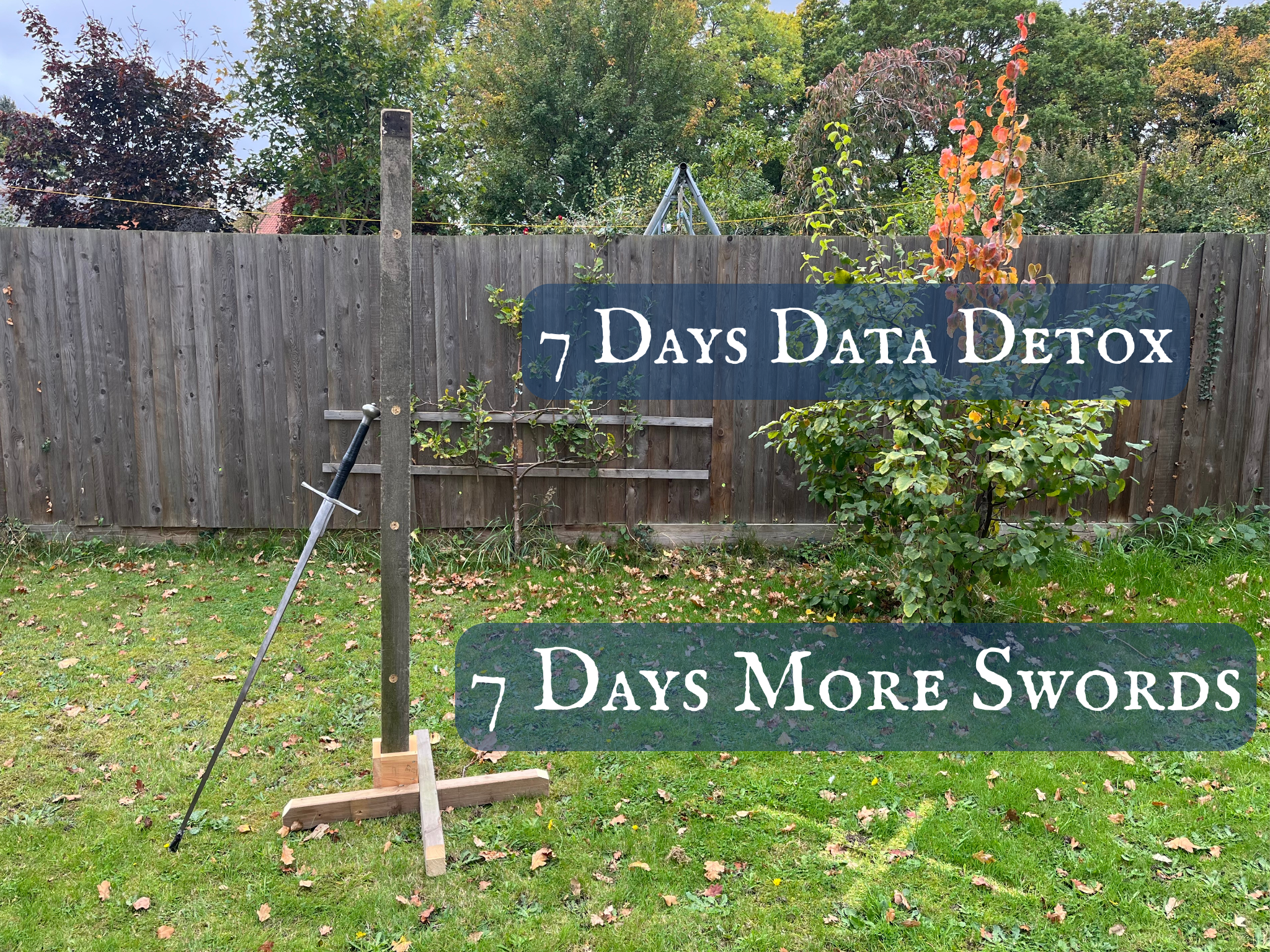
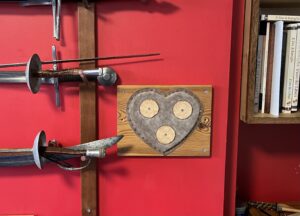
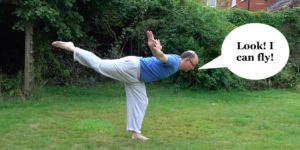
I finished making my mum’s birthday present, put a new base on my pell so it stops falling over when it’s windy (see the photo above), and rearranged my study such that I could get my point control wall target up (it needs a sturdy wall to hang on, and room in front and to the sides for footwork).
I also planned a new launch, thought about the overall structure of my business, and got a bunch of CEO stuff done. I don’t think my visionary woke up particularly, so I need to think about how to make that happen.
One of the things I’ve been thinking about is how we have all sorts of social rules and norms around other addictive behaviours, such as drinking and smoking. If someone offered you a glass of wine at 11am you might say “it’s a bit early for me”. Because these days it’s normal to avoid drinking during the day. Likewise smoking. It used to be everywhere, all the time. But now it would be very very rude to light up inside someone’s home without asking, and most smokers would automatically go outside.
But watch any TV show from the 80s and just about every rich person is having a drink at 10am, and everyone rich or poor is smoking indoors at all hours. These healthier rules around smoking and drinking are relatively new, and relatively unconnected with legislation.
I do well with rules if they’re my own. (I do much less well with other people’s rules.) Both phones and computers are incredibly useful. But they are inherently built for distraction. So here are my rules for using my computer and my phone.
Rules for the Computer
1. Be a cat. I’ve borrowed this from Jaron Lanier’s excellent 10 Arguments for Deleting All Your Social Media Accounts Right Now. Cats don’t try to please people. They just pursue their own agenda, and allow the people in their life to serve their needs. If a cat wants stroking, you’ll know. The computer belongs to me. It’s a critically important tool for writing books, editing video, running my business, and communicating with people.
But it’s been warped by the internet into also being a major source of distraction. So I will approach my computer the way a cat approaches the humans that feed it. I’ve always had all notifications turned the hell off, but that doesn’t stop me from getting distracted.
2. Decide what I want to do before waking it up. That could be work on the next book, or some critical business task like paying a freelancer, or emailing someone about something. Then do that thing first. After my week away I have a long list of things to do, including drafting this blog post, that comes ahead of checking my emails. Happy to report I’m following my own rules.
3. Unless I have a good reason, don’t open any communications app before 2pm. Exceptions include scheduled zoom sessions (running a trainalong or doing crosswords with my mum are both good reasons), or if I’m expecting a time-critical message about something actually important.
4. Turn off all comms apps at or before 5pm. Exceptions as per rule 3. And take at least one full day per week off all comms. I think probably Thursdays, which I generally keep free anyway.
5. Be a cat. It’s worth an extra rule to be reminded of the first one.
What do I want my Fondleslab Distraction Engine (aka “phone”) for?
There are many excellent things about the phone that I want to keep, that I missed during the data detox. In no particular order they are:
Camera
Podcast player
Music player
Sound recorder (when recording videos etc.)
Maps/navigation
Payments
Wallet for tickets, boarding passes, etc.
Calendar
The Sword People app for keeping in touch with my sword people and posting sword photos
Calculator
Notes app for when I don’t have a notebook or pen with me. Rare, but it happens.
StrengthLog app for tracking weights workouts
Family Whatsapp channel. I’d like to move it to Signal, but I don’t think we’d get everyone on board with it (my siblings, their kids, my kids, it’s actually quite a lot of people).
Some friends prefer Signal, so I have that for talking with them.
One dear friend, and my godson only really use Discord, so I have that too.
But other than those excellent things, why would I want to be continually distracted?
Rules for the Fondleslab Distraction Engine
1. Be a really fucking grumpy cat.
2. Delete all addictive apps. No games, nothing that makes me likely to scroll (Ebay, Vinted, Chrono24, etc.). No emails. I have the accounts still there in the system settings, but I’ve turned off the email function. That way if I need to be able to check email on my phone for some reason, it’s easy to turn back on, but it’s not on by default.
3. Turn off all notifications. All of them. Especially badges (those red things that flag the app's icon). I’ll check the apps when I want to. The phone still rings if you call me, but that’s it.
4. WhatsApp, Messenger, etc. are strictly friends and family only. I have SwordPeople for work-related messaging. (Feel free to sign up there if you want to be able to message me outside email.)
5. Switch off the phone completely for at least one full day per week. So e.g. turn it off in the evening, and not turn it on until the morning of the day after next.
Final Thoughts on the Data Detox
I’m also thinking about getting a new phone number, and relegating the current one to a no-data phone, so I can use it for two-factor authentication, and as my “business” number, and keep my other number entirely private, so only people I’ve actually given it to will have it. My current number is clearly on too many databases, given the number of spam calls and texts I get.
I’m not alone in fighting this fight. Useful resources are the aforementioned Jaron Lanier’s 10 Arguments. Also Cal Newport’s Deep Work, and for non-algo-poisoned tech solutions, the Creative Good forum has all sorts of options and suggestions. Once you have all this distraction-free time you'll need to learn to prioritise, so you may find my post about deciding what to focus on helpful.
It's worth explicitly stating that I welcome emails from my students, readers, friends, family, and even some newsletters and other things. Email isn't the problem. It's letting it spill out of a confined space to take over my brain that’s the problem. The same is true for messaging apps generally. I've broken the cycle of reflexively checking for anything new coming in with my seven days off, so now I need to keep that cycle broken. Or I'll end up having a (metaphorical) whisky and a cigarette for breakfast again.
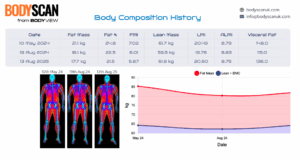
I was in London a couple of weeks ago for a family reunion, and took the opportunity to wiggle along for another DEXA scan (at BodyScan UK). My last was a year ago. On the positive side, I’ve put on about 2.4kg of ‘lean mass’ (the scan can identify fat, bone, and ‘lean mass’, which is everything that isn't fat or bone), mostly in the upper torso. And my overall fat percentage has come down from 24.8% in May 2024, to 21.5% now. Great.
But my genetics put the remaining fat mostly in my viscera, the absolutely worst place to have it. I had 148
cm² (which is a weird way to measure a volume, but hey) in May '24, down to 115cm² in August '24, but as the muscle piled on (yay!) it brought some fat with it (as it almost always does), and it all went round my organs, so it's back up to 136cm². Boo.
Subcutaneous fat isn’t such a big health problem, in reasonable amounts. But visceral fat is bad for inflammation, blood lipids, diabetes risk, the works. And it seems that’s where I store it.
I’m not a big believer in calorie restriction as the main driver of fat loss, because while the laws of thermodynamics are absolute, your body is insanely complicated, and has all sorts of ways of adjusting your metabolism to lose or put on weight depending on various triggers. What you eat, and when, is as important as how much. And don't get me started on gut biome. I first really understood this when I accidentally lost 10kg in three weeks. But if there are a bunch of unnecessary calories coming in from somewhere, that's the obvious place to start.
For me the biggest source by far of “empty” calories is alcohol. My natural state is to have a glass of wine or two while cooking, and another glass or three while having dinner, and maybe a dram afterwards, pretty much every day. I normally get through about 7 bottles of wine a week minimum, without hangovers or other obvious ill effects. I think my soul is mostly Italian!
When I went alcohol-free for a month this Spring (thanks to a bad cholesterol test), I lost about 2kg and 4cm around my waist. It messed with other things though- I didn’t get a word written in all that time, other than newsletters. And I didn’t feel any particular energy benefits. Though I ought to have been sleeping better, I wasn’t waking up full of beans and ready to face the day any more so than usual.
But, several credible sources (the folk I listen to most on these subjects are Dr. Peter Attia, and Dr. Rhonda Patrick) suggest that the real benefits to cutting booze come around the three month mark. Kevin at BodyScan said the same thing. So I’ve decided to take 100 days off alcohol. I started on August 19th. Day 100 is November 26th, four days before my birthday.
Why not just cut back?
It's very hard to measure a small amount every now and then. Sure, I bet I could get most of the benefits if I just had one glass of wine on a Friday night. I've previously established with sleep monitors that a glass of wine with dinner has no measurable effect on my sleep (I eat early). But then what happens to the rest of the bottle? How much wine is that really? What if I swapped out the wine for a dram of Lagavulin? It's just much easier to measure “no booze” than figure out “some booze”. And from a self-control issue, it takes very little effort (for me) to have decided to not drink at all, than to stop at one. The hard part is making the decision to stop. Now that's done, thanks to bastard DEXA, it's really no big deal (for me).
I know that other people have much more serious issues with alcoholism or other addictions, so please don't read this as minimising their struggles. And I can think of several life events that could occur that would lead to me immediately abandoning this experiment in favour of getting blootered. So no judgement.
The Pros and Cons of alcohol restriction
You may find the pro/con analysis I do for any intervention a useful rule of thumb, so here goes.
Cons first (always):
1. Is there any known, or likely, health downside? If someone were to suggest going without vegetables for 100 days, or going without protein, or going without exercise, or without in-person social interaction, I’d want to see an awful lot of peer-reviewed studies suggesting that it was a good idea. But there is no known health benefit (that actually stands up to scrutiny) of consuming alcohol. So I won’t be sacrificing any useful nutrients. The polyphenols in wine? I get way more of them from blueberries and dark chocolate.
2. The most common downsides of any intervention are time and money. Exercise costs time. Supplements cost money. Cutting out alcohol saves money and takes no time.
3. Alcohol has been a major component of Western culture since at ancient times. The slaves that built the pyramids were fed a kind of beer. 2600 years later Jesus's first miracle was turning water into wine. 2000 years on, not much has changed. Just about every major event is marked with booze of some kind. We drink with friends, we drink to celebrate success, to commiserate in disaster, to raise a toast or to drown a sorrow. Wine, beer, spirits of every kind have been part of our culture (and many others) since forever, and there is a huge amount of artistry that goes into creating a perfect wine to go with your steak, or the smokiest of single malts. That's the only thing that makes this in any way difficult: the sheer number of times already (it's been less than a fortnight!) when I've had to risk being thought anti-social to decline an offered drink. People who like to drink (like me!) can take this as a critique of their current habits. Nothing could be further from the truth. But cutting out alcohol does carry a social risk.
I worked out that the last time I went 100 days with no booze I was 13. It’s been nearly 40 years since I last tried this, and it’s just an experiment, not a moral position.
So the worst-case scenario is I get no noticeable benefit (but save some money), and lose out on some gustatory delight, and some people will find me stand-offish. I can live with that, for SCIENCE. I don't judge other people by what they choose to drink, so have no interest in the judgements of those that do.
Pros:
1. There is good reason to suppose that I’ll cut the visceral fat down, because it’s happened before (between my first two DEXA scans, in May and August 2024 which established a clear correlation between waist size and visceral fat quantity), and because of the waist reduction this year, in just 33 days of no alcohol.
2. There ought to be improvements in sleep quality. This is very hard to measure, and regular readers will know that I’ve tried several different sleep trackers and found problems with all of them. The only metric that seems at all reliable is heart rate. With alcohol, my heart rate is higher and more erratic when sleeping; without it, it’s lower and steadier. I've confirmed this many times since getting my first sleep tracker in 2017.
3. It’s a clear break from a habit I know is not healthy, and a fairer test of sobriety. I wouldn’t necessarily judge the effects of a diet or exercise program after just a month, so it seems reasonable to give no booze a fair crack of the whip.
The best case scenario is that I get amazing health and vitality benefits from this. But that will raise the issue of do I go back or not? I’ll have to entirely re-think the place that alcohol plays in my way of life. So I’d be lying if I said I wasn’t kind of hoping that it doesn’t help much.
It’s important to keep any test to just one variable. If I replaced booze with doughnuts I could reasonably expect to not lose any visceral fat. So I’m giving myself a couple of weeks to let my usual dietary rules slip a bit (I had four slices of my daughter’s banana bread after dinner last Sunday, with marmalade) but once I’m back from Swords of the Renaissance this weekend I’ll be pretty careful about keeping the rest of my diet as it was.
And finally…
I intend to report back here (maybe even with another DEXA scan) in due course. But I keep my friends on Sword People, and my newsletter subscribers updated on all sorts of things, including my various health experiments. Join us there, or sign up for the newsletter (or both!).
And let me just re-iterate: I'm running a health experiment. I have no moral problem with alcohol, and I don't think of myself as an alcoholic. If alcohol is damaging your health, or getting in the way of your goals, feel free to try 100 days off, or better yet get professional help. But it says nothing about your moral worth whether you drink or not.
Update at 50 Days
50 days into this experiment: so far, so good. The hard part was making the decision. Once it was decided, not drinking is normal. There are open bottles of booze in the house, but no temptation. Every now and then I fancy a drink, but the urge passes quickly. This was as true on day 1 as it is on day 50.
The closest thing to an exception has been a couple of social events in pubs, where I had a low-alcohol (0.5% or lower ABV) beer. I’ve done that twice. I don’t think it matters particularly, but I’ve decided to be careful in the last 50 days to stay off even that.
My weight is down about a kilo and a half (3.5lb), and my waist is down about 2cm. These are averages: weight fluctuates a lot during the day and from day to day: have a glass of water and you gain half a pound or so. Eat more fibre the day before and there’s more water held in your gut. So I measure weight and waist every day, and average them up over the week. Waist is especially problematic to measure, as it’s me with a tape measure, trying to be consistent about exactly where on my body I’m putting it, and exactly how tight, at what point in my breathing cycle. Sucking in my gut gets me down to 84, expanding as much as possible gets me to 96 (which is significantly smaller than my relaxed measurement in May 2024). So I’m not treating these figures as hard or accurate, but they are a reasonable guide to progress.
The oddest thing about this is that all of the weight and waist gains occurred in the first 25 days; they have been basically stable since then. Though I suppose it’s possible I’ve been losing fat and gaining muscle (or the other way round) since then. My weight training is the most reliable guide to muscle mass until the next DEXA scan, and I’m getting gradually stronger (as one would expect), so I doubt I’m losing significant muscle mass. I’m also careful to keep my protein intake quite high (about 1.5g/1kg of body mass, so about 120g/day for me).
I’m not sure if I’m sleeping better or not. I don’t wake up feeling any more rested than I did before, but I have several times slept a lot longer than I used to, for no apparent reason. I’m hoping that my brain is adapting to the lack of booze and getting better at staying asleep, but it’s too early to tell. Sleeping longer means I’m waking up later, so my usual habit of getting an hour or so of writing in before the house wakes up isn’t happening, but that’s ok; I seem to be productive enough.
On balance, this has been underwhelming in terms of health gains so far. I was expecting significantly more benefits already, given that I’ve come down from drinking an average of a whole bottle of wine every day. But who knows, maybe the next 50 days will hold some surprises.
This experiment is an example of my overall guiding principle of training: figure out what works for you, then do that. Both of those aspects are challenging: how do you figure out what works for you? And how do you maintain the practice of applying it? I go over all these things and more in The Principles and Practices of Solo Training.
It's the beginning of “Mental Health Week”, so I thought I'd share the chapter “Mental Health” from The Principles and Practices of Solo Training. This comes after a chapter on visualising your mental model for training as a tree, with mental health as the roots, physical health as the trunk, and specific attributes as the branches, and is followed by a similar overview of physical health, before we delve into the details of goal setting, how to practice, etc. I am currently working on the audiobook version of The Windsor Method, and have attached the audio for this chapter here, in case it's better for your mental health to listen rather than read. Just click the play button:
Mental Health
Mental health is the foundation of all your training. If you’re too depressed to get out of bed, or too anxious to concentrate on your striking drills, it will be very hard to train effectively. I’m not a psychiatrist, and if you are struggling I hope you will get professional help. I did, and it works, or at least it worked for me.
If we were talking about physical health, you would agree that there are many things you can do to improve your general likelihood of avoiding disease and injury. Don’t smoke. Eat healthily. Exercise regularly. I think it’s the same for mental health. There are things you can do that will reduce the severity of mental health issues if they arise, or even avoid them altogether. But there are no guarantees, and all interventions carry some risk.
Meditation can reprogramme your inner voice, can reduce depression and other conditions. It can teach you how to control where your attention goes. But it can also make things worse, depending on how you do it and what you focus on.
Breathing exercises are particularly effective at reducing stress levels, and inducing a feeling of well-being. They are excellent for bridging the gap between conscious control and autonomic processes. But they can be frustratingly slow to work and don’t work for everything.
Exercise is a great mood enhancer, and is a simple way to boost endorphin levels which help with mood. But it comes with a risk of injury.
Spending time doing things you actively enjoy (like swinging swords?) is good too – and swinging swords can include meditative, breathing, and exercise components that are a feel-good triple-whammy. But everyone who has trained for any length of time knows that you can have bad training days. Understanding the foundations of mental health will help you figure out why. As I see it, they are:
1. Agency. A sense of control over your life and its direction. In many ways practising weapons drills is an externalised form of this. See! I can control this blade – I am in control. Control is always an illusion (you could drop dead at any moment), but it’s a very useful and necessary one.
2. Meaning. If you feel your life means something, you can tolerate a great deal more stress. Sacrifices you make for a greater good are much more bearable than those that are just taken from you.
3. Connection. We are social animals, and a great deal of our sense of meaning comes from the impact we have on those around us and our connections to them. The pandemic has highlighted this to an extreme degree. We need each other, and we need others to see that our existence has meaning. Believing that nobody would care if you disappeared is perhaps the worst feeling a person can have.
4. Sleep. The one natural process that is most key to your health and wellbeing. It only takes one bad night’s sleep to ruin your day. Sleep is a process and a skill, so I’ll discuss it separately from the other three branches, in Part 2: Practices.
Agency is the feeling of being in control.
It’s often reasonable to be upset, depressed, sad, angry, annoyed, or frightened. But none of those feelings are fun, healthy, or helpful so do what you can to avoid them. This has a great deal to do with what you focus on, and your sense of agency. The one single most important tool in your mental health toolbox is the ability to focus on your area of control. You don’t control the pandemic, or the weather. You do control whether you did push-ups today, or how you speak to the people in your life. Steven Covey popularised the idea of area of control (which dates back to the Stoics), in his 1989 book The Seven Habits of Highly Effective People. He uses the terms “circle of concern” to cover all the things you are interested in or concerned by, and “circle of influence” to cover those things over which you can exert some control. The circle of influence is always much smaller than the circle of concern, but by focussing on your circle of influence, you actually grow it, and become more able to affect the things in your circle of concern.
The key skill then is being able to control what you focus on, to keep your focus within your circle of influence. A great tool for becoming better at choosing what you focus on is mindfulness meditation. As with any skill, it gets better with practice.
One way to focus on your area of control is to make good art. Neil Gaiman was, and always will be, right on this. In his commencement speech on May 17th 2012 at the University of the Arts, he said:
“Life is sometimes hard. Things go wrong, in life and in love and in business and in friendship and in health and in all the other ways that life can go wrong. And when things get tough, this is what you should do.
Make good art.
I'm serious. Husband runs off with a politician? Make good art. Leg crushed and then eaten by mutated boa constrictor? Make good art. IRS on your trail? Make good art. Cat exploded? Make good art. Somebody on the Internet thinks what you do is stupid or evil or it's all been done before? Make good art. Probably things will work out somehow, and eventually time will take the sting away, but that doesn't matter. Do what only you do best. Make good art.” (Published in The View from the Cheap Seats, 2016).
Over and over again, I’ve found this to be good advice. I don’t know what your art is: writing code, painting, baking cookies, it could be anything. And it may well be that it feels like you can’t do your art right now, but there are related things you can do, to prepare for when things get back to normal. And ideally, whatever it is, share it. Which brings me on to my next thought: for mental health purposes, you’ll get the most profound sense of agency from helping others. There is nothing more empowering. It can be super-simple, such as Sir Patrick Stewart, Captain Picard himself, deciding at the beginning of the first UK lockdown, to read one Shakespeare sonnet per day aloud . You can find it on the internet. It’s very interesting to compare this shot-at-home Sir Patrick sitting on a sofa in comfortable clothes reading out of a book, with the more polished professionally produced sonnet readings of his which you can find on YouTube. To be honest, I actually prefer the homemade version. You don’t have to be producing content like this. There are a million ways to help people, and there is nothing that is better for your sense of agency, and connection.
Meaning is the story you tell about the things you focus on.
In 2015 my family and I moved to Lucca, in Tuscany, for three months. We spent a lot of that time eating pizza, but also a great deal of time in museums, “looking at old stuff” as my kids would put it. They were aged 6 and 8, and so didn’t have most of the background stories that bring meaning to a statue or a painting. The thing was either pretty, or not. We went everywhere with art supplies, so they would often sit on the floor and draw and paint the marvels around them. My wife and I would take it in turns to hang out with them while the other went exploring.
We learned early on that it made for a much better museum experience if we prepared the kids with some stories, pitched at their level. One very successful example was a YouTube video that dramatised the story of how Michelangelo created his David. When we got to Florence and took them to the Gallery of the Academy, and there David was towering over us, it had meaning for them.
Meaning is primarily mediated through story. The meaning of a piece of art is mostly in the story it tells, and the story of its creation. The meaning of your life is entirely in the stories you believe about it.
Imagine the difference between a scrap of wood on the trash heap, and an identical scrap of wood that a devout Christian believes is a piece of the True Cross. The meaning the Christian brings to the scrap of wood determines the quality of their experience seeing it.
I have a thought experiment for you, to illustrate this. I call it “three broken legs.”
You wake up in hospital in a lot of pain. You have a broken leg. There are three possible stories to explain why.
1. You went skiing/hang-gliding/mountaineering/insert fun but dangerous activity of choice. You had an accident, and your leg is broken. It happens, you knew the risks and took them.
2. You were walking down the street one day, when somebody came up to you with a baseball bat, shouted hate into your face, and broke your leg with the bat.
3. You were walking down the same street one day, and saw a truck about to run over a child. You leap into action, you save the child, but the truck breaks your leg.
One of these injuries is neutral; one is likely to require some serious counselling and may result in long-term psychological problems, and one is a badge of honour that you will draw strength from for the rest of your life. The broken leg is the same in each case.
Your emotional response to the injury is at least as important as the injury itself. The story that comes with the scar determines your experience of the scar.
And mental health is entirely about your experience, your subjective response to external factors.
So how does this apply to training?
From an entirely rational perspective it is absolutely pointless to study most martial arts most of the time. You are never going to use them. I certainly have no intention of ever fighting a duel. My sword training is in that sense a giant waste of time. But it resonates with a depth of meaning for me that every sword person understands intuitively, and no non-sword people will ever fathom. I am wired to see meaning in swordsmanship. I’m guessing that if you are reading this, so are you. Or maybe it’s some other martial art that turns you on. It doesn’t matter which one; it matters that it has meaning to you.
The sword is a sacred object. With its sharp point it pierces the veil of illusion, and with its sharp edge it separates truth from falsehood. It demands balance and justice. It focusses my being on a single point.
But literally every object is sacred, if you see it through the eyes of the right story.
So why are you training? What meaning do you bring to the arts you practise?
It’s perfectly all right if they are just a fun way to spend time and stay reasonably fit. But you need to bring meaning to some area of your life. Endless contemplation of the infinite void in which people are meaningless specks of agitated matter and we might as well not bother might have the satisfaction of being kind of accurate, but it’s not conducive to mental health.
Connection is our relationship to the people around us.
We are social animals. Without our place in society, we are nothing. In every culture banishment is a severe punishment, and in many times and places was equivalent to or considered worse than death. For most of pre-history our place in our tribe was literally how we survived. This is as true for hermits as it is for the most gregarious among us. Having very limited connection is not at all the same as having none.
Loneliness is a plague in our society, at least as damaging as the global pandemic, and of course it has been made worse by the pandemic. It is literally better for our mental health to be hated than to be ignored.
Of course, it’s better to be loved.
But what has this got to do with training?
Simply this: a large component of martial arts training is social, and as with any other human activity, it creates tribes and societies. This is good, in that we need to feel part of a tribe, but comes with the risk of cultish behaviours. Once we are deeply connected to the people in a tribe, staying part of the in-group becomes more important than other factors like rationality, morality and kindness. Martial arts are as vulnerable to becoming irrational cults as any other kind of human organisation. All this means is that we must be mindful of our need for connection, and make sure that we are connecting with the kinds of people who will bring out our best selves. When evaluating a school or club, see how the senior students behave – do you want to become like them? Because if you stay, you probably will.
It goes deeper than our need for social interaction though. Creativity is intimately linked with connection, because we create primarily through connecting previously separate ideas. Great writers aren’t great because they invent a lot of new words – they are great because they connect old words together in new ways. When growing your tree, you need to draw on the ideas of those around you. You can do this through personal interaction, but also through books, videos, and other forms of idea-spreading.
Connection is necessary for your emotional wellbeing, but also for your creativity. I wrote my first book because a friend suggested I should. I wrote my second because a student from my old club happened to complain about there being nothing out there for the rapier. Without these chance connections, I doubt I’d have started writing; I never had “be a writer” as a goal in life. But look how that turned out! Matthew Syed’s book Rebel Ideas explores the relationship between broad social connections and creativity in depth.
During the pandemic I have had a hard rule of at least one social call with a friend every week. Most weeks I have two or three. And if any of my friends contacts me wanting to talk, that takes priority over any work I may need to do. Connection is so fundamentally important to human wellbeing, way more so than any specific project I may be working on.
Our need for connection has many downsides, such as comparisonitis. We compare ourselves to those who are richer, prettier, stronger, luckier, more charismatic, more “successful”, whatever success means to you. My books do ok, but Stephen King probably wouldn’t be impressed by my figures. I find it helpful to be mindful about whom I compare myself with, and the metrics I use for comparison. Most people I know make more money than I do. I don’t care; I have way more free time. And my job description is infinitely cooler. If it comes down to money, I prefer to compare myself to the several billion people on the planet who make less than I do, rather than the much smaller number who make more.
If you are mindful of the categories you compete in, you can optimise for your mental health.
If you are living a life you believe to be meaningful, and have a sense of agency over it, and have strong connections to those around you, then you are in the best position to have solid mental health. If your training feels meaningful, gives you a sense of agency, and fosters connections with other people, it’s likely to help your mental health. This is why it is so very important to train in such a way that you are getting meaning, agency and connection. Because otherwise your training could feel meaningless, reduce your sense of control, and sever your connections with others.
After a session that goes really well, reflect on why. The chances are good that it scored highly in one or more of the three pillars. And if a session goes badly, which pillar did it fail to strengthen? How can you correct that next time?
I should also mention that your mind needs rest too. A bit of boredom is very good for you (see Bored and Brilliant, by Manoush Zamorodi if you don’t agree).
Swords have been a major part of my life since I was a kid and I still have days when my training feels meaningless. It’s normal, and we have ways round it. My own particular fix is having students. They depend on me to have decent sword skills, so on days when I can’t see meaning or value in training, I train for them.
Physical health is important primarily because it impacts on mental health. Would you rather be blissfully happy but disabled, or utterly miserable but physically fine? A great deal of your experience is mediated through your body. To take a straightforward example: adrenaline and cortisol are produced in the adrenal glands, which are connected to your kidneys. The adrenaline rush we get from a roller-coaster or falling in love? You can thank your adrenal glands. The grinding long-term damage from elevated cortisol levels? That’s your adrenal glands too. It is artificial to separate mind and body, they are deeply intertwined. This is why in many cases changing what you do with your body can deeply affect your mental health.
There’s a lot of doom and gloom going around at the moment. As the pestilence has subsided a bit, we’ve got war and famine instead. If you’re feeling a bit overwhelmed and crap, it’s not your fault. But I have one key idea and two practices that may help.
The key idea:
Your experience is created by your external circumstances, and your reaction to them.
You may not be in control of the first, but you can be in control of the second, at least up to a point.
For most people there are limits; no amount of sang-froid will help in some situations, and it’s possible to be miserable in paradise.
But for most of us, most of the time, even when we are faced with circumstances beyond our control, we have some latitude around how we respond to them.
The first rule is: whoever stays calm longest wins.
The second rule is: focus on your area of control.
And the third and final rule is: your negative emotional state doesn’t help anyone, even you.
Let’s imagine you’ve behaved badly (shockingly unlikely I know, but this is a thought experiment). Feeling guilty about it doesn’t affect the person you’ve wronged- but making amends might.
Or let’s imagine someone has behaved badly towards you (something everyone has experienced at some point). Being angry or miserable as a consequence doesn’t change what happened, and if the action was deliberate, it’s also helping your enemy reach their goal.
The Practices
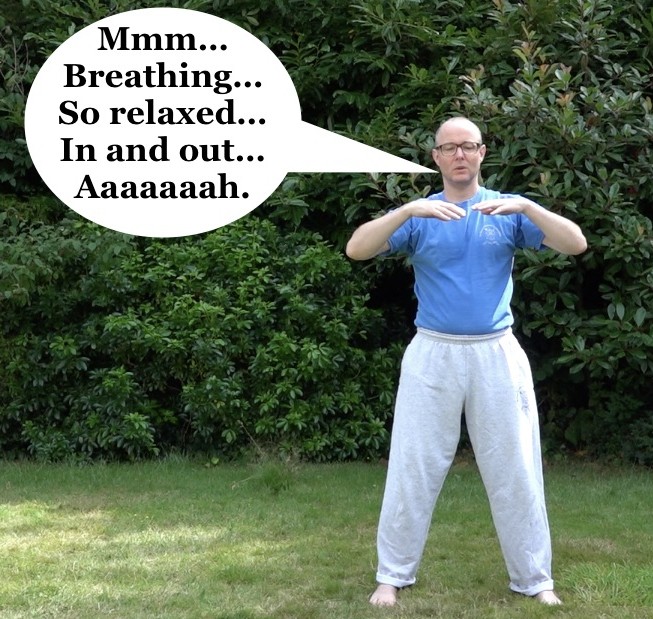
I think we can agree that being able to control your response to circumstances is a superpower. The primary skills involved are remaining calm (i.e. controlling your state of physiological arousal), and choosing what your mind dwells on. The practices I use to develop those skills are breathing exercises and meditation.
They go together very well: a lot of breathing exercises are meditative, and a lot of meditation styles involve breath work.
Here’s a very simple example for you. It will take about a minute.
Generally speaking, when your exhale is longer than your inhale, your system calms down (i.e. it stimulates the parasympathetic nervous system). And when you are paying attention to your breath, you are by definition not paying attention to the thing that is bothering you that is beyond your control.
Take a moment, and do one slow inhale, and then breathe out as long and slow as you can.
Now try that again, and focus on the feeling of the inhale, and the feeling of the exhale.\
How do you feel?
Told you it was very simple!
I’ve been studying these things for a long time (I was taught my first breathing exercise in I think 1990), and I have courses on breathing and meditation. If you are already enrolled in either course, or the Solo Training course, or the Mastering the Art of Arms subscription, you already have access, so should maybe go do some practice, or skip ahead to the podcast announcement.
But if you don’t have access to the courses yet and would like to, I’ve dropped the prices to make them super-affordable. Because almost everyone is struggling with the inflation and cost of living crisis, and this is the stuff I have that is most likely to be helpful.
The usual price is $129 but you can get it for $25 with this code: JANUARYDESTRESS
Correct sales practice is to create a sense of scarcity to increase demand by putting a time-limit on the sale (as I usually do, because it massively increases sales), but the last thing we need right now is more scarcity, so I’m not going to. Those codes expire in about three years!
It is also normal practice to bombard you with reminders, testimonials, etc. to persuade you to part with your cash, but again it seems not a kind thing to do right now. If the courses aren’t a no-brainer purchase for you, don’t buy them.
But, for those of my readers and students currently sitting on glorious piles of cash, feel free to either pay full price, and/or buy some other courses or books of mine, I’d appreciate it.
We have to move. If a shark stops swimming it dies- and if we stop moving it doesn’t take long before the problems mount up. We can get away with it for a bit longer than sharks, but sooner or later the bill comes due.
Swords are cool- cool enough to get people who have never even considered taking up a physical activity for fun before to actually start training. There are huge long-term health benefits to regular exercise, pretty much regardless of what that exercise is.
But no historical martial art is optimised for long-term health. It can’t be: the immediate needs of surviving the sword fight are more important than the possibility of eventually developing knee problems or back pain.
The specific ranges of motion required by a given sword fighting style may be quite extreme (such as in a rapier lunge), but they will never be comprehensive: in no style ever do you do a gentle forward stretch with a curved back, or indeed arch as far back as you can sensibly go, or even just touch your heel to your arse to stretch your quads. Those ranges of motion are good for us, but not included in the martial arts themselves.
I intend to be swinging swords around in various historical manners for decades to come, and I’m already 48. It is therefore necessary to have a physical practice aimed at filling in the gaps, and keeping this carcasse in sufficiently good shape that I can be whacking my friends over the head with blades when I’m 90. I also need to be able to teach my students how to do the same thing- and there’s the rub. Every body is different, and so every training regime should be tailored to the individual. And every body changes over time- ideally getting fitter and stronger, but at least not deteriorating any faster than we can help. Which means that you can’t just learn a routine now and stick with it forever, if you want the best results for the least effort.
I cover the fundamentals of how to train in my book The Windsor Method: The Principles of Solo Training and we follow those principles in class. But the book doesn’t include much in the way of specific exercises, because it was intended to lay out the principles, not cover every possible practice. The book will tell you how to train, and how to prioritise your training time, but it doesn’t tell you whether you should be doing push-ups or lunges right now.
To create our practice we need a comprehensive suite of exercises to select from, and the skill to choose from that suite wisely. We also need to know what it is we are training for at any given time. Here are some possibilities:
Pre-hab. Long-term injury prevention through movement, range of motion work, breathing and strength training. This is perhaps 50% of all my training.
Conditioning. Increasing our strength, speed, range of motion, or other attribute, through exercises of various kinds. This is about 40% of my training.
Warming up and warming down: preparing for a specific kind of movement (such as strength training, rapier footwork practice, a longsword tournament bout, or any other high-intensity activity), and promoting recovery afterwards. You may need to warm up for pre-hab or conditioning, of course.
A specific exercise such as an overhead press, or a push-up, or a hamstring stretch can be used in all three of these situations- but how we use it will differ.
I run a Trainalong training session over Zoom three mornings a week, and usually structure them like so:
Section One- warm-up.
1. Running a diagnostic. Gentle joint rotations from toes to fingers, with a few squats and some gentle range of motion work. This tells me whether I need to pay attention to a specific area, and whether the session I had in mind is likely to be a good idea.
2. Full range of motion of the spine
3. Shoulder stability work
Section Two: conditioning, focusing on my own areas of weakness, especially forearms.
1. Some kind of strength work, often bodyweight or kettlebells
2. Leg stability work such as seven-way legs, or kicking practice
3. Forearm conditioning
Section Three: skills practice
1. Some kind of footwork
2. Some kind of weapon handling (though often disguised as stick conditioning drills or bladebell exercises). These are often combined with the footwork, of course.
3. And/or breathing training, such as the Breathing Form.
Section Four: recovery
1. Some breathing
2. Some stretching, especially of the legs
3. Forearm and leg massage (which you may be familiar with from my free Human Maintenance course)
4. A very short meditation
5. Deliberately finishing.
Seeing it broken down like that doesn’t reflect the experience of it. The sections will blend into each other, and overlap- we may intersperse arm weights with footwork, for example. I very often include planks and other “core” work in with the spine range of motion or hip/knee stability exercises. The full-body survey at the beginning and the warm-down ending sequence tend to be quite consistent. I also adjust the training depending on my own health and current needs, and incorporating any requests that the students bring up on the day.
Some of the weird stuff we do sometimes includes jaw relaxation exercises, toe yoga, and finger dexterity drills.
I’ve attached a fairly comprehensive list of the exercises we do as a pdf below. Be warned, it’s just a list, and “Granny’s Scarf” may not mean anything to you just yet. But it should give you an idea of what I mean by ‘comprehensive’.
What about the skill to choose wisely from the list?
That is primarily a matter of mindset. If you go into a session with the intention of finding out what your body needs, and then carefully doing that, you will probably avoid injury, and certainly become better at listening to your body. As every body is different, I encourage my students to adapt or adjust what we’re doing to suit them. I may be recovering from an injury or illness, and be doing some gentle recovery work when we’re twenty minutes in- you may need to be doing push-ups or kettlebells while I’m resting. While the class is doing Turkish Get-ups, a student with a knee problem may be doing her prescribed rehab exercises.
Every exercise can be done at various levels of difficulty. Let’s take the humble push-up for example:
1. Knees on the ground, go down an inch.
2. Knees on the ground, work up to going all the way down.
3. One leg extended
4. Full push-up position, hold
5. Working up to a full basic pushup
6. Different hand positions- three knuckle, two knuckle, one knuckle, prima, seconda, quarta, hands wide, long, staggered, etc.
9. Plyo push-ups, eg clap push-ups, or push-up-twisting-squat-jump-burpees
10. One-armed push-ups
11. One-armed push-ups with different hand positions
12. Plyo one-armed push-ups
And so on.
I may be working on 6, while one student is on 2, and another on 11. Literally every exercise has easier and harder versions, so can be adapted to anyone’s current level.
It is very relaxing to just show up and do as you are told for a while, and indeed having a personal trainer who knows you well and pushes you as needed would be great. But as martial artists, more is expected of us. We can’t be dependent on external forces to guide our training- we must take ownership and responsibility for our own development. And outside a one-to-one coaching session, no trainer can perfectly adapt the class to your needs. But you can.
Sessions are free, or you can chip in some cash. Everyone is welcome, whether you’re super-fit or not fit at all (yet). You won’t hold up the class (or be held up) because we are all moving at our own pace.
Last month’s challenge was very simple: prioritise sleep. While sleep quality varies hugely, it’s still basically the same thing for everyone: there’s good sleep, there’s bad sleep, and there’s enough sleep or not. We all know what we mean by ‘sleep well’. But what do we mean by ‘eat well’? ‘Eat well’ is incredibly varied. Eat well for what? The challenge this month is simply this: pay attention to what you eat and why.
No area of human health is more riven with controversy and ill-feeling than discussions around what we eat. Very few people are actually rational about it, and I’m certainly not one of them.
You can optimise your diet for many different things, and they will all look different. Here are some common priorities, in no particular order:
1. Athletic performance in your chosen field. Should sprinters eat like marathon runners? Probably not.
2. Muscle gain. All serious bodybuilders have pretty strict diets, and are often eating far more than they really want to, to persuade their bodies to store so much protein as muscle.
3. Fat loss. Probably the most common reason people pay attention to their food habits, and also an area where emotions run very high.
4. Pleasure. Many pleasurable foods are contraindicated by other priorities. If only chocolate was disgusting…
5. Ethics. The food you choose to buy has been produced, distributed, and sold by people. All three of those steps have ethical considerations. Animal welfare is one; the environmental impact of crops like soy is another. How far the food has travelled is yet another.
6. Longevity. This usually revolves around restricting calories, fasting, and other unpleasant practices.
7. Social connections. Many food practices have social dimensions. I have dinner with my wife and kids every day. We sit down together for it, no screens. Sometimes what we eat is affected by that priority; if we’re running late and the kids are hungry, I might make something quickly so we can eat together. Making something that is a treat for the kids usually means it’s not good for my longevity, athletic performance, or fat loss. But it’s very good for my mental health to have strong bonds with my children.
8. Convenience. How often have we eaten a less-optimal food because it was right there, instead of taking the time to make or find something better?
9. Cost. Many people can’t afford to buy enough of the higher-quality food that would be better for them. Some people just don’t prioritise food in their budget the way they prioritise other things.
The principles of nutrition are quite straightforward: eat enough of the things you need but not too much, avoid the things that are bad for you, and spend enough time without eating for your gut to rest. Given that we live in a culture of abundance we tend to classify diets by restrictions, and take the “getting enough” side of things for granted. Those restrictions are:
1. Restricting specific foods. Many cultures have a taboo food that other cultures suffer no ill effects from. Most weight-loss diets have some form of ‘don’t eat sugar’. Vegetarianism restricts all meat.
2. Restricting food quantity. You can have this much ice-cream, but no more. For most of my lifetime, most of the popular weight-loss diets have been about calorie counting, and reducing the overall quantity of food.
3. Restricting when you can eat. Most traditional cultures have periodic fasts, and we all fast while we’re asleep. One currently popular form of this (which I actually find very useful for my body and my purposes) is the not-very-well-named “intermittent fasting”, in which you restrict food to an eating window, such as 14 hours of no food, 10 hours of food (so if you eat breakfast at 7am, you need to stop eating by 5pm). Popular versions of this include 16:8 and 20:4.
But my own parents remember food rationing during the war. Perhaps half the people currently alive and 99% of all humans who lived before the 1950s are far more concerned with getting enough food than with being precious about when and how much they eat. There are also psychological costs to viewing food as something to be restricted, so you may prefer to think about how do you get enough of the high-quality food, rather than restricting yourself.
So what should you do?
The Challenge this month is: examine your priorities regarding food, and make choices consistent with those priorities.
I did say that’s a challenge. It’s really, really, hard for most people.
I would start by asking yourself what your priorities are. Are they even on my list? Then look at what you are actually doing, and decide how closely your actions match your priorities. It might be better to do that the other way round- look at what you are doing, and from there deduce your priorities.
Some priorities are mutually exclusive. Generally speaking, dietary practices associated with longevity are not associated with muscle gain, or pleasure. But most people have many conflicting priorities. So prioritise! Which do you want more? And can you balance your priorities in a practical way?
Then look at the downsides. Swordsmanship is awesome good fun: until someone loses an eye. So we wear fencing masks.What can you do to minimise the downsides of your priorities?What are the ethical implications of your muscle-building diet? What are the longevity implications of your pleasure-focussed diet? In all things, you want to cap the downside.Can you minimise the ethical problems of some of your choices, by choosing a different brand or supplier? Can you minimise the health problems of your pleasure-focussed diet by for instance intermittent fasting?
With your better sleep, and your ability to acquire or drop habits, you should have the internal resources you need to make whatever changes you want, for your priorities.
My only specific advice is this- leave virtue out of it. Deciding you want pleasure in your life does not make you a bad person, and deciding you’re going to cut out meat and fast every week does not make you a good one. Any extreme is self-indulgent: It is no less self-indulgent to starve yourself than it is to stuff yourself.
If you are looking for ideas about how to proceed, then you may find my other posts on nutrition helpful:
Ah, sleep. The foundation of all health, mental, physical, or otherwise. One bad night’s sleep can ruin a day, and get no sleep at all for 8 days and you’ll probably die. But we as a culture do not appreciate it nearly as much as we should. Your challenge this week is to put sleep first: both sleep quality, and sleep quantity. The key source on this subject is Why We Sleep by Matthew Walker. Buy it, read it, it may save your life. But for now: Turn off those screens. Cut out the caffeine. Get to bed early. You’ll thank me later.
I’ll address how to get better sleep in a moment, but first I’ll catch you up on how last month’s challenge of adding a good habit went for me. As many of the participants have told me, it is much easier to create a new habit than it is to break an old one. Really, I should have switched the order around, but nobody’s perfect. My habit for February was to start each day with creative work, not reactive work. Creative work includes things like teaching a class, writing an article, working on the next book (current working title: The Principles of Solo Training), shooting some video. Reactive work is responding to emails, admin crap, that sort of thing. This ties in nicely with this month’s challenge, because I found that for no reason I was waking up horribly early- maybe 2 hours earlier than usual. So I decided that when that happens, I’ll just get up, do some meditation and light exercises, then storm ahead with the book. Which is why the draft currently stands at a bloated 82,000 words. And on days when I haven’t woken up so early, I’ve still put creative work first. The feeling of having made something is so much more rewarding than the feeling of having answered an email. Really. Even to someone I like. On days when I’ve woken up early, I’ve gone to bed early. Our bedtime has generally shifted an hour earlier, and sometimes I manage to sleep through to a reasonable hour- one glorious night I managed 9 hours. Oh, my, goddess. On the subject of getting up early, there are some truly insane famous people out there who seem to fetishize the time they wake up. Mark Wahlberg springs to mind: he gets up at 2.30 in the morning. I’m glad to also report that he goes to bed at 7.30pm, but simple maths will tell you that’s only 7 hours. I’d suggest getting up an hour later and skipping the fucking golf. Perhaps even stranger is Jocko Willink. Don’t get me wrong, Jocko is the real deal: ex-Navy Seal, very tough, very strong, very disciplined. But he gets up at 4.30 every morning, and posts a dramatic black and white photo of his manly watch (a Timex Ironman Triathlon, in case you care), on his manly wrist, at about 04.32 every day, and many of his followers are now doing the same. There is absolutely nothing wrong with this behaviour, except I’d like to see him posting his bedtime too, and have that be 8.30pm. 8 hours, people. As it stands, it’s incitement to sleep deprivation. If you listen to him describe his routines such as on the Tim Ferriss podcast, he is hauling himself out of bed because he’s deeply conscious of there being terrorists hiding in caves planning to get him. That may be literally true in his case, but it’s a terrible example to set: it borders on paranoia. Honestly, I worry for his mental health. And as he is so influential these days (I think 500k Twitter followers counts as influential), it also worries me that his followers will be becoming sleep deprived trying to follow his example. That is not cool. Getting up early in the morning to get the things that matter most to you done before the day can get derailed is a great habit to have. But it must, must, must, be balanced by getting to bed early, or by compensating with afternoon naps. So, as for sleep quantity, you probably need about 8 hours (Walker says so). If your alarm wakes you up, you’ve not had enough sleep. Simple as, and I’ll hear no arguments to the contrary. Sleep quality is harder to measure. Sadly the wearables on the market (such as the oura ring) are woefully inaccurate on pretty much every measure except heart rate. My oura ring once had me in “deep sleep” while I was walking briskly across downtown Helsinki at about 1.30am. But here are the general guidelines (borrowed from The Theory and Practice of Historical Martial Arts):
• Go to bed and get up at the same time every day. Earlier to bed is better: my Grandma used to say that “one before eleven is worth two after seven,” and as usual, she was right. • Avoid caffeine (for at least six hours before bedtime). Even better would be to cut it out altogether, as it stays in the body for hours and hours. I don’t touch caffeine after 12pm, usually. • Avoid alcohol (for at least four hours before bedtime). I find that a couple of glasses of wine make no difference to sleep quality (as measured by heart rate during the night), so long as the alcohol is out of my system before going to bed. • Avoid eating a heavy meal for at least three hours before bedtime. This makes a huge difference, I find. If my body is working on digesting a big meal, my heart rate remains much higher all night than if I go to bed long after the last calorie went in. If you’re waking up too early due to hunger, then a light snack before bed may help. • Avoid screens for at least an hour before bedtime. If you absolutely must be using a screen, on an iOS device enable Night Shift, or use F.lux or something similar to adjust the wavelengths of light your screen emits. • Avoid social media for at least an hour before bedtime. There is nothing more likely to keep you awake than some foolish thing said on the internet. Remember that social media companies hire really clever people whose only job is to get and keep your attention; and nothing says you’re not paying attention like falling asleep. • Keep your bedroom as dark as possible: use black-out curtains, and cover or switch off any sources of light pollution such as luminous clocks or devices with LED lights on them. This to me is one of the hardest things to get right when travelling. One hotel room I stayed in had an illuminated light switch in the middle of the headboard of the bed. I had to get my old boarding pass out and stick it over the damn thing with chewing gum to get any sleep. • Create a wind-down ritual that persuades your body that it will be going to sleep soon. Keep it gentle. I find reading a good novel is hopeless, because I stay up late to get to the next bit, but reading a fairly dull but useful non-fiction book is great. • Get a decent mattress. It’s worth it. You literally cannot put a price on sleep.
So, what are you going to do to improve your sleep this March? And how are you going to know that it has worked, or not?
My Patrons on Patreon.com/theswordguy got this article last week. Want to get everything early? You know what to do…
No, this post isn't a few days late. I posted this last week for my Patrons on Patreon: rewarding their commitment with early access to the things I produce seems fair to me. Want to join them? There's a link in the sidebar.
Well, that didn’t go quite as planned.
It turns out that quitting the booze in January 2021 is way harder than it might have been in, say, May 2019. Michaela and I got to January 20th, then cracked a bottle of bubbly to celebrate Trumperdink’s ignominious expulsion, and especially to celebrate the United States finally electing a woman to the Vice Presidency- and a not-white woman at that. If anything deserves bubbly, it’s seeing women and people of colour advanced to high office.
But that kind of cracked the seal, and while there have been a couple of dry days since, we’re pretty much back to drinking as normal (I'm writing on January 28th).
I’m not sorry though. Here’s why:
If not drinking is good for you, then 20 days of not drinking is a lot better than none.
The benefits I was hoping for from dropping the booze didn’t materialise. I didn’t sleep any better, have not been more energetic, and in general have not been feeling better. It may be that 20 days isn’t enough, but in my experience I would expect improvements within a day or two. Waking up feeling hungover because you got plastered last night is one thing. Waking up feeling hungover when you haven’t touched a drop for ages is quite another. It did reduce my reflux, but it seems that the wine is less an issue than onions and other foods.
Most interestingly, it turns out that literally none of my self-esteem is tied up with meeting arbitrary goals such as this one. I don’t feel the slightest bit like I “failed”. Which is not what I would have expected.
Here’s a question for you: having dropped one bad habit this month, has it helped you any? Do you feel better for it?
So what’s the challenge this month?
Having worked on dropping a bad habit, we’ll now work on creating a good one. Think of one thing you might benefit from, and see if you can create that habit.
Getting up a bit earlier to exercise, meditate, or write?
Eating more vegetables?
Taking up knitting?
Flossing? (Your teeth, not the Fortnite dance. C’mon people.)
Try it for a month, and see what happens.
Here’s how to do it.
start slow. If you want to create a meditation habit, start with five minutes. Not an hour. Eating something green at every meal? That could be just a slice of cucumber, to start with. No need to parboil then chargrill a head of broccoli, served with a freshly-made aioli. At least not at the beginning.
attach it to an existing routine. I get the itch to stretch when watching TV in the evening, because I’ve created that habit. It feels kind of weird to watch TV without getting down on the floor and going through my stretches.
this should be a positive thing. It’s hard to get up early for something miserable, but to practice your hobby? To read a novel? To luxuriate in a meditation? To play with swords? Looking forward to the activity makes it easier to schedule and easier to actually do it.
exploit constraints. I floss regularly, because I eat foods like oranges and chorizo (no, not together, you animal) which get stuck in my teeth. I have to floss to get rid of the annoyingly stuck bits. While I’m there, I might as well do my whole mouth. Make the thing you want to do that bit easier to start (leave your knitting lying around, so you can pick it up any time), or put it in the way of things that you want to avoid. Do you have to move your meditation cushion to get to the TV remote?
One word of warning: if your new habit requires getting up earlier to put first things first, as I would highly recommend, then it must be accompanied by going to bed that much earlier.
HEAR ME, PEOPLE: do not sacrifice your sleep for anything.
(OK, babies get a pass. If your child needs you, wake up for her. Everyone else, including you and your late-night gaming habit? No.) Sorry to get all shouty at you, but this is really important.
Me, I'm going for a fairly ambitious goal: meditation and progress on one creative project before checking any kind of social media, messages, emails, anything. Five days a week. So, I will get up, do whatever limbering I need to do to be able to sit or lie comfortably, meditate for at least 20 minutes, then get started on (probably) writing the book I'm currently working on. Let's see how this goes… I'll report back in a month, and issue the challenge for March. (There's a giant clue regarding March's challenge in this post.)
I have finally managed to articulate my health goals precisely. It’s just this: I want to play tick-tock-tick-tock-bong! with my grandchildren.
In case you don’t know the game, it’s simple: you hold the (enthusiastically willing, squealing with glee) child upside down by their ankles. Swing them a few times side to side like a pendulum, yelling ‘tick’ one way and ‘tock’ the other. Repeat a few times, then lift them straight up in the air as high as you can, and drop them straight down so their head is maybe six inches off the ground, BONG! Lift and drop BONG! Lift and drop BONG! Lower them gently to the ground, and repeat according to demand.
This requires the following things:
1) being fit enough to do it safely (for both of us): it’s a bit like a two-handed overhead press, with a kid weighing up to maybe 25kg.
2) having the sort of relationship with my kids and grand-kids, that this is natural.
I’m 46, my youngest child is 11. She might have her last child at age 40, and kids tend to get too big around age 8,that puts the window at being able to do this at 37 years from now, when I’ll be 83.
So the question to ask of any activity or intervention is this: will this make it more or less likely that I’ll be able to play tick-tock-bong at age 83? My fitness routines, diet choices, and interactions with my kids are all covered by this goal.
Let’s take diet first:
I’m running blood sugar tests; I’ve written up something about them starting with The Myth of the One True Diet. Read that if you don't know what I'm going on about.
A diabetic friend gave me a spare continuous blood glucose monitor, the Libre Freestyle, which lasted for 14 days. After my initial horror at seeing the size of the needle I was about to stick into myself (by normal standards it's tiny. By mine, it's like a 6″ nail), I found the monitor a huge improvement over the finger-prick method; not least, it automatically took readings all night, and it never forgot to run the experiment (though the 8 hour memory was not ideal; I had to remember to take a manual reading (tapping my phone to the sensor) right before sleep, and right after waking, or I’d get a gap in the data. It starts deleting the older records when the memory fills up. The sensor is small, easily installed, and I could do all my usual activities with it in place, and once I got over the needle shock, it was extremely unobtrusive. I think it ached a bit once because I’d slept with my weight on it, but that’s it. And the data is awesome. It takes a reading every 15 minutes, plus whenever you manually check.
My goals after running this experiment is to avoid unconscious blood sugar spikes, and to reduce my fasting blood sugar level a tad below the middle of the normal range. I absolutely do not intend to avoid all sugar forevermore- life is for living, and my Dad’s home-made marmalade is awesome. But being able to completely avoid sugar spikes without significant effort is very useful, and because I know what spikes it, I can avoid or embrace at will.
It’s important to establish a baseline, so I am going with fasting blood sugar at 12 hours exactly from the last calorie consumed. Simply avoiding the spikes has brought my average morning reading down from about 5.6 mmol/L to about 5.0 (which is the middle of the normal range). One reliable effect has been that exercise quickly raises my blood sugar a little (presumably as my muscles split glycogen into glucose), and no amount of exercise that I’m actually willing to do pushes my blood glucose down. This is a different body response to many people.
Another side-effect is my trousers are looser in the waist than they were. That’s no bad thing- lockdown encouraged some unhelpful habits.
I’ve also found that my previous time restricted eating protocol wasn’t doing me much good. I was doing 14:10 (last calorie in about 7pm, breakfast at about 9am). So I changed it.
At the moment, this is the protocol I’m following:
Monday to Friday: 18:6 time restricted eating (TRE). So, last calorie in about 7pm, first calorie in the next day at about 1pm. I find this works well for me; I don’t need to eat in the mornings, so skipping breakfast is no hardship. And it dropped my morning blood sugar level very quickly. I’m not terribly strict about it though: if I’m going out to do something at 12, and don’t want to be hungry for it, I’ll eat before I go (which is still a 16 hour fasting window).
At the weekends, I eat breakfast if I want to. Last Saturday I wasn’t hungry before taking my daughter to her riding lesson, so I ate when I got home at 11.30 (a bit over 16 hours since last calorie in). Sunday though, I felt like breakfast, and yes it did include marmalade on toast. And the angels sang.
I should also mention that I’ve had problems with acid reflux for the last couple of years (badly enough that the doctors shoved a camera up my nose to inspect my oesophagus). It’s been resistant to the usual interventions such as omeprazole, and over-the-counter treatments like gaviscon. One thing that I really, really, have to avoid is eating a big meal within three hours of going to bed. The consequences are truly disgusting. This puts a cap on my last-calorie-in time at 8pm at the absolute latest, 7pm better, which means when I wake up I've usually been 12 hours or more without food already. I’ve also found that this 18:10 pattern may be helping with the reflux (though I’ve no idea why).
Dinner is the main meal of the day, which we all take together (which is totally in line with the tick-tock-bong goal). We almost always cook proper food from scratch, with a decent amount of vegetables.
Thanks to reading David Sinclair’s Lifespan, I’ve also started supplementing with NMNs, and Longevinex’s resveratrol formula. If you want the details of why, I suggest reading the book. It’s very complicated, and I’m not a biologist. Suffice to say these supplements and the TRE all follow the basic rule of there being an acceptable, measurable, downside that is much lower than the probable upside.
Regarding exercise, the positive constraint of my morning training sessions has been a lifesaver (perhaps literally!). There was a time in May when I got up for my morning training and did three squats and one push-up, and thought ‘fuck it, that’ll do’. Not having seminars to stay fit for made it a serious self-discipline challenge to stay fit. I’m not a fan of using self-discipline when you can create external constraints instead. I’m a teacher first, martial artist second, swordsman third. If I wasn’t teaching swordsmanship, I’d be teaching something else. Students can bring out the best in me. So, I started the morning training sessions (Monday, Wednesday, Friday) knowing that if there was even just one student expecting me to be there to lead a session, I’d be there. It takes no mental effort, it’s a law of nature for me. It’s the same mental posture as “I have no choice”. The sessions have developed into a lovely small group of regulars (and newbies always welcome: you can join us here), such that I actively look forward to our sessions, and I am much more thorough about exercise than I ever would be on my own. We’ve even started working through my hellish ‘health qigong form’. Which means I’m practising every day to get it polished up such that I can teach it properly. Something I've been meaning to do for ages, but suddenly am finding easy. The students need it, ergo I do it. No discipline required.
You can see a sample session here:
None of this guarantees anything of course. My kids might choose not to have children, for instance. Or I could lose both my legs in a freak lightsaber accident. But luck favours the prepared. The probability is that whatever I do I’ll be alive at 83; both my grandfathers were heavy smokers who lived into their 90s. Both my parents are thankfully still alive too. The question is, at their age, will I be alive and well enough to chase toddlers over climbing frames? Fit enough for tick-tock-bong?
Framing the problem in such simple terms makes everything much, much easier. It's specific, and it includes physical strength and fitness, and mental health and connection. So that's my goal. What's yours?
Do you have asthma? If so, you might find that breathing exercises can help. But don’t just take my word for it….
I have been teaching breathing exercises for as long as I have been teaching martial arts- to my mind they go hand in hand. Over the last twenty years or so many of my students have told me that the breathing exercises have helped their asthma. This was not exactly unexpected on my part, but I certainly wouldn’t go about claiming that my breathing for martial arts practice is a cure for the condition. (Before I go on: I’m not a medical doctor. If you have any concerns about your health, go see one. Don’t get your medical advice from swordsmanship practitioners on the internet.)
Last week one of my students, Ilpo Luhtala, sent me this email (edited to remove surnames and email addresses):
You may remember when I told you a story about my asthma and the breathing exercises. I used daily medication for twenty years, I had an asthma, no question about that, it was tested several times. Then I started to do regular breathing exercises, the basic one (does it have a name?) every morning and the 12 step exercise on a weekly basis. Now I have been 7 years without any medication. Asthma has gone away…And it is not about my imagination, it has been tested and confirmed by doctors.
So I have told this story to several people. One of them is Johanna, my colleague from Skanska. And the following story is from her, a message to you:
“My 15-year-old son has been doing breathing practices that Ilpo has taught on a video and has found the technique helpful. We are very thankful for hearing about this technique. My son has had asthma for ten years and has had increasing amount of daily medication. Asthma has been following him on other seasons too, but especially during spring. In previous years he hasn’t even been able to go outdoors during the pollen season because of severe breathing difficulties. He has often been in hospital and doctors especially during spring because of the same reasons and treated with more and more medication.
Last spring my son started doing breathing exercises that Ilpo taught on a video. For the first time in ten years the spring time went without any hospital visits and he was experiencing improvement with his asthma. This summer his medication was reduced for the first time in ten years. Normally his medication has only been increased every year.
My son is keeping up with the routine and we both believe that the technique has really helped him. I am just amazed how doctors don’t encourage people more to try breathing exercises which seem to help with asthma cases and also with overall well-being.
I would like to say big thank you for teaching this technique to Ilpo as I don’t think we would have heard about this from any of the doctors. Thank you!
Johanna.”
You can imagine how pleased I am to have been able to help, however indirectly. However, the plural of ‘anecdote' is not ‘data', so while I'm pretty confident that there is a causal relationship between the breathing training done by Johanna's son and Ilpo, and their asthma improving, I'm obviously biased. But, there is an increasing body of medical research to support the idea that breathing exercises can alleviate asthma: these two studies are a good starting point:
With any intervention, the key thing is to estimate the costs and risks involved. (As with the corona cures I wrote about a while ago.) There is, as I see it, zero financial cost to breathing better, and a very close to zero risk of triggering an asthma attack with gentle breathing training. The worst case scenario is you try it and it doesn't help. So keep your ventilator handy and have a go at the exercises that Ilpo started with, if you like. I'd recommend doing perhaps 5-10 minutes, once or twice a day.
If you'd like to go deeper, you can find a 30-min class on basic breathing training included in my free Human Maintenance course, which includes breathing, meditation, and joint care. https://swordschool.teachable.com/p/bodymaintenance/
It’s free because your health shouldn’t be kept behind a paywall. I hope it helps.