Guy's Blog

Guy frequently keeps this blog updated with thoughts, challenges, interviews and more!

Category: Books and Writing

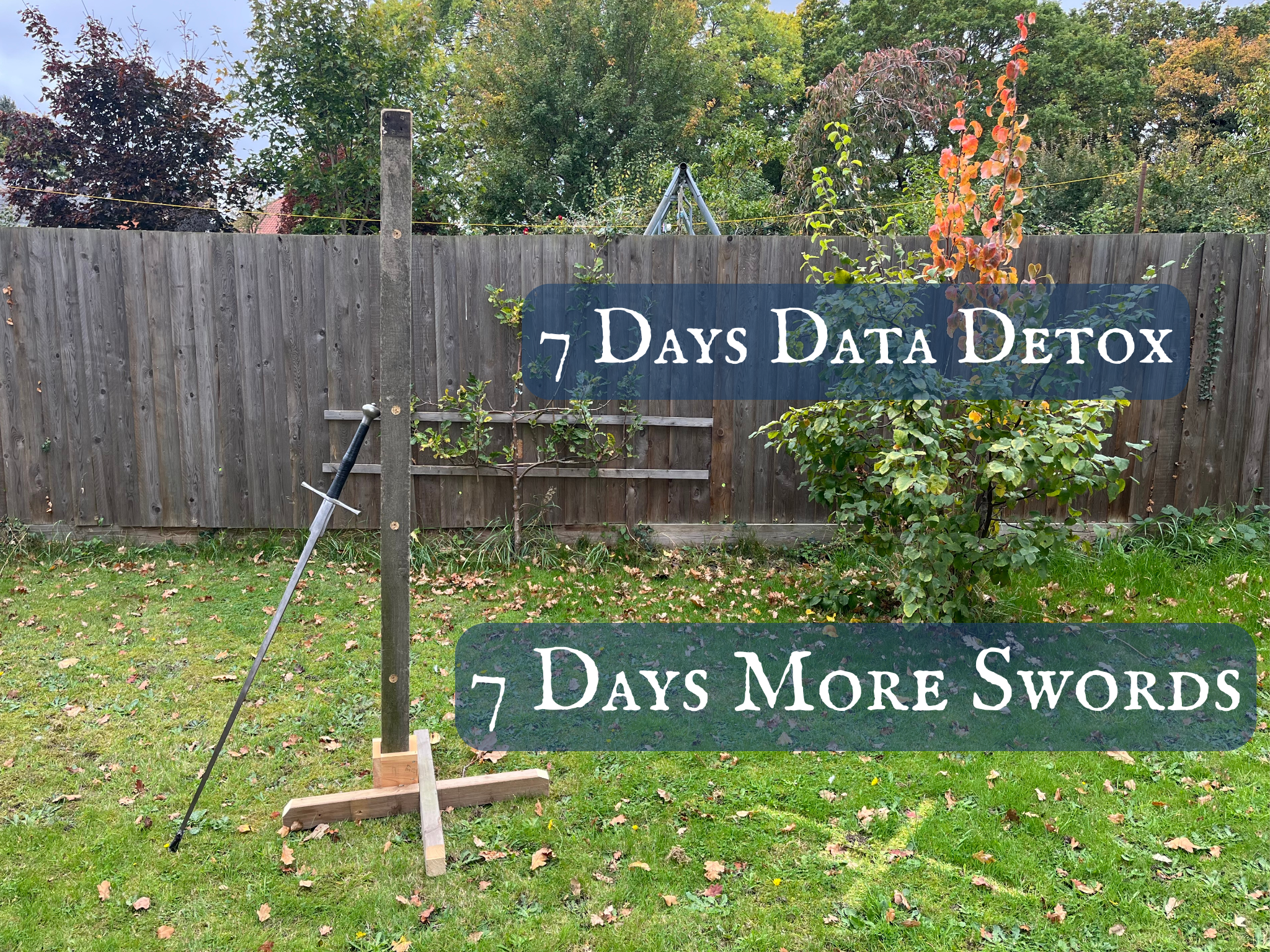
My pell on its new base, with a longsword leaning against it, put together during my 7 day data detox.

I spent the first week of October on a data detox. No emails, no whatsapp, no socialz, no scrolling. It’s been a lovely mental break. My initial reason for trying this was to allow my inner visionary to be heard, as per this post

The single biggest surprise is how little I missed it. I was really looking forward to it, and enjoyed the lack of distraction very much indeed. Days one and two were very relaxing. For reasons I can’t pin down, but which may be related to withdrawal, I was grumpy as hell for days three and four. Oddly though I didn’t have any urge to get online, so I don’t think it was withdrawal exactly. Then things perked up immensely on days 5-7, and I got a bunch of things done that I’ve been meaning to get round to. More on that below.

Filling the Void

So what filled the void created by the data detox? That gaping chasm of boredom and ennui that our marvellous machines cover up with clicks and scrolling?

1. I’ve thought a lot. It’s actually nice to be back in my own head a bit more.

2. I’ve did a lot more actual sword practice, in addition to my usual physio/fitness/strength stuff.

3. Coincidentally (I think, because these were planned ages ago) I went to the actual theatre, and met friends for lunch in the pub (yes I’m still off booze, 50 more days to go), and been to a talk (given by Roland Allen, of The Sword Guy and A History of Thinking on Paper fame). All analogue, real people in a room together, offline goodness.

I should point out that I was not religious about this. I used my wife’s laptop to print out crosswords, and fired up my phone to be able to navigate to drop off my daughter at a friend’s house for a party (I don’t have a paper map of the area, which I should!). But outside some very sensible exceptions, I’ve kept the phone turned off, and did not check any messaging apps or email when I did turn it on. The computer was not turned on at all.

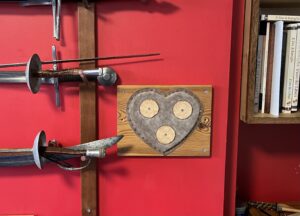
I finished making my mum’s birthday present, put a new base on my pell so it stops falling over when it’s windy (see the photo above), and rearranged my study such that I could get my point control wall target up (it needs a sturdy wall to hang on, and room in front and to the sides for footwork). 

Wall target put up during my 7 day data detox. Leather and wood, on a red wall.

I also planned a new launch, thought about the overall structure of my business, and got a bunch of CEO stuff done. I don’t think my visionary woke up particularly, so I need to think about how to make that happen.

One of the things I’ve been thinking about is how we have all sorts of social rules and norms around other addictive behaviours, such as drinking and smoking. If someone offered you a glass of wine at 11am you might say “it’s a bit early for me”. Because these days it’s normal to avoid drinking during the day. Likewise smoking. It used to be everywhere, all the time. But now it would be very very rude to light up inside someone’s home without asking, and most smokers would automatically go outside.

But watch any TV show from the 80s and just about every rich person is having a drink at 10am, and everyone rich or poor is smoking indoors at all hours. These healthier rules around smoking and drinking are relatively new, and relatively unconnected with legislation.

I do well with rules if they’re my own. (I do much less well with other people’s rules.) Both phones and computers are incredibly useful. But they are inherently built for distraction. So here are my rules for using my computer and my phone.

Rules for the Computer

1. Be a cat. I’ve borrowed this from Jaron Lanier’s excellent 10 Arguments for Deleting All Your Social Media Accounts Right Now. Cats don’t try to please people. They just pursue their own agenda, and allow the people in their life to serve their needs. If a cat wants stroking, you’ll know. The computer belongs to me. It’s a critically important tool for writing books, editing video, running my business, and communicating with people.

But it’s been warped by the internet into also being a major source of distraction. So I will approach my computer the way a cat approaches the humans that feed it. I’ve always had all notifications turned the hell off, but that doesn’t stop me from getting distracted.

2. Decide what I want to do before waking it up. That could be work on the next book, or some critical business task like paying a freelancer, or emailing someone about something. Then do that thing first. After my week away I have a long list of things to do, including drafting this blog post, that comes ahead of checking my emails. Happy to report I’m following my own rules.

3. Unless I have a good reason, don’t open any communications app before 2pm. Exceptions include scheduled zoom sessions (running a trainalong or doing crosswords with my mum are both good reasons), or if I’m expecting a time-critical message about something actually important.

4. Turn off all comms apps at or before 5pm. Exceptions as per rule 3. And take at least one full day per week off all comms. I think probably Thursdays, which I generally keep free anyway. 

5. Be a cat. It’s worth an extra rule to be reminded of the first one.

What do I want my Fondleslab Distraction Engine (aka “phone”) for?

There are many excellent things about the phone that I want to keep, that I missed during the data detox. In no particular order they are:

  • Camera
  • Podcast player
  • Music player
  • Sound recorder (when recording videos etc.)
  • Maps/navigation
  • Payments
  • Wallet for tickets, boarding passes, etc.
  • Calendar
  • The Sword People app for keeping in touch with my sword people and posting sword photos
  • Calculator
  • Notes app for when I don’t have a notebook or pen with me. Rare, but it happens.
  • StrengthLog app for tracking weights workouts
  • Family Whatsapp channel. I’d like to move it to Signal, but I don’t think we’d get everyone on board with it (my siblings, their kids, my kids, it’s actually quite a lot of people).
  • Some friends prefer Signal, so I have that for talking with them. 
  • One dear friend, and my godson only really use Discord, so I have that too.

But other than those excellent things, why would I want to be continually distracted?


Rules for the Fondleslab Distraction Engine

1. Be a really fucking grumpy cat.

2. Delete all addictive apps. No games, nothing that makes me likely to scroll (Ebay, Vinted, Chrono24, etc.). No emails. I have the accounts still there in the system settings, but I’ve turned off the email function. That way if I need to be able to check email on my phone for some reason, it’s easy to turn back on, but it’s not on by default.

3. Turn off all notifications. All of them. Especially badges (those red things that flag the app's icon). I’ll check the apps when I want to. The phone still rings if you call me, but that’s it.

4. WhatsApp, Messenger, etc. are strictly friends and family only. I have SwordPeople for work-related messaging. (Feel free to sign up there if you want to be able to message me outside email.)

5. Switch off the phone completely for at least one full day per week. So e.g. turn it off in the evening, and not turn it on until the morning of the day after next.

Final Thoughts on the Data Detox

I’m also thinking about getting a new phone number, and relegating the current one to a no-data phone, so I can use it for two-factor authentication, and as my “business” number, and keep my other number entirely private, so only people I’ve actually given it to will have it. My current number is clearly on too many databases, given the number of spam calls and texts I get.

I’m not alone in fighting this fight. Useful resources are the aforementioned Jaron Lanier’s 10 Arguments. Also Cal Newport’s Deep Work, and for non-algo-poisoned tech solutions, the Creative Good forum has all sorts of options and suggestions. Once you have all this distraction-free time you'll need to learn to prioritise, so you may find my post about deciding what to focus on helpful.

It's worth explicitly stating that I welcome emails from my students, readers, friends, family, and even some newsletters and other things. Email isn't the problem. It's letting it spill out of a confined space to take over my brain that’s the problem. The same is true for messaging apps generally. I've broken the cycle of reflexively checking for anything new coming in with my seven days off, so now I need to keep that cycle broken. Or I'll end up having a (metaphorical) whisky and a cigarette for breakfast again.

The 5 project roles every creator needs: Visionary, CEO, Project Manager, Designer, Craftsman

Every project, no matter its size, needs five people. Most of us have only one: ourselves.

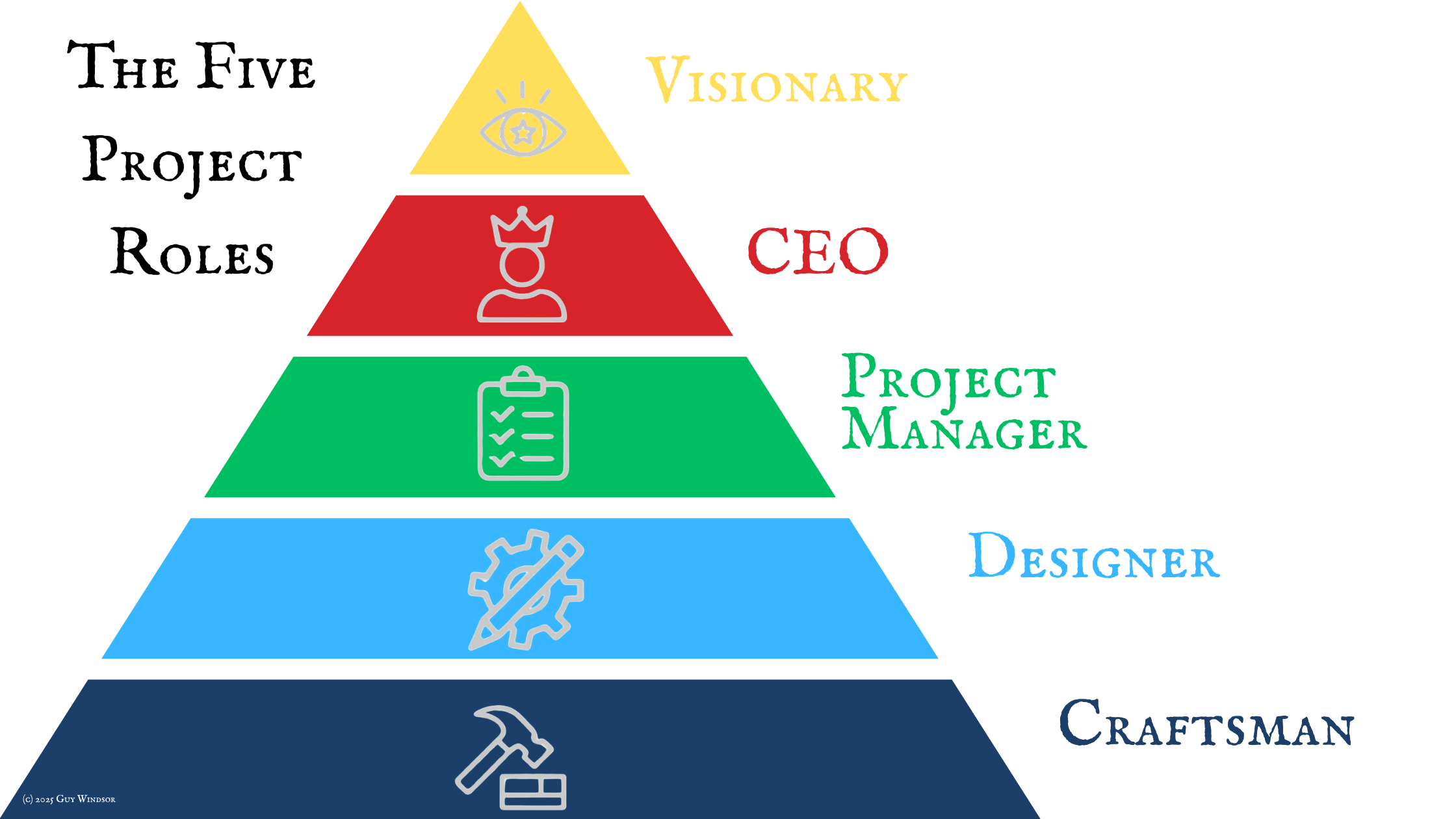
I was chatting with a friend the other day, and he mentioned a framework that his dad, a very successful entrepreneur, came up with. According to him, the five people every company needs are: The Founder, The CEO, The Project Manager, The Engineer, and the Builder.

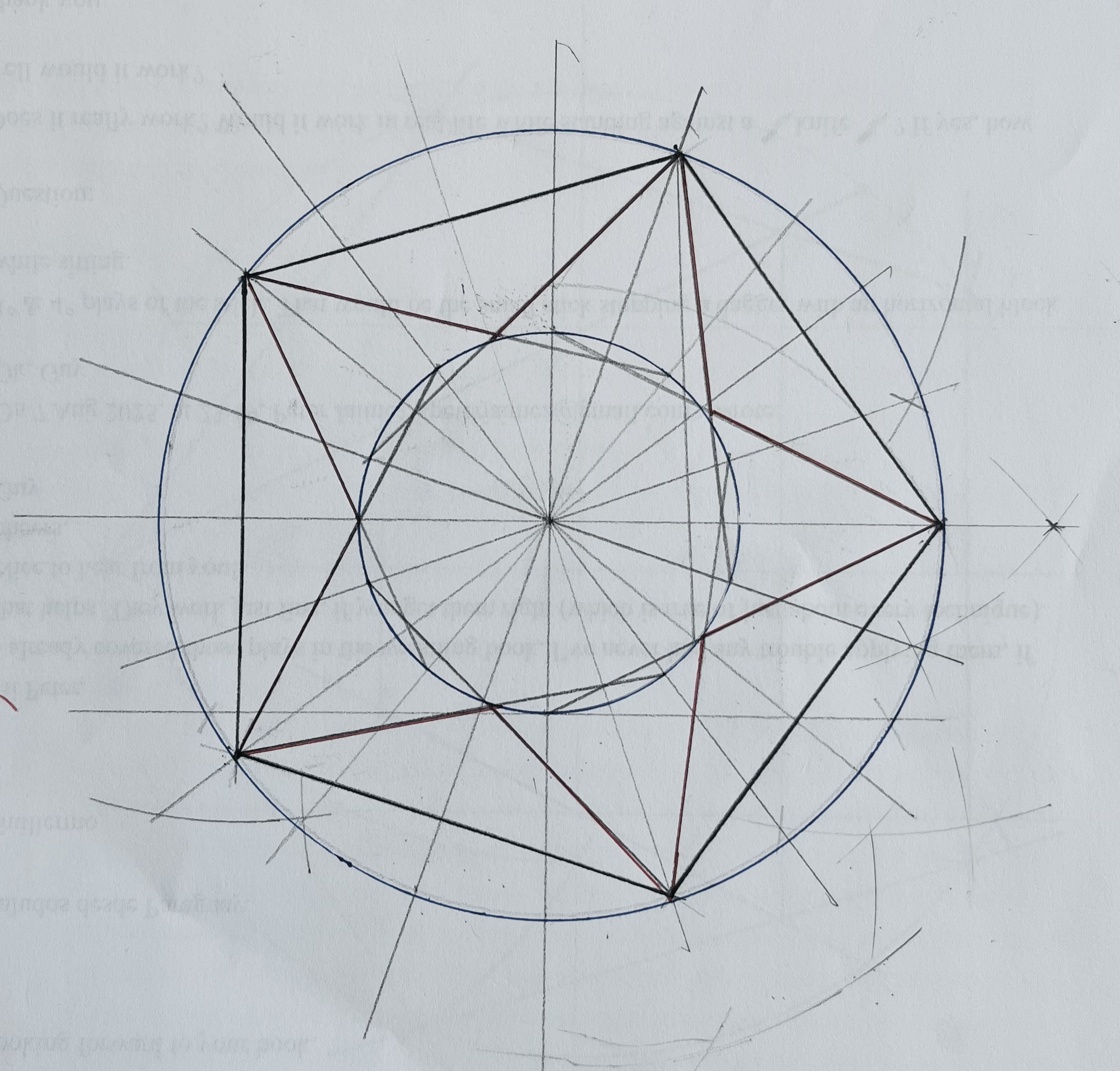
For some reason this stuck with me, to the extent that I’ve been making weird pentagonal drawings on the back of random printouts:A geometrical sketch or a pentagon and five pointed star re the five project roles

It's always a sign that something is brewing when I start spontaneously doing geometry. For weeks I couldn't get this idea out of my head. It explains many of the challenges I've faced running my business, and has highlighted some areas I need to work on.

The Five Project Roles

The catch? In my world, and probably yours, all five roles are played by the same person.  But they are very, very different roles requiring unrelated attitudes, aptitudes, and skills.

The aptitudes are:

  1. Vision,
  2. Execution,
  3. Management,
  4. Design, and
  5. Craftsmanship.

Very few people possess all five personalities and skillsets. I certainly don’t. But using this framework I can see why and how I’ve ended up outsourcing the things I’m not good at, and also confirmed what I absolutely must not outsource.

Case Study: The project roles you need when writing your book

Let’s take a concrete example that many folk can resonate with: writing, publishing, and marketing a book. These are separate processes, so while the visionary and CEO are hopefully leading the way, and the project manager is coordinating the three processes, it makes sense to treat them separately, as the design and craft teams are different.

When we think of “writing a book”, we tend to focus on the craftsman: the writer actually putting one word after another, like a bricklayer building a wall. But what colour bricks, in what pattern? Where should the wall be, and how high should it go? That’s up to the designer. In this case, the overall structure and content of the book. What does this book need to contain, in what order, to what depth of detail?

Most writers act as both Designer, shaping the structure, and Craftsman, laying down the words, but a developmental editor can help with design while a copy-editor polishes the craft. So you will only need to wear your writer hat to get this part done. And most writers I know identify only as writers. This is the hat they want to wear. But here's how it should go:

The Visionary has the idea. I want to create this thing. A single book, perhaps. An entire business, for another perhaps.

The CEO figures out how the vision can be made manifest in the real word. What project management, design, and craftsmanship will we need? It’s in a CEO’s nature to veer away from the vision towards the practical. So the visionary must keep an eye on things and make sure their beautiful idea doesn’t become watered down for business or other practical reasons.

Taking a step back, who decides what book, when? How does this specific project fit into the overall strategy of the business that is being an independent author? Many writers, including me, just write whatever they want, when they want, according to no plan of any kind. But most of the really successful ones have a strategy in place. This series in that genre, spread out over this timeframe, for this business goal. That’s CEO territory. My CEO quit a long time ago in frustration and disgust. But once the decision is made, the order comes down: this book, now.

The project manager steps into office. Ok, I’m going to need the following: a writer, a developmental editor, a copy editor, a layout designer, a photographer, an admin assistant to handle the publishing platform accounts, oh, and a marketing team when we’re ready.

Then the designer (or developmental editor) looks at the brief and decides what the overall structure of the book should be, and why. Some writers just start writing and see what structure emerges (‘discovery writers’); others plan things out in detail (‘outliners’). So the designer and the writer must get along pretty well, and pass the job back and forth as necessary. Unlike creating an engine or a building, you really don’t need detailed plans in place before starting work on a book if that’s not the way your brain works.

I’m a woodworker, and when I make a piece of furniture I usually start with the overall dimensions so it will fit where it’s going to go, and that’s it. No detailed drawings, no plans, no measurement. I’m a bit more structured when it comes to books (I usually sketch out the table of contents first), but I’m nothing like Saul Bellow, who famously planned his (Nobel Prize-winning) novels “down to the last flicker of an eyebrow”.

The draft emerges and goes through the necessary rounds of editing until it satisfies the project manager. Not the writer. Writers generally don’t like people messing with their words. But they are not in charge of this bit. The fight is usually between the craftsman wanting to tweak more, and the project manager who can see that the project meets spec and so should be pushed out the door.

Then it goes to layout, and the designer, writer, layout person, and editors fiddle about with the laid-out book until again the project manager signs off, and out it goes to the publishing team.

Publishing your book

Creating the book itself, the actual print files, is down to the graphic designer. Again, some writers can do this themselves, but most really can’t, or shouldn’t. Graphic design is its own thing. This, I would say, is still craftsmanship, but in a field that most writers have no knowledge of. For simple text-only books there are tools like Vellum which put simple book design within reach of the graphically unskilled, but for more complex projects (like my From Medieval Manuscript to Modern Practice series, or my workbooks) you absolutely need a professional.

Then who organises the planning, writing, editing, and layout, and gets the finished files uploaded to the right places, so the book is actually published? That’s project management, pure and simple. A lot of Indie authors do this for themselves too, and many stumble at this point. Because it’s hard, not least because emailing an editor to say the book is ready to be edited, or sending the edited files to the layout person, feels like handing your baby over at the daycare centre.

Then it goes to layout, and the designer, writer, layout person, and editors fiddle about with the laid-out book until again the project manager signs off. The writer, layout person, and editors, are all craftspeople, with their own areas of expertise, which often expand into design territory.

Then it goes to the admin assistant for publishing. The careful uploading of all the right files to all the right places, with metadata and all the rest, is a craft.

Marketing your book

At some point in the publication process the marketing team gets to work. Usually some time before the book is actually finished, sometimes before it’s actually started. Tragically often, after it’s already published.

The marketing team report to the project manager. What kind of campaigns should we run? Paid ads or no? Content marketing? If so what kind? The marketing approach should be engineered to fit with the vision, the overall strategy, and the project management of the book itself.

Most writers have a severely under-developed and under-staffed marketing team. The writer says “I’ll mention it on my socials” or “I’ll let my email list know” and that’s that. The question really is how does the marketing strategy fit with the overall strategic vision? If my strategic vision is “I want to write my books and don’t care how they sell”, then no marketing plan is required. If my strategic vision is “these books should pay the mortgage”, then a marketing team (usually still just another facet of the single person doing all these roles) needs to make that happen.

A common problem with marketing teams is that they mess up the vision, just like CEOs. It may be part of your vision that your work is at the luxury end of the market (super-fancy $100+ special editions), or that it’s as accessible as possible (hello free ebooks), or some combination of both. But the vision will determine the price-point, which is the starting point for the marketing. It’s easier to persuade people to buy a $10 book than a $100 book, but pricing is related to value, so you need to have a clear idea how much value your books will deliver.

My books are generally much more expensive than novels (my paperbacks go for about $30), because I’m not selling a few hours of entertainment to a broad range of people, I’m selling months or years of utility to a narrow range of highly interested people. That comes from the vision, which determines pricing. I also have premium-end books (in the $60 full-colour hardback range), and ebooks priced to be accessible for anyone who really wants the information ($10). I make about half my income from book sales: they literally feed my children. That’s both a product of the pricing strategy, and one of the reasons for it. But my marketing really needs work.

If you're looking for help writing, publishing, or marketing a book, my marketing team would lynch me if I didn't mention From Your Head to Their Hands.

How much time does each project role get?

  • 80% of the work is done by the craftsman. Typing out the right words in the right order, deciding what images are needed and where they’ll go, producing the file that goes to the editor and then to layout.
  • 10% is done by the designer. Organising the material, making sure the whole thing will hang together.
  • 7% is project management, getting the craftsman, designer, editor, and graphic designer talking to each other.
  • 2.9% is the CEO making sure the project manager is on the right track. Once the team is assembled, the CEO is really only there to keep things on track with a gentle hand on the tiller.
  • 0.1% or less is the actual spark of vision. The visionary can literally be done and dusted in a second. The idea strikes, and that’s that.

Let’s put this in a Fiorean framework, just for fun (Fiore was a 14th century master of knightly combat). The Visionary is Ardimento, boldness. It takes courage to see through what is to what might be. The CEO is Avvisamento, foresight, the strategist. The Project Manager is Presteza, speed, making sure everything actually gets done on time. The Designer is Forteza, strength, which comes from structuring everything correctly. So who is the Craftsman? Every single master, remedy master, counter-remedy master, and scholar in the treatise. They are actually putting the plan in action in the real world.

The most obvious thing I’ve noticed in my own work using this framework is that my craftsman, designer, and project manager are getting lots done. I produced six books and two online courses in 2024. This year so far I've produced four new online courses (Vadi Longsword, Vadi Dagger, Body Mechanics, and Introduction to Historical Martial Arts), and one or two more books are expected out by the end of this year. I think that counts as “lots”.

But my CEO is usually on holiday, and the visionary gets almost no time at all. Which is ironic given how this all started, with an actual vision on a Scottish mountain a quarter of a century ago.

Wearing All Five Hats as a Solo Creator

This framework matters because it is very useful for making decisions. Which of the five project roles should be to the fore, which hat should I be wearing, when I decide a book is ready to publish? Really, it should go through all five.

  1. Does this book come from an authentic vision?
  2. Does this book meet our strategy goals?
  3. Is this book technically ready to publish?
  4. Is this book well structured, so it will do its job?
  5. Is this book well made, in terms of writing, editing, and graphic design?

My current work in progress is From Medieval Manuscript to Modern Practice: the Dagger Techniques of Fiore dei Liberi. It’s with the editor now, and available to pre-order here. See? The marketing team is on the case even while the publishing team is in play. The vision is clear: this is 100% on-mission, making my interpretation of Fiore dei Liberi’s art of arms more available and completely transparent (the book includes every single dagger play in the treatise, with the image from the manuscript, my transcription of the text, my translation, my interpretation with academic justification, and a video of how I do the play in practice).

The CEO thinks it aligns with the strategy.

The project manager is keeping an eye on the editor and has the layout professional ready to go (and in communication with the editor directly).

The designer is happy with the structure and overall content.

The craftsman was sure he was done tinkering and needed a second opinion before further improvements could be made, so agreed to send it to the editor.

Phew.

I’m also working on a new facsimile project, similar to my Flower of Battle. It will have the straight, unaltered, facsimile of Philippo Vadi’s De Arte Gladiatoria Dimicandi, and a second facsimile with my translation superimposed, and a link on each page to a video of my interpretation of the play. It’s a lot of work, but most of it was already done for other projects. The translation comes from The Art of Sword Fighting in Earnest (with minor edits that will also result in an update to the book), the video clips come from my Vadi Longsword and Dagger courses.

The project manager was perfectly happy just using the videos as they are; all of the dagger plays are edited page by page, but the longsword plays have a video each (they are more complex to set up and explain). For this project, I really ought to create a new set of title cards, and re-edit the videos so that there’s one video per illustrated manuscript page. That’s about 56 videos.

The project manager was horrified by how much time that would take, for what is basically a cosmetic improvement.

The craftsman told him to bugger off.

Which role is not getting their fair share of my attention?

As we've seen, from the project manager on down everyone is working pretty hard. But the CEO hasn't got a lot of my attention lately. The last formal CEO thing I did was attend a business seminar with Joanna Penn and Orna Ross on The Creator Economy in 2022. And when was the last time I sat on a mountain?

To give the visionary a fighting chance (and maybe to get the CEO to return to work) I’m taking a week off from all screens and inbound traffic. No email, no socialz, no phone. Which means no actual making stuff unless it’s woodwork or bookbinding. No writing unless it’s pen on paper. No distractions. Give the inner voice a chance to be properly heard. We’ll see what comes of that. My feeling is that anyone who knows me well enough to need to contact me urgently will also be able to contact my wife and/or kids, so can find me that way. Everything else can wait a week without the sky falling.

I’ve done similar retreats before, but this one will be a bit different, as I’ll be home, and not on holiday in any way. It’s work, just of a different kind. Meditation, exercise, writing, reading, thinking. Not typing, editing, or responding to external requests for my time. That’ll run from Wednesday October 1st to Wednesday 8th because I have a regular zoom call with my mum on Wednesday mornings where we solve cryptic crosswords together, and I’m not cancelling that. But it’s all screens off the moment we hang up, until it’s time to get cracking again the following week.

The visionary’s whisper can’t be heard over the noise of constant production.

So whether you’re writing a book, starting a historical martial arts club, or building a shed, ask yourself:

  1. Can I hear the Visionary?
  2. Is the CEO guiding strategy?
  3. Is the Project Manager keeping things on track?
  4. Is the Designer building a solid plan?
  5. Is the Craftsman executing their art with skill?

On Monday this week I sent the final draft of From Medieval Manuscript to Modern Practice: the Dagger Techniques of Fiore dei Liberi off to the editor. Hurrah! There's a lot of admin work to do from here, checking edits, sending to layout, making sure all the links work etc., but let's put it this way: if I became incapacitated, my highly competent assistant could get the book finished and into your hands no problem. Some authors call this the “truck draft”, as in, if I were hit by a truck, the book would still come out.

Which means that it's ready to preorder, in ebook, paperback, or hardback. I expect the book back from the editor this month, and back from layout in October, so if all goes well it should ship in mid-November.

You can find it here.

So what's the book about?

It's my complete interpretation of Fiore dei Liberi's dagger plays. Every single one of the 76 plays we see in the Getty manuscript is there, with the illustration from the manuscript, my transcription, my translation, my explanation of how it works, and a link to a video clip showing my interpretation in action.

There is also a comprehensive introduction about Fiore himself, the treatise, and the four known manuscript versions of his work, and various asides and digressions about elements of practice. Going by word count, the actual dagger plays and interpretation text are about 60% of the book, so there's a lot of extra material.

Sound like fun? Preorder here.

Here's an example of what you'll get (it will look better when the layout is done by a professional: this is just me pasting stuff into an email program).

The Seventh and Eighth Plays of the Ninth Master

F18v

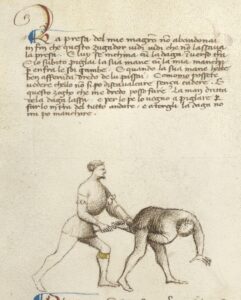
Fiore's 7th play of the 9th master, dagger between the legs, interpreted by Guy Windsor
La presa del mie magistro non abandonai in fin che questo zugador vidi vidi che non lassava la presa. E luy se inchina cum la daga in verso terra. E io subito piglai la sua mane cum la mia mancha per enfra le soi gambe. E quando la sua mane hebbe ben afferada, dredo de lu passai. Comomo possete vedere chello non si po discavalcare senza cadere. E questo zogho che me dredo posso fare. La man dritta dela daga lassa, e per lo pe lo vegno a piglare per farlo in terra del tutto andare, e a torgli la daga no mi po manchare.

I will not abandon the grip of my master so that this player saw that he could not leave the grip. And he leant down with the dagger towards the ground. And I immediately will grip his hand with my left hand between his legs. And when his hand has been well secured, I will pass behind him. As you can see, he cannot dismount [from my grip] without falling. And this play that is after me I can do. The right hand leaves the dagger, and I will come to grab him by the foot to put him completely on the ground, and I will not forget to take his dagger from him.

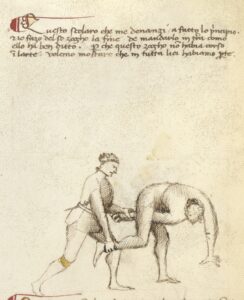
Fiore's 8th play of the 9th master, with the leg lift, interpreted by Guy Windsor

Questo scolaro che me denanzi a fatto lo principio, et io fazo del so zogho la fine de mandarlo in terra como ello ha ben ditto. Per che questo zogho non habia corso in larte, volemo mostrare che in tutta liei habiamo parte.

This scholar that is before me has done the start, and I do the end of the play, by sending him to the ground as he has well said. Because this play is not common in the art, we want to show that we have a part in all of it.

This technique is fascinating, and lots of fun to practice if you’re careful. It works best if the player is pulling back on contact, or you can create some space for it by a sneaky backfist to the groin with your left hand. Having made the cover, you slam their wrist into their groin, then let go with your left hand (unless you already did to do the backfist) and reach around their leg to grab their wrist again from behind. This is quite easy because you are just finding your own right hand. Then let go with your right hand and bring that around too. You’re now holding their wrist between their legs from behind. If you just yank upwards they will fall on their face, or you can grab their ankle and yank that up for extra vim. Fiore recommends doing the disarm too, which we see in the first image.

You can see this play here: guywindsor.net/dagger064

I'm hoping it's really obvious to you whether this is your kind of thing or not. If not, no worries, there's plenty of other material for you. But if it is your thing, you can preorder here. And if you think your friends will like it, do share.

Swordfighting with Vadi

I started editing the second edition of my book Swordfighting for Writers, Game Designers, and Martial Artists a little while ago and pretty quickly it developed into a total rewrite, aimed solely at writers. I’ve cut 45,000 words already, and will probably end up redoing the whole thing from scratch. Good writing is all about the reader, so I created an online form for writers to ask me questions, to help me figure out what they need to know. Many of the responses have been very on-topic for the book I’m trying to write, and I’ll answer those questions in due course in the book.

But some folk took the opportunity to ask me whatever they wanted (and why not?). As there’s no reasonable prospect of addressing the questions in the book, I thought I’d do it here instead. Some of the questions have lengthy answers that I've already given in books and courses, so while I've tried to give a brief stab at it here, I'll also link to the relevant longer work. I’m running a Swordschool birthday sale until the end of March 2025: use the code SWORDSCHOOL24 at checkout to get 24% off any digital product (ebooks, courses, etc.).

There were a bunch of questions about Vadi, and how he relates to Fiore. I’ll start with them:

Q: I am curious, working from my own copy, how Vadi's implicit tactics compare to Fiore's?

A: Both masters include attacking and countering the defence; and waiting for the attack to counter it. They both agree that you should control your opponent's weapon. Arguably Vadi makes more mention of feints, but other than that I don't see much difference.

Q: Would you include discussion of Vadi's use of measure, feints, and counter-cutting vs slicing-off vs blocking passively in an interpretive section, or within the main body of the text?

A: I wouldn’t include it at all in a book on writing swordfights. It’s way too specific to one source, and way too technical. Also, slicing-off and passive blocking aren’t mentioned anywhere in Vadi that I can find. He also doesn’t explicitly discuss measure.

Q: How do Vadi's regional origins contribute to which techniques or tactics he emphasises (eg does the law code of Vadi's residence effect what kinds of executive action he favours, as compared to other contemporary fencing treatises)?

A: We have no way to know. There are no contemporary sources at all: Fiore was 70 years earlier, the first Bolognese sources 40+ years later. Vadi doesn’t mention law at all, and while there may be a connection between local law codes and what he recommends, it’s impossible to say. Are we talking in Urbino, where the dedicatee was Duke? or in Pisa, where Vadi came from?

Q: Which works were influenced by Vadi's work?

A: I’ve not found any direct evidence of Vadi’s influence in any later works. I go through the possible relationship between Vadi’s guards and the Bolognese guards in the introduction to my book The Art of Sword Fighting in Earnest.

Q: How does Vadi's work relate to Fiore's work?

A: It’s a short question with a very long answer, which you’ll find in the introduction to my book The Art of Sword Fighting in Earnest. Basically, I think it’s unlikely that Vadi was taught in a direct lineage from Fiore, and he may or may not have read a version of Il Fior di Battaglia. There’s not enough internal evidence to say for sure.

Then some more general questions:

Q: Learning fight choreography is challenging enough without running out of breath or not being able to fight with a sword in rehearsals and the actual performance. How do you train actors to get fit for stage sword fighting if they have not already been sword fighting before including arm strength and endurance?

A: I don’t. But I do train anyone who wants to learn, regardless of their physical fitness, so my system includes a huge amount of training solutions for range of motion, strength, joint health, and fitness. You’ll find them in the Solo Training course, or in my book The Principles and Practices of Solo Training.

Q: I'm a martial artist (Shito-Ryu karate) and one of my biggest shifts for fencing vs karate is what moves first (I tend to move hip first/at the same time for MA and have been repeatedly reminded that it's sword first for rapier fighting). Do you have any recommendations to facilitate the change in mindset between picking up a sword in ongoing training and my continuing karate work? IDK how question-y my question is: rewording is sort of how to keep my karate habits and rapier habits separate I guess? While still actively training and building in both and acknowledging that there is crossover for pieces like some stances, mindset, footwork, etc.

A: Yes I do. In short, if you understand why you move in a certain way, not just intellectually but at a fundamental ‘this solves a problem’ level, then you’ll move correctly for whatever you’re doing. In other words, if your mind is on the right thing (solving the problem presented by your opponent), and you’ve been trained to solve that problem correctly, you’ll do it correctly. It’s not a matter of style (which you have to remember), it’s a matter of function (which is made obvious by the context). In the same way that you might talk shit with your mates, but speak politely in a business meeting, you’ll initiate with the hip when doing karate (because it works better that way), and with the point of the sword when doing rapier (because it works better that way).

The best example of this was teaching a student to do a scannatura with a rapier (plate 13 from Capoferro). He kept binding the opponent’s point down and walking onto it, because he wasn’t leading enough with the sword. I took a sharp rapier off the wall and took the part of the opponent. He bound that sharp scary stabby thing the hell away from himself and then stepped in. Problem solved. Don’t try this at home, but you get the idea, I hope.

Q: How would you describe the difference in fighting styles between a Fiore fighter and a Chinese Jian user?

A: I wouldn’t, because I don’t know any Jian users who actually fight. (I’m sure there are many, I just don’t know them). My first step would be to find such people, and watch them train and fence, and ideally fence with them. Then compare that to what I know (Fiore stuff). As a writer, you could find someone using a jian online in the way that works for your character, and someone doing the same with a longsword, and compare what you see.

Q: I teach a Beowulf camp and include a HEMA section. I use Liechtenauer. Is that a good source to pair with Beowulf?

A: No. It’s many centuries later, and a completely different weapon. Beowulf dates to around 1000AD, so they would be using what laypeople think of as “Viking” swords, shields, and armour. The closest we have to that is probably I.33 sword and buckler. (I have a course on it here.) There are folk online working with swords and shields from that period, but it’s always going to be reconstructive archaeology, not based on written sources (because there aren’t any). Doesn’t mean they’re wrong though!

Q: What would be the best content to teach writers as a HEMA instructor? I teach at a writing conference and do the basics of long sword and short sword over three days. My goal is experience over sitting, but there's so much to offer!

A: AFAIK there’s no such thing as “short sword” in historical martial arts. So I don’t know what you’re teaching there. But I’d say that all writers would benefit from either longsword, or rapier, or both, because they are the two most common types of swords used in historical fiction and fantasy. Of course historical fiction writers would be best served with a style from their period. E.g. smallsword or backsword/sabre for Napoleonic era swordsmanship, Liechtenauer or Fiore for late 14th-early 15th century, etc. But that’s probably out of scope for this kind of intro class.

If you have questions you’d like to see answered in the book, here’s the form: https://forms.gle/QHspLZNQ2Lw7A1nT9

Questions that are off-topic for the book are best asked on my social media platform, swordpeople.com in the “advice wanted”, “pub”, or “salle” spaces.

If you want access to any of the courses, the best value is probably the subscription package: access to everything for $45/month. You can get 24% off with the code SWORDSCHOOL24 The code also works for ebooks and audiobooks at swordschool.shop. The code expires on March 31st.

Hallelujah! At last! After three months of back and forth with the printers (and setting up to print with someone else at twice the price), the Fiore Facsimile with translation is now working properly.

Everyone who bought it in December has had their order re-run yesterday, so new copies are being printed and shipped. Now that they have been taken care of, we can open it up for new orders!

The Facsimile

This book reproduces the Getty manuscript in its entirety, in full colour, and as close as possible to the size of the original.

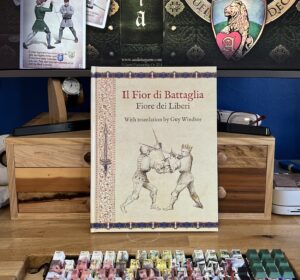
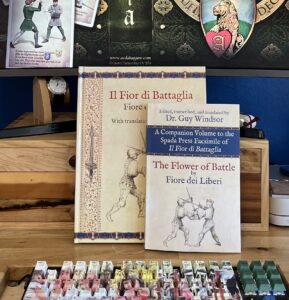
Spada Press facsimile of Il Fior di Battaglia on Guy's desk

But that's not all:

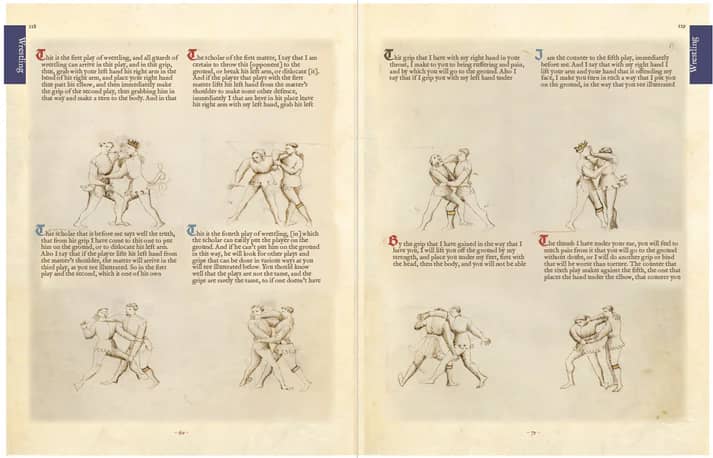
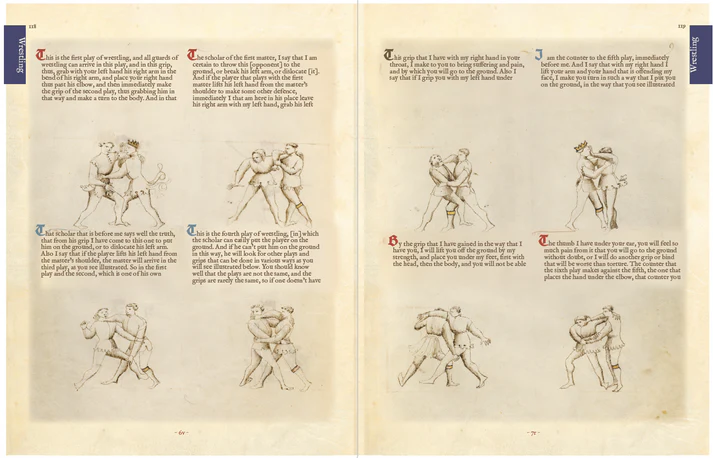
The second half of this volume is a second reproduction of the manuscript with the original Italian text replaced by my English translation. This recreates the experience of reading the original Italian as closely as possible. The book also includes an introduction to Fiore and his life and times, the provenance of the manuscript, and suggestions for further study.

This way, you get the original, and the translation, in one volume… for the same price as the original facsimile-only edition.

The excellent Katie Mackenzie has done a gorgeous job on the cover and layout:

Interior page spread of the manuscript showing the translation

The translation section includes tags on the pages so you can find the section you want from the page edges.

The Facsimile Companion Volume

If you buy the facsimile you will get a free ebook copy of the companion volume, which includes a complete transcription of the manuscript. Or you can order it as a paperback too (with a discount if you get them both together).

Spada Press facsimile of Il Fior di Battaglia and companion volume on Guy's deskYou can  find the facsimile here, and the companion volume here.

It has been a long slog to get this to work, for reasons that don't really matter (six defective proofs before we got a good one. The previous record is one). It started with the awful cold-water shock of embarrassment when I realised we had shipped defective books, and ended with an eye-watering bill for reprinting and shipping new ones. But I've done my best to keep everyone informed, and to make good on the trust placed in me by everyone who buys from my store.
So, not the customer experience I was hoping to generate for my people, but we got there in the end!

It’s an exiting time this week. We have a brand-new book out today, and, as it’s my birthday on Saturday (I'll be 51), we’re also running a birthday sale on all ebooksaudiobooks, and online courses. Hurrah! Just use the code GUYSBIRTHDAY30 to get 30% off at checkout (code is valid for all digital products- not print books or t-shirts).

First up, the new book:


I have completed my translation of Fiore’s Il Fior di Battaglia, as found in the Getty manuscript. You may recall I produced an affordable facsimile of the Getty a few years ago. Well, we’ve now produced an updated version, that reproduces the Getty manuscript in its entirety, in full colour, and as close as possible to the size of the original. But there’s a twist:

The second half of this volume is a second reproduction of the manuscript with the original Italian text replaced by my English translation. This recreates the experience of reading the original Italian as closely as possible. The book also includes an introduction to Fiore and his life and times, the provenance of the manuscript, and suggestions for further study.

This way, you get the original, and the translation, in one volume… for the same price as the original facsimile-only edition. Because we can. And it’s my birthday.

The excellent Katie Mackenzie has done a gorgeous job on the cover and layout:

A page from the translation laid out on the facsimile
Sample page from part 2

The translation section includes tags on the pages so you can find the section you want from the page edges. You can find it here:

Glorious Getty!

I don’t know if the book will get to you in time for Christmas- much depends on how busy the printer is, and the shipping options you select at checkout. But we’ve done our best to get it out fast enough that there’s a fair chance…

You can also get an audiobook of me reading my translation (remember to use your discount code!) here.

This birthday sale will end on Tuesday December 3rd, so timing is everything…

The code: GUYSBIRTHDAY30

Ebooks and audiobooks: https://swordschool.shop

Courses: https://courses.swordschool.com

Learn to teach historical martial arts!

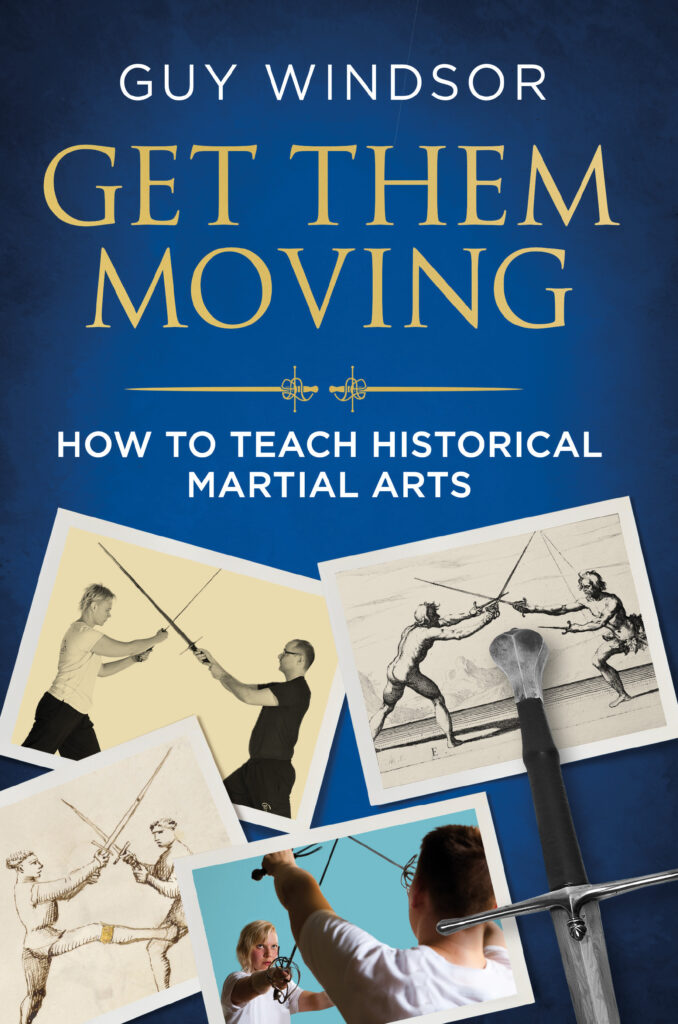
My new book, Get Them Moving: how to teach historical martial arts is now available at the swordschool shop. It will go live on other platforms (Amazon, Barnes and Noble, etc etc.) in a few months, but you can get it now: Click here to Get Them Moving


Guy_Windsor_book_Get_Them_Moving

Here's the blurb:


In ​Get Them Moving I’ve distilled over twenty years of teaching experience into a comprehensive guide that’s as practical as it is motivational. Whether you’re stepping into the salle as an instructor for the first time or you’ve been teaching students for years, this book offers clear and actionable guidelines to improve outcomes for your students.

From constructing effective lesson plans to overcoming the hurdle of imposter syndrome, I’ve laid out strategies and insights to elevate your teaching craft. Learn how to engage beginners with effective drills, run advanced classes, and how to incorporate the historical sources into your teaching.
This isn’t just a manual; it’s a mentorship in book form, designed to accompany you as you forge the next generation of martial artists.
Ready to transform your practice into impactful teaching? Let’s begin.

Here's a thought- you could get a copy for your historical fencing instructor… if they will take it as a friendly gesture, not a critique of their current skills!

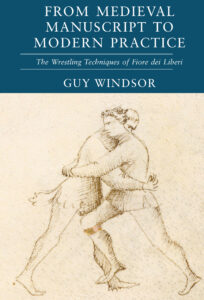
I’m delighted to let you know that From Medieval Manuscript to Modern Practice: the Wrestling Techniques of Fiore dei Liberi is now out on the Swordschool shop! For the next week only, you can get 10% off the hardback, paperback, and ebook here. Use the code wrestle10 at checkout to apply the discount.

This book is the academic basis of my interpretation of Fiore’s wrestling plays, following the format I pioneered in the first book to come out in this series, From Medieval Manuscript to Modern Practice: the Longsword Techniques of Fiore dei Liberi.

I start at the very beginning, and provide a transcription and translation of the full introduction from the Getty Manuscript, then for each play, I provide the drawing from the manuscript, transcribe the text, translate it, and interpret it, with a video clip of the action in practise. The book also includes an essay by Jessica Finley comparing the Italian wrestling with German medieval wrestling, and a bonus section where I transcribe and translate the wrestling plays from the mounted combat section.

The book provides the “what” and “why” of Fiore’s wrestling plays. For instruction in how to train Fiore’s wrestling, you will need my online course which I created with Jessica Finley, so I have also discounted that by 45%, here.

These discounts expire on March 14th.

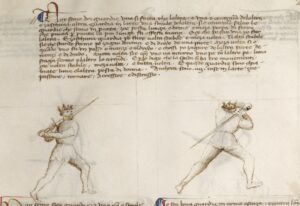
Fiore dei Liberi's text on footwork and the voltas

For an academic, it is the best feeling in the world when the ground you have built a mansion on starts to tremble. (Less so for an architect, I’d imagine.) I had that experience on my recent trip to the Panoplia Iberica where I finally met Dario Magnani in person. He runs the THOKK gloves enterprise, and is a keen Fiore scholar. We talked for literally hours about the most minute details of our interpretations, starting with his take on the famous “three turns of the sword”. It was so much fun I got him onto my podcast to revisit the topic, which you can hear here:

What is a volta? A very detailed examination of Fiore, with Dario Magnani

I’ll go through the passage first, then describe my current interpretation of it, then his take on the same text, and then sum up. We’re talking about folio 22 recto from the Getty manuscript. I’ll quote the transcription, translation, and interpretation from pages 116-117 of From Medieval Manuscript to Modern Practice: The Longsword Techniques of Fiore dei Liberi.

What does Fiore dei Liberi say?

The text reads:

Noy semo doi guardie, una si fatta che l’altra, e una e contraria de l’altra. E zaschuna altra guardia in l’arte una simile de l’altra sie contrario, salvo le guardie che stano in punta, zoe, posta lunga e breve e meza porta di ferro che punta per punta la piu lunga fa offesa inanci. E zoe che po far una po far l’altra. E zaschuna guardia po fare volta stabile e meza volta. Volta stabile sie che stando fermo po zugar denanci e di dredo de una parte. Meza volta si e quando uno fa un passo o inanzi o indredo, e chossi po zugare de l’altra parte de inanzi e di dredo. Tutta volta sie quando uno va intorno uno pe cum l’altro pe, l’uno staga fermo e l’altro lo circundi. E perzo digo che la spada si ha tre movimenti, zoe volta stabile, meza volta, e tutta volta. E queste guardie sono chiamate l’una e l’altra posta di donna. Anchora sono iv cose in l’arte, zoe passare, tornare, acressere, e discressere.

We are two guards, one made like the other, and one is counter to the other. And [with] every other guard in the art one like the other is the counter, except for the guards that stand with the point [in the centre], thus, long guard and short, and middle iron door, that thrust against thrust the longer will strike first. And thus what one can do the other can do. And every guard can do the stable turn and the half turn. The stable turn is when, standing still, you can play in front and behind on one side. The half turn is when one makes a pass forwards or backwards, and thus can play on the other side, in front and behind. The whole turn is when one goes around one foot with the other foot, the one staying still and the other going around. And so I say that the sword has three movements, thus stable turn, half turn, and full turn. And these guards are called, one and the other, the woman’s guard. Also there are four things in the art, thus: pass, return, advance, and retreat.

What do Fiore's words mean?

Let me unpack this:

1. The two guards shown are both posta di donna. One is shown forward weighted, the other back weighted. I interpret the difference between them to be a volta stabile (more on that later).

2. Any two guards that are alike can counter each other.

3. Except for guards that have the point in the centre line (longa, breve, and mezana porta di ferro; more on those in the next section). This is because the longer sword will strike first. Here I’m translating punta as point (stano in punta, stand with the point), and thrust (punta per punta, thrust against thrust). The meaning is obvious whichever way you translate it though: don’t stand with your point in line against someone else who has their point in line unless you have the longer sword.

4. Any similar guards can do what the guards they are like can do.

5. Every guard can do the volta stabile and the meza volta. (I use the Italian terms for technical actions, guards, etc. where possible. Refer to the glossary [link] if you need it.)

6. The volta stabile: I interpret stando fermo, standing still, to mean without stepping, or moving a foot. As I do the volta stabile, the balls of my feet stay on the same spot on the ground. It makes no sense for a turning action to involve no movement at all, so standing still cannot mean literally ‘not moving’.

7. The meza volta: this is a passing action, forwards or backwards. I interpret that to include a turn of the hips and body, so you go from one side to the other.

8. The tutta volta: here again we have a ‘fixed’ foot, that, unless your legs are made of swivel-joints (top tip: they’re not), must at least turn around itself for the action to occur. This supports my reading of stando fermo above. Simply, this is whenever you pivot on one foot by turning the other one around it. There is a video of me doing these three movements linked to further on in this chapter.

9. The sword also has three movements: stable turn, half turn, and full turn. Unfortunately there is no further discussion of this, and these terms simply aren’t used in the rest of the book. Fiore will tell us to ‘turn the sword’, for instance in the play of the punta falsa, on f27v, but never with the qualifiers stable half or full. So I simply do not use these terms to apply to sword actions. Other instructors and interpreters do, but you should be aware that there is no evidence supporting any one interpretation of these turns over another.

10. In case you missed it the first time: both these guards are posta di donna. Both of them. Got that?

11. There are four things in the art: pass, return, advance and retreat. See the video: three turns, four steps: https://www.guywindsor.net/lgg01

Okay, so that’s the current state of affairs, and it accords with what most Fiore scholars I know think of the three turns.

Dario’s reading is different though. In essence, he thinks that the volte Fiore is describing here are specifically the turns of the sword. Or better, the movements of the sword.

In other words: a volta stabile is what you can do moving the sword forwards and backwards while standing still. For example, thrust from breve to longa without stepping at all.

A meza volta is what you do with the sword when passing forwards or backwards, and the sword goes from one side of the body to the other. This could be a blow, or just changing guard.

A tuta volta is what you do with the sword while turning one foot around the other.

This makes sense for the following reasons:

1. Why would footwork come between the sword in one hand and the sword in two hands? Surely if this was meant to be a purely footwork description, it would be earlier in the manuscript.

2. The volta stabile as we do it as a footwork action cannot reasonably be described as ‘standing still’. It took some wrangling to get it to apparently mean that (as you can see in points 6 and 8 above).

3. The line “And so I say that the sword also has three movements, thus stable turn, half turn, and full turn” can be read as a summary of the preceding sentences, not an application of footwork actions to the sword. The “also” there doesn’t come from “anchora”, it’s more pleonastic: it comes from E perzo digo che la spada si ha tre movimenti, zoe volta stabile, meza volta, e tutta volta. That bit “la spada si ha” literally means “the sword it has”. There’s really no “also” in that sentence, thought I’m not alone in inserting one: Leoni translates it as “the sword also has” (Leoni and Mele, Flowers of Battle vol. 1 page 252). Drop the questionable “also”, and the sentence reads as a summarising of the preceding three turns as turns of the sword.

4. Volta has many meanings and shades of meaning. You can find literally dozens of meanings for it on pages 1000-1002 of Battaglia’s dictionary, online here: https://www.gdli.it/sala-lettura/vol-xxi/21 Dario’s contention is that these actions don’t have to be read as specifically turning actions (which allows for a simple thrust from breve to longa to be a ‘volta’). To be honest, that’s the hardest part of this for me- I haven’t found a solid linguistic reference to justify a non-circular interpretation of the word, though the expression “dai volta”, lit. ‘give turn’, means “get a move on”.

It is very convenient to translate words that may have many meanings into simple, specific, and concrete technical actions. The volta stabile then gets to be one simple thing, easy to explain and teach, rather than a class of things (what you do with the sword while standing still). But this can be a false sanctuary. Likewise with the final sentence of this troublesome passage: “Anchora sono iv cose in l’arte, zoe passare, tornare, acressere, e discressere. Also there are four things in the art, thus: pass, return, advance, and retreat.”

These have long been interpreted by me and just about everyone else as passing forwards, passing backwards, stepping forwards, stepping backwards.

We know from the definition of the meza volta that ‘passare’ means to pass forwards or backwards. What is ‘tornare’ then? It means return, and when we see it in action, such as in the defence of the dagger against the sword thrust on f19r, “Lo pe dritto cum rebatter in dredo lu faro tornare”, it isn’t a pass at all: it’s the withdrawal of the front foot (see From Medieval Manuscript to Modern Practice pages 44-47 for the transcription, translation, and video).

Likewise the discrescere that we find on f26r when we slip the leg against a sword cut; it’s not a step backwards; your back foot doesn’t move.

So our neat classification of footwork actions starts to fail.

So is this passage, the beginning of the sword in two hands section, all about how the sword moves? That would not be a stretch. And for sure the volta stabile is not a great big movement of the body. I’ve started calling that movement (which is still a fundamental part of the art) a “volta stabile of the body”.

I’m not sure where I stand on all this yet. I’m convinced of one thing though: it’s past time to return to the assumptions that I have based my interpretations on and work through them with ever-closer attention to the text.

And if you listen to the podcast episode, you'll hear the moment when I'm convinced that the “also” has to go!

Academic research is the foundation of Historical Martial Arts. When you try to recreate an action described in a book, that’s academic research. When you try to figure out what a particular phrase in a source means, that’s academic research.

Most mainstream academic research is presented in a way that is deliberately hard to get access to, and often deliberately hard to read. The only reason to publish that way is to get jobs at universities.

Historical martial arts books are usually written for practitioners. All of mine are, so I need my research to be perfectly clear and easy to distribute among the active historical martial arts community. I want my work to be accessible to beginners, experienced fencers, and my fellow instructors.

If you want your academic work to appear in academic journals, you need to find out what that journal wants, and present your work the way they ask. But if you want it to be of maximum use to the HMA world, this post will show you how I think you should go about it.

This is a big post, and not all of it will be relevant to your needs, so here's a table of contents to guide you through it. I've written each section to be reasonably independent, so cherry-pick what you need:

Introduction

Many historical martial artists generously share their interpretations, but do so in a way that makes it impossible to check their work. Simply doing the action in a video and posting it online is helpful to people who want to know how you do it, but useless for establishing whether it’s an accurate interpretation of the source. For that you need at the very least to quote the source, and explain any interpretive decisions you made. Video is not a good medium for that; it’s far too slow, and far too difficult to check the text. Books are better, but suffer from other limitations, such as being unable to show movement. The ideal way to show your work is to combine books and video. This post will show you how I do that.

It’s important to note that academic work is the foundation of our knowledge of Historical Martial Arts. But it has no necessary connection to our martial skill. You can be highly skilled in an interpretation and be able to teach it, fence with it, and apply it in all sorts of situations, without even knowing the name of the source it is originally based on. Likewise, you can be incredibly knowledgeable about a given source and be able to perfectly recreate the choreography of every action, without having any fencing skill at all. Most historical martial artists are somewhere in between.

In this guide I am only dealing with the academic side of things. I have a whole other book on creating training manuals for developing skill. You can find it at here.

What kind of work are you doing?

Before you present your work to the world, you need to know what kind of book it is. There are at least five different kinds of modern HMA publication.

  1. Facsimile. This is a printed copy of scans of the source. The ideal is to make it as close as possible to owning an original copy of the source. This is not an academic work, usually. It’s much more of an art project.
  2. Transcription. You take the trouble to type out the entire source (or part of it). This makes it much easier for people to use the source, because the electronic version of the transcription is now searchable.
  3. Translation. You translate the source from one language to another. Personally, I much prefer a translation to include at least a transcription, or a full facsimile, so I can check the translation against the source. This should also include copies of the images in the source if there are any.
  4. Interpretation. You demonstrate how you think the actions in the source should be done in practice. This can be through text and images, or through video.
  5. Training manual or workbook. You teach the student how to execute your interpretation as a living martial art. This can also be done through online courses.

It is generally not practical to create a book that is all five of these things in one volume. It would simply take up too much paper. It is much easier to demonstrate movement on video, but video is hopeless for sharing a transcription or translation. And a facsimile is by definition in the same general format as the source, which is some kind of book. But these five categories can overlap considerably. My From Medieval Manuscript to Modern Practice includes transcription, translation, and interpretation. But it’s not a facsimile, and it’s not a training manual.

I have produced all of these types of publication, in one form or another. Such as:

Facsimiles: I have published facsimiles of Fiore dei Liberi’s Il Fior di Battaglia (Getty Museum MS Ludwig XV 13), and Philippo Vadi’s De Arte Gladiatoria Dimicandi, (Biblioteca Nazionale di Roma MS Vitt.Em 1324). These are both affordable un-fiddled-with reproductions of the manuscripts, with a single-page description of what they are and where they come from at the back. It’s as close as you can get to owning the manuscripts themselves for under $50.

Michael Chidester at HEMA Bookshelf does much fancier facsimiles, in gorgeous leather bindings, and much higher production values, which is as close as you can get to owning the manuscripts, for under $500.

Transcriptions: I include transcription in my From Medieval Manuscript to Modern Practice series, and also produced a transcription of Vadi which I released free online. There are many other researchers who do the community a huge service by producing and releasing transcriptions of all sorts of other works. These are usually available online somewhere.

It’s actually quite unusual to find a pure transcription (with no facsimile or translation) published as a commercially available printed book.

Translations: my first properly published translation is in The Art of Sword Fighting in Earnest. This is my translation and commentary on Vadi. I licensed the translation under a Creative Commons Attribution licence, which means it is free to use and share in any way, you just have to give credit. Perhaps the gold standard in translations are Jeffrey Forgeng’s translations of the Royal Armouries MS I.33,  published as The Medieval Art of Swordsmanship and of Joachim Meyer’s treatise published as The Art of Combat.

Interpretations: they say there is no translation without interpretation, and that’s largely true. How you understand the text will influence how you translate it. I include interpretation in most of my works, including From Medieval Manuscript to Modern Practice, and The Duellist’s Companion. There are many, many, published interpretations out there.

Training manuals: a training manual teaches you how to train in a particular interpretation. It does not usually include much about why you think the source means what you think it means. It must by default include your interpretation, but it does not usually show your working. The three books in my Mastering the Art of Arms series, The Medieval Dagger, The Medieval Longsword, and Advanced Longsword, are all training manuals.

Workbooks: a workbook is a training manual that is formatted for the student to make notes in. The difference is primarily in the format, though a workbook will usually have even less academic content than a training manual. I have a series of four workbooks for the rapier, combined into The Complete Rapier Workbook, and the first in what will probably be a series for Fiore’s Art of Arms, The Armizare Workbook, part one: Beginners.

As you can see, I’ve produced works of all five kinds (not to mention a book of mnemonic verses: The Armizare Vade Mecum).

Now that we have defined some terms, let’s go through the list and have a look at how to present your transcription, translation, and interpretation. Facsimiles are a separate category, and so are training manuals. I’ve written a whole other book (From Your Head to Their Hands: how to write, publish, and market training manuals for historical martial artists [link]) on, you guessed it from the title, how to write training manuals, because it’s the one kind of book that you actually write from scratch. Each kind of book will need a somewhat different introduction, so I’ll include specific instructions for the introductions too.

Transcription

Transcription introduction

Your introduction should answer the following questions:

  1. What book or other source are you transcribing?
  2. What versions of the source exist, and why have you chosen this one?
  3. Where can that source be found?
  4. Who wrote it?
  5. What do we know about the author?
  6. What images do we have, and are you reproducing them?
  7. What kind of transcription are you trying to produce? Where on the “diplomatic” scale do you fall?
  8. What conventions will you be following regarding contractions, suspensions, brevigraphs etc.?
  9. Who are you and why should the reader trust you?

You can find a very useful guide to transcription conventions, published by the University of Hull, here: guywindsor.net/transcriptionconventions (that's a redirectable link in case the article gets moved).

Transcription layout

You need to make a decision about whether to include scans of the original sources in your work. In general, if you can (due to copyright restrictions etc.), do. It’s much better to present the reader with the chance to check your work. This is especially true if you are transcribing a manuscript. If you are making a machine-readable copy of a perfectly clear-to-read source, then you don’t need to include the original.

If you are going to include scans of the original source, then layout becomes an issue. For instance, the first page of Fiore’s introduction is laid out in two columns, with a fancy capital. The text also continues onto the next page mid-sentence.

You basically have two options. You can reproduce your transcription and keep all of the layout decisions, so arrange your transcription on the page the same way Fiore does. Or you can arrange it separately. My preference would be to reproduce the whole source intact, and then present the transcription separately but with the same basic layout. That makes it much easier for readers to find the original source for any give bit of transcription.

If you are quoting from a part of the transcription that includes a page break, note the point of the break by putting the page reference in square brackets, such as:

… l'o mostrada sempre oculta mente si che non gle sta presente alchuno [page break: F1r to F1v] a la mostra se non lu Scolaro,…

Or more simply:

…l’o mostrada sempre oculta mente si che non gle sta presente alchuno [F1v] a la mostra se non lu Scolaro,…

Translation

Translation introduction

Your introduction should answer the following questions:

  1. What book or other source are you translating?
  2. What versions of the source exist, and why have you chosen this one?
  3. Where can that source be found?
  4. Who wrote it?
  5. What do we know about the author?
  6. What images do we have, and are you reproducing them?
  7. What kind of translation are you trying to produce? Where on the “literal” to “analogous” scale do you fall?
  8. Who are you and why should the reader trust you?
Translation choices

Because of the interplay between translation and interpretation, we should discuss what kind of translation you doing. However you choose to do your translation, you need to make your approach clear in your introduction, so readers know what to expect.

A strictly literal translation translates each word in the source in turn, without reference to the meaning of the phrase, sentence, paragraph, or rest of the book. This is also called a direct translation, a word-by-word translation, or a metaphrase. Generally speaking, this is not a useful approach. How would you translate the word “match” in this sentence: “I met my match while striking a match at a football match”?

Beginners are often surprised or even upset to find that the same word is apparently translated differently in different places; this is only because they don’t understand that the context the word appears in is different. Languages are not ciphers of each other- you can’t simply convert each word and expect to find the meaning.

An analogous translation translates the meaning of the source into the target language. This is also called a paraphrase. This would allow you to translate “match” in three different ways based on those three meanings, as made clear from the context. Taken to extremes though, this can lead to translation decisions that fail to properly convey what the original author said.

All translations exist on a spectrum from 100% metaphrase to 100% paraphrase. You have to decide where on that spectrum you want to work, and what point is most useful to your target readers.

To my mind, it’s more useful to translate a bit too literally than a bit too freely. A lot of the readers of these translations are using them to teach themselves to work with the original sources. Over-interpretation makes that much harder.

Let’s take this phrase from Fiore, for example. It is part of the text regarding the punta falsa play, on f27v.

…Io mostro d’venire cum granda forza per ferir lo zugadore cum colpo mezano in la testa. E subito ch’ello fa la coverta, io fiero la sua spada lizeramente. E subito volto la spada mia de l’altra parte piglando la mia spada cum la mane mia mancha quasi al mezo. E la punta gli metto subita in la gola o in lo petto…

My translation in From Medieval Manuscript to Modern Practice:

I show that I am coming with great force to strike the player with a middle blow in the head. And immediately that he makes the cover I strike his sword lightly. And immediately turn my sword to the other side, grabbing my sword with my left hand at about the middle. And I place the thrust immediately in the throat or in the chest.

Tom Leoni’s, in The Flower of Battle, vol. 1, page 275

… I feint a strong mezzano to the opponent’s head. As he forms his parry, I lightly strike his blade, then immediately turn my sword to the other side, grasping it almost at mid-blade with my left hand. I can then place a quick thrust to his throat or chest…

I have a huge regard for Tom’s translation work, but every now and then he strays a bit too far in the analogous direction. Fiore’s description “I show that I am coming with great force to strike the player” becomes “I feint”. He also uses “forms the parry” for “makes the cover”, “opponent” for “player”, and I’d have to say that “mid-blade” is clearly not in the text (it’s just “at the middle”).

I should note that The Flower of Battle quoted here is an absolute gem of a book, and a must-read for any Fiore scholar. And I agree very much with most of the translation.

If you are faced with a phrase that has no meaning in the target language, then I would still translate it as written but add its equivalent phrase in a footnote. For instance, when Vadi wrote Et romperoti il brazo al diri dunave (on f20r), it means ‘And I will break your arm while saying a Hail Mary’. So that’s how I translated it. But I included a footnote which reads:

Though the Hail Mary prayer is quite long, the expression means “in a jiffy”. If you’re running late, you might say (in Italian) “I’ll be there before you can say a Hail Mary”, which is equivalent to “I’ll be there before you know it”.

That way, the reader knows what Vadi said, and also what I think he meant, where it might not be clear. This is very different to the modern English meaning of “Hail Mary”, which is a desperate last-ditch attempt.

You may also come across a word or expression that you can’t translate because you can’t find it in your various dictionaries. In many historical martial arts translations, the common practice is to throw in a word that might be right and hope for the best. A hail mary translation, if you like. But best practice here is to translate as much of the sentence as you can, and leave the untranslated bit in square brackets. Such as in this line describing the guard bicorno, in the Getty ms:

Questa e posta di bicorno che sta cossi serada che sempre sta cum la punta per mezo de la strada.

I translate this as “This is the guard of two horns that stands so closed that it always stands with the point in the middle of the way.”

Let’s say “serada” was unknown. Then it would read: “This is the guard of two horns that stands so [serada] that it always stands with the point in the middle of the way.”

It is perfectly alright to publish a translation with a few mystery words in it, so long as you’ve done due diligence to find them out. If they are commonly understood by native speakers, or easily found in a proper dictionary, then your reader will understandably lose faith in you.

It is common practice to leave some words untranslated, especially technical terms. As the translator, it’s your job to make judgement calls, and this is one of them. Some translators translate everything. Some leave far too much untranslated, rendering the translation useless to the reader. When I’m translating, I have my students in mind. What do they need? What do they already know?

So I often leave technical terms that we use in class all the time untranslated. This includes the names of blows (mandritto fendente for example), and the names of guards, and the names of certain techniques (colpo di villano, for example).

But I don’t do this the same way in every book. In a training manual aimed at practitioners, I’ll leave the terms untranslated throughout, and define them only on the first use. The students are supposed to learn them. But in a book billed as a translation (such as From Medieval Manuscript to Modern Practice), I’ll translate everything (as you see in the punta falsa and bicorno translations above).

However a lot of words that appear to be technical terms wouldn’t appear so to a native speaker, and it’s critically important that the target reader gets what they need, so I think it’s better to err on the side of translating everything.

Translation layout

Wherever you choose to fall on the analogous translation spectrum, you have choices about how to present your work. If there are large chunks of text with no illustrations, you have the following options:

Reproducing the layout of the original. This is excellent for making a version of the original text that’s simply more accessible to the reader. The trickiest part is the page breaks, where you have to decide where exactly in the sentence you make the break.

Side-by-Side with the original. This can make it even easier for readers to find which bit of the translation applies to which bit of the source, but will often compromise the layout of the source. The team at Freelance that produced The Flower of Battle went with this option, sacrificing the page layout of the source, but presenting each page with the transcription and translation in about the same place as on the facsimile.

Side-by-Side with the transcription. This is great for readers trying to learn to work with the original source. You can break up the transcription into paragraphs or even sentences, to make it even clearer. I used this for my transcription and translation of Fiore’s introduction to the Getty ms, in my From Medieval Manuscript to Modern Practice: the Wrestling Techniques of Fiore dei Liberi.

Where you have images, you must make it absolutely clear which image your transcription and/or translation refers to.  Many sources simply have one image per page, which makes things quite simple. But where you have multiple images per page, you must arrange the transcription/translation so that it is crystal clear which image the text refers to.

Using other people’s transcriptions and translations

You have to be very careful about copyright, and giving credit, when using somebody else’s work. If you are going to quote more than a few lines, you absolutely must have permission from the rights holder. In some cases, the work has been published under copyright terms that allow for unlimited non-commercial use, in which case have at it, just give credit (whether it’s required or not).

In most cases, you need permission from the publisher. I always check with both the author and the publisher, assuming I can get hold of both.

This is true regardless of the format you are using. For instance, I checked with Reinier van Noort before quoting his translation of Johan Georg Pascha’s jaegerstock material in a series of jaegerstock videos I was doing.

My quotation of the few lines of Leoni’s translation above falls squarely within fair use, but as a matter of courtesy I let the publishers know. It’s always better to be open about what you’re doing, and to give more credit than is strictly required.

It’s very common for HMA researchers to use other people’s translations. Translation is hard, and you may not have the language skills to do it yourself. There are some drawbacks though:

  1. You may have no way to know how accurate the translation is
  2. You may be using an out-of-date or inaccurate version
  3. Every translation is also an interpretation, so the translator may be coming from a completely different point of view, or have unfortunate ideas about how swords work that lead them to translate things incorrectly
  4. You have no right to use the translation without permission unless explicitly stated (which is unusual)
  5. You have no right to alter, correct, or change the translation, even if you find a mistake. You have to quote it precisely, and add any corrections in the commentary or footnotes.

I think that a professional instructor is morally obliged to be able to work with the original source in its original language. You simply can’t trust somebody else’s translation, unless you are able to at least check it yourself. But it would be absurd to require amateurs to master a long-dead dialect of a foreign language before getting to work on the interpretation.

Just be aware of the pitfalls.

Incidentally, the reason I only teach from sources in English, Italian, Spanish, French, and Latin, is because those are the languages I can reasonably work in. The only foreign language I would publish a translation of would be Italian, but my skills in the other languages are at least sufficient to have an informed opinion about the translator’s choices. If you’ve ever wondered why I don’t publish work on German medieval combat, this is the reason.

Interpretation and Commentary

So far this has been fairly simple. There are tried and tested ways of presenting transcriptions and translations. But presenting your physical interpretation of the actions in the source takes us to relatively uncharted territory. There is no established academic model to follow, so I have created one. We should start with the questions your introduction should answer.

Interpretation introduction
  1. What book or other source are you translating?
  2. What versions of the source exist, and why have you chosen this one?
  3. Where can that source be found?
  4. Who wrote it?
  5. What do we know about the author?
  6. What images do we have, and are you reproducing them?
  7. Are you intending the reader to actually reproduce your interpretation?
  8. If yes, what equipment and prior training will they need?
  9. If no, have you provided other resources for readers who want to have a go?
  10. Who are you and why should the reader trust you?
Interpretation layout

Here is the ideal layout for presenting your interpretation:

  1. Source image where available.
  2. Transcription of the text if necessary.
  3. Translation of the text if necessary.
  4. Commentary on your translation and the play it represents.
  5. A blow-by-blow description of your interpretation.
  6. A video clip of how you enact that interpretation.

If you follow this format, people can see what you are basing your interpretation on, and why. They may agree with you 100% right up to the video clip. Or they may see an error in your translation that affects everything downstream from there.

You can see how this looks on the page here:
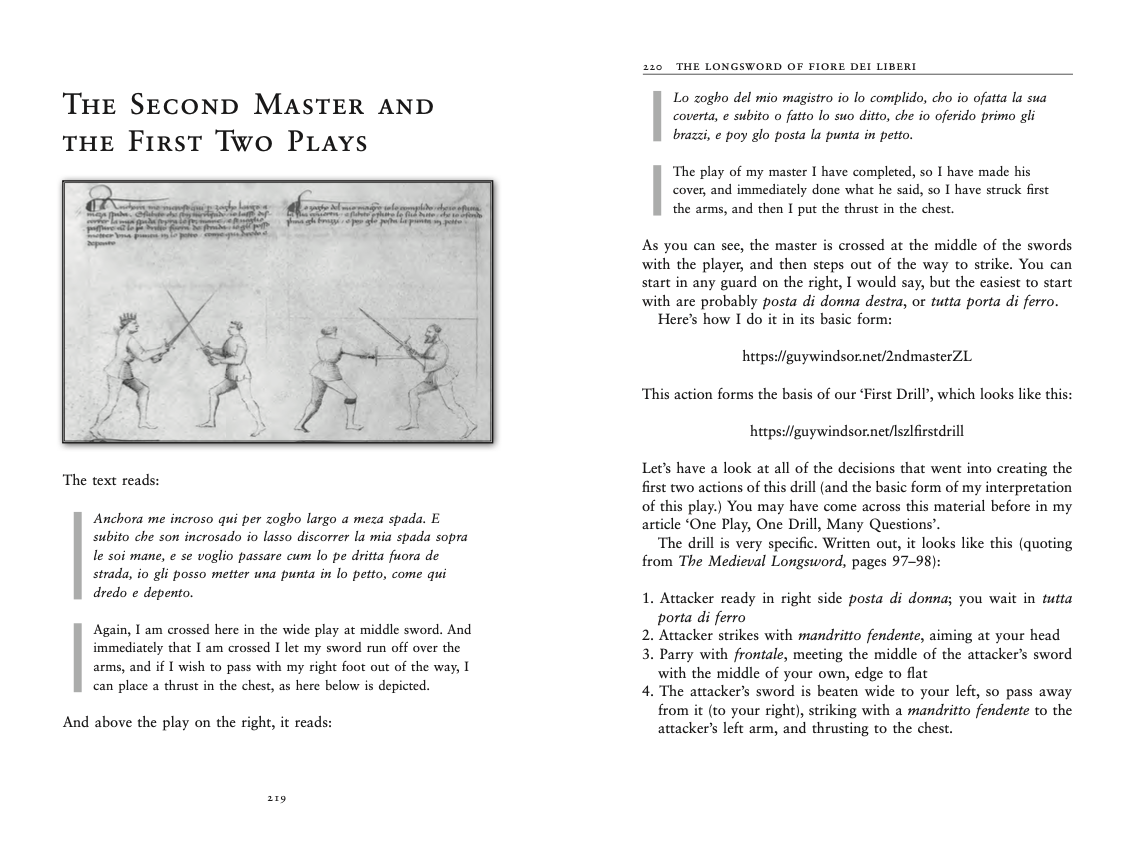
You may need to go into some depth and detail about a concept, rather than an action. In that case, it is best to separate that out into its own chapter. In From Medieval Manuscript to Modern Practice, I have a 13 page chapter on what largo and stretto mean, and conclude each section (such as the sword in one hand, or the plays of the zogho largo) with a chapter on how the plays fit together.

It’s necessary to separate these things out for three reasons:

  1. It makes it easier for readers to find
  2. It maintains the distinction between theory and practice
  3. Your physical execution is ‘what’ and ‘how’. The theory explanation is about ‘why’. It’s clearer to keep these separate.

For the blow-by-blow description, I would suggest using the same format as for teaching drills in a training manual, with the prerequisites clearly stated, and the actions carefully ordered into a numbered list. Here’s a sample from the second edition of The Duellist's Companion.
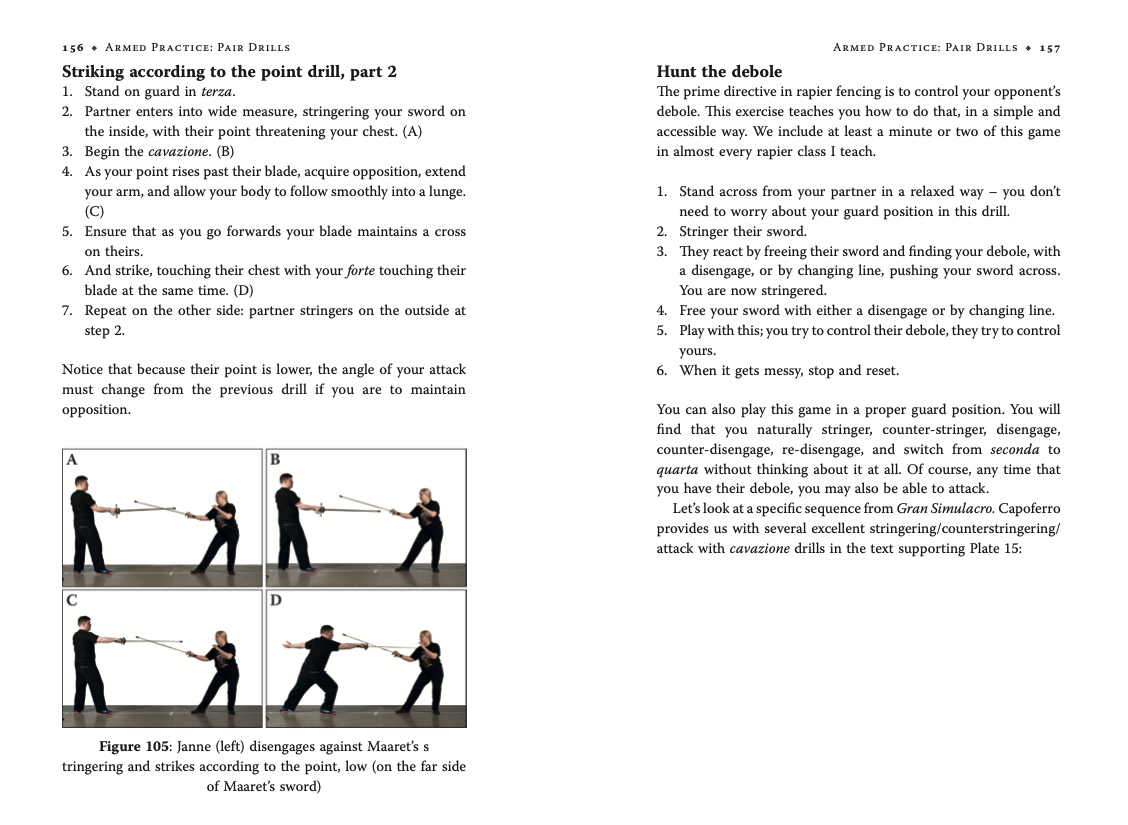
Creating video clips

Let the text do the work of explaining the ‘why’ of your interpretation. It’s simply miserable to sit through a video of somebody trying to explain why they do an action a certain way, unless it has been carefully scripted and beautifully produced. The video’s purpose is to show the action. If the clip is more than a minute long, you’re talking too much.

Set up a camera on a tripod, make sure there’s enough light and you’re in shot, and just record you and whatever training partner may be required doing the action. Record it from both sides (so, you facing right, you facing left). Edit out everything that isn’t clean or necessary.

You can add title cards and end cards too. This is a good idea if you plan to release the videos publicly, so people watching have an idea of why you’re NOT TALKING. And you can advertise your work to them. Your title card text should include:

  1. The name of the project.
  2. Your name and the name of any assistants
  3. The name of the specific action you are doing and where it comes from
  4. The date you shot the video (in case your interpretation changes later)
  5. My video clips are usually extracted from my online courses, so I also credit the course at the end. That also tells people who like the interpretation and want to be taught how to fence with it where to look for instruction.

You now have a video example of your interpretation of that specific action. How do we embed that into the book?

Embedding video clips into your work

It is tempting to just produce the book as a very large PDF, with the video clips embedded in it. Don’t do that. So many people will tell you it didn’t load, or doesn’t work, that you’ll spend far too much time answering emails and not enough time swinging swords. Instead, the best approach is the following:

  1. Upload your clips to an online hosting service. I use Vimeo, but you can use a free service if you don’t mind advertising other people’s stuff.
  2. Create a redirectable link that is easy to type, and paste the clip’s address as the target. I use PrettyLink, through my website hosted at guywindsor.net. So every link is guywindsor.net/somethingeasytotype and points to the specific video clip I want.
  3. For academic content, that is sufficient. But for training manuals and workbooks I also use a free online tool (easy to find with basic search skills) to create a QR code of the link, and include that in the book. Here’s an example from my Complete Rapier Workbook:
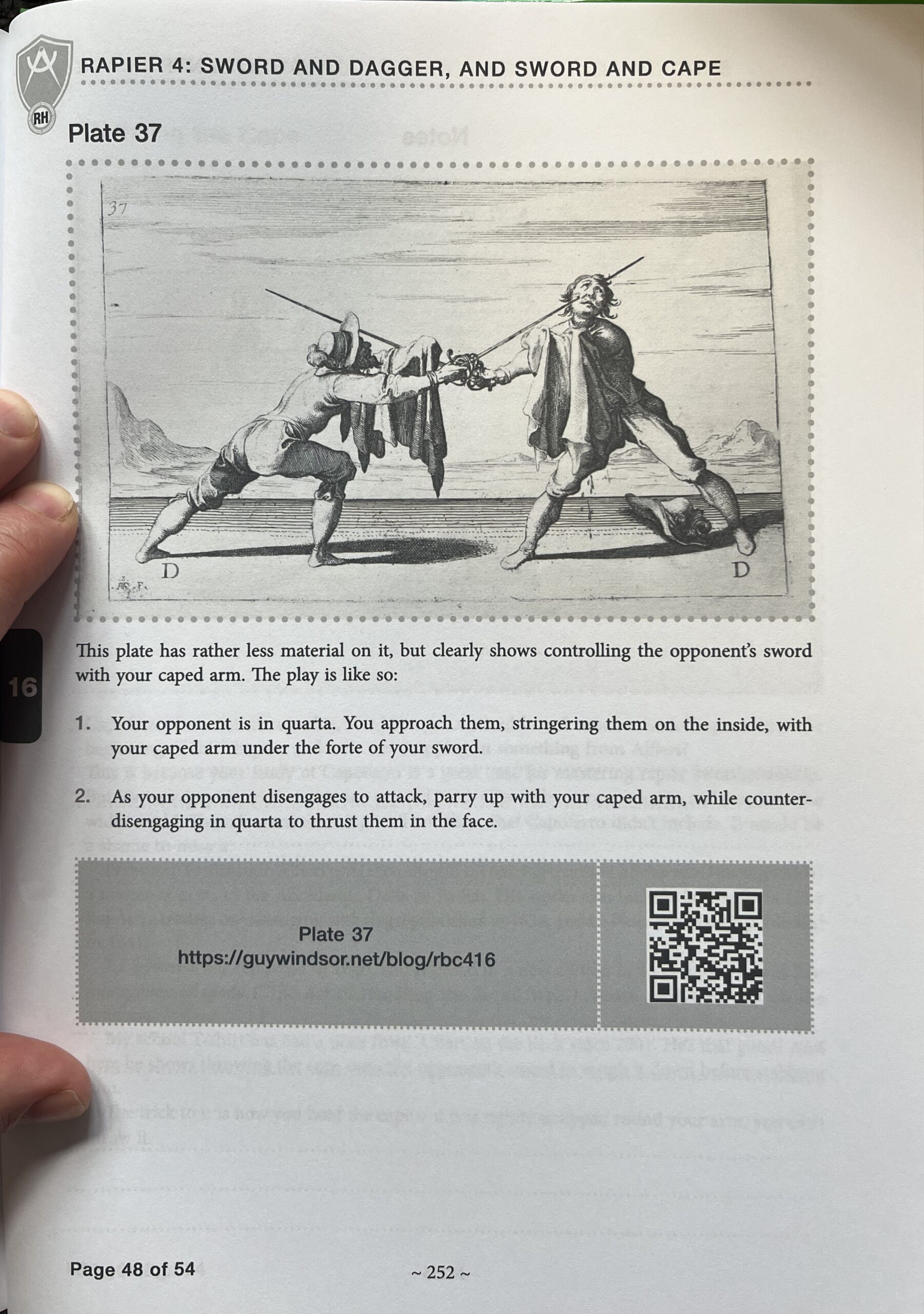
It is critically important to use the redirectable link. Do not ever just use e.g. a YouTube link. Unless you own YouTube and can therefore control what happens to it. The point is to future-proof your book. If I change the way I do an action, or create a better video, I can upload it somewhere, and go in to my website’s dashboard and redirect the link. If my Vimeo account was suddenly destroyed, I could upload the clips somewhere else, and redirect the links.

Using Photos

I highly recommend hiring a professional photographer if you can possibly afford it. It is really hard to take print-worthy photos without high-level gear, and without high-level post-production. You may have students, friends, or colleagues with a serious interest in photography, in which case by all means let them help. But be aware of what you’re asking for. The weekend it takes to pose and shoot a book is perhaps a fifth of the time needed to do the post-production.

Clarity is the watchword here, as always. Don’t go for artistic, don’t go for fancy. Make the photos crystal clear, and at a resolution that allows you to print them as large as possible. Shoot on the plainest background you can find, not the prettiest.

Do not insert the images in your text file. It will make the whole process horrendously difficult. Instead, name your pictures in a sensible way, and insert an instruction to layout, in square brackets, like so:

[pic: Getty fol 6v 4 4th play]

That tells me that it should be an image from folio 6v of the Getty MS, 4th image on that page, which happens to be the 4th play of the Abrazare.

If you have hundreds of images from a photoshoot, you might just go with the automatic image numbering from the camera. That’s fine, so long as you are very strict about getting the right numbers in the right place. I copy and paste the file names rather than typing out digits.

This way, even when your layout designer has no idea about your subject, if they can’t find an image, or they put the wrong image somewhere, you can find the correct image easily. Do not try to number your images in order (figure 1, figure 2 etc.) because you will end up having to redo the numbering many times as you edit the text. If you want figure numbers, put them in at the very end, after the first layout draft has been done.

For showing actual movements, I use video clips. Unless you are writing a training guide for videography, the video just has to be clear. Shoot it in the highest resolution you can, and edit it as short as you can make it without losing the necessary detail, and you’re done. The point is to replace the need for photos, not to create instructional videos.

Adding a Glossary

Are there any terms a lay reader may need to look up? If there are six or more, I’d suggest including a glossary at the back of the book. Such as my Academese glossary, reproduced here:

Academese Glossary v.1.02

Citations and Bibliography

Your research will no doubt refer to other people’s work. The modern standard is for in-line citations. This works by simply putting the author’s name, the year of publication of the source you’re citing (if necessary- see below), and the page reference in brackets, in the sentence or immediately after a quote. For example:

Guy’s completely erroneous interpretation of Fiore’s sword draw (Windsor 2018, 52) sets the seal once and for all on his reputation as a complete turnip-head!

Or:

Questo zogo sie del magistro che fa lo partito qui dinanzi. Che segondo chello ha ditto per tal modo io fazo. Che tu vedi bene che tua daga tu no mi poy fare nissuno impazo.

This play is of the master that does the technique before this one. I do it in the way that he has said. You can well see that your dagger cannot cause me any trouble. (Windsor 2018, 52)

Note that I indicate the quotation with a change of text formatting. Whatever you do, make it abundantly clear what you are quoting, and exactly where your reader can find it.

Bibliography

What books have you referred to in your book? List them here. I usually divide them up by type, then organise by author’s last name. Include the author’s full name, the title of the work, the publisher, and the date published. Such as:

Windsor, Guy. Mastering the Art of Arms, Book 1: The Medieval Dagger. Freelance Academy Press, 2012.

Windsor, Guy. Mastering the Art of Arms, Book 2: The Medieval Longsword. The School of European Swordsmanship, 2014.

The date is especially important if the author has more than one book in your bibliography. That way when you are citing them in your text, you can use the standard in-line format, for example (Windsor 2012, 147) which means page 147 of the book this Windsor chap published in 2012.

If they only have one book in your bibliography, you can leave out the year. Such as (Windsor 147).

If they have produced more than one book in the same year, then format it like so: 2018/1, or 2018/2 etc.

Other Things to Include

These are less critical to making your research available, but they are good practice to include. Your work should have an acknowledgments section, a list of your other works, and some biographical information about you. I summarise this like so:

Acknowledgments:

Who helped you learn this stuff in the first place, and to produce the book?

More books by Guy:

If they liked this one, they may like the others.

About the Author

Who am I, and why should you listen to me?

How can they find you online?

And how can they get on your mailing list? [top tip: you can get on my mailing list with the form at the bottom of this post]

Publishing and Distribution

There is no sense in putting all this work into writing up your research if nobody ever reads it. So you need to make some decisions about distribution. Let’s start with copyright.

Copyright options

As the author, your work is automatically protected by copyright law. But, you have various options available to you whether you want to give it away, or get paid for it.

If you want to sell your work it is not strictly necessary but still a good idea to register your copyright. This can be done through various agencies. I use protectmywork.com.

If you publish your work yourself, then you don’t need to get anyone’s permission. If someone else publishes it for you, then you will need a contract with them that licenses your copyright to them. Freelance Academy Press has licensed the copyright to my book The Medieval Dagger for English language only, paperback and ebook only, worldwide distribution. I have the rights to the hardback and to foreign language versions. This is why you can find a German translation of the work, and you can only get the hardback from my online store (swordschool.shop), not the paperback or ebook.

Releasing the work for free can be done by simply stating your terms in the form of one of the creative commons licences. You can for instance allow:

  1. Free use to anyone for any reason, with no need to credit you (CC0)
  2. Free use to anyone for any reason, but you want credit (CC BY)
  3. Free use for non-commercial use, but anyone selling your work needs your permission (CC BY-NC)

And there are other options, allowing for the work to be changed or not. You can find the entire list here: https://creativecommons.org/about/cclicenses/

You apply the licence you want by simply stating it somewhere in your work, with a link to the licence terms. This booklet Show Your Work, for instance, is © 2023 Guy Windsor. This work is licensed under a CC BY-NC-ND 4.0

Which allows allows reusers to copy and distribute the material in any medium or format in unadapted form only, for noncommercial purposes only, and only so long as attribution is given to the creator.

Note that this noncommercial licence stops other people selling the work. I can still, for instance, produce a version of the book for sale.

For free distribution, you simply need to produce the book to a reasonable standard of editing and layout (any word processing software will do that), and export it as a PDF. Then share that PDF wherever you like. I would suggest including the following, which are easily forgotten:

  1. Your name
  2. Your copyright terms
  3. Page numbers
  4. A link to your website or anything else of yours that the reader may be interested in.

I cover publishing books and marketing them in detail in From Your Head to Their Hands: how to write, publish, and market training manuals for historical martial artists, so if you are planning on producing an actual book that people can buy, please refer to that.
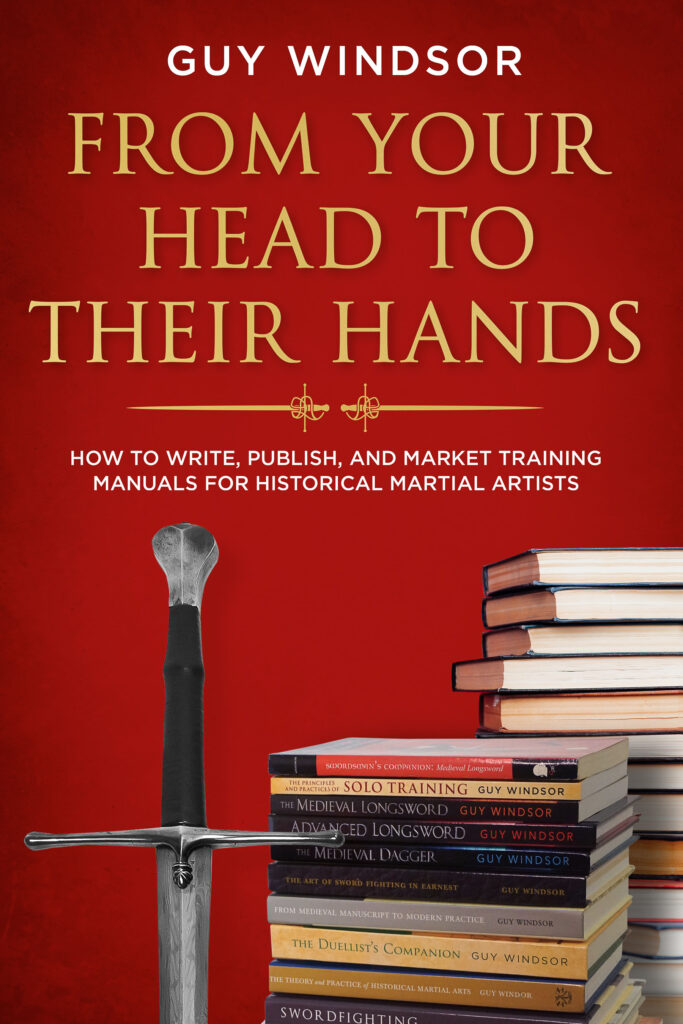

Search

Recent Posts

Categories

Categories

Tags